
BIOL-340 · Lesson 5 of 12 · 33 min
Water relations and transpiration
A sunflower on a hot afternoon can lose its own weight in water in a single day. A large tree may move several hundred litres from soil to air, lifting it tens of metres against gravity without any pump. For every gram of carbon dioxide a C3 plant takes up through its stomata, it loses several hundred grams of water through the same pores. Water is therefore the resource that most often limits plant growth, in fields on the Canadian Prairies and the US Great Plains as much as in deserts, and understanding how plants take up, move and lose water is central to plant biology and agriculture. This lesson develops the concept of water potential, follows water from the soil through the root and xylem to the leaf, explains the cohesion–tension mechanism that lifts it, examines what happens when the water columns break, and shows how stomata balance the need for carbon dioxide against the danger of drying out.
Water potential
Water moves spontaneously from regions where its free energy is higher to regions where it is lower. Plant physiologists express this free energy per unit volume as water potential, Ψ (the Greek letter psi), measured in megapascals. Pure water at atmospheric pressure, at the same height and temperature, is defined as having Ψ = 0, so water in a plant usually has a negative potential. Water potential has several components that add together:
The solute potential \(\Psi_s\), also called osmotic potential, is always negative or zero: dissolved solutes lower the free energy of water. For dilute solutions it is given by the van ’t Hoff relation, \(\Psi_s = -iCRT\), where \(C\) is the molal concentration, \(i\) is the number of particles per formula unit (about 1 for sucrose, nearly 2 for NaCl), \(R\) is the gas constant and \(T\) is absolute temperature. A 0.1 molal sucrose solution at 20 °C has a solute potential of about −0.24 MPa. The pressure potential \(\Psi_p\) is the hydrostatic pressure above or below atmospheric. In living cells it is positive and called turgor pressure; in the xylem it is usually negative, a tension. The gravitational potential \(\Psi_g\) rises by about 0.01 MPa for each metre of height and matters only in tall trees, where it adds about 0.1 MPa per 10 m. In soils and in cell walls a further component, the matric potential, describes water held by surfaces and in small pores; it is often folded into \(\Psi_p\).
Water potential explains how a cell gains and loses water. A cell placed in pure water takes up water until its turgor rises enough to balance its negative solute potential and its total Ψ reaches zero; the wall stops it from bursting. A cell placed in a concentrated solution loses water, its turgor falls, and if its water potential falls below the point at which turgor is zero, the protoplast shrinks away from the wall in plasmolysis. Within a tissue, cells adjust their solute content to stay turgid as conditions change, a process called osmotic adjustment that helps plants keep growing as soils dry.
import math

R = 8.314e-3     # MPa L mol-1 K-1, so -iCRT gives MPa when C is in mol/L (dilute, ~molal)
def psi_s(C, i=1.0, T_C=20.0):
    return -i * C * R * (T_C + 273.15)

# 1. Solute potentials of some solutions at 20 C
for name, C, i in (("0.1 M sucrose", 0.1, 1.0), ("0.3 M sucrose", 0.3, 1.0),
                   ("0.1 M NaCl", 0.1, 1.9), ("sea water (~0.55 M NaCl)", 0.55, 1.9)):
    print(f"{name:26s} psi_s = {psi_s(C, i):6.2f} MPa")

# 2. A cell with psi_s = -0.9 MPa and turgor 0.5 MPa is put into 0.3 M sucrose
cell = -0.9 + 0.5
bath = psi_s(0.3)
print(f"\ncell psi = {cell:.2f} MPa, bath psi = {bath:.2f} MPa ->",
      "water leaves the cell" if bath < cell else "water enters the cell")

# 3. Water potential of air: psi = (R T / V_w) ln(RH)
Vw = 0.018    # L per mol of liquid water
for rh in (0.99, 0.95, 0.80, 0.50, 0.30):
    psi_air = R * 293.15 / Vw * math.log(rh)
print(f"air at {100*rh:3.0f}% relative humidity: psi = {psi_air:7.1f} MPa")0.1 M sucrose psi_s = -0.24 MPa 0.3 M sucrose psi_s = -0.73 MPa 0.1 M NaCl psi_s = -0.46 MPa sea water (~0.55 M NaCl) psi_s = -2.55 MPa cell psi = -0.40 MPa, bath psi = -0.73 MPa -> water leaves the cell air at 99% relative humidity: psi = -1.4 MPa air at 95% relative humidity: psi = -6.9 MPa air at 80% relative humidity: psi = -30.2 MPa air at 50% relative humidity: psi = -93.9 MPa air at 30% relative humidity: psi = -163.0 MPa
The last block of output is the key to transpiration. Even air at 99 per cent relative humidity has a water potential of about −1.4 MPa, more negative than a well-watered leaf, and air at 50 per cent relative humidity sits near −94 MPa. The difference between leaf and air is so large that the atmosphere, not the plant, provides the driving force for water movement. The plant’s task is not to pump water but to control the rate at which the air pulls it out.
From soil to root
Soil water is held in pores and on particle surfaces. After heavy rain has drained away, a soil is at field capacity, by convention a water potential of about −0.01 to −0.03 MPa. As roots extract water, soil water potential falls. The permanent wilting point, the potential at which many crop plants wilt and fail to recover overnight, is conventionally −1.5 MPa, although desert shrubs can extract water at −5 MPa or below. The water held between field capacity and the wilting point is the plant-available water, which is much larger in loams than in sands. As soil dries, its hydraulic conductivity drops by orders of magnitude, so water near the root surface can be depleted even when the bulk soil still holds water. Root hairs, fine roots and mycorrhizal fungi (lesson 6) help by extending the absorbing surface.
Inside the root, water can follow three paths to the stele. In the apoplastic route it moves through cell walls and intercellular spaces without crossing a membrane. In the symplastic route it enters a cell and moves from cell to cell through plasmodesmata. In the transcellular route it crosses membranes repeatedly, passing through aquaporins, the water channel proteins discovered by Peter Agre in 1992. At the endodermis, the Casparian strip blocks the apoplastic route, so all water must cross at least one membrane before entering the xylem. Aquaporin activity is regulated by phosphorylation, pH and gating, and roots can change their hydraulic conductance within minutes, for example closing aquaporins when soil is flooded and cells become acidic from lack of oxygen.
When transpiration is low, at night or in very humid air, roots of many plants continue to load ions into the xylem. Water follows osmotically, building a positive root pressure of up to a few tenths of a megapascal. Root pressure can push sap out through hydathodes at leaf margins, producing the droplets of guttation seen on grass blades in the early morning, and in some vines and in maple and birch in spring it helps refill embolized vessels. Root pressure is far too weak to raise water to the top of a tall tree in daytime, and it is absent in many conifers.
The cohesion–tension theory
How then does water reach the top of a 100 m redwood? The answer, proposed by Henry Dixon and John Joly in Dublin in 1894, is that it is pulled. Water evaporates from the wet walls of mesophyll cells inside the leaf into the air spaces and out through the stomata. As water evaporates, the remaining water retreats into the tiny spaces between cellulose microfibrils, and surface tension at the curved air–water interfaces places the water behind them under tension. That tension is transmitted through the continuous water columns of the xylem, all the way to the roots, because water molecules cohere strongly through hydrogen bonds and adhere to the hydrophilic walls of the conduits. Water moves up the plant along a gradient of decreasing water potential, from soil to root to stem to leaf to air.
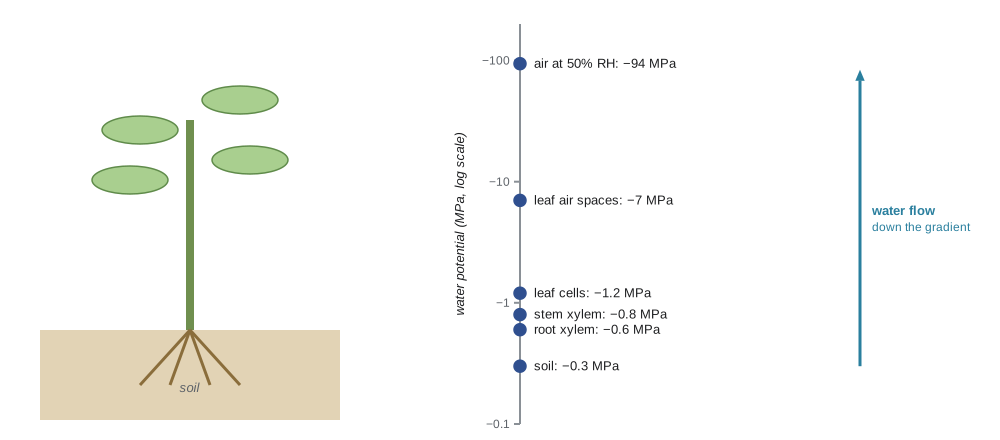
The tensions involved are large. The xylem of a well-watered crop at midday may be at −0.5 to −1.5 MPa, and that of a desert shrub at −5 MPa or less, many times stronger than a perfect vacuum pump could achieve. Water can sustain such tensions because, in narrow, clean, gas-free conduits, it has a high tensile strength. Measurements with the pressure chamber, introduced by Per Scholander and colleagues in 1965, confirmed the theory: a cut shoot is sealed into a chamber with its cut end protruding, and gas pressure is raised until sap just appears at the cut surface. The balancing pressure equals the tension that existed in the xylem. Pressure chambers are now used routinely to schedule irrigation in vineyards and orchards.
The rate of flow through xylem depends strongly on conduit size. For laminar flow through an ideal tube, the Hagen–Poiseuille equation states that volume flow is proportional to the fourth power of the radius. A vessel with twice the diameter of another conducts sixteen times as much water under the same pressure gradient, so a few wide vessels can carry most of the flow in a stem. Real conduits are less efficient than ideal tubes because water must pass through pits between them, which may account for half or more of the total resistance, but the strong dependence on diameter remains.
When columns break: cavitation and embolism
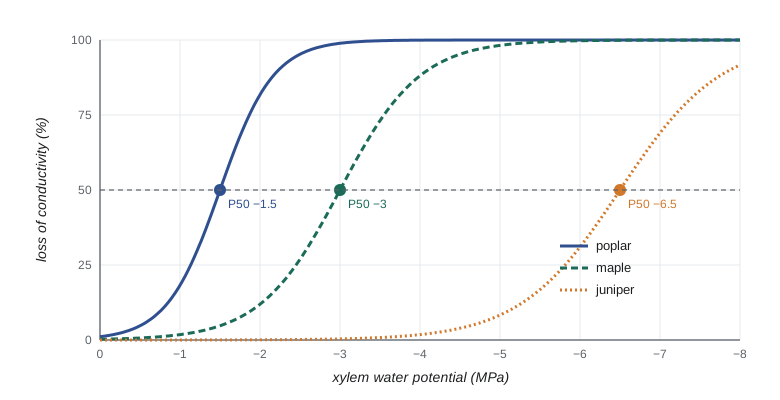
Water under tension is metastable. If air is pulled into a conduit through a pit membrane, a process called air seeding, the water column snaps, the tension is released and the conduit fills with water vapour and then air. This is cavitation, and the gas-filled conduit is embolized and no longer conducts. Pit membranes, the porous primary walls in the pits between conduits, act as safety valves: their pores are small enough that the surface tension of water can usually prevent air from passing, and in conifers a central thickening, the torus, seals the pit when a neighbouring tracheid embolizes. The tension at which air seeding occurs depends on the size of the largest pores, which is why species differ greatly in their resistance.
Physiologists describe resistance to embolism with a vulnerability curve, which plots the percentage loss of hydraulic conductivity against xylem water potential. The potential at which half the conductivity is lost, P50, ranges from about −1 MPa in some riverside poplars and tropical trees to below −10 MPa in some desert shrubs. Many species operate with small safety margins, keeping their minimum daily water potential only slightly above the point at which embolism begins. In severe droughts, runaway embolism, called hydraulic failure, is now recognized as a leading cause of tree death, behind recent waves of forest mortality in western North America and elsewhere. Freezing and thawing cause embolism by a different route: gas dissolved in sap comes out of solution as bubbles when water freezes, and the bubbles expand when the water thaws under tension. Wide vessels are especially vulnerable, which is one reason ring-porous trees such as oaks must build new earlywood vessels each spring and why conifers with narrow tracheids dominate the boreal forest.
Transpiration and stomata
About 95 per cent of the water a plant loses passes out through stomata, the pores between pairs of guard cells in the epidermis; the rest escapes through the cuticle. The rate of transpiration E is approximately the product of the stomatal (and boundary-layer) conductance to water vapour \(g\) and the difference in water vapour concentration between the leaf air spaces, which are almost saturated, and the outside air. That difference is usually expressed as the vapour pressure deficit (VPD) divided by atmospheric pressure. On a warm, dry day, VPD can exceed 3 kPa; on a cool, humid morning it may be below 0.5 kPa. Because saturation vapour pressure rises steeply with temperature, a leaf warmer than the air experiences an even larger deficit.
import math

def es(T):                     # saturation pressure of water in air, kPa (Tetens equation)
    return 0.6108 * math.exp(17.27 * T / (T + 237.3))

P = 101.3                      # atmospheric pressure, kPa
g = 0.30                       # stomatal + boundary-layer conductance, mol m-2 s-1
print(" Tair  RH   Tleaf  VPD_leaf(kPa)  E (mmol m-2 s-1)")
for Tair, rh, Tleaf in ((20, 0.70, 21), (25, 0.50, 27), (30, 0.30, 33), (35, 0.20, 37)):
    vpd = es(Tleaf) - rh * es(Tair)
    E = g * vpd / P * 1000
    print(f"  {Tair}  {rh:.2f}  {Tleaf}      {vpd:4.2f}          {E:4.1f}")

# Water lost per CO2 gained: E / A
A = 20e-3      # 20 umol CO2 m-2 s-1 expressed in mmol
E = g * (es(27) - 0.5 * es(25)) / P * 1000
print(f"\nat 25 C, 50% RH: {E/A:.0f} mol water lost per mol CO2 fixed")
print(f"daily water use of 2 m2 leaf area, 10 h at this rate: "
f"{E*1e-3*18*2*3600*10/1000:.1f} kg")Tair RH Tleaf VPD_leaf(kPa) E (mmol m-2 s-1) 20 0.70 21 0.85 2.5 25 0.50 27 1.98 5.9 30 0.30 33 3.76 11.1 35 0.20 37 5.15 15.3 at 25 C, 50% RH: 293 mol water lost per mol CO2 fixed daily water use of 2 m2 leaf area, 10 h at this rate: 7.6 kg
With the same stomatal opening, transpiration would rise about sixfold from a mild, humid morning to a hot, dry afternoon, because the vapour pressure deficit grows so steeply with temperature. Real stomata partly close as the air dries, which is exactly how plants keep such increases in check. The leaf in this example loses a few hundred moles of water for every mole of CO₂ it fixes, a typical figure for C3 plants. The ratio of carbon gained to water lost is the water use efficiency, and it is two to three times higher in C4 plants and higher still in CAM plants (lesson 4). For whole fields, hydrologists and agronomists estimate evapotranspiration with the Penman–Monteith equation, which combines radiation, temperature, humidity, wind and canopy conductance, and is the basis of irrigation scheduling across North America.
How guard cells open and close
Guard cells change shape by changing their turgor. In kidney-shaped guard cells, typical of eudicots, cellulose microfibrils run radially around the cell, like the hoops of a barrel arranged in a fan, and the walls are thickened at the ends. When turgor rises, the cells cannot widen much but they lengthen, and because they are joined at the ends they bow apart, opening the pore. Grasses have dumbbell-shaped guard cells flanked by subsidiary cells, which open faster and contribute to the high water use efficiency of grasses.
Opening is driven by ion uptake. Blue light, perceived by phototropin receptors, and red light, acting partly through photosynthesis, activate plasma membrane H⁺-ATPases that pump protons out of the guard cells. The resulting negative membrane potential opens inward potassium channels, and K⁺ floods in, accompanied by Cl⁻ and by malate made from starch. The guard cell’s solute potential falls, water follows, turgor rises and the pore opens. Closure reverses the process: anion channels open, the membrane depolarizes, K⁺ leaves through outward channels, water follows and the pore closes. The plant hormone abscisic acid (ABA), made in leaves and roots as water becomes scarce, triggers rapid closure through a signalling pathway that lesson 8 describes in detail. Stomata also respond to CO₂, closing when leaf CO₂ is high, to humidity, closing as air dries, and to the circadian clock.
Stomatal density is set during leaf development and responds to the environment. Leaves that develop at high CO₂ often form fewer stomata, a relationship that palaeobotanists have used to estimate past CO₂ concentrations from the stomatal density of fossil leaves. Experiments with barley and rice engineered to make fewer stomata have shown that plants can maintain yield with reduced water use, a promising avenue for drought-prone regions.
| Signal | Effect on stomata | Mechanism in outline |
|---|---|---|
| Blue light | Opening | Phototropins activate H⁺-ATPase; K⁺ uptake |
| Red light | Opening | Photosynthesis lowers internal CO₂; guard cell chloroplasts contribute |
| High internal CO₂ | Closing | Activates anion channels; reduces H⁺-ATPase activity |
| Low humidity (high VPD) | Closing | Partly through ABA synthesis in leaves |
| Abscisic acid | Closing | PYR/PYL receptors inhibit PP2C phosphatases; SnRK2 kinase activates anion channels |
| Pathogen molecules | Closing | Immune signalling closes pores to keep bacteria out |
| Circadian clock | Anticipatory opening near dawn | Clock regulation of channel and pump genes |
Leaves, heat and the cost of water
Transpiration does more than lift water and nutrients. Evaporating water absorbs about 2.45 MJ per kilogram, and on a sunny day this latent heat loss keeps leaves several degrees cooler than they would otherwise be. When stomata close in drought, leaf temperature rises, which is why thermal cameras on drones and satellites can map water stress across fields. Plants in dry environments reduce the energy load on their leaves with small or divided leaves that shed heat by convection, with reflective hairs or wax, by orienting leaves edge-on to the midday sun, and by dropping leaves altogether in the dry season. Every stomatal decision is a trade-off: open stomata let in CO₂ for growth and cool the leaf but spend water and risk embolism; closed stomata save water but starve the leaf of CO₂ and let it overheat. Models of optimal stomatal behaviour, which assume plants maximize carbon gain for a given water cost, predict the observed responses to light, humidity and CO₂ surprisingly well.
Worked problem
Reading a pressure chamber measurement
A grape grower measures midday stem water potential with a pressure chamber. Sap appears at the cut end at a gas pressure of 1.4 MPa. The grower’s target range for moderate stress during ripening is −1.0 to −1.2 MPa. What is the vine’s stem water potential, and what should the grower do?
Show solution
- The balancing pressure equals the tension in the xylem, so the stem water potential is about −1.4 MPa.
- This is more negative than the target range, so the vine is more stressed than intended.
- Prolonged stress at this level reduces photosynthesis and berry growth and risks leaf loss.
- The grower should irrigate and re-measure, adjusting the schedule to keep midday values within the target range.
Answer: About −1.4 MPa, more stressed than the target. Pressure chamber readings let growers manage deficit irrigation precisely, saving water while controlling vine vigour and fruit quality.
Common mistakes
MistakeThinking that roots pump water to the top of trees.
InsteadRoot pressure is weak and often absent; water is pulled up by tension generated by evaporation in the leaves.
MistakeSaying that water moves from low to high solute concentration as a complete explanation.
InsteadWater moves down a gradient of total water potential, which includes pressure and gravity as well as solutes.
MistakeTreating a negative water potential as abnormal.
InsteadWater potential in plants is almost always negative; pure free water at atmospheric pressure defines zero.
MistakeAssuming wider vessels are always better.
InsteadWider vessels conduct much more water (radius to the fourth power) but are more prone to freeze–thaw embolism and sometimes to drought embolism.
MistakeIgnoring leaf temperature when estimating transpiration.
InsteadA leaf warmer than the air has a higher internal vapour pressure, so the driving deficit is larger than air humidity alone suggests.
MistakeExpecting stomata to respond only to light.
InsteadStomata integrate light, CO₂, humidity, ABA, pathogens and the circadian clock.
Summary and key terms
- Water moves down gradients of water potential, Ψ = Ψs + Ψp + Ψg, measured in megapascals relative to pure water at zero.
- Solute potential follows the van ’t Hoff relation; turgor is positive pressure in cells and tension is negative pressure in the xylem.
- Water enters roots by apoplastic, symplastic and transcellular routes but must cross a membrane at the endodermis; aquaporins regulate root conductance.
- The cohesion–tension theory explains the ascent of sap: evaporation in leaves generates tension transmitted through continuous water columns.
- Flow scales with the fourth power of conduit radius; air seeding through pit membranes causes cavitation and embolism, described by vulnerability curves and P50.
- Transpiration depends on conductance and vapour pressure deficit; the atmosphere supplies the driving force.
- Guard cells open by H⁺-ATPase-driven K⁺ uptake and close by anion and K⁺ efflux; ABA, CO₂, humidity and light regulate aperture.
- water potential
- The free energy of water per unit volume relative to pure water, symbol Ψ, measured in MPa.
- solute potential
- The component of water potential due to dissolved solutes; always negative or zero.
- turgor pressure
- Positive hydrostatic pressure inside a plant cell.
- plasmolysis
- Shrinkage of the protoplast away from the wall when a cell loses water.
- aquaporin
- A membrane channel protein that allows water to cross membranes rapidly.
- root pressure
- Positive xylem pressure produced by ion loading in roots when transpiration is low.
- cohesion–tension theory
- The explanation that water is pulled up the xylem by tension generated by evaporation.
- cavitation
- The sudden breaking of a water column under tension, leaving a gas-filled conduit.
- P50
- The xylem water potential at which 50 per cent of hydraulic conductivity is lost.
- vapour pressure deficit
- The difference between saturation vapour pressure and the actual vapour pressure of the air.
- stomatal conductance
- The ease with which gases diffuse through stomata.
- water use efficiency
- The ratio of carbon fixed to water transpired.
Practice problems
Work each problem on paper first, then reveal the answer to check.
Calculate the solute potential of a 0.2 molal sucrose solution at 25 °C.
Show answer
−1 × 0.2 × 0.008314 × 298 ≈ −0.50 MPa.
A cell has Ψs = −1.0 MPa and Ψp = +0.6 MPa. What is its water potential?
Show answer
−0.4 MPa.
That cell is placed in a solution with Ψ = −0.7 MPa. What happens?
Show answer
Water leaves the cell, turgor falls until the cell’s Ψ equals −0.7 MPa (if it can do so without plasmolysis).
Why does the Casparian strip give the plant control over what enters the xylem?
Show answer
It blocks the apoplastic route, forcing water and solutes through endodermal plasma membranes with their transporters.
What is the water potential of air at 70 per cent relative humidity and 20 °C?
Show answer
(0.008314 × 293/0.018) × ln 0.7 ≈ −48 MPa.
How much more water does a 100 µm vessel conduct than a 50 µm vessel under the same gradient?
Show answer
2⁴ = 16 times.
What does P50 measure, and how would it differ between a riverside poplar and a desert shrub?
Show answer
The water potential at 50 per cent loss of conductivity; the poplar’s P50 would be much less negative.
Why are freeze–thaw embolisms more common in wide vessels?
Show answer
Larger bubbles form in wider conduits when sap freezes, and they expand under tension on thawing.
Describe the ionic events that open a stoma.
Show answer
Light activates H⁺-ATPases; hyperpolarization opens K⁺ channels; K⁺, Cl⁻ and malate accumulate; water follows and turgor bows guard cells apart.
Why does a leaf in drought become warmer than the air?
Show answer
Closed stomata reduce transpiration, removing evaporative cooling.
Lesson quiz · 5 questions
Score 60% or more to complete this lesson.
Create a free account to save your progress, take quizzes and earn a certificate.