
BIOL-340 · Lesson 6 of 12 · 34 min
Mineral nutrition, symbioses and transport
Plants build themselves from air, water and a handful of mineral elements taken from the soil. Carbon, hydrogen and oxygen come from CO₂ and water and make up about 95 per cent of a plant’s dry mass. The remaining few per cent, nitrogen, phosphorus, potassium and a dozen other elements, are just as essential, and their supply limits plant growth across much of the world. Modern agriculture feeds about half of humanity with nitrogen fixed industrially by the Haber–Bosch process, and the run-off of fertilizer nitrogen and phosphorus pollutes lakes, rivers and coastal seas. This lesson asks which elements plants need and why, how they take nutrients up against steep concentration gradients, how they enlist bacteria and fungi as partners, and how they move the sugars made in leaves to roots, fruits and growing tips through the phloem.
Which elements are essential?
In 1939, Daniel Arnon and Perry Stout proposed criteria that are still used to decide whether an element is essential. A plant must be unable to complete its life cycle without the element; the element must not be replaceable by another; and it must act directly in the plant’s metabolism rather than, for example, by improving soil conditions. Testing these criteria became possible with hydroponics, growing plants with their roots in nutrient solutions of defined composition, a method developed by Julius Sachs and Wilhelm Knop in the 1860s and refined by Dennis Hoagland at Berkeley in the 1930s. Because trace contaminants in water, salts and glassware can supply micronutrients, proving essentiality for elements needed in tiny amounts required extraordinary care; nickel was added to the list only in 1987, when it was shown that barley could not produce viable seed without it.
Seventeen elements are now generally accepted as essential for all higher plants. Beyond carbon, hydrogen and oxygen, the macronutrients are needed in amounts above about 0.1 per cent of dry mass and the micronutrients in much smaller amounts, sometimes only a few parts per million. A few further elements, called beneficial elements, help some plants: silicon strengthens the walls of grasses and horsetails and helps rice resist pests; sodium is needed by some C4 and CAM plants; cobalt is needed by nitrogen-fixing bacteria in legume nodules; and selenium accumulates in certain plants of the western plains, sometimes to levels toxic to livestock.
| Element | Absorbed as | Typical tissue level | Main functions | Mobility in phloem |
|---|---|---|---|---|
| Nitrogen | NO₃⁻, NH₄⁺ | 1–5 % | Amino acids, proteins, nucleic acids, chlorophyll | Mobile |
| Phosphorus | H₂PO₄⁻, HPO₄²⁻ | 0.1–0.5 % | ATP, nucleic acids, phospholipids, sugar phosphates | Mobile |
| Potassium | K⁺ | 1–5 % | Osmotic regulation, enzyme activation, stomatal movement | Mobile |
| Calcium | Ca²⁺ | 0.2–2 % | Pectin cross-links, membrane stability, signalling | Immobile |
| Magnesium | Mg²⁺ | 0.1–0.5 % | Chlorophyll centre, ATP chemistry, rubisco activation | Mobile |
| Sulfur | SO₄²⁻ | 0.1–0.5 % | Cysteine, methionine, coenzymes, glucosinolates | Somewhat immobile |
| Iron | Fe²⁺, Fe³⁺ chelates | 50–200 ppm | Cytochromes, iron–sulfur proteins, chlorophyll synthesis | Immobile |
| Manganese | Mn²⁺ | 20–200 ppm | Water-splitting complex of photosystem II | Immobile |
| Zinc | Zn²⁺ | 20–100 ppm | Enzyme cofactor, zinc-finger proteins, auxin synthesis | Intermediate |
| Copper | Cu²⁺ | 5–20 ppm | Plastocyanin, oxidases, lignin synthesis | Intermediate |
| Boron | H₃BO₃ | 10–60 ppm | Cross-links rhamnogalacturonan II in walls | Immobile in most species |
| Molybdenum | MoO₄²⁻ | 0.1–1 ppm | Nitrate reductase, nitrogenase | Intermediate |
| Chlorine | Cl⁻ | 100–1,000 ppm | Water splitting, osmotic and charge balance | Mobile |
| Nickel | Ni²⁺ | 0.1–1 ppm | Urease | Mobile |
Reading deficiency symptoms
Nutrient deficiencies produce characteristic symptoms, and where they appear first depends on whether the element can be moved in the phloem. Mobile elements, including nitrogen, phosphorus, potassium and magnesium, are withdrawn from older leaves and sent to young, growing ones when supply runs short, so deficiency symptoms appear first in older, lower leaves. Nitrogen deficiency causes a general yellowing (chlorosis) of older leaves; magnesium deficiency causes yellowing between the veins of older leaves, because magnesium sits at the centre of the chlorophyll molecule; potassium deficiency causes scorching along the margins of older leaves. Immobile elements, including calcium, iron and boron, cannot be remobilized, so symptoms appear in young leaves and growing points. Iron deficiency causes interveinal chlorosis of young leaves, common on the alkaline, calcareous soils of the Prairies and the western Great Plains. Calcium deficiency causes blossom-end rot in tomatoes and tip burn in lettuce, because calcium moves only in the xylem and reaches poorly transpiring organs such as fruits slowly. Diagnosis from symptoms alone can be misleading, since diseases, herbicides and other stresses can mimic deficiencies, so agronomists confirm with soil and tissue tests.
Getting nutrients into the root
Most nutrients reach the root surface by mass flow, carried in the water drawn toward the root by transpiration, or by diffusion through the soil solution. Mass flow supplies most of the calcium and nitrate a plant needs, but phosphate and potassium diffuse slowly and are depleted near the root, creating zones of exhaustion that roots must grow out of. Soil chemistry strongly affects availability. Clay particles and organic matter carry negative charges that hold cations such as K⁺, Ca²⁺ and Mg²⁺, the soil’s cation exchange capacity, and protons released by roots displace these cations into solution. Soil pH matters greatly: phosphate binds iron and aluminium in acid soils and calcium in alkaline ones, so it is most available near pH 6.5; iron, manganese and zinc become less available as pH rises; aluminium becomes soluble and toxic below about pH 5.
Crossing the plasma membrane requires transport proteins, and the membrane’s energetics decide which ions can enter passively. Plant cells pump protons out with plasma membrane H⁺-ATPases, creating a membrane potential of −120 to −200 mV, negative inside, and a pH gradient. The Nernst equation predicts the internal concentration at which an ion would be in equilibrium with a given membrane potential. If the measured concentration differs from that prediction, the ion must be actively transported in the direction that maintains the difference, or excluded.
import math

R, F, T = 8.314, 96485, 298.0
Em = -0.150      # measured membrane potential of a root cortex cell, volts

def predicted_inside(c_out, z):
    # internal concentration at equilibrium with Em (Nernst equation rearranged)
    return c_out * math.exp(-z * F * Em / (R * T))

# external and measured internal concentrations (mM), illustrative root cell
ions = [("K+", 1, 1.0, 80.0), ("Na+", 1, 1.0, 10.0), ("Ca2+", 2, 1.0, 1.5),
        ("NO3-", -1, 2.0, 15.0), ("H2PO4-", -1, 0.01, 10.0), ("Cl-", -1, 1.0, 8.0)]
print(" ion     out    in(meas)   in(predicted)   conclusion")
for name, z, out, inside in ions:
    pred = predicted_inside(out, z)
    if abs(math.log(inside / pred)) < math.log(1.5):
        verdict = "near equilibrium (passive)"
    elif inside > pred:
        verdict = "active uptake required"
    elif pred / inside < 20:
        verdict = "below equilibrium: passive entry possible"
    else:
        verdict = "far below equilibrium: active export needed"
print(f" {name:6s} {out:6.2f} {inside:6.1f} {pred:12.3g} {verdict}")ion out in(meas) in(predicted) conclusion K+ 1.00 80.0 344 below equilibrium: passive entry possible Na+ 1.00 10.0 344 far below equilibrium: active export needed Ca2+ 1.00 1.5 1.19e+05 far below equilibrium: active export needed NO3- 2.00 15.0 0.00581 active uptake required H2PO4- 0.01 10.0 2.9e-05 active uptake required Cl- 1.00 8.0 0.0029 active uptake required
With a membrane potential of −150 mV, a cation is pulled inward so strongly that, at equilibrium, it could be several hundred times more concentrated inside than outside. Potassium at 80 mM inside is therefore well below its equilibrium value and can enter passively through channels, though at very low external concentrations plants also use high-affinity K⁺–H⁺ symporters. Sodium and calcium are far below equilibrium, so cells must actively pump them out or keep them in the vacuole, an important part of salt tolerance (lesson 11). Anions face the opposite problem: the negative interior repels them, so nitrate, phosphate and chloride must all be taken up actively, usually by symporters that couple each anion to the inward movement of two or more protons.
Uptake rates follow saturation kinetics like those of enzymes. Plotting uptake against external concentration often reveals two systems: a high-affinity transport system with a low Michaelis constant (micromolar) that operates when nutrients are scarce, and a low-affinity system that does not saturate easily and dominates when nutrients are abundant. Nitrate, phosphate, potassium and ammonium all have such dual systems, encoded by families of transporter genes whose expression is induced when supply is low. Roots also respond to scarcity by changing their architecture: they proliferate laterals in nitrate-rich patches, make more and longer root hairs under phosphate deficiency, and release organic acids that free phosphate bound to iron and aluminium.
Iron poses a special problem because, in aerated soils above neutral pH, it exists almost entirely as insoluble ferric oxides. Plants have evolved two strategies. Most eudicots and non-grass monocots use strategy I: they acidify the soil near the root, reduce Fe³⁺ chelates to Fe²⁺ with a ferric reductase (FRO2 in Arabidopsis) and take up Fe²⁺ through the transporter IRT1. Grasses use strategy II: they secrete phytosiderophores, small molecules of the mugineic acid family that bind Fe³⁺ tightly, and take up the whole iron–phytosiderophore complex. Strategy II works better in calcareous soils, which is one reason wheat and barley tolerate the alkaline soils of the northern plains better than soybean does.
Nitrogen: assimilation and fixation
Plants take up nitrogen mainly as nitrate in well-aerated agricultural soils and as ammonium in acid, waterlogged or forest soils. Nitrate is reduced to nitrite by nitrate reductase in the cytosol, a molybdenum enzyme, and nitrite to ammonium by nitrite reductase in plastids, using electrons from ferredoxin. Ammonium, whether taken up directly, produced from nitrate or released by photorespiration, is assimilated by the glutamine synthetase–glutamate synthase (GS–GOGAT) cycle into glutamine and glutamate, from which other amino acids are made. Reducing nitrate to ammonium costs the equivalent of about 15 ATP per nitrogen, a substantial part of a leaf’s energy budget.
No plant can fix atmospheric N₂ itself, but some form symbioses with bacteria that can. The best known is the symbiosis between legumes and rhizobia. It begins with a chemical conversation: roots release flavonoids, which induce rhizobia to make Nod factors, lipochitooligosaccharides recognized by receptor kinases in the root. Root hairs curl around the bacteria, an infection thread grows into the root, and cortical cells divide to form a nodule. Inside nodule cells the bacteria differentiate into bacteroids, surrounded by a plant membrane, and fix nitrogen with the enzyme nitrogenase. Nitrogenase is destroyed by oxygen, so the nodule maintains a very low free O₂ concentration while still supplying enough oxygen for bacterial respiration, using leghemoglobin, a plant haemoglobin that gives active nodules their pink colour. The plant pays for the ammonium with sugar: nitrogenase needs about 16 ATP per N₂ fixed, and legumes may spend 20 per cent or more of their photosynthate on their nodules.
In Canada, legumes are a pillar of prairie agriculture. Saskatchewan and Alberta grow most of the country’s field peas, lentils, faba beans and chickpeas, and Canada is one of the world’s largest exporters of pulses. Rotating a pulse crop with wheat or canola cuts the nitrogen fertilizer the following crop needs, and seed is usually inoculated with the right Rhizobium strain, because the bacteria that nodulate peas and lentils are absent from soils where those crops have never been grown. Soybean has also spread from Ontario and Quebec onto the Prairies with the breeding of early-maturing varieties, and soybean needs its own inoculant, Bradyrhizobium japonicum, the first time it is grown in a field.
Legume nitrogen fixation is the basis of crop rotations worldwide. Other symbioses include alders and sweet gale with the actinobacterium Frankia, which matter for soil development after glaciers retreat and on disturbed boreal sites, cycads and the aquatic fern Azolla with cyanobacteria, and some grasses with associative bacteria that fix small amounts of nitrogen. A long-standing goal of plant biotechnology is to extend nitrogen fixation to cereals, either by engineering nodulation or by expressing nitrogenase in plant mitochondria or plastids, but this remains a research problem as of 2026.
Mycorrhizae
Most land plants obtain nutrients with the help of mycorrhizal fungi. About 70 to 80 per cent of plant species, including most crops, form arbuscular mycorrhizae with fungi of the Glomeromycota, which penetrate root cortical cells and form finely branched arbuscules where nutrients and sugars are exchanged. Fossils show arbuscule-like structures in some of the earliest land plants about 400 million years ago, and the symbiosis was probably essential for colonizing land. The fungal hyphae extend centimetres beyond the depletion zone around the root and are far thinner than root hairs, so they explore soil more cheaply; they are especially important for phosphate uptake. In exchange the plant supplies sugars and lipids, perhaps 4 to 20 per cent of its photosynthate. Remarkably, nodulation by rhizobia evolved by co-opting much of the signalling pathway used for arbuscular mycorrhizae.
Ectomycorrhizal fungi, mostly basidiomycetes such as the familiar forest mushrooms, form a sheath around root tips and a network of hyphae between cortical cells without entering them. They dominate in pine, spruce, fir, birch, oak and other trees of boreal and temperate forests, where they help trees obtain nitrogen from organic matter. Studies since the 1990s have reported that fungal networks connect neighbouring trees and might transfer carbon or signals between them, an idea popularized as the wood wide web. A 2023 review by Justine Karst and colleagues argued that the field evidence for widespread, ecologically significant transfer through such networks is weaker than often claimed, and the question is actively debated. Mycorrhizal networks certainly exist; how much they matter for forest dynamics is still being worked out.
Phloem transport: from source to sink
Mature leaves are sources, exporting more sugar than they use; roots, developing leaves, flowers, fruits, seeds and tubers are sinks. Phloem carries sugar from sources to sinks at speeds of about 0.5 to 1 metre per hour, far faster than diffusion. In 1930 Ernst Münch proposed the pressure-flow hypothesis that still explains how. At the source, sugar is loaded into sieve elements, lowering their water potential; water enters from the nearby xylem, raising turgor. At the sink, sugar is unloaded, water potential rises, water leaves and turgor falls. The resulting difference in pressure drives bulk flow of the whole solution through the sieve tubes. Unlike xylem flow, which is driven by tension and goes in one direction, phloem flow is driven by positive pressure and can go up or down, depending on where the sources and sinks are; a single stem can carry phloem sap in opposite directions in different bundles.
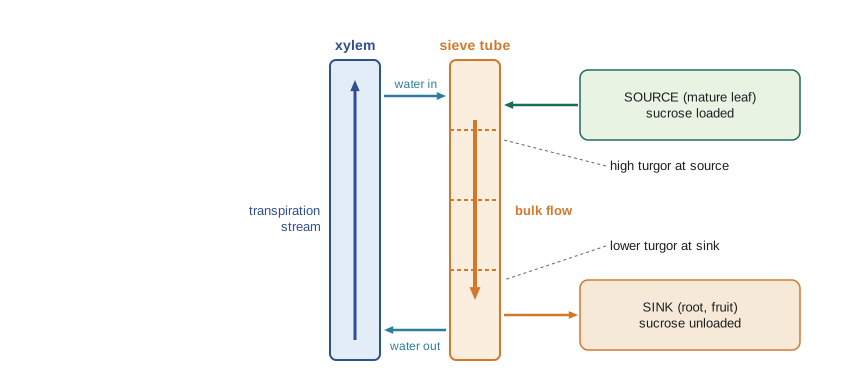
Plants load sucrose into the phloem in three main ways. In apoplastic loading, used by many herbaceous crops including sugar beet, canola and maize, sucrose is first released from mesophyll or phloem parenchyma cells into the cell wall space by SWEET transporters, and then pumped into the companion cell–sieve element complex against its concentration gradient by sucrose–proton symporters (SUC or SUT proteins), powered by the proton gradient. This creates sucrose concentrations of 0.5 to 1 M in the phloem. In symplastic polymer trapping, used by cucurbits and some woody plants, sucrose diffuses through plasmodesmata into specialized companion cells, where it is converted into larger sugars, raffinose and stachyose, that are too big to diffuse back. In passive loading, used by many trees including willows and poplars, sucrose simply diffuses down a concentration gradient from mesophyll to phloem through abundant plasmodesmata, which requires high sugar concentrations in the leaf.
import math

R, T = 8.314e-3, 293.0          # MPa L mol-1 K-1; K

# Pressure flow in a sieve tube: osmotic turgor at source and sink
c_source, c_sink = 0.80, 0.30   # sucrose, mol/L
psi_xylem_source, psi_xylem_sink = -0.8, -0.4   # MPa, surrounding water potential
P_source = psi_xylem_source + c_source * R * T  # turgor = psi - psi_s at equilibrium
P_sink = psi_xylem_sink + c_sink * R * T
dP = P_source - P_sink
print(f"turgor at source = {P_source:.2f} MPa, at sink = {P_sink:.2f} MPa, difference = {dP:.2f} MPa")

# Velocity of flow through a sieve tube (Hagen-Poiseuille, ignoring sieve plates)
r = 10e-6                        # radius, m
L = 1.0                          # path length, m
mu = 1.5e-3                      # viscosity of concentrated sugar solution, Pa s
v = r**2 * (dP * 1e6) / (8 * mu * L)
print(f"ideal velocity = {v*3600:.1f} m/h")
# Sieve plates add resistance; suppose they triple it
print(f"with sieve plates (x3 resistance) = {v*3600/3:.1f} m/h")
# sugar delivery through 5,000 sieve tubes in a petiole
flux = v / 3 * math.pi * r**2 * 5000 * c_source * 342 * 1000   # g/s
print(f"sucrose delivered: {flux*3600:.2f} g per hour")turgor at source = 1.15 MPa, at sink = 0.33 MPa, difference = 0.82 MPa ideal velocity = 24.5 m/h with sieve plates (x3 resistance) = 8.2 m/h sucrose delivered: 3.52 g per hour
The calculation shows that realistic sugar concentrations give turgor of more than a megapascal at the source and a pressure difference of about a megapascal between source and sink, enough to drive flow at metres per hour through an ideal tube. Sieve plates and the proteins that line them add resistance, and real velocities, typically 0.5 to 1 m/h, are lower still, because callose and proteins on the sieve plates and the lateral exchange of water and sugar along the path add further resistance. The simple calculation nonetheless gets the order of magnitude right, which is the main reason pressure flow is accepted. Whether pressure flow can explain transport in the tallest trees, where paths are tens of metres long, is still debated; one proposal is that very long sieve tubes in tall trees are wider, keeping resistance manageable.
Phloem sap is not just sugar water. It contains amino acids, potassium, hormones, proteins and RNA molecules, including signals that coordinate development across the plant. The florigen protein FLOWERING LOCUS T travels in the phloem from leaves to the shoot apex to trigger flowering (lesson 9), and small RNAs move through the phloem to silence genes at a distance. Much of what we know about phloem sap comes from an ingenious technique: an aphid feeding on a stem is immobilized and its stylet, inserted into a single sieve element, is cut with a laser, after which pure sap exudes from the stump for hours.
Worked problem
Diagnosing a nutrient problem in a field
A soybean field on calcareous soil (pH 8.1) shows yellowing between the veins of the youngest trifoliate leaves, while the veins stay green and older leaves look normal. A neighbouring wheat field on the same soil is healthy. What is the most likely cause?
Show solution
- Symptoms on young leaves point to an immobile nutrient, such as iron, calcium or boron.
- Interveinal chlorosis with green veins on young leaves is the classic pattern of iron deficiency.
- High soil pH makes iron very insoluble; calcareous soils are notorious for iron deficiency chlorosis.
- Wheat, a grass, uses strategy II phytosiderophores and copes better with alkaline soils than soybean, a strategy I plant.
Answer: Iron deficiency chlorosis, a well-known problem for soybean on high-pH soils of the northern plains. Managers choose tolerant varieties, apply iron chelates suited to alkaline soils with the seed, or avoid the most calcareous fields; a tissue test would confirm the diagnosis.
Common mistakes
MistakeAssuming plants get their mass mainly from the soil.
InsteadAbout 95 per cent of dry mass comes from CO₂ and water; mineral nutrients make up a few per cent.
MistakeLooking for deficiency symptoms of mobile nutrients on young leaves.
InsteadMobile nutrients such as N, P, K and Mg are remobilized from older leaves, so symptoms appear there first.
MistakeSaying that all ion uptake requires energy.
InsteadCations such as K⁺ can often enter passively down the electrochemical gradient created by the H⁺-ATPase; anions usually need active symport.
MistakeThinking that legumes fix nitrogen themselves.
InsteadRhizobia in root nodules fix nitrogen; the plant provides sugar, a low-oxygen environment and leghemoglobin.
MistakeDescribing phloem flow as one-way like xylem flow.
InsteadPhloem flows from sources to sinks and can move up or down depending on where sinks are.
MistakeTreating common mycorrhizal networks as a proven channel for large transfers between trees.
InsteadNetworks exist, but evidence for ecologically important transfers in the field is debated.
Summary and key terms
- Seventeen elements are essential for higher plants; macronutrients are needed above about 0.1 per cent of dry mass, micronutrients in parts per million.
- Deficiency symptoms of phloem-mobile nutrients appear in older leaves; those of immobile nutrients appear in young tissues.
- Soil chemistry, especially pH and cation exchange, controls nutrient availability; roots acidify their surroundings and release organic acids.
- The H⁺-ATPase creates a membrane potential that drives passive cation entry and powers proton-coupled symport of anions; the Nernst equation shows which ions must be transported actively.
- Iron is acquired by reduction (strategy I) or phytosiderophores (strategy II); nitrate is reduced and ammonium assimilated by GS–GOGAT.
- Rhizobia in legume nodules and Frankia in actinorhizal plants fix nitrogen; arbuscular and ectomycorrhizal fungi improve phosphate and nitrogen supply.
- Phloem carries sugars from sources to sinks by pressure flow; loading can be apoplastic, by polymer trapping or passive.
- essential element
- An element without which a plant cannot complete its life cycle and that acts directly in its metabolism.
- macronutrient
- An essential element required in relatively large amounts, above about 0.1 per cent of dry mass.
- chlorosis
- Yellowing of leaves caused by loss of chlorophyll.
- cation exchange capacity
- The ability of soil particles to hold and release positively charged ions.
- Nernst equation
- An equation giving the membrane potential at which an ion is at electrochemical equilibrium.
- phytosiderophore
- A compound secreted by grass roots that binds and solubilizes ferric iron.
- nitrogenase
- The bacterial enzyme complex that reduces N₂ to ammonia.
- leghemoglobin
- An oxygen-binding protein in legume nodules that protects nitrogenase while supplying O₂ for respiration.
- arbuscular mycorrhiza
- A symbiosis in which Glomeromycota fungi form branched arbuscules inside root cortical cells.
- source
- An organ that exports more photosynthate than it uses, such as a mature leaf.
- sink
- An organ that imports photosynthate, such as a root, fruit or growing tip.
- pressure-flow hypothesis
- Münch’s explanation that phloem sap moves by bulk flow driven by a turgor gradient between source and sink.
Practice problems
Work each problem on paper first, then reveal the answer to check.
State Arnon and Stout’s criteria for essentiality.
Show answer
The plant cannot complete its life cycle without it; it cannot be replaced by another element; it acts directly in metabolism.
A plant shows yellowing between the veins of its older leaves. Which nutrient is a likely cause?
Show answer
Magnesium, a mobile nutrient at the centre of chlorophyll.
Why does blossom-end rot of tomato occur even in soils with adequate calcium?
Show answer
Calcium moves only in the xylem with transpiration; fruits transpire little, so calcium reaches the fruit tip slowly, especially if water supply fluctuates.
With Em = −120 mV and external K⁺ of 0.1 mM, what is the equilibrium internal K⁺ at 25 °C?
Show answer
0.1 × e^(120/25.7) ≈ 0.1 × 10⁷ ≈ 11 mM.
Why must nitrate uptake be active in a cell with a negative membrane potential?
Show answer
The negative interior repels anions, so nitrate is moved inward by proton symport.
Contrast strategy I and strategy II iron uptake.
Show answer
Strategy I acidifies, reduces Fe³⁺ to Fe²⁺ and takes up Fe²⁺; strategy II secretes phytosiderophores and takes up Fe³⁺ complexes.
Why do legume nodules contain leghemoglobin?
Show answer
It keeps free O₂ very low to protect nitrogenase while delivering oxygen for bacteroid respiration.
How do arbuscular mycorrhizal fungi improve phosphate uptake?
Show answer
Their fine hyphae extend beyond the depletion zone around roots and explore more soil at lower cost.
Explain how loading and unloading create flow in the phloem.
Show answer
Loading lowers water potential at the source, water enters and turgor rises; unloading at the sink lowers turgor; bulk flow follows the pressure gradient.
What is polymer trapping?
Show answer
Sucrose diffuses into companion cells and is converted to raffinose and stachyose, which are too large to diffuse back.
Lesson quiz · 5 questions
Score 60% or more to complete this lesson.
Create a free account to save your progress, take quizzes and earn a certificate.