
BIOL-340 · Lesson 8 of 12 · 34 min
Plant hormones II: abscisic acid, ethylene and other signals
Lesson 7 described three hormones that mainly promote growth. This lesson turns to two hormones that are often described as stress or ageing hormones, abscisic acid and ethylene, and then to a group of signals discovered more recently: brassinosteroids, jasmonates, salicylic acid, strigolactones, peptides and the karrikins in smoke. The labels can mislead. Abscisic acid is essential for normal seed development and for everyday control of stomata, not only for drought; ethylene shapes seedlings, flowers and roots as well as ripening fruit. What these signals share is that they help plants respond to conditions around them, often by slowing growth, closing pores, shedding organs or switching development to a new programme. The lesson ends with the problem of crosstalk: how plants integrate many hormones into coherent decisions.
Abscisic acid: discovery and synthesis
In the early 1960s two groups were chasing quite different substances. Frederick Addicott in California was looking for the compound that promoted the shedding of young cotton bolls and called it abscisin II; Philip Wareing in Wales was looking for a substance that induced dormancy in sycamore buds and called it dormin. In 1965 the two turned out to be the same molecule, a 15-carbon sesquiterpenoid that was named abscisic acid (ABA). The name stuck, although later work showed that ABA has only a minor role in abscission in most plants; ethylene is the main abscission signal. ABA’s real importance lies in seed maturation and dormancy and in responses to water deficit.
ABA is made from carotenoids. In plastids, the carotenoid violaxanthin is converted to 9-cis-neoxanthin, which is cleaved by 9-cis-epoxycarotenoid dioxygenase (NCED) to a 15-carbon aldehyde, xanthoxin; this cleavage is the rate-limiting, highly regulated step. Xanthoxin moves to the cytosol and is converted to ABA in two further steps. ABA is inactivated by hydroxylation, mainly by CYP707A enzymes, or by conjugation to glucose, from which it can be released quickly. When leaves lose turgor, NCED genes are switched on within minutes, and ABA levels can rise tens of times within hours. ABA made in the vascular tissues of leaves is now thought to be the main source for stomatal closure, though roots in drying soil also make ABA, and chemical and hydraulic signals from roots both contribute to closing stomata before leaves wilt.
How cells perceive ABA
The ABA signalling core was assembled in 2009, after a long search. ABA binds to soluble receptors of the PYR/PYL/RCAR family, of which Arabidopsis has 14. ABA binding closes a lid over the binding pocket, and the receptor–ABA complex then binds and inhibits type 2C protein phosphatases (PP2Cs) such as ABI1 and ABI2. In the absence of ABA these phosphatases keep SnRK2 protein kinases dephosphorylated and inactive. With the phosphatases inhibited, SnRK2s, especially OST1 (also called SnRK2.6), autoactivate and phosphorylate their targets. In guard cells, OST1 activates the SLAC1 anion channel, inhibits the inward potassium channel KAT1 and stimulates production of reactive oxygen species by NADPH oxidase, which in turn activates calcium channels. Anion efflux depolarizes the membrane, potassium leaves through outward channels, water follows, and the stomata close within minutes. In the nucleus, SnRK2s phosphorylate ABF and ABI5 transcription factors that switch on hundreds of genes for dehydration tolerance, including those for dehydrins and late embryogenesis abundant (LEA) proteins and for enzymes making compatible solutes.
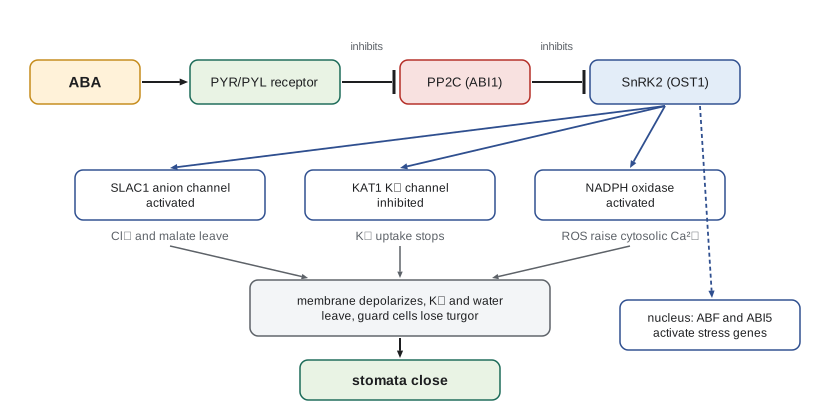
The receptors were found partly through chemical genetics. Sean Cutler’s group screened for synthetic compounds that mimicked ABA in germinating seeds and found pyrabactin, a molecule that activated only some receptors; mutants insensitive to pyrabactin led them to the PYR1 gene. Because ABA itself is expensive and short-lived in the field, synthetic ABA mimics that activate the receptors more selectively and persistently, such as quinabactin and opabactin, are being developed as agrochemicals that could help crops conserve water during drought.
import numpy as np
from scipy.optimize import curve_fit

rng = np.random.default_rng(340)
# Stomatal aperture of epidermal peels incubated in ABA (micromolar), simulated data
aba = np.array([0, 0.01, 0.03, 0.1, 0.3, 1, 3, 10, 30])
def hill(c, amax, amin, ec50, n):
    return amin + (amax - amin) / (1 + (c / ec50) ** n)
true = (7.5, 2.0, 0.4, 1.2)                     # aperture in um
ap = hill(aba, *true) + rng.normal(0, 0.25, aba.size)
p, cov = curve_fit(hill, aba, ap, p0=[7, 2, 0.5, 1], bounds=([0, 0, 1e-3, 0.2], [15, 6, 50, 5]))
se = np.sqrt(np.diag(cov))
print(f"open aperture {p[0]:.1f} um, closed {p[1]:.1f} um")
print(f"EC50 = {p[2]:.2f} +/- {se[2]:.2f} uM ABA, Hill coefficient = {p[3]:.2f}")
# a mutant with weaker PP2C inhibition: tenfold higher EC50
for c in (0.1, 1, 10):
    wt, mut = hill(c, *p), hill(c, p[0], p[1], p[2] * 10, p[3])
print(f"{c:5.1f} uM ABA: wild type {wt:.1f} um, insensitive mutant {mut:.1f} um")open aperture 7.7 um, closed 2.2 um EC50 = 0.30 +/- 0.04 uM ABA, Hill coefficient = 1.38 0.1 uM ABA: wild type 6.7 um, insensitive mutant 7.6 um 1.0 uM ABA: wild type 3.1 um, insensitive mutant 6.7 um 10.0 uM ABA: wild type 2.2 um, insensitive mutant 3.1 um
The fitted curve gives a half-maximal effect near 0.4 µM ABA, the concentration range found in leaves of stressed plants. A tenfold shift in sensitivity, the kind of change produced by dominant mutations such as abi1-1 that make the phosphatase resistant to the receptor, leaves stomata almost fully open at concentrations that close them in wild-type plants. Such mutants wilt readily, and they were among the first evidence that ABA controls stomata.
ABA in seeds
During seed development ABA rises as the embryo completes its growth, and it drives the maturation programme: accumulation of storage proteins and oils, synthesis of LEA proteins that protect cellular structures as the seed dries to 5 to 15 per cent water, acquisition of desiccation tolerance and the onset of dormancy. Mutants that cannot make or perceive ABA show vivipary, germinating while still on the parent plant; the viviparous mutants of maize, in which kernels sprout on the cob, were among the first hormone mutants studied. Pre-harvest sprouting, in which grain germinates in the head during wet weather before harvest, is a related and costly problem for wheat growers on the Prairies and in the northern US, and breeders select for adequate dormancy to prevent it. After the seed is shed, the balance between ABA and gibberellin decides whether it germinates, a decision lesson 10 examines in detail.
Ethylene: a gaseous hormone
Ethylene, C₂H₄, is the simplest plant hormone and the only common gaseous one. Its effects were noticed long before it was identified. In the nineteenth century, trees near leaking gas street lamps shed their leaves prematurely; in 1901 Dimitry Neljubov, a Russian graduate student, showed that ethylene in illuminating gas caused pea seedlings grown in darkness to show the triple response: a short, thick hypocotyl and stem, horizontal growth, and an exaggerated apical hook. Growers had long known that fruit ripened faster when stored near ripe fruit or when smoked; in 1934 Richard Gane showed that ripening fruit produce ethylene themselves, and it became recognized as a natural hormone.
Plants make ethylene from the amino acid methionine through a short pathway called the Yang cycle, after Shang Fa Yang, who worked it out in the 1970s. Methionine is converted to S-adenosylmethionine (SAM), which ACC synthase converts to 1-aminocyclopropane-1-carboxylic acid (ACC); ACC oxidase then converts ACC to ethylene, using oxygen. ACC synthase is usually the rate-limiting step and is controlled by many signals, including auxin, wounding, flooding, pathogens and ethylene itself. The sulfur atom of methionine is recycled, so tissues can make ethylene for long periods without running out of sulfur.
Ethylene signalling works backwards from what one might expect. The receptors, ETR1 and four relatives in Arabidopsis, sit in the endoplasmic reticulum membrane and bind ethylene through a copper cofactor. In the absence of ethylene, the receptors are active and keep a kinase called CTR1 switched on, and CTR1 suppresses the response by phosphorylating the membrane protein EIN2. When ethylene binds, the receptors and CTR1 are switched off, EIN2 is no longer phosphorylated, and its C-terminal part is cleaved off and moves to the nucleus, where it stabilizes the EIN3 family of transcription factors and activates ethylene-responsive genes. Because the receptors are negative regulators, mutations that destroy a receptor’s ability to bind ethylene, such as etr1-1, make plants insensitive, while losing all the receptors makes plants respond constitutively, as if ethylene were always present. The same backward logic explains how a compound called 1-methylcyclopropene (1-MCP) works: it binds the receptors almost irreversibly, locking them in their active, response-blocking state.
Ripening, senescence and abscission
Fruits fall into two groups according to how they ripen. Climacteric fruits, including bananas, tomatoes, apples, pears, avocados and peaches, show a burst of respiration and ethylene production at the onset of ripening, and ethylene coordinates the softening, colour change, aroma production and starch-to-sugar conversion that follow. The burst is autocatalytic: ethylene induces genes for ACC synthase and ACC oxidase, so a little ethylene makes more, and the system switches from a low-production state to a high-production state. Non-climacteric fruits, such as strawberries, grapes, citrus, cherries and peppers, ripen without an ethylene burst, under the control of other signals including ABA.
import numpy as np

# Autocatalytic ethylene production in a climacteric fruit (illustrative model)
# dE/dt = basal + k*E^n/(K^n + E^n) - d*E ; 1-MCP blocks receptors, reducing k
def simulate(k, days=30, dt=0.01, E0=0.05, basal_rise=0.012):
    t = np.arange(0, days, dt); E = np.empty_like(t); E[0] = E0
    for i in range(1, t.size):
        basal = 0.02 + basal_rise * t[i]          # slow developmental rise in competence
        dE = basal + k * E[i-1]**4 / (1.0 + E[i-1]**4) - 0.5 * E[i-1]
        E[i] = E[i-1] + dE * dt
    return t, E

for label_, k in (("untreated", 2.5), ("1-MCP treated", 0.25)):
    t, E = simulate(k)
    onset = t[np.argmax(E > 1.0)] if (E > 1.0).any() else None
    print(f"{label_:14s} ethylene at day 10, 20, 30: {E[1000]:.2f}, {E[2000]:.2f}, {E[-1]:.2f}"
+ (f" climacteric onset ~ day {onset:.0f}" if onset else " no climacteric within 30 days"))untreated ethylene at day 10, 20, 30: 0.24, 4.21, 5.70 climacteric onset ~ day 17 1-MCP treated ethylene at day 10, 20, 30: 0.23, 0.49, 0.84 no climacteric within 30 days
The model captures the essence of the climacteric. While the positive feedback is weak, ethylene creeps up slowly with fruit development; once it crosses a threshold, feedback takes over and production jumps to a much higher level within days. Blocking the receptors weakens the feedback so much that the switch does not occur in the period simulated. This is the logic of commercial practice. Apples are stored for months in controlled atmospheres with low oxygen and high CO₂, which slow ethylene synthesis and action, often after treatment with 1-MCP; bananas are shipped green and ripened on demand in rooms charged with ethylene. The proverb that one bad apple spoils the barrel has a sound physiological basis.
Ethylene also promotes senescence of leaves and flowers; cut carnations, for example, wilt quickly in its presence, and florists use silver thiosulfate, which blocks the receptors, to extend vase life. Abscission, the shedding of leaves, flowers and fruits, occurs at an abscission zone of small, densely packed cells at the base of the organ. As long as the organ supplies a steady stream of auxin through the zone, the cells are insensitive to ethylene; when auxin flow declines, as in an ageing leaf in autumn, ethylene induces enzymes such as cellulases and polygalacturonases that dissolve the middle lamella, and the organ falls. Growers use this balance in both directions: ethylene-releasing chemicals such as ethephon loosen cherries and walnuts for mechanical harvest, while auxin sprays prevent premature drop of apples.
Ethylene helps plants cope with flooding. Because gases diffuse ten thousand times more slowly in water than in air, ethylene accumulates in submerged tissues and acts as a signal of submergence. In many wetland plants it triggers the formation of aerenchyma, tissue with large air channels made by programmed death of cortical cells, which allows oxygen to diffuse down to the roots. Deepwater rice responds to rising floods by elongating its internodes rapidly to keep its leaves above water, an ethylene response mediated by the SNORKEL genes. Lowland rice varieties carrying the SUB1A gene do the opposite: they stop growing and conserve energy, surviving two weeks of complete submergence. SUB1A varieties, released from 2009 onward, have spread to millions of farmers in flood-prone South and Southeast Asia.
Brassinosteroids
Brassinosteroids are steroid hormones, chemically similar to animal sex steroids, first isolated in 1979 from 230 kg of rape (Brassica napus) pollen, which yielded 4 mg of brassinolide. Their importance became clear in the 1990s when Arabidopsis dwarf mutants with dark, curled leaves were found to be defective in brassinosteroid synthesis or perception. Unlike animal steroids, which bind nuclear receptors, brassinosteroids are perceived at the cell surface by the receptor kinase BRI1 and its partner BAK1. Activation of BRI1 leads, through a phosphorylation cascade, to inhibition of the kinase BIN2, which otherwise keeps the transcription factors BZR1 and BES1 out of the nucleus. Brassinosteroids promote cell expansion and division, vascular differentiation, pollen tube growth and tolerance of temperature stress, and they interact closely with auxin and gibberellin; a semi-dwarf barley variety widely grown in the past century turned out to carry a mutation in a brassinosteroid receptor gene.
Jasmonates, salicylic acid and strigolactones
Jasmonates are lipid-derived signals made from linolenic acid released from chloroplast membranes. The active form, jasmonoyl-isoleucine (JA-Ile), binds to the F-box protein COI1 and promotes the destruction of JAZ repressor proteins, a mechanism strikingly parallel to auxin perception. Jasmonates coordinate defences against chewing insects and necrotrophic pathogens, inducing proteinase inhibitors that disrupt insect digestion and the synthesis of toxic secondary metabolites, and they regulate stamen development, so jasmonate-deficient Arabidopsis is male sterile. Salicylic acid, the plant compound from which aspirin was derived, is the central signal of defence against biotrophic pathogens and of systemic acquired resistance; jasmonate and salicylic acid often antagonize each other. Lesson 11 develops both in the context of plant immunity.
Strigolactones have a remarkable history. They were first identified in 1966 as compounds in cotton root exudates that triggered germination of seeds of witchweed (Striga), a parasitic plant that attaches to the roots of maize, sorghum, millet and rice and causes enormous crop losses in sub-Saharan Africa. Why would a plant release a signal that helps a parasite? The answer came in 2005, when Kohki Akiyama and colleagues showed that strigolactones stimulate the branching of arbuscular mycorrhizal fungi: parasites had hijacked a signal plants use to recruit fungal partners. In 2008, two groups showed that strigolactones are also hormones inside the plant, inhibiting shoot branching; the branching mutants of pea (rms), petunia (dad), rice (d) and Arabidopsis (max) all turned out to be defective in strigolactone synthesis or signalling. Strigolactones are made from carotenoids in roots and perceived by the receptor D14, an enzyme that hydrolyses the hormone as it signals and promotes degradation of repressor proteins. Synthetic strigolactone mimics are being tested as suicidal germination agents, applied to infested fields before planting so that Striga seeds germinate and die without a host.
Peptides, karrikins and other signals
Plants also use small peptides as signals. CLAVATA3 regulates the shoot meristem (lesson 2); systemin, an 18-amino-acid peptide from tomato and the first plant peptide hormone discovered, in 1991, amplifies wound signalling; RALF peptides regulate cell expansion and pollen tube growth; and phytosulfokines promote cell proliferation. Many of these peptides are perceived by leucine-rich repeat receptor kinases in the plasma membrane, of which Arabidopsis has more than 200. Karrikins are compounds in the smoke of burning vegetation that stimulate the germination of many fire-following plants, explaining why some species appear only after fires. They act through a receptor, KAI2, closely related to the strigolactone receptor D14, which suggests that plants also make an unidentified endogenous compound that KAI2 normally perceives.
| Hormone | Origin | Receptor | Representative effects |
|---|---|---|---|
| Abscisic acid | Carotenoid cleavage (NCED) | PYR/PYL/RCAR; inhibits PP2C, releases SnRK2 | Stomatal closure, seed maturation and dormancy, drought tolerance |
| Ethylene | Methionine via ACC (Yang cycle) | ETR1 family in ER; negative regulators | Triple response, ripening, senescence, abscission, flooding responses |
| Brassinosteroids | Sterol pathway | BRI1–BAK1 receptor kinases | Cell expansion, vascular development, stress tolerance |
| Jasmonates (JA-Ile) | Linolenic acid | COI1 F-box; JAZ degradation | Defence against insects and necrotrophs, stamen development |
| Salicylic acid | Chorismate (isochorismate pathway) | NPR proteins | Defence against biotrophs, systemic acquired resistance |
| Strigolactones | Carotenoids (in roots) | D14 hydrolase–receptor | Inhibit branching, recruit mycorrhizae, trigger parasitic seed germination |
| Peptides (CLV3, systemin, RALF) | Processed precursor proteins | LRR receptor kinases | Meristem size, wound signalling, cell expansion |
Crosstalk: making decisions with many hormones
Real developmental decisions rarely depend on one hormone. Whether an axillary bud grows is decided by auxin flowing down the stem, cytokinin supplied from the roots and the bud’s neighbourhood, strigolactones that dampen auxin transport and act within the bud, and sugar supply. Whether a seed germinates depends on the balance of ABA and gibberellin, adjusted by light, temperature and nitrate. Whether a leaf grows or switches to defence depends on the trade-off between growth signals and jasmonates, which slow growth while defences are built. At the molecular level, crosstalk happens at every stage: one hormone changes the synthesis, inactivation or transport of another, signalling components interact physically (DELLA proteins, for example, bind JAZ repressors and transcription factors of other pathways), and target genes carry promoter elements for several pathways. This integration explains why hormone mutants often have unexpected phenotypes and why applying a single hormone in agriculture can have side effects. Modelling these networks quantitatively is one of the active frontiers of plant biology.
Worked problem
Using mutants to order an ethylene pathway
In Arabidopsis, etr1-1 mutant seedlings grown in darkness with ethylene do not show the triple response. ctr1 mutant seedlings show the triple response even without ethylene. The double mutant etr1-1 ctr1 shows the triple response without ethylene. What does this tell us about the order of ETR1 and CTR1 in the pathway?
Show solution
- etr1-1 blocks the response, so ETR1 is needed to sense ethylene; ctr1 activates the response constitutively, so CTR1 normally represses it.
- In the double mutant, the ctr1 phenotype appears even though etr1-1 is present: ctr1 is epistatic to etr1-1.
- When a constitutive mutation is epistatic to an insensitive one, the gene with the constitutive phenotype acts downstream.
- So CTR1 acts downstream of ETR1: the receptor, when not bound to ethylene, keeps CTR1 active; ethylene switches off the receptor and hence CTR1.
Answer: CTR1 acts downstream of the receptor ETR1. Epistasis analysis of exactly this kind established the order of the ethylene pathway in the 1990s, before most of the proteins’ biochemical activities were known.
Common mistakes
MistakeAssuming abscisic acid is the main hormone of abscission.
InsteadDespite its name, ABA has a minor role in abscission; ethylene, opposed by auxin, is the main signal.
MistakeTreating ABA as purely a drought hormone.
InsteadABA also controls seed maturation and dormancy and regulates stomata daily under normal conditions.
MistakeThinking that ethylene receptors switch the response on when they bind ethylene.
InsteadThe receptors actively suppress the response; ethylene binding switches them off, releasing the response.
MistakeExpecting all fruits to ripen faster with ethylene.
InsteadClimacteric fruits respond strongly; non-climacteric fruits such as strawberries, grapes and citrus ripen without an ethylene burst.
MistakeAssuming brassinosteroids work like animal steroids through nuclear receptors.
InsteadThey are perceived at the cell surface by the BRI1 receptor kinase.
MistakeThinking strigolactones exist to help parasitic plants.
InsteadThey recruit mycorrhizal fungi and regulate branching; Striga exploits the signal.
Summary and key terms
- ABA is made from carotenoids, with NCED as the regulated step, and rises rapidly when leaves lose turgor.
- ABA binds PYR/PYL/RCAR receptors, which inhibit PP2C phosphatases and release SnRK2 kinases that close stomata and activate stress genes.
- ABA drives seed maturation, desiccation tolerance and dormancy; ABA-deficient mutants show vivipary.
- Ethylene is made via ACC in the Yang cycle and perceived by ER receptors that act as negative regulators of the CTR1–EIN2–EIN3 pathway.
- Ethylene coordinates the autocatalytic climacteric of ripening fruit, senescence, abscission and flooding responses; 1-MCP blocks its receptors.
- Brassinosteroids signal through BRI1 at the cell surface; jasmonates and salicylic acid regulate defence; strigolactones inhibit branching and recruit mycorrhizae.
- Hormone crosstalk occurs at synthesis, transport and signalling levels and integrates many signals into developmental decisions.
- abscisic acid
- A carotenoid-derived hormone that controls stomatal closure, seed maturation and dormancy.
- NCED
- 9-cis-epoxycarotenoid dioxygenase, the rate-limiting enzyme of ABA synthesis.
- PYR/PYL receptor
- A soluble ABA receptor that inhibits PP2C phosphatases when bound to ABA.
- SnRK2
- A protein kinase activated in ABA signalling that phosphorylates ion channels and transcription factors.
- vivipary
- Germination of seeds while still attached to the parent plant.
- triple response
- The ethylene response of dark-grown seedlings: short thick stems, horizontal growth and an exaggerated apical hook.
- ACC
- 1-aminocyclopropane-1-carboxylic acid, the immediate precursor of ethylene.
- climacteric
- A burst of respiration and ethylene production at the onset of ripening in some fruits.
- 1-MCP
- 1-methylcyclopropene, a compound that blocks ethylene receptors and delays ripening.
- aerenchyma
- Tissue with large air spaces that allows oxygen to reach submerged organs.
- brassinosteroid
- A steroid hormone perceived by the BRI1 receptor kinase that promotes cell expansion.
- strigolactone
- A carotenoid-derived signal that inhibits shoot branching and stimulates mycorrhizal fungi.
Practice problems
Work each problem on paper first, then reveal the answer to check.
Why is abscisic acid misnamed?
Show answer
It was isolated as an abscission-promoting substance, but its main roles are in dormancy, seed maturation and stomatal control; ethylene mainly controls abscission.
List the core components of ABA signalling in order.
Show answer
ABA → PYR/PYL/RCAR receptor → inhibition of PP2C phosphatases → activation of SnRK2 kinases → phosphorylation of SLAC1, KAT1 and transcription factors.
A dominant mutation makes a PP2C phosphatase unable to bind the receptor. Predict the phenotype.
Show answer
ABA insensitivity: stomata fail to close, plants wilt readily, and seeds are less dormant.
What is the rate-limiting step in ethylene synthesis, and how is it regulated?
Show answer
ACC synthase, controlled transcriptionally and by protein stability in response to auxin, wounding, flooding, pathogens and ethylene.
Why do plants lacking all ethylene receptors show a constitutive ethylene response?
Show answer
The receptors repress the pathway through CTR1; without them, repression is lost.
Explain how 1-MCP extends the storage life of apples.
Show answer
It binds ethylene receptors almost irreversibly, preventing ethylene from triggering the autocatalytic climacteric.
How does auxin prevent abscission?
Show answer
A steady flow of auxin through the abscission zone keeps its cells insensitive to ethylene.
Contrast the responses of SUB1A rice and deepwater rice to flooding.
Show answer
SUB1A rice stops growing and conserves energy to survive short complete submergence; deepwater rice elongates rapidly to keep leaves above slowly rising water.
Why might a parasitic plant use strigolactones as a germination cue?
Show answer
They are released by host roots to recruit mycorrhizae, so their presence reliably signals a nearby host root.
What is meant by hormone crosstalk? Give one example.
Show answer
Interaction between hormone pathways, for example DELLA proteins binding JAZ repressors linking gibberellin and jasmonate signalling, or the ABA–GA balance in germination.
Lesson quiz · 5 questions
Score 60% or more to complete this lesson.
Create a free account to save your progress, take quizzes and earn a certificate.