
BIOL-340 · Lesson 7 of 12 · 33 min
Plant hormones I: auxin, cytokinins and gibberellins
Without nerves or a circulating blood system, plants coordinate growth across their bodies with small signalling molecules called hormones. Plant hormones differ from animal hormones in several ways. They are not made in dedicated glands; most cells can make several of them. They often act close to where they are made, as well as at a distance, and their transport routes include cell-to-cell movement, the xylem and the phloem. Each hormone influences many processes, and most processes are influenced by several hormones, so the effect of a hormone depends heavily on context: on which tissue receives it, on its concentration, and on the levels of other hormones. This lesson covers the three growth-promoting hormones that were discovered first and whose signalling pathways are best understood: auxin, cytokinins and gibberellins. Lesson 8 covers abscisic acid, ethylene and the newer signals, and lessons 9 to 11 show how hormones carry the effects of light, the seasons and stress.
Discovering auxin
The story of auxin begins with Charles Darwin and his son Francis. In The Power of Movement in Plants, published in 1880, they reported that grass seedlings (coleoptiles of canary grass) bend toward a light from one side, but not if the tip is covered with an opaque cap, even though the bending occurs well below the tip. They concluded that some influence travels from the tip to the growing region. Peter Boysen-Jensen showed in 1913 that the influence could pass through a block of gelatin but not through a sheet of mica, so it was chemical, and Árpád Paál showed that placing a cut tip off-centre on the stump made the seedling bend away from that side, even in darkness. In 1926 Frits Went, then a graduate student in Utrecht, collected the substance by placing cut oat coleoptile tips on agar blocks and showed that a block placed off-centre on a decapitated coleoptile caused bending in proportion to the amount of substance it contained. He called it auxin, from the Greek for ‘to grow’. The main natural auxin was later identified as indole-3-acetic acid (IAA).
Went’s experiment also created the first quantitative hormone bioassay, the Avena curvature test, in which the angle of bending measures the auxin content of a block. Within a range, curvature is proportional to the logarithm of the concentration, so a standard curve made with known concentrations can be used to estimate the auxin in an unknown extract. Bioassays like this, though now replaced by mass spectrometry, were the only way to measure hormones for decades.
import numpy as np

rng = np.random.default_rng(340)
# Avena curvature bioassay: standard curve (curvature vs log10 IAA) and an unknown
conc = np.array([0.01, 0.02, 0.05, 0.1, 0.2, 0.5])            # mg IAA per L in agar blocks
curv = 6.5 * np.log10(conc / 0.004) + rng.normal(0, 0.6, conc.size)   # degrees, simulated
slope, intercept = np.polyfit(np.log10(conc), curv, 1)
r = np.corrcoef(np.log10(conc), curv)[0, 1]
print(f"standard curve: curvature = {slope:.2f} log10(C) + {intercept:.2f}  (r = {r:.3f})")
for c, k in zip(conc, curv):
    print(f"  {c:5.2f} mg/L -> {k:5.1f} degrees")
unknown = 9.8                                                   # degrees, mean of replicates
est = 10 ** ((unknown - intercept) / slope)
print(f"unknown extract: {unknown} degrees -> about {est:.3f} mg/L IAA")
print(f"outside the standard range? {not (conc.min() <= est <= conc.max())}")standard curve: curvature = 5.65 log10(C) + 14.68 (r = 0.995) 0.01 mg/L -> 3.1 degrees 0.02 mg/L -> 5.5 degrees 0.05 mg/L -> 6.9 degrees 0.10 mg/L -> 9.4 degrees 0.20 mg/L -> 10.5 degrees 0.50 mg/L -> 13.0 degrees unknown extract: 9.8 degrees -> about 0.137 mg/L IAA outside the standard range? False
The standard curve is close to linear on a logarithmic scale, so each tenfold increase in auxin adds a fixed number of degrees of curvature. The unknown falls within the range of the standards, which matters: extrapolating a bioassay beyond its standards is unreliable, because at very high concentrations auxin becomes inhibitory and the curve bends over. The same logic of a standard curve and interpolation applies today to immunoassays and to mass spectrometry with internal standards.
Making and moving auxin
Plants make IAA mainly from the amino acid tryptophan, in a two-step pathway: TAA1 family enzymes convert tryptophan to indole-3-pyruvic acid, and YUCCA flavin monooxygenases convert that to IAA. Synthesis is highest in young leaves, shoot apices, developing seeds and root tips. Plants also control auxin levels by forming inactive conjugates with sugars and amino acids, from which IAA can be released, and by oxidizing it irreversibly.
Auxin is the only plant hormone known to be transported directionally from cell to cell, a process called polar auxin transport. In stems it moves from the shoot tip toward the base at about 1 cm per hour, much faster than diffusion would allow over such distances and in a specific direction, even when the stem is held upside down. The chemiosmotic model, proposed by Philip Rubery, Alan Sheldrake and Peter Raven in the mid-1970s, explains how. In the acidic cell wall at pH 5.5, a fraction of IAA, a weak acid with pKa 4.8, is protonated and uncharged and can diffuse across the plasma membrane; the anionic form is taken up by AUX1/LAX symporters together with protons. Inside the cell, at pH 7, nearly all of it dissociates to the anion IAA⁻, which cannot cross the membrane on its own and is trapped. It can leave only through efflux carriers, the PIN-FORMED (PIN) proteins, which are concentrated at one end of each cell. If PINs sit at the basal end of every cell in a file, auxin moves basally through the file. ABCB transporters add to efflux and keep auxin within the transport stream.
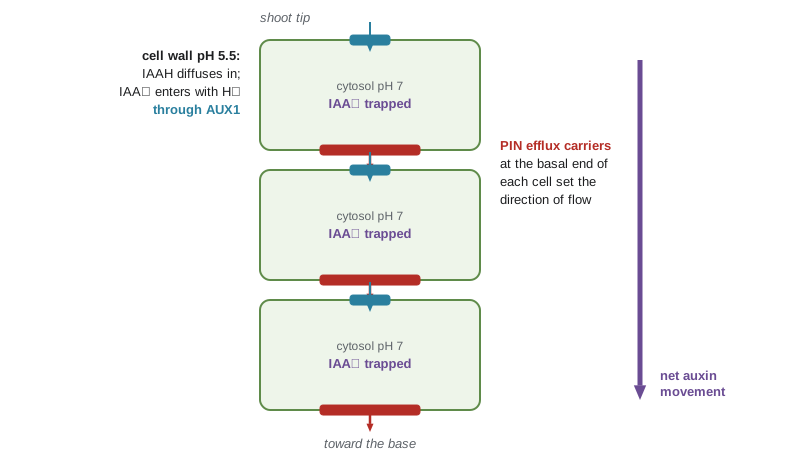
Because PIN proteins cycle continually between the plasma membrane and internal compartments, cells can redirect auxin flow within minutes by changing which face of the cell their PINs occupy. This makes auxin transport a flexible routing system. It explains how auxin maxima form at the sites of new leaves in the shoot apex (lesson 2), how auxin is redistributed to the shaded side of a stem or the lower side of a root, and how veins form: according to the canalization hypothesis, cells that conduct some auxin become better at conducting it, so auxin flow becomes concentrated into narrow channels that differentiate into vascular strands. Drugs that block auxin efflux, such as N-1-naphthylphthalamic acid (NPA), disrupt all of these processes, and Arabidopsis pin1 mutants form bare, pin-shaped inflorescences without flowers, which gave the gene its name.
import numpy as np

# Toy model: auxin in a file of 30 cells. Source at cell 0 (shoot tip),
# sink at cell 29 (base). Compare symmetric diffusion with polar (PIN) transport.
n, steps, dt = 30, 6000, 0.01
D = 0.5          # symmetric exchange between adjacent cells, per unit time
P = 2.0          # additional basal-directed PIN transport, per unit time
def run(polar):
    a = np.zeros(n)
    for _ in range(steps):
        a[0] = 1.0                             # constant production at the tip
        flux_down = D * a[:-1] + (P * a[:-1] if polar else 0)
        flux_up = D * a[1:]
        net = flux_down - flux_up              # net flux from cell i to i+1
        a[:-1] -= net * dt
        a[1:] += net * dt
        a[-1] *= 0.5                           # the base acts as a sink
    return a
for label_, polar in (("diffusion only", False), ("with basal PIN", True)):
    a = run(polar)
    print(f"{label_:15s} auxin at cells 5, 15, 25: {a[5]:.3f}, {a[15]:.3f}, {a[25]:.3f}")
a = run(True)
print("profile with PIN (every 5th cell):", np.round(a[::5], 2).tolist())diffusion only auxin at cells 5, 15, 25: 0.518, 0.053, 0.001 with basal PIN auxin at cells 5, 15, 25: 1.000, 1.000, 0.998 profile with PIN (every 5th cell): [0.98, 1.0, 1.0, 1.0, 1.0, 1.0]
In the model, after the same simulated time, diffusion alone has produced a steep gradient, with almost no auxin reaching cells far from the source, because random exchange is as likely to move auxin back toward the tip as away from it, and the time diffusion needs grows with the square of the distance. Adding a basal bias in efflux turns the file into a conveyor belt that delivers auxin all the way to the sink. Real tissues combine both: polar transport over long distances and local diffusion and redistribution, which together shape the auxin landscape that cells read.
How cells perceive auxin
The auxin receptor was identified in 2005, and it turned out to work in an unexpected way. The receptor is TIR1, an F-box protein that is part of an SCF ubiquitin ligase complex, together with related AFB proteins. Auxin binds in a pocket of TIR1 and acts as a molecular glue, increasing the binding of TIR1 to Aux/IAA proteins, which are repressors of auxin-responsive genes. Once bound, the Aux/IAA proteins are tagged with ubiquitin and destroyed by the proteasome. When auxin is low, Aux/IAA proteins bind auxin response factors (ARFs), transcription factors that sit on auxin-responsive promoters, and keep the genes off. When auxin rises, Aux/IAAs are degraded within minutes, ARFs are freed and the genes switch on. Among the genes induced are those for Aux/IAA proteins themselves, a negative feedback that makes the response transient. Arabidopsis has 6 TIR1/AFB receptors, 29 Aux/IAA proteins and 23 ARFs, and their combinations allow different tissues to respond differently. Some fast responses, including wall acidification, also involve a TIR1/AFB-dependent but non-transcriptional pathway and cell-surface signalling components, a topic of current research.
The degradation-based mechanism discovered for auxin turned out to be a common theme in plant hormone signalling: gibberellin, jasmonate and strigolactone responses also work by triggering the destruction of repressor proteins, an arrangement sometimes called relief of restraint.
What auxin does
Auxin influences nearly every aspect of plant development. It promotes cell elongation in stems and coleoptiles through acid growth (lesson 1), and its asymmetric distribution produces tropisms: the Cholodny–Went hypothesis, proposed in the 1920s and well supported today, holds that phototropic and gravitropic bending result from auxin moving to one side of the organ (lesson 9). In roots, auxin at high concentrations inhibits elongation, so the same redistribution makes roots bend down while shoots bend up. Auxin initiates lateral and adventitious roots, which is why commercial rooting powders contain the synthetic auxins indole-3-butyric acid or naphthaleneacetic acid. It maintains apical dominance by inhibiting the outgrowth of axillary buds, working indirectly through cytokinins and strigolactones. Auxin from developing seeds stimulates fruit growth; strawberries whose seeds (the achenes on the surface) are removed fail to enlarge unless auxin is applied, and auxin sprays can produce seedless (parthenocarpic) fruit.
Synthetic auxins have been some of the most important agricultural chemicals ever made. 2,4-dichlorophenoxyacetic acid (2,4-D), introduced in the 1940s, and later compounds such as dicamba and MCPA kill broadleaf weeds in cereal crops and lawns while sparing grasses, because broadleaf plants metabolize them more slowly and are more sensitive. At herbicidal doses they cause uncontrolled growth, epinasty and death. Crops engineered for tolerance to dicamba and 2,4-D have been widely grown in the United States since the late 2010s, and drift of dicamba onto neighbouring sensitive crops has led to repeated lawsuits and regulatory changes. Agent Orange, used as a defoliant in the Vietnam War, was a mixture of 2,4-D and 2,4,5-T; its notorious toxicity came largely from dioxin contaminating the 2,4,5-T.
Cytokinins: promoters of cell division
In the 1950s, Folke Skoog and Carlos Miller at the University of Wisconsin were searching for factors that would make tobacco pith tissue divide in culture. They found that autoclaved herring sperm DNA contained a powerful active compound, which they named kinetin; it was a breakdown product of DNA, not a natural plant hormone. In 1963 D. S. Letham identified the first natural cytokinin, zeatin, from immature maize kernels. Cytokinins are adenine derivatives with a side chain on the N⁶ position. Plants make them mainly through isopentenyltransferase (IPT) enzymes, and roots are a major source, sending cytokinins up the xylem to the shoot, though shoots make them too.
Cytokinin signalling uses a phosphorelay system related to the two-component systems of bacteria. Cytokinin binds to histidine kinase receptors in the endoplasmic reticulum and plasma membrane (AHK2, AHK3 and CRE1/AHK4 in Arabidopsis). The receptor autophosphorylates and passes the phosphate to histidine phosphotransfer proteins, which move into the nucleus and phosphorylate response regulators. Type-B response regulators are transcription factors that activate cytokinin-responsive genes, including the type-A response regulators, which feed back to dampen the response.
Skoog and Miller’s most famous discovery was that the ratio of auxin to cytokinin determines what cultured plant tissue becomes. A high auxin-to-cytokinin ratio makes callus form roots; a low ratio makes it form shoots; intermediate ratios keep it growing as undifferentiated callus. This principle underlies plant tissue culture and micropropagation, used to produce millions of genetically identical plants of potatoes, strawberries, orchids, bananas and forest trees, and it underlies the regeneration of whole plants from transformed cells in plant biotechnology (lesson 12). The crown gall bacterium Agrobacterium tumefaciens exploits the same principle: it transfers into the plant genome genes for auxin and cytokinin synthesis, and the resulting hormone imbalance makes infected cells proliferate into a tumour.
Cytokinins have many other effects. They promote shoot branching by releasing axillary buds, in opposition to auxin. They delay leaf senescence: a leaf disc treated with cytokinin stays green while untreated tissue yellows, and tobacco plants engineered to make cytokinin in senescing leaves stay green longer. They influence the size of the shoot meristem through WUSCHEL (lesson 2) and help coordinate shoot growth with nitrogen supply, because roots make more cytokinin when nitrate is plentiful.
| Auxin : cytokinin ratio | Outcome in tissue culture | Application |
|---|---|---|
| High (e.g. 10:1) | Roots form from callus | Rooting of shoots in micropropagation |
| Intermediate (about 1:1) | Undifferentiated callus grows | Maintaining callus and cell cultures |
| Low (e.g. 1:10) | Shoots form from callus | Regenerating plants from transformed cells |
Gibberellins and the Green Revolution
Gibberellins were discovered through a disease. In the late nineteenth and early twentieth centuries, Japanese rice farmers knew of bakanae, ‘foolish seedling’ disease, in which infected seedlings grew abnormally tall and spindly and often fell over and died. In 1926 Eiichi Kurosawa showed that a sterile filtrate from the fungus responsible, now called Fusarium fujikuroi (formerly Gibberella fujikuroi), reproduced the symptoms, and in the 1930s Teijiro Yabuta and colleagues isolated the active substance and called it gibberellin. Western scientists learned of the work only after the Second World War, when it was found that plants make gibberellins themselves. More than 130 gibberellins are known, but only a few, such as GA₁ and GA₄, are biologically active in plants; the rest are precursors or inactive products.
Gibberellins are diterpenoids made in plastids, the endoplasmic reticulum and the cytosol. The final steps are controlled by GA 20-oxidases and GA 3-oxidases, which make active gibberellins, and GA 2-oxidases, which inactivate them; these enzymes are regulated by light, temperature and feedback from gibberellin signalling. The receptor is GID1, a soluble protein. When gibberellin binds GID1, the complex binds DELLA proteins, nuclear growth repressors named after a conserved amino-acid motif. The GID1–GA–DELLA complex is recognized by an F-box protein (SLY1 in Arabidopsis, GID2 in rice), and DELLA proteins are ubiquitinated and destroyed. Gibberellin promotes growth, in other words, by destroying the brakes.
This mechanism explains one of the great achievements of twentieth-century agriculture. The high-yielding wheat varieties bred by Norman Borlaug and colleagues in Mexico from the 1950s, and spread to South Asia in the 1960s, carried dwarfing genes called Reduced height (Rht-B1b and Rht-D1b) derived from the Japanese variety Norin 10. In 1999, Jinrong Peng, Nicholas Harberd and colleagues showed that these genes encode DELLA proteins with a small deletion that prevents their destruction in response to gibberellin. The plants therefore stay short. Short, stiff stems do not collapse (lodge) under the weight of heavy grain heads when given generous nitrogen fertilizer, so the plants can put more of their growth into grain. The semi-dwarf rice varieties of the International Rice Research Institute, starting with IR8 in 1966, carry a mutation in a different step, sd1, a defective GA 20-oxidase gene that reduces gibberellin synthesis. Together these varieties more than doubled cereal yields in much of Asia within a few decades.
Gibberellins have other roles and uses. They stimulate stem elongation in plants that bolt before flowering, such as lettuce and cabbage in long days. They break seed dormancy and promote germination; in cereal grains, gibberellin made by the embryo signals the aleurone layer to secrete α-amylase and other enzymes that digest the starchy endosperm, a response exploited in malting barley for brewing. Seedless table grapes such as Thompson Seedless are sprayed with gibberellin to lengthen the stalks of the bunch and enlarge the berries. Conversely, growth retardants that block gibberellin synthesis, such as chlormequat, trinexapac-ethyl and paclobutrazol, are used to shorten cereal stems, keep potted plants compact and control vigour in fruit trees.
| Hormone | Chemical class | Receptor and signalling | Main effects |
|---|---|---|---|
| Auxin (IAA) | Indole derivative from tryptophan | TIR1/AFB F-box receptors; Aux/IAA degradation frees ARFs | Elongation, tropisms, apical dominance, root initiation, vascular patterning, fruit growth |
| Cytokinins (zeatin and others) | N⁶-substituted adenines | Histidine kinase receptors; phosphorelay to response regulators | Cell division, shoot formation, branching, delayed senescence |
| Gibberellins (GA₁, GA₄) | Diterpenoids | GID1 receptor; DELLA degradation | Stem elongation, germination, bolting, fruit growth |
Worked problem
Interpreting a dwarf mutant
Two dwarf pea mutants are found. Spraying mutant A with gibberellin restores normal height; spraying mutant B has no effect. In mutant B, DELLA protein levels stay high even after gibberellin treatment. What kind of defect does each mutant carry?
Show solution
- Mutant A responds to added gibberellin, so it can perceive and respond to the hormone; its defect must be in gibberellin synthesis.
- Mutant B does not respond, so it either cannot perceive gibberellin or cannot destroy DELLA.
- DELLA stays high after treatment, consistent with a receptor (GID1) defect, an F-box defect or a DELLA protein resistant to degradation.
- Mendel’s tall/short gene (Le) in pea turned out to be a GA 3-oxidase, a synthesis gene, like mutant A; Rht wheat resembles mutant B.
Answer: Mutant A is a biosynthesis mutant; mutant B is a signalling or response mutant, probably with a degradation-resistant DELLA or a defective receptor. Mendel’s stem-length gene, cloned in 1997, is a synthesis gene, so Mendel was unknowingly studying gibberellin biosynthesis.
Common mistakes
MistakeExpecting each hormone to have one function.
InsteadEach hormone affects many processes, and the effect depends on tissue, concentration and interactions with other hormones.
MistakeSaying that auxin moves from cell to cell by diffusion.
InsteadLong-distance cell-to-cell auxin movement is polar, driven by ion trapping and asymmetric PIN efflux carriers.
MistakeAssuming that hormone receptors always activate genes directly.
InsteadAuxin and gibberellin receptors work by triggering the destruction of repressor proteins.
MistakeAssuming that auxin always promotes elongation.
InsteadConcentrations that promote shoot elongation inhibit root elongation; dose and tissue matter.
MistakeThinking that Green Revolution dwarf wheat lacks gibberellin.
InsteadRht wheat makes gibberellin but carries DELLA proteins that resist gibberellin-triggered degradation.
MistakeTreating kinetin as a natural plant hormone.
InsteadKinetin was first found as a DNA breakdown product; zeatin is the main natural cytokinin in many plants.
Summary and key terms
- Plant hormones are made by many cells, act locally and at a distance, and interact; context determines their effects.
- Auxin was discovered through coleoptile phototropism experiments culminating in Went’s agar-block bioassay.
- IAA is made from tryptophan via TAA1 and YUCCA and moves by polar transport: ion trapping plus asymmetrically placed PIN efflux carriers.
- Auxin binds TIR1/AFB and glues it to Aux/IAA repressors, which are destroyed, freeing ARF transcription factors.
- Auxin drives elongation, tropisms, apical dominance, root initiation, vascular patterning and fruit growth; synthetic auxins are herbicides.
- Cytokinins signal through a phosphorelay, promote division and shoot formation, and delay senescence; the auxin:cytokinin ratio steers tissue culture.
- Gibberellins promote growth by triggering DELLA destruction through GID1; DELLA and GA-synthesis mutations gave the semi-dwarf crops of the Green Revolution.
- auxin
- A class of hormones, chiefly indole-3-acetic acid, that regulates elongation, tropisms and patterning.
- polar auxin transport
- Directional cell-to-cell movement of auxin driven by ion trapping and asymmetric efflux carriers.
- PIN protein
- An auxin efflux carrier whose position in the plasma membrane sets the direction of auxin flow.
- TIR1
- An F-box auxin receptor that targets Aux/IAA repressors for degradation.
- Aux/IAA protein
- A repressor of auxin-responsive genes that is destroyed when auxin is present.
- canalization
- The hypothesis that auxin flow becomes concentrated into channels that become veins.
- cytokinin
- An adenine-derived hormone that promotes cell division and shoot formation.
- phosphorelay
- A signalling chain in which phosphate groups pass from a histidine kinase receptor to response regulators.
- gibberellin
- A diterpenoid hormone that promotes stem elongation, germination and bolting.
- DELLA protein
- A nuclear growth repressor destroyed in response to gibberellin.
- GID1
- The soluble gibberellin receptor.
- Rht genes
- Wheat dwarfing genes encoding gibberellin-insensitive DELLA proteins.
Practice problems
Work each problem on paper first, then reveal the answer to check.
What did Boysen-Jensen’s gelatin and mica experiment show?
Show answer
The signal from the tip passes through gelatin but not mica, so it is a chemical that diffuses, not an electrical impulse.
Why is IAA trapped inside cells?
Show answer
At cytosolic pH 7 it dissociates to IAA⁻, which cannot diffuse across the membrane and needs efflux carriers.
What would happen to auxin transport if PIN proteins were spread evenly around each cell?
Show answer
Efflux would occur in all directions and polar transport would be lost; auxin would spread more like diffusion.
Describe how TIR1 perceives auxin.
Show answer
Auxin binds TIR1 and acts as molecular glue that increases its binding to Aux/IAA proteins, which are ubiquitinated and degraded.
Why do roots bend down and shoots bend up when auxin accumulates on the lower side?
Show answer
Auxin promotes elongation of shoot cells but inhibits root cells at those concentrations.
How would you make callus form shoots in culture?
Show answer
Use a low auxin-to-cytokinin ratio in the medium.
How does Agrobacterium cause crown gall tumours?
Show answer
It inserts genes for auxin and cytokinin synthesis into plant cells, which proliferate because of the hormone imbalance.
Explain the phrase relief of restraint for gibberellin signalling.
Show answer
Gibberellin promotes growth by causing degradation of DELLA repressors rather than by directly activating genes.
Why did semi-dwarf wheat increase yields?
Show answer
Short, stiff stems resist lodging under heavy fertilized grain heads, and more growth goes to grain.
A barley grain without its embryo is placed on starch agar with and without gibberellin. Predict the result.
Show answer
With gibberellin, the aleurone secretes α-amylase and starch is digested around the grain; without it, little digestion occurs.
Lesson quiz · 5 questions
Score 60% or more to complete this lesson.
Create a free account to save your progress, take quizzes and earn a certificate.