
BIOL-207 · Lesson 9 of 12 · 30 min
Gene regulation in bacteria
A bacterium carries genes for thousands of proteins but needs only some of them at any moment. Making enzymes to digest a sugar that is not present, or to build an amino acid already abundant in the medium, wastes energy and materials that could be spent on growth. Bacteria therefore regulate their genes, mostly at the level of transcription, switching them on when needed and off when not. The study of how they do this, beginning with the lac operon of E. coli, created the vocabulary used for gene regulation in all organisms: repressors and activators, operators and inducers, negative and positive control. This lesson works through the lac and trp operons in detail, models their behaviour, and surveys other bacterial strategies, from riboswitches to quorum sensing and CRISPR.
Jacob, Monod and the lac operon
When E. coli grows on glucose, it makes very little of the enzyme β-galactosidase, which splits the sugar lactose into glucose and galactose. If lactose is the only sugar available, the enzyme’s level rises about 1,000-fold within minutes. In the 1950s and early 1960s, François Jacob and Jacques Monod at the Pasteur Institute in Paris used genetics to explain this induction. Their operon model, published in 1961, earned them a share of the 1965 Nobel Prize with André Lwoff.
The lac operon contains three structural genes transcribed together as one mRNA (lesson 5): lacZ, encoding β-galactosidase; lacY, encoding lactose permease, which brings lactose into the cell; and lacA, encoding a transacetylase whose role is minor. Upstream lie the promoter and the operator, a DNA sequence that overlaps the promoter. Nearby, a separate gene, lacI, is transcribed from its own promoter and encodes the lac repressor.
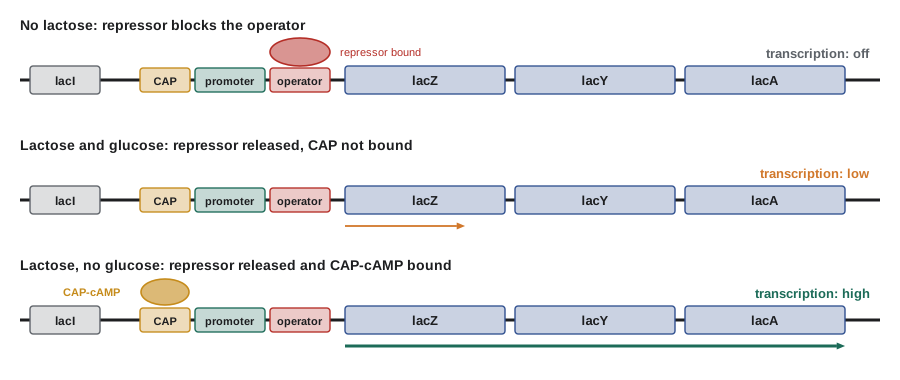
In the absence of lactose, the repressor, a tetramer, binds tightly to the operator and blocks RNA polymerase from transcribing the genes. When lactose enters the cell, some is converted by β-galactosidase into allolactose, an isomer that acts as the inducer. Allolactose binds the repressor and changes its shape so that it releases the operator, allowing transcription. Because the repressor turns the genes off and the inducer relieves that repression, the lac operon is said to be under negative control. In the laboratory, the synthetic inducer IPTG is used instead of lactose because β-galactosidase cannot break it down, so its concentration stays constant.
Positive control by CAP
Lactose is not the whole story. If both glucose and lactose are present, E. coli uses glucose first and the lac genes stay largely off, a phenomenon called catabolite repression. Glucose is the preferred fuel. The mechanism involves a second regulatory protein, the catabolite activator protein (CAP, also called CRP). When glucose is scarce, levels of the small molecule cyclic AMP (cAMP) rise. cAMP binds CAP, and the CAP–cAMP complex binds a site just upstream of the lac promoter, bends the DNA and contacts RNA polymerase, recruiting it to the promoter. Recall from lesson 5 that the lac promoter matches the consensus poorly: without CAP, it is weak. When glucose is plentiful, cAMP is low, CAP does not bind and transcription remains low even if lactose is present. CAP is therefore a positive regulator, an activator.
| Glucose | Lactose | Repressor on operator? | CAP–cAMP bound? | lac transcription |
|---|---|---|---|---|
| Present | Absent | Yes | No | Off |
| Present | Present | No | No | Low |
| Absent | Absent | Yes | Yes | Off (repressed despite CAP) |
| Absent | Present | No | Yes | High |
The two controls together implement simple logic: transcribe strongly only if lactose is present AND glucose is absent. The code below encodes this logic and adds the detail that the repressor does not shut the operon off completely; a low basal level of transcription allows a few molecules of permease and β-galactosidase to be present, which is essential, because without them lactose could never enter the cell to produce the inducer in the first place.
def lac_output(lactose, glucose):
    repressed = not lactose            # inducer (allolactose) releases the repressor
    cap_bound = not glucose            # low glucose -> high cAMP -> CAP-cAMP binds
    if repressed:
        return 1                        # basal leak (relative units)
    return 1000 if cap_bound else 50   # induced: strong with CAP, weak without

print("glucose  lactose  relative lac expression")
for glucose in (True, False):
    for lactose in (False, True):
print(f"{str(glucose):8s} {str(lactose):8s} {lac_output(lactose, glucose):6d}")glucose lactose relative lac expression True False 1 True True 50 False False 1 False True 1000
Genetic analysis of the operon
Jacob and Monod worked out this scheme largely from mutants. Mutations in lacI that destroy the repressor (lacI⁻) cause constitutive expression: the genes are on all the time, with or without inducer. Mutations in the operator that prevent repressor binding (lacOᶜ, for operator constitutive) have the same effect. To tell them apart, Jacob and Monod built partial diploids, or merodiploids, in which a second copy of part of the lac region is carried on a plasmid-like F′ factor. A normal lacI⁺ gene on the F′ restored regulation to a cell with a lacI⁻ chromosome, because the repressor protein diffuses and can act on any operator in the cell: lacI acts in trans. But a normal operator on the F′ did not restore regulation of genes on a chromosome with lacOᶜ, because an operator controls only the genes physically next to it on the same DNA molecule: lacO acts in cis. This cis–trans test remains a basic tool for distinguishing DNA sites from diffusible products.
Worked problem
Predicting expression in partial diploids
For each partial diploid, predict whether β-galactosidase is made without inducer and with inducer. (a) lacI⁻ lacO⁺ lacZ⁺ / F′ lacI⁺ lacO⁺ lacZ⁻. (b) lacI⁺ lacOᶜ lacZ⁺ / F′ lacI⁺ lacO⁺ lacZ⁻. (c) lacIˢ lacO⁺ lacZ⁺ / F′ lacI⁺ lacO⁺ lacZ⁺, where lacIˢ is a “super-repressor” that cannot bind inducer.
Show solution
- (a) The F′ supplies functional repressor, which acts in trans on the chromosomal operator. The only working lacZ is on the chromosome, so β-galactosidase is made only with inducer: inducible.
- (b) The chromosomal lacZ⁺ is next to a constitutive operator, which the repressor cannot bind. Operators act in cis, so this lacZ⁺ is expressed with or without inducer: constitutive.
- (c) The super-repressor binds both operators and cannot be released by inducer. It is dominant: no β-galactosidase with or without inducer.
Answer: (a) Inducible. (b) Constitutive. (c) Uninducible. These results show that lacI encodes a diffusible product acting in trans, while lacO is a site acting in cis on its own operon.
All-or-none induction
Something interesting happens at low inducer concentrations. Because the permease encoded by lacY imports more inducer, the operon is part of a positive feedback loop: more expression brings in more inducer, which causes more expression. With weak inducers at intermediate concentrations, individual cells tend to be either fully on or fully off, rather than all partly on. Aaron Novick and Milton Weiner described this all-or-none behaviour in 1957, and it is now understood as bistability, a property of positive feedback loops that is important in development and cell-fate decisions. The model below, a pair of simple differential equations solved step by step, shows how a cell’s outcome depends on its starting state when the external inducer is at an intermediate level.
import numpy as np

def simulate(y0, inducer_out, hours=10, dt=0.01):
    """y = permease level (relative). Internal inducer depends on permease;
    expression rises steeply (Hill n=2) with internal inducer; dilution by growth."""
    y = y0
    for _ in range(int(hours / dt)):
        inside = inducer_out * (0.05 + y)                 # leak plus active import
        expression = 0.02 + inside**2 / (1 + inside**2)   # basal + induced
        y += dt * (expression - 0.7 * y)                  # synthesis - dilution
    return y

for ext in (0.5, 1.5, 4.0):
    low, high = simulate(0.02, ext), simulate(1.2, ext)
print(f"external inducer {ext:3.1f}: start OFF -> {low:4.2f} start ON -> {high:4.2f}")external inducer 0.5: start OFF -> 0.03 start ON -> 0.03 external inducer 1.5: start OFF -> 0.07 start ON -> 1.10 external inducer 4.0: start OFF -> 1.41 start ON -> 1.42
At low inducer, cells end low whatever their start; at high inducer, cells end high. At the intermediate level, the outcome depends on the starting state: cells that were already induced stay on, and uninduced cells stay off. This memory, called hysteresis, explains why a population grown at intermediate inducer can contain two kinds of cells.
The trp operon: repression and attenuation
The tryptophan (trp) operon contains five genes for enzymes that make the amino acid tryptophan. Here the logic is reversed: the genes should be on when tryptophan is scarce and off when it is plentiful. The trp repressor is made in an inactive form. When tryptophan is abundant, it binds the repressor as a corepressor, and the repressor–tryptophan complex binds the operator and blocks transcription. This is repression of a biosynthetic operon, still negative control, but triggered by the end product rather than a substrate.
Charles Yanofsky at Stanford discovered a second, more subtle layer of trp control: attenuation. The trp mRNA begins with a leader sequence of about 160 nucleotides, containing a short coding region for a 14-amino-acid leader peptide with two tryptophan codons in a row, and four segments (1 to 4) that can pair in alternative ways. Segments 3 and 4 can form a terminator hairpin followed by a run of U (lesson 5). Segments 2 and 3 can instead form an antiterminator hairpin, which prevents the terminator from forming. Which structure forms depends on where the ribosome translating the leader peptide sits. If tryptophan is plentiful, charged tryptophan tRNA is abundant, the ribosome moves quickly through the tryptophan codons and covers segment 2, so segments 3 and 4 pair and transcription terminates. If tryptophan is scarce, the ribosome stalls at the tryptophan codons on segment 1, leaving segment 2 free to pair with 3, forming the antiterminator, and transcription continues into the genes.
| Tryptophan level | Repressor | Ribosome on leader | Leader RNA structure | Outcome |
|---|---|---|---|---|
| High | Active; bound to operator | Moves quickly, covers segment 2 | 3–4 terminator forms | Transcription mostly blocked; any that starts usually terminates |
| Low | Inactive | Stalls at Trp codons on segment 1 | 2–3 antiterminator forms | Full transcription of the operon |
Attenuation depends on the coupling of transcription and translation in bacteria and so could not work the same way in eukaryotes, where the processes are separated by the nuclear envelope. Repression alone reduces trp operon expression about 70-fold, and attenuation adds about another 8- to 10-fold, giving roughly 600-fold total control.
Worked problem
Combining layers of control
Repression changes trp expression 70-fold and attenuation about 8.5-fold. If the two act independently, what is the total range? If a mutation removed the leader region, what would the range become?
Show solution
- Independent factors multiply: 70 × 8.5 ≈ 600-fold.
- Without attenuation, only repression remains: about 70-fold.
Answer: About 600-fold with both layers, falling to about 70-fold if attenuation is lost. Such multiplicative layering is a common way biological systems achieve a wide dynamic range.
Other bacterial strategies
Riboswitches are segments of mRNA, usually in the 5′ untranslated region, that bind a small molecule directly and change shape, switching transcription or translation on or off without any protein. A riboswitch that binds thiamine pyrophosphate, for example, controls genes for thiamine synthesis in many bacteria, and similar switches control genes for other vitamins and amino acids. Because they act without proteins, riboswitches may be relics of an RNA world (lesson 2), and some are being explored as antibiotic targets.
Small regulatory RNAs (sRNAs), typically 50 to 300 nucleotides, pair with target mRNAs to block or promote translation or trigger degradation, often with help from the chaperone protein Hfq. Two-component systems let bacteria sense their environment: a membrane sensor kinase detects a signal, phosphorylates itself and transfers the phosphate to a response regulator protein that changes gene expression. E. coli has about 30 such systems, sensing things from osmotic pressure to phosphate levels.
Quorum sensing allows bacteria to coordinate behaviour with population density. Each cell secretes a small signal molecule, an autoinducer; when enough cells are present, the signal reaches a threshold and switches on genes, often for light production, biofilm formation or virulence. The marine bacterium Aliivibrio fischeri produces light only at high density inside the light organ of the Hawaiian bobtail squid, where it helps camouflage the squid against moonlight. The opportunistic pathogen Pseudomonas aeruginosa, a major cause of lung infections in people with cystic fibrosis, uses quorum sensing to control toxin production and biofilms, and blocking quorum sensing is being explored as a way to disarm pathogens without killing them, which may slow resistance.
CRISPR: an adaptive immune system
Many bacteria and most archaea carry CRISPR loci: clustered regularly interspaced short palindromic repeats, in which short repeated sequences alternate with spacers derived from the DNA of viruses and plasmids that previously attacked the cell or its ancestors. The locus is transcribed and processed into short CRISPR RNAs, each carrying one spacer. Bound to Cas (CRISPR-associated) proteins, the RNA guides the complex to matching foreign DNA or RNA, which is then cut. New spacers are added when the cell survives an infection, so CRISPR gives bacteria a heritable memory of past infections, a form of adaptive immunity. Studies of yogurt-making Streptococcus thermophilus by the food company Danisco showed in 2007 that bacteria gaining spacers from a phage became resistant to it. In 2012, Jennifer Doudna and Emmanuelle Charpentier showed that one CRISPR protein, Cas9, could be programmed with a designed guide RNA to cut any chosen DNA sequence, the basis of genome editing (lesson 12). They received the 2020 Nobel Prize in Chemistry.
Common mistakes
MistakeThe lac repressor binds lactose and then binds the operator.
InsteadThe inducer (allolactose) binds the repressor and causes it to release the operator.
MistakeCAP is active when glucose is high.
InsteadCAP binds DNA when cAMP is high, which happens when glucose is low.
MistakeAn operator mutation can be complemented by a normal operator on a plasmid.
InsteadOperators act in cis, controlling only genes on the same DNA molecule.
MistakeThe trp repressor is active without tryptophan.
InsteadTryptophan is the corepressor; the repressor binds the operator only when tryptophan is bound.
MistakeAttenuation works the same way in eukaryotes.
InsteadAttenuation needs coupled transcription and translation, which do not occur in eukaryotic nuclei.
Summary and key terms
- The lac operon (lacZ, lacY, lacA) is controlled by the lac repressor (negative control) and CAP–cAMP (positive control).
- Allolactose (or IPTG) induces the operon by releasing the repressor from the operator; basal expression lets inducer enter.
- Catabolite repression: low glucose raises cAMP, so CAP–cAMP activates the weak lac promoter only when glucose is scarce.
- Partial diploids show that lacI acts in trans (a diffusible protein) and lacO acts in cis (a DNA site).
- Positive feedback through the permease causes all-or-none, bistable induction at intermediate inducer levels.
- The trp operon is repressed by the trp repressor with tryptophan and further controlled by attenuation in the leader RNA.
- Riboswitches, small RNAs, two-component systems, quorum sensing and CRISPR provide additional layers of bacterial regulation and defence.
- operator
- A DNA site near a promoter where a repressor binds.
- repressor
- A protein that binds DNA and reduces transcription.
- activator
- A protein that binds DNA and increases transcription.
- inducer
- A small molecule that switches on transcription, often by inactivating a repressor.
- corepressor
- A small molecule that activates a repressor, as tryptophan does for the trp repressor.
- catabolite repression
- Reduced expression of genes for alternative sugars when glucose is available.
- cis-acting
- Affecting only genes on the same DNA molecule, as a DNA site does.
- trans-acting
- Able to affect genes on any DNA molecule in the cell, as a diffusible protein does.
- attenuation
- Regulation by premature termination of transcription in a leader region.
- riboswitch
- An mRNA element that changes shape on binding a small molecule, controlling expression.
Practice problems
Work each problem on paper first, then reveal the answer to check.
What are the products of lacZ and lacY?
Show answer
β-galactosidase and lactose permease.
Why is IPTG used instead of lactose in experiments?
Show answer
It induces the operon but is not broken down by β-galactosidase, so its concentration stays constant.
Predict lac expression with high glucose and high lactose.
Show answer
Low: the repressor is released but CAP–cAMP is not bound.
A cell has lacI⁻ on the chromosome and lacI⁺ on an F′. Is the operon inducible?
Show answer
Yes; the repressor acts in trans.
A cell is lacOᶜ lacZ⁺ / F′ lacO⁺ lacZ⁻. Is β-galactosidase constitutive?
Show answer
Yes; the constitutive operator acts in cis on the adjacent lacZ⁺.
Why does the lac operon need basal expression?
Show answer
Without some permease and β-galactosidase, lactose could not enter and be converted to the inducer.
What is bistability?
Show answer
The existence of two stable states under the same conditions, often caused by positive feedback.
How does tryptophan scarcity prevent attenuation?
Show answer
The ribosome stalls at Trp codons in segment 1, so segments 2 and 3 form an antiterminator.
Name one example of a riboswitch ligand.
Show answer
Thiamine pyrophosphate (others: lysine, glycine, S-adenosylmethionine).
What do the spacers in a CRISPR array contain?
Show answer
Short sequences from viruses or plasmids that previously infected the cell or its ancestors.
Lesson quiz · 5 questions
Score 60% or more to complete this lesson.
Create a free account to save your progress, take quizzes and earn a certificate.