
BIOL-207 · Lesson 3 of 12 · 32 min
DNA replication I: the mechanism in bacteria
Every time a bacterium divides, it must copy about 4.6 million base pairs of DNA, accurately, in less time than it takes to read this lesson. Every time one of your cells divides, it copies 6.2 billion. Replication is the process that makes heredity possible, and the molecular machinery that carries it out is one of the best understood systems in biology. This lesson works out the basic logic of replication in the bacterium Escherichia coli, where it was first understood: how the double helix is opened, how new strands are started and extended, why one strand must be made in pieces, and how the pieces are joined. Lesson 4 adds the complications of eukaryotic chromosomes and the mechanisms that make copying so accurate.
Semiconservative replication
Watson and Crick’s model suggested that each strand serves as a template for a new partner, so that each daughter molecule contains one old strand and one new strand. This is semiconservative replication. Two alternatives were possible in principle: conservative replication, in which the original duplex stays intact and an entirely new duplex is made, and dispersive replication, in which old and new DNA are mixed in patches along both strands of both daughters.
In 1958 Matthew Meselson and Franklin Stahl, at the California Institute of Technology, distinguished these models in what has been called the most beautiful experiment in biology. They grew E. coli for many generations in a medium whose only nitrogen source was the heavy isotope ¹⁵N, so that all the cells’ DNA was dense. They then moved the cells to medium containing ordinary ¹⁴N and took samples after one and two rounds of replication. They separated DNA by density using equilibrium centrifugation in a cesium chloride gradient, in which molecules settle at the position matching their own density.
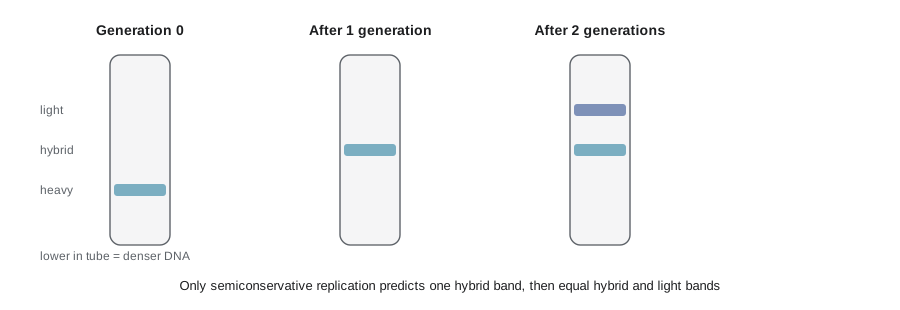
After one generation, all the DNA formed a single band of intermediate density, halfway between heavy and light. That ruled out conservative replication, which would have produced separate heavy and light bands. After two generations there were two bands of equal amount, one intermediate and one light. That ruled out dispersive replication, which would have produced a single band that became steadily lighter. Only semiconservative replication predicts exactly this pattern.
Worked problem
Predicting bands in later generations
In a Meselson–Stahl experiment, cells grown on ¹⁵N are transferred to ¹⁴N. What fraction of DNA molecules will be hybrid (¹⁵N/¹⁴N) and what fraction light (¹⁴N/¹⁴N) after three generations?
Show solution
- Start with one heavy duplex: two ¹⁵N strands.
- Those two heavy strands are never lost; after each generation each one sits in a separate hybrid molecule.
- After three generations there are 2³ = 8 duplexes, of which 2 are hybrid.
- The remaining 6 contain only ¹⁴N.
Answer: After three generations, 2/8 = 1/4 of molecules are hybrid and 3/4 are light; there are never any heavy molecules after the first generation.
# Track strands through rounds of semiconservative replication.
# Each molecule is a pair of strand labels: 'H' (15N) or 'L' (14N).
from collections import Counter

molecules = [("H", "H")]
for gen in range(1, 5):
    new = []
    for a, b in molecules:          # each old strand pairs with a new light strand
        new += [(a, "L"), (b, "L")]
    molecules = new
    counts = Counter("hybrid" if "H" in m else "light" for m in molecules)
    total = len(molecules)
    print(f"generation {gen}: {total:2d} molecules  "
          f"hybrid {counts['hybrid']}/{total} = {counts['hybrid']/total:.3f}  "
f"light {counts['light']}/{total} = {counts['light']/total:.3f}")generation 1: 2 molecules hybrid 2/2 = 1.000 light 0/2 = 0.000 generation 2: 4 molecules hybrid 2/4 = 0.500 light 2/4 = 0.500 generation 3: 8 molecules hybrid 2/8 = 0.250 light 6/8 = 0.750 generation 4: 16 molecules hybrid 2/16 = 0.125 light 14/16 = 0.875
Origins and the replication bubble
Replication does not begin at random. In E. coli it starts at a single site, the origin of replication oriC, about 245 bp long, containing repeated sequences that bind the initiator protein DnaA and an AT-rich region that melts easily (recall from lesson 2 that A–T pairs are less stable). DnaA molecules assemble on the origin and pry open the AT-rich region. Two copies of the helicase DnaB are then loaded, one on each strand, with help from the loader protein DnaC. From there, replication proceeds in both directions, creating a replication bubble with two replication forks moving apart around the circular chromosome until they meet on the opposite side, in a region called the terminus.
Bidirectional replication doubles the speed of copying. An E. coli replication fork moves at about 1,000 nucleotides per second at 37 °C, so two forks moving in opposite directions copy the 4.6 Mb chromosome in about 40 minutes.
Worked problem
How long does it take to copy the E. coli chromosome?
The E. coli chromosome is 4.64 Mb. Each fork moves at 1,000 nt/s, and replication is bidirectional from a single origin. How long does replication take?
Show solution
- Each fork copies half the chromosome: 4.64 × 10⁶ / 2 = 2.32 × 10⁶ bp.
- Time = 2.32 × 10⁶ bp / 1,000 bp per second = 2,320 s.
- Convert: 2,320 / 60 ≈ 39 minutes.
Answer: About 39 minutes. Yet E. coli can divide every 20 minutes in rich medium. It does so by starting new rounds of replication before the previous round finishes, so a fast-growing cell contains chromosomes that are already partly replicated for its grandchildren.
The problem of direction
Every DNA polymerase has two properties that shape the whole process. First, it can only add a nucleotide to an existing 3′-OH group, so it extends strands only in the 5′ to 3′ direction. Second, it cannot start a new strand from nothing: it needs a primer, a short stretch already paired to the template with a free 3′ end. The incoming nucleotide is a deoxyribonucleoside triphosphate (dNTP); the polymerase joins its innermost phosphate to the 3′-OH of the growing strand and releases the outer two phosphates as pyrophosphate. Pyrophosphate is then split into two phosphates, which makes the reaction effectively irreversible.
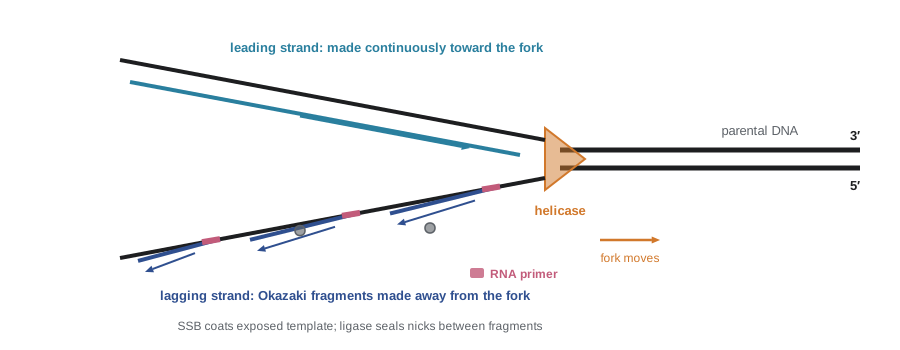
Because the two template strands are antiparallel, the 5′ to 3′ rule creates an asymmetry at every fork. On one template, the new strand can be made continuously in the same direction that the fork moves; this is the leading strand. On the other template, the new strand must be made in the opposite direction to fork movement. It is synthesized as a series of short pieces, each started by its own primer and extended away from the fork. These pieces are called Okazaki fragments, after Reiji and Tsuneko Okazaki, who discovered them in the 1960s. The strand made this way is the lagging strand. In bacteria, Okazaki fragments are about 1,000 to 2,000 nucleotides long; in eukaryotes, about 100 to 200.
The proteins at the fork
A replication fork is a molecular machine, the replisome, built from many proteins working together. Their roles follow logically from the problems they solve.
| Protein | Problem solved | What it does |
|---|---|---|
| DnaA | Finding and opening the origin | Binds oriC and melts the AT-rich region |
| DnaB helicase | Separating the strands | A ring of six subunits that moves 5′ to 3′ along the lagging-strand template, unwinding the duplex using ATP |
| Single-strand binding protein (SSB) | Exposed single strands re-pair or form hairpins | Coats single-stranded DNA and keeps it extended |
| DNA gyrase (topoisomerase II) | Unwinding creates overwinding ahead of the fork | Introduces negative supercoils ahead of the fork to relieve strain |
| Primase (DnaG) | Polymerases cannot start chains | Makes RNA primers about 10 nucleotides long |
| DNA polymerase III holoenzyme | Rapid, processive synthesis | The main replicative polymerase; extends primers on both strands |
| β sliding clamp | Polymerase falls off | A ring that encircles DNA and tethers polymerase III, raising processivity to many thousands of nucleotides |
| DNA polymerase I | RNA primers must be replaced | Removes RNA primers with its 5′ to 3′ exonuclease and fills in with DNA |
| DNA ligase | Fragments remain separate | Seals the nick between adjacent fragments, forming a phosphodiester bond |
The helicase opens the duplex at the fork. Opening a right-handed helix at one point overwinds the DNA ahead of the fork, just as pulling apart the strands of a twisted rope makes the rope ahead twist tighter. Without gyrase removing these positive supercoils, the fork would stall after a few hundred base pairs. Behind the helicase, single-strand binding proteins protect the exposed template. Primase, which is associated with the helicase, lays down RNA primers: once at the origin for the leading strand, and repeatedly, every 1,000 to 2,000 nucleotides, on the lagging strand.
DNA polymerase III does the bulk of the synthesis. It is a holoenzyme containing three polymerase cores, a clamp loader, and the β clamp. The clamp is a ring that slides along DNA and holds the polymerase on, so a single polymerase molecule can add many thousands of nucleotides without letting go; this property is called processivity. Without the clamp, polymerase III would add only about 10 nucleotides before falling off. Because the leading-strand and lagging-strand polymerases are physically linked, the lagging-strand template must loop out so that both polymerases can move in the same overall direction as the fork. This trombone model describes how the loop grows during synthesis of each Okazaki fragment and is released when the fragment is finished.
When the lagging-strand polymerase reaches the RNA primer of the previous fragment, it releases. DNA polymerase I then takes over: its 5′ to 3′ exonuclease activity removes the RNA nucleotides one at a time while its polymerase activity replaces them with DNA. This process, called nick translation, leaves a single break in the backbone, a nick, between the last nucleotide added by polymerase I and the first DNA nucleotide of the next fragment. DNA ligase seals the nick, using energy from NAD⁺ in bacteria (ATP in eukaryotes and phage T4).
Worked problem
How many Okazaki fragments?
Estimate the number of Okazaki fragments made during one round of E. coli replication, if fragments average 1,500 nucleotides. How many RNA primers must be made in total?
Show solution
- Each half of the chromosome has one leading strand and one lagging strand; in total, lagging strands cover 4.64 Mb (one strand of every region is lagging).
- Fragments = 4.64 × 10⁶ / 1,500 ≈ 3,100.
- Primers: one per Okazaki fragment plus one for each of the two leading strands ≈ 3,100.
Answer: About 3,000 Okazaki fragments and about the same number of primers per round of replication. Each must be removed and the gaps filled and sealed, which shows why polymerase I and ligase are essential.
Modelling the fork
The code below simulates lagging-strand synthesis with simple rules. It places primers at random intervals around the 1,500-nucleotide average and reports the fragment lengths and the number of nicks that ligase must seal. Random spacing in real cells arises because primase acts when it encounters a suitable site and when the replisome signals that the previous fragment is finished.
import numpy as np
rng = np.random.default_rng(207)

region = 100_000          # nt of lagging-strand template to copy
mean_len = 1_500          # average Okazaki fragment length
lengths = []
copied = 0
while copied < region:
    L = int(rng.normal(mean_len, 300))
    L = max(400, min(L, region - copied))
    lengths.append(L)
    copied += L

lengths = np.array(lengths)
print("fragments:", len(lengths))
print("mean length:", round(lengths.mean()), "nt; shortest", lengths.min(), "; longest", lengths.max())
print("RNA primers removed by Pol I:", len(lengths))
print("nicks sealed by ligase:", len(lengths) - 1)
print(f"time to copy at 1,000 nt/s: {region / 1000:.0f} s")fragments: 66 mean length: 1515 nt; shortest 421 ; longest 2257 RNA primers removed by Pol I: 66 nicks sealed by ligase: 65 time to copy at 1,000 nt/s: 100 s
Termination
In E. coli the two forks meet in the terminus region, opposite oriC. The terminus contains several Ter sites, each bound by the Tus protein, which acts as a one-way gate: a fork can pass a Tus–Ter complex from one direction but is stopped coming from the other. This traps the forks in the terminus region so that they meet there. When replication is complete, the two daughter circles are interlinked like links in a chain. Topoisomerase IV, another type II enzyme, unlinks them by passing one duplex through a double-strand break in the other, so the chromosomes can be separated into the two daughter cells.
Rates and energy
Replication is fast but costly. Each nucleotide added consumes a dNTP, which carries the equivalent of two high-energy phosphate bonds. Copying the E. coli chromosome therefore uses about 9.3 million dNTPs and the energy of roughly twice that many phosphate bonds, plus ATP for the helicase, primase, clamp loading and ligation. Making the dNTPs themselves costs much more. This is one reason bacteria keep genomes compact, with little non-coding DNA: in competition for resources, a cell that replicates faster and more cheaply can leave more descendants.
# Replication time with one bidirectional origin at different fork speeds
genome_bp = 4_641_652
for speed in (250, 500, 750, 1000):          # nt per second per fork
    t = (genome_bp / 2) / speed
    print(f"fork speed {speed:5d} nt/s -> {t/60:6.1f} minutes")

doubling = 20  # minutes in rich medium
t = (genome_bp / 2) / 1000 / 60
print(f"\nAt 1,000 nt/s replication takes {t:.0f} min, longer than a {doubling}-min doubling,")
print("so fast-growing cells must start new rounds before old ones finish.")fork speed 250 nt/s -> 154.7 minutes fork speed 500 nt/s -> 77.4 minutes fork speed 750 nt/s -> 51.6 minutes fork speed 1000 nt/s -> 38.7 minutes At 1,000 nt/s replication takes 39 min, longer than a 20-min doubling, so fast-growing cells must start new rounds before old ones finish.
Antibiotics and replication
Because the bacterial replisome differs from ours, several antibiotics target it. Fluoroquinolones such as ciprofloxacin trap gyrase and topoisomerase IV on DNA after they have cut it, turning the enzymes into agents that break chromosomes. Novobiocin blocks the ATP site of gyrase. Resistance arises through mutations in the genes for these enzymes or through pumps that remove the drugs. In Canada and the United States, fluoroquinolone use is restricted in many clinical guidelines because of rising resistance and side effects, an example of how molecular understanding of a mechanism shapes medicine and public health.
Common mistakes
MistakeDNA polymerase can start a new strand on a bare template.
InsteadAll DNA polymerases need a primer with a free 3′-OH; in cells, primase supplies short RNA primers.
MistakeThe lagging strand is synthesized 3′ to 5′.
InsteadBoth strands are synthesized 5′ to 3′; the lagging strand is made in short fragments in the direction opposite to fork movement.
MistakeMeselson and Stahl’s first-generation result proved semiconservative replication.
InsteadOne intermediate band ruled out conservative replication; the second generation was needed to rule out dispersive replication.
MistakeHelicase relieves the overwinding ahead of the fork.
InsteadHelicase unwinds the strands; gyrase (topoisomerase II) relieves the resulting positive supercoils.
MistakeDNA ligase fills gaps between Okazaki fragments.
InsteadPolymerase I fills the gaps after removing primers; ligase only seals the final nick in the backbone.
Summary and key terms
- Replication is semiconservative: each daughter duplex has one parental and one new strand, as Meselson and Stahl showed with ¹⁵N and ¹⁴N.
- E. coli replication starts at oriC, where DnaA opens the AT-rich region, and proceeds bidirectionally to the terminus.
- Forks move at about 1,000 nt/s, so the 4.6 Mb chromosome is copied in about 40 minutes.
- Polymerases need a primer and synthesize only 5′ to 3′, so the leading strand is continuous and the lagging strand is made as Okazaki fragments.
- Helicase, SSB, gyrase, primase, polymerase III with its sliding clamp, polymerase I and ligase each solve a specific problem at the fork.
- Tus–Ter complexes trap forks in the terminus; topoisomerase IV unlinks the daughter chromosomes.
- Antibiotics such as fluoroquinolones target bacterial topoisomerases.
- semiconservative replication
- Replication in which each daughter molecule contains one old strand and one new strand.
- origin of replication
- A specific DNA sequence where replication begins.
- replication fork
- The Y-shaped region where the parental duplex is unwound and copied.
- leading strand
- The new strand synthesized continuously in the direction of fork movement.
- lagging strand
- The new strand synthesized discontinuously, away from the fork.
- Okazaki fragment
- A short piece of lagging-strand DNA, each begun with an RNA primer.
- primase
- An enzyme that synthesizes short RNA primers for DNA polymerase.
- processivity
- The number of nucleotides a polymerase adds before releasing the template.
- sliding clamp
- A ring-shaped protein that encircles DNA and holds polymerase in place.
- DNA ligase
- An enzyme that seals nicks by forming a phosphodiester bond.
Practice problems
Work each problem on paper first, then reveal the answer to check.
What would Meselson and Stahl have seen after one generation if replication were conservative?
Show answer
Two bands, one heavy and one light, instead of a single intermediate band.
After four generations of semiconservative replication starting from all-heavy DNA, what fraction of molecules are hybrid?
Show answer
2/16 = 1/8.
Why does the E. coli origin contain an AT-rich region?
Show answer
A–T pairs have two hydrogen bonds and stack less strongly, so the region melts easily.
A bacterium has a 6.0 Mb chromosome and forks moving at 800 nt/s. How long does bidirectional replication take?
Show answer
3.0 × 10⁶ / 800 = 3,750 s ≈ 62.5 minutes.
What is the role of the β clamp?
Show answer
It encircles DNA and tethers polymerase III, greatly increasing processivity.
Why are RNA primers needed on the lagging strand repeatedly?
Show answer
Each Okazaki fragment begins anew, and polymerase cannot start a chain without a primer.
Which enzyme removes RNA primers in E. coli, and how?
Show answer
DNA polymerase I, using its 5′ to 3′ exonuclease activity, replacing them with DNA.
What would happen if gyrase were inhibited during replication?
Show answer
Positive supercoils would build up ahead of the fork and stop it.
What does Tus protein do?
Show answer
It binds Ter sites and blocks forks coming from one direction, trapping them in the terminus.
How does E. coli divide every 20 minutes when replication takes 40?
Show answer
It starts new rounds of replication at the origin before earlier rounds have finished.
Lesson quiz · 5 questions
Score 60% or more to complete this lesson.
Create a free account to save your progress, take quizzes and earn a certificate.