
BIOL-207 · Lesson 5 of 12 · 31 min
Transcription in bacteria
A gene is useful only when it is read. Transcription, the copying of a DNA sequence into RNA, is the first and most heavily regulated step in gene expression. In bacteria it is also a remarkably simple process in outline: one kind of RNA polymerase, guided by a detachable subunit that recognizes start signals, copies genes into RNA that can be translated even before transcription is finished. This lesson follows a bacterial transcript from start to finish, introduces the DNA signals that mark the beginning and end of genes, and models how strongly promoters bind and how quickly messages decay. Lesson 6 contrasts this with the more elaborate eukaryotic process, and lesson 9 shows how bacteria switch genes on and off.
The RNA polymerase
Bacterial RNA polymerase is a large enzyme built from five kinds of subunit. The core enzyme, made of two α subunits, β, β′ and a small ω subunit, can synthesize RNA but cannot find the beginning of a gene by itself. Adding a sixth subunit, the sigma factor (σ), forms the holoenzyme, which recognizes promoters. Like DNA polymerase, RNA polymerase synthesizes 5′ to 3′, adding ribonucleoside triphosphates (ATP, GTP, CTP and UTP) to the 3′ end of the growing chain. Unlike DNA polymerase, it needs no primer: it can start a chain from scratch, and it uses only one strand of the DNA as a template.
Two strand names cause endless confusion, so it is worth fixing them now. The template strand is the strand that RNA polymerase reads; the RNA is complementary to it. The other strand, the coding strand (also called the sense or non-template strand), has the same sequence as the RNA, except that it contains T where the RNA has U. Gene sequences in databases are written as the coding strand, 5′ to 3′, so that they can be read directly as codons.
Worked problem
From template strand to RNA
The template strand of a short region reads 3′-TACGGATCCATT-5′. Write the coding strand and the RNA transcript, both 5′ to 3′.
Show solution
- The coding strand is complementary to the template: 5′-ATGCCTAGGTAA-3′.
- The RNA has the same sequence as the coding strand with U for T: 5′-AUGCCUAGGUAA-3′.
- Check: the RNA is antiparallel and complementary to the template strand, as it must be.
Answer: Coding strand 5′-ATGCCTAGGTAA-3′; RNA 5′-AUGCCUAGGUAA-3′. Lesson 7 shows that this RNA begins with a start codon (AUG) and ends with a stop codon (UAA).
COMP = str.maketrans("ACGT", "TGCA")

def transcribe(coding_5to3):
    """RNA has the coding-strand sequence with U in place of T."""
    return coding_5to3.replace("T", "U")

def template_from_coding(coding_5to3):
    """Template strand written 3'->5' under the coding strand."""
    return coding_5to3.translate(COMP)

coding = "ATGCCTAGGTAA"
print("coding   5'", coding, "3'")
print("template 3'", template_from_coding(coding), "5'")
print("mRNA 5'", transcribe(coding), "3'")coding 5' ATGCCTAGGTAA 3' template 3' TACGGATCCATT 5' mRNA 5' AUGCCUAGGUAA 3'
Promoters
A promoter is the DNA sequence where RNA polymerase binds and begins transcription. In E. coli the most common sigma factor, σ⁷⁰, recognizes two short sequences, located about 10 and 35 base pairs upstream of the transcription start site (called position +1). By convention, positions upstream are negative and downstream positive; there is no position 0. The −10 element, also called the Pribnow box, has the consensus sequence TATAAT. The −35 element has the consensus TTGACA. They are separated by a spacer of 16 to 18 bp, ideally 17.
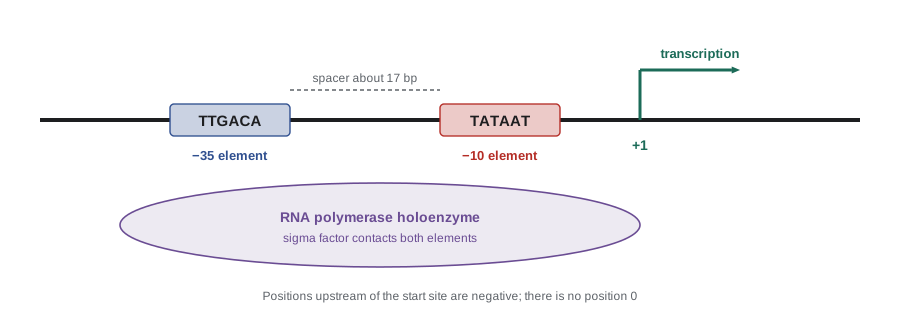
A consensus sequence is the most common base at each position across many examples, and real promoters rarely match it perfectly. In general, the closer a promoter matches the consensus, the more tightly the holoenzyme binds and the more often transcription starts. Strong promoters, such as those for ribosomal RNA genes, start transcription every second or two; weak ones may start only once or twice per cell generation. Matching can be scored simply by counting agreements, or better by weighting each position by how strongly it is conserved, using a position weight matrix.
CONS35, CONS10 = "TTGACA", "TATAAT"

def score(seq, cons):
    return sum(a == b for a, b in zip(seq, cons))

def best_promoter(dna, spacers=(16, 17, 18)):
    best = None
    for i in range(len(dna) - 6):
        for sp in spacers:
            j = i + 6 + sp
            if j + 6 > len(dna):
                continue
            s35, s10 = score(dna[i:i+6], CONS35), score(dna[j:j+6], CONS10)
            total = s35 + s10 - abs(sp - 17)       # small penalty for non-ideal spacing
            if best is None or total > best[0]:
                best = (total, i, dna[i:i+6], s35, sp, dna[j:j+6], s10)
    return best

promoters = {
    "near-consensus": "GCATTGACAATTAATCATCGGCTCGTATAATGTGTGGAATTG",
    "lac-like (weak)": "GCTTTACACTTTATGCTTCCGGCTCGTATGTTGTGTGGAATTG",
    "poor match":     "GCAGGCCGAGCAAGTCGCATCCGCCTGCGCCAGCGGTAATTG",
}
for name, dna in promoters.items():
    total, i, m35, s35, sp, m10, s10 = best_promoter(dna)
print(f"{name:16s} -35 {m35} ({s35}/6) spacer {sp} -10 {m10} ({s10}/6) score {total}")near-consensus -35 TTGACA (6/6) spacer 16 -10 TATAAT (6/6) score 11 lac-like (weak) -35 TTTACA (5/6) spacer 18 -10 TATGTT (4/6) score 8 poor match -35 AAGTCG (2/6) spacer 17 -10 GGTAAT (4/6) score 6
The lac promoter in the second example is deliberately weak: its −35 and −10 elements match the consensus poorly, and it depends on an activator protein (CAP, lesson 9) to recruit RNA polymerase. This is a common design. A weak promoter that needs an activator gives the cell a way to turn a gene on strongly only when a signal is present.
Bacteria have several sigma factors, each recognizing a different class of promoters. In E. coli, σ⁷⁰ handles most genes during normal growth, σ³² recognizes promoters of heat-shock genes, σ⁵⁴ controls genes for nitrogen metabolism, and σ³⁸ takes over many genes as cells enter stationary phase. Switching sigma factors is a quick way to reprogram large sets of genes at once. Bacillus subtilis uses a cascade of sigma factors to drive the stages of spore formation.
Initiation, elongation and termination
Transcription proceeds in three stages. In initiation, the holoenzyme binds the promoter as a closed complex, then melts about 13 base pairs around the start site to form an open complex in which the template strand is exposed. It begins making RNA but often produces short abortive transcripts of 2 to 10 nucleotides, which are released, before it escapes from the promoter. Once the RNA is longer than about 10 nucleotides, the sigma factor is usually released and the core enzyme moves on.
During elongation, the polymerase moves along the template at about 40 to 80 nucleotides per second in E. coli, maintaining a transcription bubble of about 13 to 14 bp of unwound DNA in which about 8 to 9 bp of RNA are paired with the template as an RNA–DNA hybrid. Behind the bubble the DNA rewinds and the RNA exits. Like replication, transcription overwinds the DNA ahead and underwinds it behind, so topoisomerases are needed here too. RNA polymerase lacks a true proofreading exonuclease, but it can backtrack and, with help from GreA and GreB proteins, cut off a few nucleotides including a mistake. Its error rate is about 1 in 10⁴ to 10⁵, far higher than replication, which is acceptable because a mistake affects only one RNA copy among many, not the inherited genome.
| Property | DNA replication | Transcription |
|---|---|---|
| Product | Complete copy of both strands | RNA copy of one strand of one gene or operon |
| Primer needed? | Yes | No |
| Substrates | dATP, dGTP, dCTP, dTTP | ATP, GTP, CTP, UTP |
| Speed in E. coli | About 1,000 nt/s | About 40–80 nt/s |
| Error rate (final) | About 10⁻⁹ to 10⁻¹⁰ | About 10⁻⁴ to 10⁻⁵ |
| Products remain paired with template? | Yes, as duplex | No; RNA leaves as a single strand |
Termination in bacteria happens in two main ways. In intrinsic (Rho-independent) termination, the newly made RNA contains a GC-rich inverted repeat followed by a run of about eight U residues. The inverted repeat folds into a stable hairpin as soon as it emerges from the polymerase, and the weak A–U pairs in the RNA–DNA hybrid behind it allow the transcript to slip off. In Rho-dependent termination, a ring-shaped helicase called Rho binds to a C-rich, unstructured stretch of RNA, moves along it using ATP, catches up with a paused polymerase and pulls the RNA away. About half of E. coli genes end at intrinsic terminators.
Worked problem
Spotting an intrinsic terminator
The coding strand near the end of a gene reads 5′-…AAGCCCGCCTAATGAGCGGGCTTTTTTTT…-3′. Find the inverted repeat and explain why this sequence would terminate transcription.
Show solution
- Look for a sequence followed later by its reverse complement: GCCCGC … GCGGGC. The reverse complement of GCCCGC is GCGGGC.
- In the RNA, these two stretches pair to form a GC-rich stem, with the intervening CTAATGA forming the loop.
- The stem is followed by a run of U residues (TTTTTTTT in DNA).
- Hairpin formation pauses the polymerase, and the weak rU–dA hybrid lets the RNA dissociate.
Answer: GCCCGC and its reverse complement GCGGGC form a stable GC-rich hairpin followed by a run of U, the classic signature of an intrinsic terminator.
Coupled transcription and translation
Bacteria have no nucleus, so ribosomes can bind an mRNA as soon as its 5′ end emerges from RNA polymerase. Transcription and translation are therefore coupled: the leading ribosome often follows closely behind the polymerase, which helps prevent Rho from terminating transcription prematurely inside genes. Electron micrographs from the 1970s by Oscar Miller and colleagues show a DNA strand with RNA polymerases strung along it, each trailing an mRNA studded with ribosomes, like a Christmas tree. Lesson 9 shows how coupling allows a regulatory mechanism called attenuation.
Many bacterial mRNAs are polycistronic: a single transcript carries several protein-coding sequences, each with its own ribosome-binding site. Genes transcribed together from one promoter form an operon, and they usually encode proteins that work in the same pathway, such as the three lac genes (lesson 9). Operons ensure that the proteins of a pathway are made together and in fixed proportion.
mRNA lifetimes
Bacterial mRNAs are short-lived, with half-lives typically of 2 to 5 minutes at 37 °C, compared with hours for many eukaryotic mRNAs. Rapid decay means that when transcription of a gene stops, its protein soon stops being made, letting bacteria respond quickly to change. If mRNA decays with a constant half-life, the amount remaining after time t is given by exponential decay:
At steady state, when synthesis and decay balance, the number of mRNA molecules equals the synthesis rate divided by the decay constant. A gene transcribed once per minute, with a half-life of 3 minutes, has about 1 / (0.693 / 3) ≈ 4.3 mRNA copies per cell on average. This simple balance explains why cells can tune expression either by changing how often transcription starts or by changing how fast mRNA is degraded.
import math

def steady_state(rate_per_min, half_life_min):
    k = math.log(2) / half_life_min
    return rate_per_min / k

print("mRNA copies at steady state (synthesis rate / decay constant)")
for rate in (0.2, 1, 5):
    row = [f"{steady_state(rate, h):6.1f}" for h in (1, 3, 10)]
    print(f"  {rate:3} transcripts/min: half-life 1, 3, 10 min ->", "  ".join(row))

# Decay after transcription stops, half-life 3 min, starting at 13 copies
k = math.log(2) / 3
for t in range(0, 16, 3):
print(f"t = {t:2d} min: {13 * math.exp(-k * t):5.1f} copies left")mRNA copies at steady state (synthesis rate / decay constant)
0.2 transcripts/min: half-life 1, 3, 10 min -> 0.3 0.9 2.9
1 transcripts/min: half-life 1, 3, 10 min -> 1.4 4.3 14.4
5 transcripts/min: half-life 1, 3, 10 min -> 7.2 21.6 72.1
t = 0 min: 13.0 copies left
t = 3 min: 6.5 copies left
t = 6 min: 3.2 copies left
t = 9 min: 1.6 copies left
t = 12 min: 0.8 copies left
t = 15 min: 0.4 copies leftWorked problem
Response time after a gene is switched off
A bacterial mRNA has a half-life of 2.5 minutes. When transcription stops, how long until only 10 per cent of the mRNA remains?
Show solution
- k = ln 2 / 2.5 = 0.277 per minute.
- Solve 0.10 = e^(−0.277 t): t = ln 10 / 0.277 = 2.303 / 0.277 ≈ 8.3 minutes.
- Equivalently, 10 per cent remains after log₂ 10 ≈ 3.3 half-lives: 3.3 × 2.5 ≈ 8.3 minutes.
Answer: About 8 minutes. Protein made from that mRNA lasts longer, because most bacterial proteins are stable and are diluted mainly by cell growth and division.
Antibiotics that target transcription
Rifampicin (rifampin in the United States) binds the β subunit of bacterial RNA polymerase and blocks the path of the growing RNA after two or three nucleotides, so initiation fails. It does not affect human RNA polymerases, which differ in structure. Rifampicin is a mainstay of tuberculosis treatment, always in combination with other drugs because resistance, caused by mutations in the rpoB gene encoding the β subunit, arises readily. Rapid molecular tests that detect rpoB mutations directly from a patient sample are now used to identify drug-resistant tuberculosis within hours, an example of molecular biology moving from the bench to the clinic. Tuberculosis remains a serious problem in parts of northern Canada, where incidence among Inuit communities has been many times the national rate, and federal and Inuit organizations have committed to eliminating it.
Common mistakes
MistakeRNA polymerase needs a primer, like DNA polymerase.
InsteadRNA polymerase can start chains without a primer.
MistakeThe RNA has the same sequence as the template strand.
InsteadThe RNA matches the coding strand (with U for T) and is complementary to the template strand.
MistakePromoter positions are counted from 0 at the start site.
InsteadThe start site is +1; upstream positions are negative and there is no position 0.
MistakeSigma factor stays bound throughout elongation.
InsteadSigma is usually released after initiation; the core enzyme carries out elongation.
MistakeAll bacterial genes are terminated by Rho.
InsteadAbout half end at intrinsic terminators: a GC-rich hairpin followed by a run of U.
Summary and key terms
- Bacterial RNA polymerase core (α₂ββ′ω) plus sigma factor forms the holoenzyme, which recognizes promoters.
- RNA is synthesized 5′ to 3′ without a primer; it matches the coding strand and is complementary to the template strand.
- σ⁷⁰ promoters have −35 (TTGACA) and −10 (TATAAT) elements separated by about 17 bp; closer matches give stronger promoters.
- Alternative sigma factors switch on whole sets of genes, for example heat-shock genes.
- Transcription proceeds through initiation (closed and open complexes, abortive initiation), elongation (40–80 nt/s) and termination.
- Termination is intrinsic (GC-rich hairpin plus U run) or Rho-dependent.
- Bacterial transcription and translation are coupled; mRNAs are often polycistronic and short-lived, with half-lives of minutes.
- RNA polymerase
- The enzyme that synthesizes RNA from a DNA template.
- sigma factor
- The subunit that directs bacterial RNA polymerase to specific promoters.
- holoenzyme
- The complete enzyme: RNA polymerase core plus sigma factor.
- promoter
- The DNA sequence where RNA polymerase binds and starts transcription.
- template strand
- The DNA strand read by RNA polymerase, complementary to the RNA.
- coding strand
- The DNA strand with the same sequence as the RNA (T for U).
- consensus sequence
- The most frequent base at each position across a set of related sequences.
- intrinsic terminator
- A transcription stop signal formed by an RNA hairpin followed by a run of U.
- operon
- A group of genes transcribed together from one promoter as a single mRNA.
- polycistronic mRNA
- An mRNA carrying more than one protein-coding sequence.
Practice problems
Work each problem on paper first, then reveal the answer to check.
A coding strand reads 5′-ATGAAACCC-3′. Write the RNA.
Show answer
5′-AUGAAACCC-3′.
A template strand reads 3′-TACCGGTTT-5′. Write the RNA.
Show answer
5′-AUGGCCAAA-3′.
Give the consensus −10 and −35 elements for σ⁷⁰ promoters.
Show answer
−10: TATAAT; −35: TTGACA.
Why might a cell benefit from a weak promoter that needs an activator?
Show answer
Expression stays low unless the activator signal is present, allowing strong induction only when needed.
What is abortive initiation?
Show answer
The repeated synthesis and release of very short RNAs before the polymerase escapes the promoter.
A gene is transcribed 2 times per minute and its mRNA half-life is 4 minutes. Estimate steady-state copies.
Show answer
2 / (0.693 / 4) ≈ 11.5 copies.
After how many half-lives does about 3 per cent of an mRNA remain?
Show answer
About 5 half-lives (2⁻⁵ ≈ 0.031).
Describe the two features of an intrinsic terminator.
Show answer
A GC-rich inverted repeat forming a hairpin in the RNA, followed by a run of about 8 U.
Why can bacterial ribosomes begin translating before transcription ends?
Show answer
There is no nuclear membrane separating the processes.
How does rifampicin work, and how does resistance arise?
Show answer
It binds the β subunit of bacterial RNA polymerase and blocks RNA elongation; resistance comes from rpoB mutations.
Lesson quiz · 5 questions
Score 60% or more to complete this lesson.
Create a free account to save your progress, take quizzes and earn a certificate.