
BAS-420 · Lesson 8 of 12 · 24 min
Comfort complaints: hot, cold and stuffy
▶ Video coming soon A video version of this lesson is on the way.
Most of the calls in the trouble file did not start with an alarm. They started with a person. A professor in Tilden room 214 who was cold every morning and warm every afternoon while her thermostat read 22 °C all day. An instructor in room 108 who said it was 27 degrees by mid-morning while students opened windows on a grey November day. Lecture wing occupants who felt cold drafts. Students in lecture hall T-120 who said the room was stuffy by the end of a class. "A comfort call is the hardest kind," Prakash said, "because the instrument that raised the alarm is a human being, and you cannot trend a human being. But they are nearly always right that something is wrong. Your job is to find out what."
This lesson covers comfort complaints: what thermal comfort depends on, how to turn a complaint into a measurable symptom, and the usual causes of hot, cold and stuffy calls in buildings with BAS control. It builds on the comfort and ventilation material in BAS-110, BAS-120 and BAS-230.
What comfort depends on
ASHRAE Standard 55 (the current edition is 55-2023), which is used in both Canada and the US, describes thermal comfort in terms of six factors. Four describe the environment: air temperature, mean radiant temperature, air speed and humidity. Two describe the person: metabolic rate, which depends on activity, and clothing insulation. A thermostat measures only the first of these, and only at one point on one wall. That is why the thermostat and the occupant can disagree and both be right.
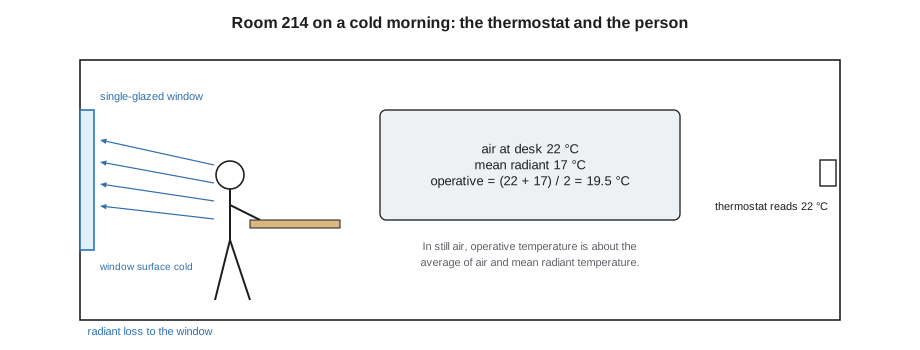
Mean radiant temperature is the average temperature of the surfaces a person sees, weighted by how much of the view each one takes up. A cold window, a sunlit floor or a hot ceiling panel changes how warm a person feels without changing the air temperature much. At low air speeds, the temperature a person actually responds to, called the operative temperature, is close to the average of the air temperature and the mean radiant temperature.
Worked problem
Why room 214 felt cold
On a cold morning in room 214, the air at the professor's desk was 22 °C and the mean radiant temperature, pulled down by a single-glazed window, was 17 °C. The air was nearly still. What operative temperature did she feel?
Show solution
- In still air, operative temperature ≈ (air temperature + mean radiant temperature) ÷ 2.
- (22 + 17) ÷ 2 = 19.5 °C.
- That is 2.5 K colder than the thermostat reading.
Answer: About 19.5 °C. The thermostat was right about the air and she was right about being cold. The fix was not a lower setpoint elsewhere or a higher one at the thermostat, but a change to the perimeter radiation reset, an earlier occupied start and advice about the blinds, with the window itself passed to Gus as an envelope item.
Air speed matters in both directions. A gentle breeze cools, which can help in a warm room but feels like a draft in a cool one, especially on the neck and ankles. Humidity matters most at the edges: very dry winter air feels cooler and irritates eyes and throats, and humid summer air makes warm rooms feel worse. Clothing and activity vary from person to person, which is why one setpoint rarely satisfies everyone in a shared space.
Triage: one room or many, and when
The first questions on a comfort call narrow it down quickly. Is it one room, a group of rooms, or a whole floor or building? Does it happen at a particular time of day, in particular weather, or on particular days? Did it start suddenly or gradually?
| Pattern | Points toward | Example from the file |
|---|---|---|
| One room, all the time, since a date | That zone's equipment: box, valve, sensor, damper | Room 108: reheat valve coupling slipped |
| One room, worse at certain times or weather | Envelope or solar effects, radiant asymmetry, schedule | Room 214: cold window mornings, sun afternoons |
| All rooms on one air handler | The air handler: supply temperature, airflow, a loop, a mode | Lecture wing: AHU-2 discharge air hunting |
| Many rooms on one floor or trunk | Network, shared power, floor-level equipment | Ninefield seventh floor boxes offline |
| Whole building, first thing in the morning | Start times, warm-up or cool-down, plant start | Tilden AHU-1 integral windup at 6:00 start |
| A space that fills with people | Ventilation and cooling capacity, demand-controlled ventilation | T-120: CO2 control and sensor drift |
Before going to the space, read the zone trends: temperature, setpoint, airflow or fan status, reheat or cooling output, and the supply air or water temperature feeding the zone. Then go and measure, because the zone sensor is only one point. A small logger placed at the occupant's desk for a day or two, a surface thermometer pointed at the window, a handheld anemometer near a diffuser and a CO2 meter are the basic comfort toolkit.
Talk to the person who complained, and listen. Ask when it is worst, where they sit, what they have tried, and whether others agree. Look at their space: a printer next to the thermostat, a space heater under a desk, a blind that has been taped shut, a diffuser that has been blocked with cardboard. These are clues, not accusations. People adapt their space to make up for what the building does wrong, and the adaptations often point straight at the cause.
Hot complaints
Too hot means more heat is entering the space than the system removes. The causes fall into a few groups.
- Heat the controls did not ask for: a leaking or stuck-open reheat valve, as in room 108; a radiation valve that does not close; a heating coil in an air handler leaking through; a steam trap passing steam.
- Not enough cooling: a VAV box maximum airflow set too low or a damper that does not open; supply air warmer than it should be; an air handler whose cooling coil is not getting chilled water; a filter or coil restricting airflow.
- Heat gains bigger than the design: sun through unshaded glass, more people or equipment than planned, a new server or kitchen appliance, lights left on.
- Heating and cooling fighting: a zone where heating and cooling setpoints overlap, or two systems serving one space with different sensors, such as perimeter radiation controlled by an outdoor reset and a VAV box controlled by the room.
- The wrong reading: a zone sensor in a cool spot or behind furniture, reading low while the room is warm.
Room 108 is the model hot call. The trend showed the box at maximum cooling airflow, the reheat command at 0, and the discharge air at 34 °C (93 °F) against supply air at 13 °C (55 °F). The extra airflow (the box maximum had been raised on November 11) was only making things worse: it delivered more air through a coil that was heating it. The cause was a slipping coupling on the reheat valve stem, found by looking at the valve with the actuator commanded closed. The fix was mechanical, with a witness mark, the box maximum set back to design and a fault rule so the next one alarms.
Worked problem
Heat the controls did not ask for
Room 108's box was passing 200 L/s (425 cfm) of air while the reheat valve was stuck open, heating air from 13 °C (55 °F) to 34 °C (93 °F). Using a typical sensible heat factor for air of 1.21 W per L/s per K, how much heat was the reheat coil adding?
Show solution
- Temperature rise: 34 − 13 = 21 K.
- Heat ≈ 1.21 × 200 × 21 = 5,082 W, about 5.1 kW.
- For a classroom, that is more heat than several dozen people would add.
Answer: About 5.1 kW (17,400 Btu/h), which explains why the room was hot even with maximum cooling air. Any heat the controls did not ask for is a fault, whether or not anyone complains.
Cold complaints
Too cold is the mirror image, with some extra causes.
- Not enough heat: a reheat valve or actuator that does not open; no hot water at the coil because of a pump, a closed isolation valve or an air-bound coil; a converter or boiler not keeping up; a hot water reset curve set too low for the weather.
- Too much cool air: a VAV box minimum set high with cold supply air, so the box overcools the room even with reheat; a supply air temperature reset that is not working.
- Radiant and draft effects: cold windows and walls, as in room 214; cold air falling off glass; drafts from diffusers throwing cold air at occupants; infiltration through doors and gaps.
- A loop that hunts: supply air swinging cold and warm, which people feel as drafts even if the average is right. The lecture wing complaint was exactly this: AHU-2's discharge air swinging between 17 and 19 °C (62.6 and 66.2 °F) every 96 seconds.
- Schedule and start problems: equipment starting too late after a cold night or weekend; a room unoccupied in the schedule but used.
Cold complaints in perimeter rooms in winter are often radiant, so measure surfaces, not only air. A surface thermometer on the window, the wall and the floor near the occupant shows the radiant picture in a minute. If the window is far colder than the air, the cure may be perimeter heating control, an earlier start, or an envelope repair that belongs to the owner, not a setpoint change.
Stuffy complaints
Stuffy is a vaguer word. It can mean too warm, too humid, not enough air movement, odours, or not enough outdoor air. Ask what the person means and when it happens, and measure temperature, humidity, air movement and CO2 together.
CO2 is a useful indicator of how much outdoor air each person is getting, because people exhale it at a fairly predictable rate. At steady state, the indoor level rises above outdoors by about the CO2 each person exhales divided by the outdoor air each person receives. In BAS-110, that calculation for a full T-120 gave a steady rise of about 1,250 ppm above outdoors. CO2 is not itself a pollutant at those levels; it stands in for everything else people add to the air. ASHRAE 62.1 sets ventilation rates, not a CO2 limit, and a single CO2 reading on its own does not prove a room is under-ventilated, because the room may not have reached steady state.
Demand-controlled ventilation uses CO2 to adjust outdoor air. When its sensor reads low, the system under-ventilates. In BAS-110, T-120's return CO2 sensor, installed in 2019, was found reading about 330 ppm low from drift. A second sensor was installed in the hall on October 22, and the sequence now uses the higher reading.
Worked problem
A drifted CO2 sensor and demand-controlled ventilation
T-120's ventilation ramps from minimum to full outdoor air as CO2 rises from 700 to 1,000 ppm. Suppose the true CO2 in the hall is 1,100 ppm but the sensor reads 330 ppm low. What does the sequence do, and what should it do?
Show solution
- Sensor reading: 1,100 − 330 = 770 ppm.
- Position on the ramp: (770 − 700) ÷ (1,000 − 700) = 70 ÷ 300 = 0.23, so the sequence asks for only about a quarter of the way from minimum to full ventilation.
- At the true 1,100 ppm, above the top of the ramp, the sequence should be at full ventilation.
Answer: The hall gets about a quarter of the ramp when it needs all of it, so it gets stuffier the longer the class runs. Checking a CO2 sensor against a portable meter, and using two sensors where it matters, catches this kind of drift.
Other stuffy causes include an outdoor air damper that does not open (mechanical or a minimum position set too low), an air handler running on recirculation because of a mode or override, a space with too few supply diffusers for its use, high humidity from a cooling coil that cycles off too often, and air that is warm and still rather than lacking outdoor air. If CO2 is fine but people still complain, look at temperature, humidity and air movement.
Fixing comfort without fighting the occupants
The fix for a comfort complaint should remove the cause, not just move the setpoint until the calls stop. Setpoint changes have a way of piling up. A room set two degrees warmer to cover a cold window, a box minimum raised to cover a stuffy room, an override left at maximum to cover a heat wave: each one wastes energy and hides the next fault. The 14 overrides at Tilden were each someone's fix for a comfort call.
When the real cause is something the controls cannot fix, such as a cold window, a space used in a way it was not designed for, or two people with different preferences sharing one zone, say so clearly in the report and offer practical options. That might mean a different schedule, a local adjustment range for the occupant, a fan or blind, or a recommendation to the owner for an envelope or mechanical change. Gus received room 214's window as an envelope item, with the evidence, rather than as a heating complaint that would come back every winter.
Close the loop with the person who complained. Tell them what was found and what was done, and ask them to report if it comes back. A comfort call that ends with a conversation is much less likely to become a repeat call than one that ends with a work order closed in a system the occupant never sees.
Common mistakes
MistakeTrusting the zone sensor over the occupant.
InsteadThe sensor measures air temperature at one point; measure radiant temperature, drafts and conditions at the occupant's position.
MistakeChanging the setpoint to make a complaint go away.
InsteadFind the cause; record any temporary setpoint change with a reason and a date to undo it.
MistakeJudging ventilation from one CO2 reading.
InsteadCO2 rises over time; trend it over an occupied period and check the sensor against a portable meter.
MistakeTreating every cold complaint as a heating fault.
InsteadLook at radiant effects, drafts, box minimums, supply air temperature and hunting loops as well.
Summary and key terms
- ASHRAE 55 comfort depends on air temperature, mean radiant temperature, air speed, humidity, activity and clothing; a thermostat measures only the first.
- In still air, operative temperature is about the average of air and mean radiant temperatures.
- Triage by pattern: one room or many, when it happens and since when.
- Hot calls come from unrequested heat, too little cooling, large gains, systems fighting or a wrong reading; any unrequested heat is a fault.
- Cold calls come from too little heat, too much cool air, radiant and draft effects, hunting loops and late starts.
- Stuffy calls need temperature, humidity, air movement and CO2 measured together; CO2 indicates outdoor air per person and drifted sensors cause under-ventilation.
- Fix causes, not setpoints, and close the loop with the occupant.
- Operative temperature
- The temperature a person responds to, about the average of air and mean radiant temperature in still air.
- Mean radiant temperature
- The average temperature of the surfaces around a person, weighted by how much of the view each takes up.
- Radiant asymmetry
- A large difference in surface temperature on different sides of a person, such as a cold window.
- Draft
- Unwanted local cooling of the body by air movement.
- Demand-controlled ventilation (DCV)
- Adjusting outdoor air to the number of occupants, often using CO2.
Practice problems
Work each problem on paper first, then reveal the answer to check.
A perimeter office is cold on winter mornings only, and the thermostat reads setpoint. What would you measure?
Show answer
Surface temperatures of the window, wall and floor near the occupant, air temperature at the desk, and air movement; then look at the perimeter heating schedule and reset and the morning start time.
Every room on one air handler complains of drafts, but average temperatures look fine. What do you check?
Show answer
A fast trend of the air handler's supply or discharge air temperature for hunting, and its loop settings and sensor location.
A meeting room reaches 1,400 ppm CO2 by the end of a two-hour meeting while its DCV sequence shows minimum ventilation. What do you check?
Show answer
The CO2 sensor against a portable meter, the outdoor air damper's actual position, the minimum outdoor air setting, and any override or mode holding the air handler on recirculation.
Lesson quiz · 5 questions
Score 60% or more to complete this lesson.
Create a free account to save your progress, take quizzes and earn a certificate.