
BAS-420 · Lesson 10 of 12 · 21 min
Working safely on live systems
▶ Video coming soon A video version of this lesson is on the way.
On Monday, November 9, Tegan Farrow of Kelso Electric ran the new 120 V circuit and disconnect for Ninefield's RTU-1 controller panel, and left the disconnect locked off with her own lock and tag. The next day, when Quillon's crew installed the panel on the roof, they did not touch that disconnect. Tegan came back, checked the installation, removed her lock and energized the circuit; Quillon powered up the controls from the transformer secondary at 13:40. "That is what normal looks like," Prakash told Callie. "Nobody in a hurry, nobody working on somebody else's lock, and the line-voltage side done by the person licensed to do it." The trouble file has a tab for safety, and he keeps it at the front of the second half because troubleshooting is when people take shortcuts.
This lesson covers working safely on systems that are running: electrical hazards and who may work on what, lockout and stored energy, the particular hazards that come from automatic controls, rooftop work, and the habits that keep a controls technician safe during troubleshooting. It names the main rules and standards; your employer's safety program and the site's rules apply on top of them.
Why troubleshooting is risky
Installation work usually happens on equipment that is not yet running. Troubleshooting happens on equipment that is running, or that the technician needs to run to see the fault. The technician is often alone, under time pressure, in an unfamiliar mechanical room or on a roof, with a customer waiting. Panels are open, covers are off, and the fault itself may have created a hazard: a burnt contactor, a shorted transformer, a wet panel. Every lesson in this course has said to measure before changing, and measuring often means working near live parts.
The controls technician's hazards include electric shock and arc flash at line-voltage parts in or near control panels, rotating equipment that can start automatically, stored energy in springs, capacitors and pressurized systems, hot surfaces and steam, falls from roofs and ladders, and sometimes chemical or biological exposure, such as on a laboratory exhaust fan like Tilden's EF-3. Each has its own controls.
Who may work on what
In Ontario, electrical work on building wiring is regulated by the Electrical Safety Authority (ESA) under the Ontario Electrical Safety Code, and must be done by a licensed electrical contractor using certified electricians. Controls technicians work on Class 2 low-voltage controls wiring, which is installed under the Canadian Electrical Code's Class 2 rules, and do not do line-voltage work unless they hold the qualifications for it. At Ninefield, that is why Kelso Electric brings a dedicated circuit and disconnect to each control panel and Quillon starts at the transformer secondary.
Being allowed to work on Class 2 wiring does not make the panel safe. A typical controls panel contains a transformer whose primary is at line voltage, and many are mounted beside or inside equipment with line-voltage terminals: starters, contactors, drive terminals, heater circuits, rooftop unit control boxes. Measuring the 24 VAC side with the line-voltage side exposed is still work near live parts.
Worked problem
Why the transformer primary matters
A fully loaded 100 VA Class 2 transformer supplies 24 VAC to a panel from a 120 V circuit. What currents flow on each side, and what does that say about the hazard?
Show solution
- Secondary current: 100 VA ÷ 24 V = 4.2 A.
- Primary current: 100 VA ÷ 120 V = 0.83 A, ignoring transformer losses.
- The secondary carries more current but at a voltage, and with a power limit, that the code treats as low hazard. The primary carries less current, but at 120 V, on a branch circuit that can deliver far more than 100 VA into a fault.
Answer: About 4.2 A at 24 V on the secondary and 0.83 A at 120 V on the primary. The small current on the primary does not make it safe; it is a line-voltage circuit and is treated as one.
Workplace electrical safety in Canada is set out in CSA Z462 (the 2024 edition is current), which covers how to assess shock and arc flash risk, approach boundaries, personal protective equipment and when energized work is justified. Ontario's Occupational Health and Safety Act and its regulations (O. Reg. 851 for industrial establishments such as existing commercial buildings, and O. Reg. 213/91 for construction projects) require electrical equipment to be locked out and de-energized before work, with limited exceptions for work that must be done live by competent workers with proper precautions.
Arc flash and approach
An arc flash is an explosive release of energy when current jumps through air between conductors or to ground. It can happen when a tool slips, a test lead touches the wrong terminal, or a failing component shorts. It produces intense heat, light, pressure and molten metal. Arc flash hazards are greatest in switchgear, panelboards, motor control centres and variable frequency drives, where the available fault current is high. A controls technician measuring at a drive's control terminals with the power section's cover off is working inside an arc flash boundary.
The standards set approach boundaries around exposed live parts. Inside the limited approach boundary, only qualified people, or others escorted by them, may be present. Inside the arc flash boundary, arc-rated protective equipment suited to the incident energy is required. Equipment that has had an arc flash study usually carries a label with the boundaries and the required protective equipment. Read the label before opening the cover, and if there is no label, treat the equipment with caution and ask your supervisor.
Variable frequency drives have an extra stored-energy hazard. A drive rectifies the incoming power and stores it on a DC bus, which stays charged for minutes after the supply is switched off. The drive's label gives the waiting time before its terminals are safe to touch, and the voltage must still be tested before work.
Worked problem
How high a drive's DC bus voltage is
For a typical six-pulse drive, the DC bus runs at about 1.35 times the supply's line-to-line voltage. What is the bus voltage on a 600 V (480 V) drive?
Show solution
- 1.35 × 600 V = 810 V DC.
- That voltage remains on the bus capacitors after the disconnect is opened, until they discharge.
Answer: About 810 V DC. A drive that has just been switched off is not yet safe; wait the time on its label and test before touching.
Lockout and stored energy
Lockout means isolating every energy source to a piece of equipment and locking the isolating devices in the safe position, so that the equipment cannot start or be energized while someone is working on it. The steps in most programs are similar.
- Prepare: know every energy source, including electrical supplies, control power from other panels, stored energy, gravity, pressure and temperature.
- Notify: tell the operator and anyone affected that the equipment will be shut down and locked out.
- Shut down the equipment by its normal stop.
- Isolate every source at its disconnecting device: the disconnect, breaker or valve, not a control switch or a BAS command.
- Apply your own lock and tag to each isolating device. Each worker uses their own lock.
- Release or restrain stored energy: let capacitors discharge, block or release springs, bleed pressure, let hot parts cool.
- Verify: try to start the equipment, then test for absence of voltage with a meter checked on a known source before and after (test, verify, test).
- Remove locks only by the person who applied them, after checking that everyone is clear and guards are back.
Controls systems add sources that are easy to miss. A fan's control power may come from a transformer fed by a different circuit than the motor. A controller may be on a UPS or a generator-backed panel and stay live when the building's normal power is off. A spring-return actuator will drive its damper or valve to its fail position when power is removed, and can pinch fingers or move a linkage suddenly. A drive may have a bypass contactor that can run the motor across the line.
Automatic controls start things
The particular hazard of a BAS is that it starts equipment on its own. A schedule turns on at 6:00. Optimal start brings a fan on early. A freeze protection routine starts a pump. A fire alarm reset restarts air handlers; at Marlow Lane, the design was changed so that AHU-1 waits for an operator restart, but many systems restart automatically, and at Ninefield every fan restarted in the same minute after the October fire alarm test. A technician who stops a fan from the front end and reaches into the fan section is relying on software that someone else might change, on a schedule, a program or an operator command.
So the rule is absolute: a BAS command, a hand-off-auto switch in off, or a point placed out of service is never a lockout. They can be used to stop equipment before isolating it, and to keep the BAS from fighting while you work, but the protection against unexpected start must come from a locked isolating device.
Commanding outputs during troubleshooting has its own hazards. Stroking a valve on a steam converter, starting a pump, opening an outdoor air damper on a cold day or overriding a chiller can affect people and equipment you cannot see. Before commanding anything, tell the operator, know what the output does and what it is connected to, and stay in control of it: release the command when you are done, and do not leave the site with anything overridden that you did not record and agree.
Safeties deserve special respect. Freezestats, high static limits, fire alarm shutdowns, low water cut-offs and smoke dampers protect equipment and people. Never jumper or bypass a safety to keep equipment running unless the owner's representative has agreed, the bypass is tagged and recorded, someone is watching the equipment, and there is a set time to remove it. AHU-2's freezestat in lesson 5, which was wired only to the BAS with a 15-minute delay, shows what a safety that is not really a safety looks like.
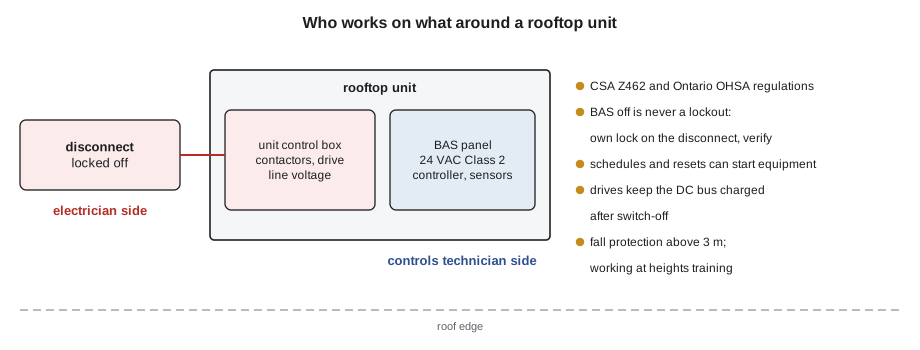
Roofs and ladders
Rooftop units, exhaust fans, cooling towers and outdoor sensors put controls technicians on roofs often. Falls are among the most common causes of serious injury in construction and maintenance.
In Ontario, the construction regulation (O. Reg. 213/91) requires fall protection where a worker may fall more than 3 m, with guardrails preferred where practicable, and the industrial establishments regulation sets similar requirements for work in existing buildings. Workers on construction projects who may use a fall protection system must have completed approved working at heights training, which is valid for three years, plus in-person training on the specific system in use.
Practical rooftop habits matter as much as the rules. Plan the route from the hatch or door to the equipment and stay well away from unprotected edges and skylights. Carry tools and meters in a bag so that hands are free on ladders. Check the weather: wind, ice and rain change everything, and a wet roof is no place to open a panel. Tell someone you are going up and when you expect to be down. Ninefield's RTU-1 panel was mounted on the north curb of the unit, about 600 mm (24 in) above the membrane, a comfortable working height from the roof surface that keeps the technician off the unit itself.
Habits for safe troubleshooting
- Stop and think before opening any cover: what is live in here, and what could start?
- Read labels: arc flash labels, drive discharge times, multiple-source warnings.
- Use a meter rated for the location, checked before and after on a known source.
- Keep one hand away from live parts where possible, and never wear rings or watches near exposed terminals.
- Tell the operator before you command, override or isolate anything, and again when you finish.
- Lock out with your own lock; never rely on someone else's lock or on a BAS command.
- Know your limits. If the job needs line-voltage work, call the electrician. If a situation feels wrong, stop and call your supervisor.
Prakash's view is simple: no troubleshooting call is so urgent that it is worth an injury. The customer would rather wait an hour for the electrician than have a technician hurt in their building. Saying "I need to stop and get help with this" is part of the job.
Common mistakes
MistakeStopping a fan from the BAS and working inside it.
InsteadA BAS command is not a lockout. Isolate at the disconnect with your own lock and verify.
MistakeOpening a drive cover as soon as the disconnect is off.
InsteadWait the discharge time on the label and test for absence of voltage before touching.
MistakeMeasuring 24 VAC in a panel without noticing the exposed line-voltage terminals beside it.
InsteadAssess the whole panel; use the right meter and protective equipment, or have the line side covered or isolated.
MistakeJumpering a safety to get equipment running for a test.
InsteadOnly with the owner's agreement, a tag, a record, someone watching and a set time to remove it.
Summary and key terms
- Troubleshooting is risky because it happens on running equipment, often alone and under time pressure.
- Controls technicians work on Class 2 wiring; line-voltage work is for licensed electricians.
- CSA Z462 and Ontario's OHSA regulations govern electrical safety and lockout.
- Arc flash hazards are greatest at switchgear, panelboards, motor control equipment and drives; drives keep their DC bus charged after switching off.
- Lockout isolates every source with your own lock, releases stored energy and verifies; BAS commands and hand-off-auto switches are never lockout.
- Automatic controls start equipment; tell the operator before commanding outputs and never bypass a safety without agreement, a tag and a time limit.
- On roofs, fall protection is required above 3 m on construction projects, with working at heights training.
- Stop and get help when the work needs it.
- Arc flash
- An explosive release of heat, light and pressure when current arcs through air between conductors.
- Approach boundary
- A distance from exposed live parts inside which only qualified people with suitable protection may work.
- Lockout
- Isolating every energy source with locks in the safe position so equipment cannot start or be energized during work.
- Stored energy
- Energy remaining after isolation, such as charged capacitors, wound springs, pressure or heat.
- DC bus
- The rectified, capacitor-stored supply inside a variable frequency drive.
- Class 2
- A power-limited low-voltage circuit that controls technicians may work on.
Practice problems
Work each problem on paper first, then reveal the answer to check.
Why is putting a fan's BAS start command in off not enough protection before reaching into the fan?
Show answer
A schedule, program, operator, optimal start or fire alarm reset could start it, and the command could be changed by someone else. Only a locked isolating device prevents unexpected start.
You need to measure the 24 VAC supply in a rooftop unit's control box, where the contactor's line-voltage terminals are exposed. What should you do first?
Show answer
Assess the hazard, check whether the line side can be isolated or covered, use a meter rated for the location and the required protective equipment, and if in doubt call the electrician.
Name two Ontario requirements for using fall protection on a construction project roof.
Show answer
Fall protection where a fall of more than 3 m is possible (guardrails preferred where practicable), and approved working at heights training plus in-person training on the system in use.
Lesson quiz · 5 questions
Score 60% or more to complete this lesson.
Create a free account to save your progress, take quizzes and earn a certificate.