
BAS-330 · Lesson 7 of 12 · 22 min
Fault detection and diagnostics
▶ Video coming soon A video version of this lesson is on the way.
Thursday, November 12 was the day Callie and Prakash walked Tilden Hall from the plant to the zones and found room 108. The room was too hot, its VAV box was supplying air at 34 °C (93 °F) with the reheat valve commanded fully closed, and the actuator's coupling had slipped on the valve stem, leaving the valve stuck open. Someone had also raised the box's maximum airflow the day before, from 150 to 200 L/s (320 to 425 cfm), presumably to cool the room, which only pushed more hot air into it. The repair was booked for Friday morning. That evening, Declan's session had only one subject.
"How long had that valve been stuck?" he asked. Nobody knew. The room's complaint had come in on Wednesday, but the valve might have slipped weeks earlier, in mild weather when a little extra heat went unnoticed. "That is the problem fault detection solves. The data to catch it was in the controller the whole time. Nobody was looking."
BAS-110 had promised Callie, back in September, that she would see the rule that catches this fault. This is the lesson where she wrote it.
Faults, symptoms and alarms
A fault is something wrong with the equipment or its control: a valve that leaks, a damper stuck at one position, a sensor that has drifted, a schedule left in override, a loop tuned so that it hunts. A symptom is what the fault does to the data: a discharge temperature higher than it should be, a mixed air temperature that does not match the damper position. Fault detection finds symptoms; diagnosis works back from symptoms to the fault.
Alarms, covered in BAS-320, are meant for conditions that need an operator's response now: a freezestat trip, a failed fan, a temperature far out of range. Most energy faults are not like that. A leaking valve wastes energy for months without ever putting a temperature out of its alarm limits. Fault detection and diagnostics (FDD) is the tool for those slow, quiet faults, and its output is usually a ranked list for maintenance, not an alarm on the operator's screen.
| Alarm | Fault detection | |
|---|---|---|
| Purpose | Immediate response to abnormal conditions | Finding equipment and control faults that waste energy or degrade comfort |
| Typical time scale | Seconds to minutes | Hours to weeks |
| Who acts | The operator on duty | Maintenance staff, service contractor, energy manager |
| Output | An alarm in the alarm console | A list of faults ranked by cost or priority, with evidence |
| Example | Supply fan failed | Heating valve leaking at one box since mid-October |
Approaches to fault detection
There are three broad approaches, and most commercial FDD software uses a mixture.
- Rule-based FDD applies expert rules to the data: if the heating valve is closed, the discharge air should be no warmer than the supply air plus a small allowance. Rules are transparent, so a technician can see exactly why a fault was flagged and check it on site.
- Model-based FDD compares measurements with what a physical or calibrated model predicts, such as the expected fan power at a given airflow and pressure, or a chiller's expected efficiency at its current load and lift.
- Data-driven FDD uses statistics or machine learning to learn normal behaviour from history and flags departures from it. It can find patterns nobody wrote a rule for, but it can also learn a fault as normal if the fault was present from the start, and its reasons can be hard to explain.
Two published rule sets are widely used as starting points for air handlers. The AHU Performance Assessment Rules (APAR), developed at the US National Institute of Standards and Technology, organize rules by operating mode: heating, economizer cooling, mechanical cooling with economizer, mechanical cooling only. Guideline 36 includes an automatic fault detection and diagnostics section with fault conditions for air handlers and terminal units, each tied to the operating states in which it applies. Both stress the same two ideas: a rule applies only in the mode where it makes sense, and it must persist for a while before it counts.
Anatomy of a fault rule
A good rule has five parts.
| Part | What it is | Room 108 example |
|---|---|---|
| Condition | The comparison that indicates a fault | Discharge air warmer than supply air by more than an allowance |
| Applicability | The modes and states in which the rule is valid | Box in occupied mode, AHU supply fan proven, reheat valve commanded 0 |
| Allowance | A margin for sensor error and normal heat gains | 3 K (5 °F), more than the combined sensor error and duct heat gain |
| Persistence | How long the condition must hold | 30 minutes continuously |
| Evidence and action | What to show and suggest | Trend of SAT, DAT, valve command; check valve and actuator coupling |
Fault rule VAV-REHEAT-LEAK (terminal units with hot water reheat)
  Applies when:
    zone mode is OCCUPIED or WARMUP or COOLDOWN
    AHU supply fan status is ON and proven for at least 15 min
    reheat valve command = 0 for at least 15 min
    box airflow is at least 0.5 x minimum airflow setpoint
  Fault condition:
    DAT > SAT_AHU + 3.0 K
  Persistence:
    condition true continuously for 30 min
  Result:
    fault VAV-REHEAT-LEAK active for this box
    evidence: 4 h trend of SAT_AHU, DAT, valve command, airflow
    likely causes: valve leaking or stuck open, actuator coupling slipped,
                   actuator failed or wired to the wrong output, DAT sensor fault
  Clears when: condition false continuously for 60 min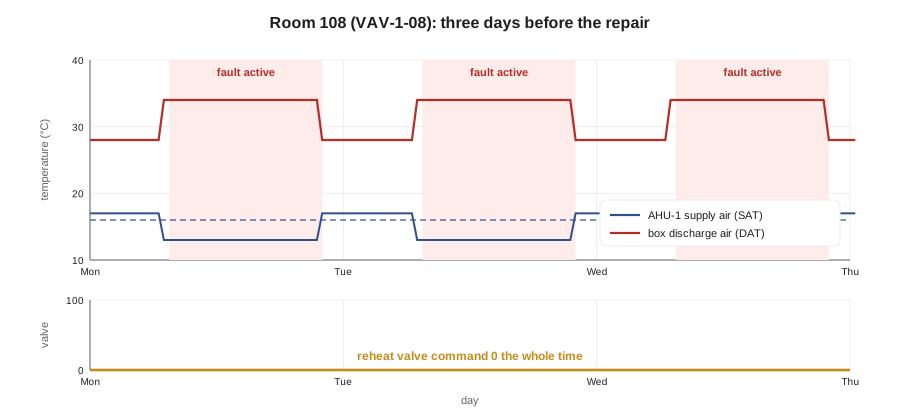
Each line has a reason. The fan must be proven, because with no airflow the box's discharge sensor reads the temperature of still air around a warm coil. The valve must have been closed for 15 minutes, so that a coil cooling down after the valve closes does not trip the rule. The box needs real airflow, because at very low flow a small heat gain looks large. And the allowance must be larger than the combined error of two sensors plus the heat the air picks up in the ducts. A rule with too small an allowance flags every box in the building; with too large an allowance, it misses small leaks.
The rule also needs a discharge air temperature sensor at every box, which Tilden's 1988 boxes mostly do not have. Room 108's box had one because of its 2009 controls. The AHU-2 replacement proposal Declan was preparing for Gus in early December would add discharge sensors on the lecture wing's boxes, and he planned to include the rule in it.
Worked problem
What room 108's leak cost
Room 108's air was supplied at 34 °C (93 °F) to a room at about 23 °C (73 °F), at 200 L/s (425 cfm) after the maximum was raised. At the original maximum of 150 L/s (320 cfm), how much heat was the leak delivering above room temperature, and what would that be over 3,000 occupied hours?
Show solution
- At 200 L/s: 1.2 × 200 × 11 K = 2,640 W, about 2.6 kW, the figure BAS-220 used.
- At 150 L/s: 1.2 × 150 × 11 K = 1,980 W, about 2.0 kW.
- Over 3,000 h: 1.98 × 3,000 = 5,940 kWh of heat, all of which the air handler then had to remove.
Answer: About 6,000 kWh of heat a year from one box, paid for twice: once in the heating plant, and again in cooling to offset it. One leaking valve is small; a building with a dozen of them, which is common, is wasting more than a mid-size retrofit saves.
Air handler rules
The same structure applies to air handlers, where most of the big energy faults live. A few typical rules, paraphrased from the published sets:
| Mode | Rule (in words) | Typical fault found |
|---|---|---|
| Heating | Supply air much colder than setpoint with the heating valve fully open | Heating coil fault, low water temperature, failed pump |
| Heating | Supply air warmer than mixed air with the heating valve closed | Leaking heating valve |
| Economizer only | Mixed air temperature not close to outdoor air with the outdoor damper fully open | Stuck or broken damper linkage, sensor fault |
| Economizer only | Cooling valve open while the outdoor air could do the job | Economizer disabled or lockout set wrongly |
| Any occupied mode | Heating and cooling valves both open at the same time | Overlapping loops, leaking valve, bad sequence |
| Any mode | Mixed air temperature outside the range between return and outdoor temperature | Sensor fault: one of the three temperatures is wrong |
| Any mode | Fan running outside its schedule with no request or override | Schedule fault or held override |
| Any mode | Outdoor air damper open more than minimum in unoccupied mode | Damper fault or sequence error |
The mixed-air rule in that table is worth understanding because it checks sensors against each other. Mixed air is a blend of return and outdoor air, so its temperature must lie between them, allowing for sensor error and fan heat. If it does not, one of the three sensors is wrong. Rules like this one should run before any rule that depends on those sensors, because a bad sensor will otherwise produce a cascade of false faults downstream. Callie remembered replacing AHU-1's mixed air averaging sensor on November 2 because its element was kinked; a rule like this would have flagged it before anyone noticed.
False alarms and trust
An FDD system that produces too many faults, or faults that turn out to be wrong when someone visits, is soon ignored, just like an alarm system that floods. The causes are similar: thresholds too tight, persistence too short, rules applied outside their mode, and sensor faults producing secondary faults. Tuning an FDD system after it is installed is normal, and the tuning should be documented: which rules were adjusted, by how much, and why.
Declan's rule of thumb was that a technician should be able to confirm a reported fault from the evidence trend before leaving the office. If the trend does not make the fault obvious, the rule is not ready.
Ranking faults
A building of Ninefield's size may have hundreds of active faults when FDD is first switched on, most of them small. Ranking them is the step that turns a list into a work plan. Common ranking factors are:
- Estimated energy cost per day or per year, calculated from the fault's size, as in the room 108 example.
- Comfort impact: zones out of range, complaints, hours of discomfort.
- Equipment risk: short-cycling, freezing risk, running outside safe limits.
- Duration: a fault active for 60 days is a pattern; one active for an hour may be a transient.
The cost estimates need not be precise to be useful. A leak worth 6,000 kWh a year and a stuck economizer damper worth 60,000 kWh a year are in different leagues whatever the uncertainty in either.
From fault to fix
FDD only saves energy when someone fixes the fault. That sounds obvious, but many FDD installations stall at this step, because the fault list goes to a person with no time or budget to act on it. A working FDD program has a weekly review, an owner for each fault, a work order for each fix, and a check that the fault cleared afterward. The fix for room 108 took Prakash about forty minutes on Friday morning: re-seat and tighten the coupling, stroke the valve from the controller, mark the stem with a witness line, put the box's maximum airflow back to its design value, and watch the discharge temperature fall to within a degree of the supply air.
Callie added a line to her notes that evening: the room 108 fault was found by a complaint after the fact; with the rule running, it would have been found by the data, probably weeks earlier, and nobody would have raised the airflow trying to fix a symptom.
Common faults and their cost
Studies of commercial buildings find the same faults again and again. The table lists the ones Declan saw most often, with a rough sense of their cost. The exact cost depends on the building, which is why FDD platforms estimate it fault by fault.
| Fault | Typical symptom | Typical cost |
|---|---|---|
| Leaking or stuck-open reheat valve | Discharge air warm with valve closed | Small per box; large across a building |
| Economizer damper stuck closed | Mechanical cooling in mild weather; mixed air not following outdoor air | Large in spring and autumn |
| Economizer damper stuck open | Mixed air near outdoor temperature in very cold or hot weather | Large heating or cooling waste; freeze risk |
| Schedule override left on | Equipment running outside schedule | Proportional to hours; often large |
| Sensor drift | Loop controlling to a wrong value | Varies; can be large on supply air or outdoor air sensors |
| Simultaneous heating and cooling at the air handler | Heating and cooling valves both open | Large |
| Hunting loop | Oscillating valve or damper | Wear more than energy; discomfort |
The schedule override is the cheapest of all to fix and often the most expensive to leave, which is why Callie's override report from BAS-320, run every week, counts as fault detection even though it is only a list.
Common mistakes
MistakeSending FDD faults to the operator's alarm console.
InsteadFDD output is a ranked maintenance list; reserve alarms for conditions needing immediate response.
MistakeApplying a rule in every operating mode.
InsteadEach rule applies only in the modes where its comparison makes sense.
MistakeSetting allowances smaller than combined sensor error.
InsteadInclude sensor accuracy and normal heat gains in the allowance.
MistakeRunning equipment rules before sensor-check rules.
InsteadCheck sensors against each other first so a bad sensor does not cause a cascade of false faults.
MistakeTreating the fault list as the result.
InsteadThe result is the fix; track each fault to a work order and confirm it clears.
Summary and key terms
- A fault is a problem in equipment or control; a symptom is what it does to the data.
- FDD finds slow, quiet faults that alarms miss and produces a ranked maintenance list.
- Rule-based FDD is transparent; model-based and data-driven approaches add coverage.
- APAR and Guideline 36 provide published rule sets organized by operating mode.
- A rule has a condition, applicability, an allowance, persistence, and evidence with likely causes.
- Sensor-check rules come first to avoid cascades of false faults.
- Faults are ranked by cost, comfort, risk and duration, and the program succeeds only when faults are fixed.
- Fault
- A problem with equipment or control, such as a leaking valve or drifted sensor.
- Symptom
- An observable effect of a fault in the data.
- Fault detection and diagnostics (FDD)
- Automated analysis that finds faults and suggests their causes.
- Rule-based FDD
- Fault detection using expert if-then rules applied to the data.
- APAR
- The AHU Performance Assessment Rules developed at NIST.
- Persistence
- How long a fault condition must hold before it is reported.
- Allowance
- A margin in a rule that covers sensor error and normal effects.
- Operating mode
- The state of a system, such as heating or economizer cooling, that decides which rules apply.
Practice problems
Work each problem on paper first, then reveal the answer to check.
A box at 120 L/s discharges air 8 K above the room with its valve closed. How much heat is it adding?
Show answer
1.2 × 120 × 8 = 1,152 W.
Two sensors each have an accuracy of ±0.5 K and duct heat gain is 0.5 K. What is the smallest sensible allowance?
Show answer
At least 0.5 + 0.5 + 0.5 = 1.5 K; Callie used 3 K.
Mixed air reads 25 °C, return 22 °C, outdoor 5 °C. What does a mixed-air rule conclude?
Show answer
Mixed air is outside the return-outdoor range: a sensor is wrong.
Why require the fan to be proven before the reheat rule applies?
Show answer
With no airflow the discharge sensor reads warm still air near the coil.
Name two ranking factors for faults.
Show answer
Energy cost, comfort impact, equipment risk, duration.
Lesson quiz · 5 questions
Score 60% or more to complete this lesson.
Create a free account to save your progress, take quizzes and earn a certificate.