
BAS-330 · Lesson 1 of 12 · 23 min
How buildings use energy
▶ Video coming soon A video version of this lesson is on the way.
On Thursday, October 8, Callie spent the day at Tilden Hall with Prakash, draining water out of the pneumatic air dryer that still serves AHU-2's dampers. That evening Declan Kilbride stayed late at Quillon's office with a stack of utility bills. Declan manages Quillon's retrofit projects, and the retrofits Quillon sells are mostly energy projects: new controls that pay for themselves by making the building use less. "You have spent a month learning how the system controls things," he told Callie. "On Thursdays, for the next few weeks, I want to show you what it costs to run them. The control system is the cheapest energy-saving tool in most buildings, and almost nobody uses it fully."
He started with Ninefield Tower, because Quillon had just started a retro-commissioning proposal for it and because he had a full year of its bills on the table.
Energy, power and the units on a bill
Two words get mixed up constantly, and the difference matters for everything in this course.
- Power is the rate of using energy at an instant. It is measured in watts and kilowatts (kW). A fan motor drawing 11 kW is using energy at that rate right now.
- Energy is power used over time. Electrical energy is measured in kilowatt-hours (kWh): 11 kW for one hour is 11 kWh; 11 kW for 84 hours is 924 kWh.
Natural gas is bought by volume, in cubic metres (m³), and its energy content is about 37 to 39 megajoules per cubic metre. One kilowatt-hour is 3.6 megajoules, so a cubic metre of gas holds a little over 10 kWh of energy. To compare gas and electricity on the same scale, energy managers convert both to equivalent kilowatt-hours (ekWh) or to gigajoules.
Heating and cooling equipment is often rated in its own units as well. Cooling capacity is the rate heat is removed from the building, not the electrical power the chiller draws, and the two differ by a factor of three to six. That ratio is the coefficient of performance, covered below.
| Quantity | Common units | Notes |
|---|---|---|
| Electrical power | kW | What a meter reads at an instant; the basis of demand charges |
| Electrical energy | kWh | What the energy charge on a bill is based on |
| Gas energy | m³ and GJ | About 10.4 ekWh per m³ at 37.3 MJ/m³ |
| Heating or cooling capacity | kW (thermal) | Thermal kW are not electrical kW |
| Floor area | m² | Used to normalize energy into energy use intensity |
Where the energy goes in an office building
A building does not use energy for its own sake. Every kilowatt-hour is bought to deliver a service: warm or cool air, fresh air, light, hot water, working computers, moving elevators. The control system manages most of the biggest of those services directly, which is why it matters so much.
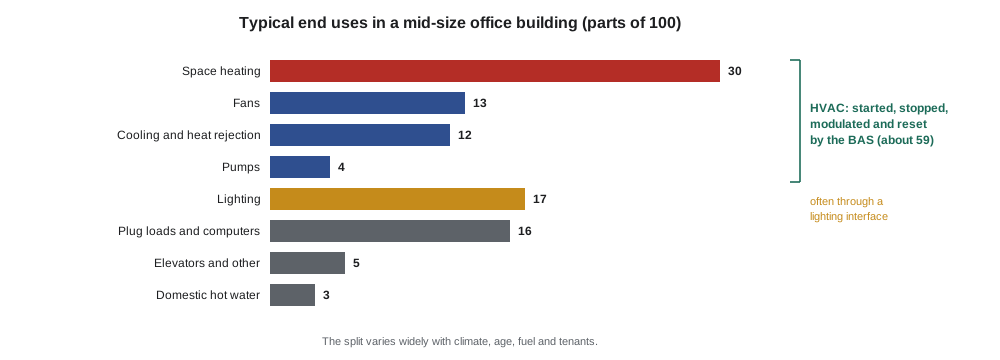
The split varies enormously. A building heated by electric resistance shows heating on the electric bill instead of the gas bill. A building with a data room may have plug and process loads above 30 in 100. A well-lit modern building with LED lighting may have lighting below 10. But in almost every commercial building, heating, cooling, ventilation fans and pumps together account for between 40 and 60 in 100 of the energy, and those are exactly the systems the building automation system starts, stops, modulates and resets.
Declan put it in a sentence Callie wrote at the top of her notebook: the building automation system decides when the equipment runs, how hard it runs, and what it is trying to achieve, and those three decisions are most of the energy bill.
| Decision | Example | Lesson |
|---|---|---|
| When equipment runs | Schedules, optimal start, setback, holiday calendars | Lesson 4 |
| How hard it runs | Fan speed, pump speed, chiller staging, demand limits | Lessons 5 and 6 |
| What it tries to achieve | Setpoints, resets, deadbands, minimum outdoor air | Lesson 5 |
| Whether it is working as intended | Fault detection, analytics, trends | Lessons 7 and 8 |
Loads, efficiency and the coefficient of performance
Every HVAC system has two parts to its energy use: the load it has to meet and the efficiency with which it meets it. The load is the heat that has to be added or removed: heat lost through walls and windows, heat gained from the sun, people, lights and computers, and the heat needed to bring outdoor air to room conditions. The efficiency is how much purchased energy the equipment needs to move that heat.
For heating with fuel, efficiency is the useful heat out divided by the fuel energy in. A condensing boiler like the two at Morrow House reaches about 0.90 to 0.95 when its return water is cool enough to condense the flue gases, and drops toward 0.85 when the return water is hot. For equipment that moves heat with a refrigeration cycle, the ratio of heat moved to electricity used is greater than one, and it is called the coefficient of performance (COP).
Chillers are often rated in kW of electricity per ton of cooling. Ninefield's chiller CH-1, trended in August, was removing 440 kW of heat while drawing 112 kW, a COP of about 3.9, or 0.90 kW per ton. A new water-cooled centrifugal chiller at full load might reach a COP of 6 or more.
Both halves offer savings. Reducing the load means not heating, cooling or moving air that does not need it: running fewer hours, bringing in only the outdoor air the occupants need, not reheating air that was cooled a minute earlier. Improving the efficiency means operating the equipment where it works best: cool return water to a condensing boiler, a chiller loaded where its COP is highest, fans and pumps slowed down to the speed the load actually needs. Good controls do both.
Simultaneous heating and cooling
One waste deserves special mention because it is common, expensive and nearly invisible: heating and cooling the same air at the same time. A VAV system cools the supply air to 13 °C (55 °F) and then reheats it at boxes serving rooms that are too cool. Some reheat is unavoidable at minimum airflow in winter, but a supply air setpoint that is lower than necessary, or minimum airflows set too high, or a heating valve leaking through, turns the building into a machine that pays twice for the same air. Lesson 5 shows how reset strategies reduce it, and lesson 7 shows how fault detection catches the leaks.
Callie remembered room 108 at Tilden, the box whose old program BAS-220 had been reading. Declan nodded. "Keep that one in mind. We will come back to it."
Energy use intensity
To compare one building with another, or a building with itself over time, energy managers divide the annual energy by the floor area. The result is energy use intensity (EUI). Ninefield's 2025 bills gave Declan the numbers.
Worked problem
Ninefield Tower's energy use intensity
In 2025 Ninefield used 2,800,000 kWh of electricity and 95,000 m³ of natural gas at 37.3 MJ/m³ (33,590 therms of natural gas). Its gross floor area is 17,500 m² (188,000 ft²). The gas serves a penthouse boiler that heats the air handler preheat coils and the domestic hot water; the perimeter zones are heated electrically. Find the site EUI.
Show solution
- Convert the gas: 95,000 m³ × 37.3 MJ/m³ = 3,543,500 MJ; ÷ 3.6 MJ/kWh = 984,300 ekWh.
- Total site energy: 2,800,000 + 984,300 = 3,784,300 ekWh.
- Divide by floor area: 3,784,300 ÷ 17,500 m² = 216 ekWh/m².
Answer: Site EUI is about 216 ekWh/m² (68.7 kBtu/ft²): somewhat above a typical figure for an older office building in a cold climate, and in line with Ilona's view that Ninefield has room to improve.
Site energy is the energy delivered to the building and measured by its meters. Source energy adds the energy lost in generating and delivering it, which matters when comparing a building that buys mostly electricity with one that burns mostly gas. ENERGY STAR Portfolio Manager, covered in lesson 10, reports both and uses source energy for its score.
EUI is a blunt tool. A building with a large data room, long hours or a restaurant tenant will have a high EUI for good reasons. It is most useful for comparing a building with itself, year to year, and with similar buildings in the same climate.
The load profile: when energy is used
Annual totals say how much; interval data says when. Ninefield's main switchboard meter, PM-1, has been trended every 15 minutes since Prakash and Sophie integrated it in August. Declan plotted a typical week of the readings.
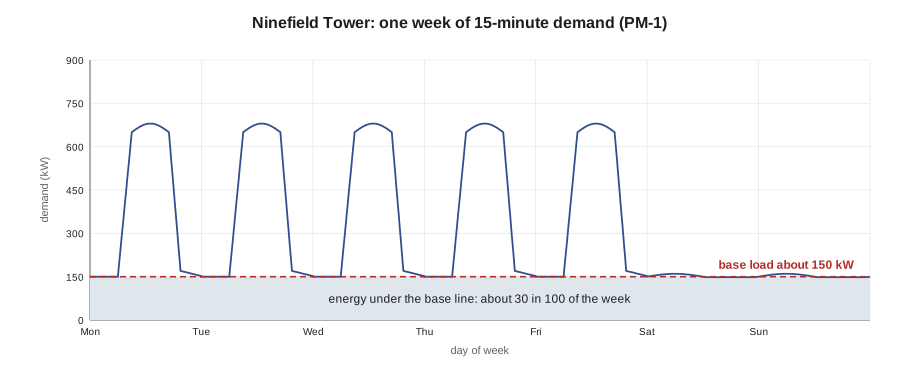
Three features of a load profile tell an energy manager most of what they need.
- The base load is the demand when the building is unoccupied: nights, weekends, holidays. It is made up of equipment that never turns off, such as exhaust fans, elevators on standby, computers, refrigerators, emergency lighting, and anything that should be off but is not.
- The peak is the highest demand, usually on a hot weekday afternoon in summer, or a cold morning in an electrically heated building. Lesson 2 shows why the peak, not just the total, appears on the bill.
- The shape around the schedule shows when the building starts and stops. A start at 4:00 for a 7:00 occupancy, or a slow decline that lasts until midnight, shows equipment running longer than it should.
Ninefield's base load was about 150 kW. Declan worked out what that cost.
Worked problem
The cost of Ninefield's base load
Ninefield is occupied 7:00 to 19:00 on weekdays, 60 hours a week, so it is unoccupied 168 − 60 = 108 hours a week. The base load is 150 kW. What share of the 2,800,000 kWh annual electricity does it represent, and how much would a 110 kW base save?
Show solution
- Unoccupied energy at 150 kW: 150 × 108 h/week × 52 weeks = 842,400 kWh.
- Share of the annual total: 842,400 ÷ 2,800,000 = 0.30, or 30 in 100.
- At a 110 kW base: savings = (150 − 110) × 108 × 52 = 224,640 kWh a year.
Answer: About 30 in 100 of Ninefield's electricity is used when nobody is there. Cutting the base by 40 kW would save about 225,000 kWh a year, 8 in 100 of the total, before touching anything during occupied hours.
"That is why I always start at night," Declan said. "The building is empty, nothing should be running, and whatever is running is costing money for nobody. Find out what makes up the 150 kW and you have half of a proposal." Some of it is unavoidable: elevators, emergency lighting, the tenants' servers, exhaust fans that run continuously by design. Some may not be. A walk through the building at 22:00 with the front end open on a laptop is one of the most productive hours in energy work.
Weather, occupancy and other drivers
Energy use changes for reasons the control system does not control, and an energy manager has to separate those from the reasons it does. The main drivers are:
- Weather. Heating energy rises with cold weather and cooling energy with hot, humid weather. Degree-days, covered in lesson 9, measure how cold or hot a period was.
- Occupancy. More people mean more ventilation, more plug loads and more heat to remove. A building that is half empty after a tenant leaves should use less.
- Operating hours. A tenant who starts working Saturdays adds hours to the schedule.
- Changes to the building. A new data room, an LED retrofit or replacing a chiller changes the baseline.
A building whose bill went up 5 in 100 in a winter that was 10 in 100 colder than the last one may have improved. A building whose bill went down in a mild year may have got worse. Lesson 9 shows how to adjust for weather properly so that savings can be proven, not just claimed.
The technician's part
Energy managers and engineers write proposals, but technicians make the savings real, or lose them. A schedule left in override after an event, a sensor that drifted, a valve that leaks, a loop tuned so badly it hunts: each wastes energy quietly. Callie had already seen several. The override report Callie had run at Tilden would turn up 14 points still held at the operator priority, some since summer, including two VAV boxes held at maximum airflow during a heat wave. Each of those was a technician's adjustment that nobody had undone.
Declan's view was simple. "Every time you touch a building, you either leave it using less or you leave it using more. Know which."
Common mistakes
MistakeTreating kW and kWh as the same thing.
InsteadkW is the rate at an instant; kWh is energy over time. A bill charges for both separately.
MistakeComparing a chiller's cooling capacity with its electrical input as if they were the same kind of kW.
InsteadCooling capacity is thermal; the electrical input is three to six times smaller. The ratio is the COP.
MistakeJudging a building by its total bill alone.
InsteadNormalize by floor area (EUI) and adjust for weather and occupancy before comparing.
MistakeLooking only at occupied hours for savings.
InsteadThe base load at night and on weekends is often 25 to 35 in 100 of the electricity and is the easiest to cut.
MistakeAssuming the control system is working because nobody complains.
InsteadMany energy faults, such as simultaneous heating and cooling, cause no complaints at all.
Summary and key terms
- Power (kW) is a rate; energy (kWh) is power over time.
- Heating, cooling, fans and pumps typically account for 40 to 60 in 100 of a commercial building's energy, and the BAS controls them directly.
- Energy use is the load times the inverse of efficiency; controls can reduce both.
- COP is heat moved divided by electrical input; chillers and heat pumps have COPs well above one.
- Simultaneous heating and cooling is a common, invisible waste.
- EUI divides annual energy by floor area to allow comparison.
- A load profile shows the base load, the peak and how the building starts and stops.
- Power
- The rate of using energy, in watts or kilowatts.
- Energy
- Power used over time, in kilowatt-hours or equivalent units.
- Coefficient of performance (COP)
- Heat moved divided by the electrical energy used to move it.
- Energy use intensity (EUI)
- Annual energy use divided by floor area.
- Site energy
- Energy delivered to the building and measured at its meters.
- Source energy
- Site energy plus the energy lost generating and delivering it.
- Base load
- The demand of a building when it is unoccupied.
- Load profile
- A chart of demand against time, usually from interval meter data.
Practice problems
Work each problem on paper first, then reveal the answer to check.
A 15 kW exhaust fan runs 24 hours a day all year. How much energy does it use?
Show answer
15 × 8,760 = 131,400 kWh.
A chiller removes 600 kW of heat while drawing 150 kW. What is its COP?
Show answer
600 ÷ 150 = 4.0.
A building's base load is 80 kW for 110 unoccupied hours a week. What is the annual unoccupied energy?
Show answer
80 × 110 × 52 = 457,600 kWh.
Why is site EUI not always a fair comparison between a gas-heated and an electrically heated building?
Show answer
Electricity has larger generation and delivery losses; source energy accounts for them.
Name three things that make up a typical office building's base load.
Show answer
Elevators on standby, exhaust fans, computers and servers, emergency lighting, refrigeration; also equipment left on.
Lesson quiz · 5 questions
Score 60% or more to complete this lesson.
Create a free account to save your progress, take quizzes and earn a certificate.