
BAS-330 · Lesson 11 of 12 · 27 min
Electrification, heat pumps and decarbonization
▶ Video coming soon A video version of this lesson is on the way.
Gus Thibodeaux had asked Quillon a question in October that had nothing to do with Tilden Hall: what would it take to stop burning gas at Morrow House, the residence whose two condensing boilers Quillon had integrated in 2023? Harcastle had a climate commitment to meet, and Morrow House, with modern boilers and a hot water system, looked like the easiest building on campus to start with. Declan had sketched an answer and used it for his last teaching session before the case study. "Saving energy and cutting emissions are related," he told Callie, "but they are not the same thing. This is where they part company."
Energy, emissions and decarbonization
Decarbonization means reducing the greenhouse gas emissions caused by a building. Most of a typical building's direct emissions come from burning fuel on site, mainly natural gas for heating and hot water. Its indirect emissions come from the electricity it buys, and depend on how that electricity is generated. Emissions are usually counted in tonnes of carbon dioxide equivalent (t CO₂e).
| Source | Emission factor | Notes |
|---|---|---|
| Natural gas | About 1.9 kg CO₂e per m³ | Fairly constant everywhere |
| Ontario grid electricity | A sample value of 0.06 kg per kWh | Low because of hydro and nuclear generation; varies by year and by hour, higher when gas plants run |
The emission factor of grid electricity is the number that decides whether electrifying a building cuts emissions a lot or a little. A heat pump replacing a gas boiler in a region with a clean grid cuts emissions dramatically; in a region with a fossil-heavy grid it still cuts them, but by much less, and the result improves every year the grid gets cleaner. Grid factors also vary by hour: in Ontario, the marginal electricity on a cold winter evening is more likely to come from gas-fired plants than the annual average suggests.
Federal and provincial policy pushes in the same direction. The federal consumer carbon charge on fuels such as natural gas ended on April 1, 2025, which reduced the cost advantage of electrification, while industrial carbon pricing continues and the City of Hamilton's climate plans aim for net-zero emissions by 2050. Harcastle's own commitment was what had prompted Gus's question.
Heat pumps
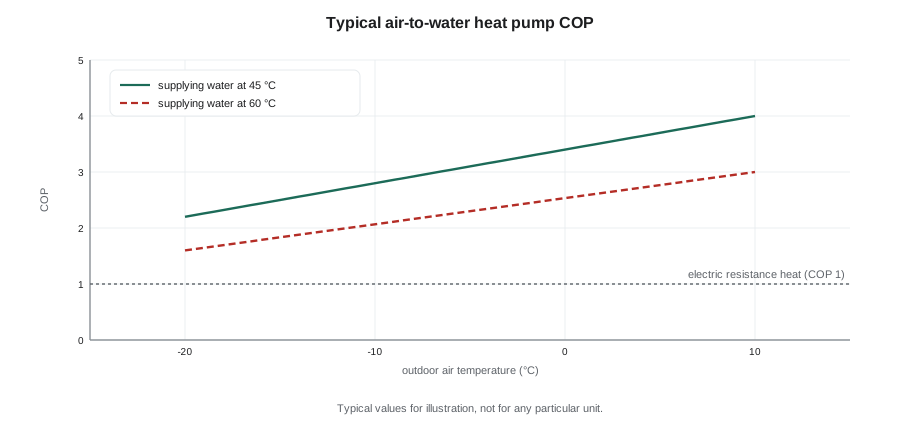
A heat pump uses a refrigeration cycle to move heat from a cold place to a warm one: from outdoor air, the ground or a water loop into the building. Because it moves heat rather than making it, it delivers more heat than the electricity it uses. Its coefficient of performance (COP) falls as the temperature difference it works across rises: a cold outdoor source, or hot water to be supplied, both lower it.
| Type | Heat source | Typical use |
|---|---|---|
| Air-to-air | Outdoor air | Rooftop units, split systems, variable refrigerant flow systems |
| Air-to-water | Outdoor air | Replacing or supplementing boilers on hot water systems |
| Water-to-water or water-to-air | A building water loop, ground loop or waste heat | Ground source systems, heat recovery chillers, loop systems |
| Heat recovery chiller | The building's own cooling load | Buildings with simultaneous heating and cooling, such as hospitals and labs |
The water temperature is the critical issue for an existing hot water building. Most air-to-water heat pumps using common refrigerants supply water efficiently up to about 55 °C (130 °F), and some newer units reach 65 to 70 °C (150 to 160 °F) at reduced capacity and COP. Morrow House's heating water reset, like Tilden's, calls for up to 80 °C (176 °F) on the coldest days.
Morrow House: full electrification on paper
Worked problem
Replacing gas with heat pumps at Morrow House
Morrow House uses about 60,000 m³ of gas a year at 37.3 MJ/m³ (21,220 therms of gas a year), burned at an average seasonal efficiency of 0.90. Suppose air-to-water heat pumps with a seasonal COP of 2.8 supplied all of that heat. Find the heat delivered, the heat pump electricity, and the change in emissions using the factors in the table.
Show solution
- Gas energy: 60,000 × 37.3 ÷ 3.6 = 621,700 ekWh.
- Heat delivered: 621,700 × 0.90 = 559,500 kWh.
- Heat pump electricity: 559,500 ÷ 2.8 = 199,800 kWh.
- Emissions now: 60,000 × 1.9 = 114,000 kg = 114 t.
- Emissions with heat pumps: 199,800 × 0.06 = 12,000 kg = 12 t.
Answer: Energy bought falls from about 621,700 ekWh to about 199,800 kWh, and emissions from about 114 t to about 12 t, a reduction of nearly nine-tenths on a sample Ontario grid factor.
Worked problem
What it costs to run
Using sample prices of 0.45 dollars per m³ for gas and 0.16 dollars per kWh for electricity, compare the annual energy cost.
Show solution
- Gas now: 60,000 × 0.45 = 27,000 dollars.
- Heat pumps: 199,800 × 0.16 = 31,970 dollars.
Answer: At these sample prices the heat pumps cost about 5,000 dollars a year more to run, before any change in demand charges. Electrification is often justified by emissions, not by energy cost, and the price ratio of electricity to gas decides the economics.
The paper exercise skips the hard parts: the water temperature, the electrical service, and the cold days.
Water temperature and the hybrid plant
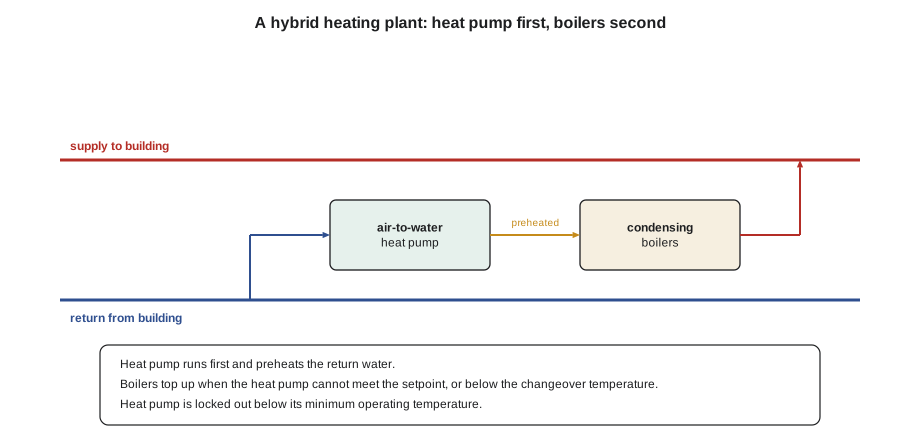
On Morrow House's reset curve, the supply water reaches 55 °C (130 °F) when the outdoor temperature is about 5 °C (41 °F). Above that, a heat pump could carry the building alone; below it, the water is too hot for an efficient heat pump. Two approaches deal with that.
- Lower the water temperature the building needs. Many hot water systems were designed with generous margins, and the coils and radiators can heat the building at lower temperatures than the design curve, especially after envelope improvements. Testing a lower reset curve over a winter, zone by zone, with demand overrides for the zones that cannot cope, is a controls task that costs almost nothing and often finds that the building needs far less than its curve says.
- Keep the boilers as a second stage in a hybrid plant. The heat pump preheats the return water and the boiler tops it up when the supply temperature needed is above what the heat pump can deliver efficiently, or when the outdoor air is too cold. The heat pump carries most of the annual heat, because most hours of the heating season are mild, while the boilers carry the coldest hours.
Worked problem
A hybrid plant's emissions
Suppose a hybrid plant at Morrow House supplies three-quarters of the annual heat from the heat pump at a seasonal COP of 2.6 and the rest from the boilers. Find the electricity, the remaining gas and the emissions.
Show solution
- Heat from the heat pump: 0.75 × 559,500 = 419,600 kWh; electricity 419,600 ÷ 2.6 = 161,400 kWh.
- Remaining gas: 0.25 × 60,000 = 15,000 m³.
- Emissions: 15,000 × 1.9 + 161,400 × 0.06 = 28,500 + 9,700 = 38,200 kg, about 38 t.
Answer: About 38 t, a reduction of two-thirds from 114 t, without replacing the boilers or the radiators.
The control logic for a hybrid plant is where the technician comes in. It needs to decide, every few minutes, which source runs, using the outdoor temperature, the required supply temperature, the heat pump's actual output, and sometimes the relative prices and emission factors. A changeover based on price alone and one based on emissions alone may choose differently on the same hour, and the owner has to decide which matters more.
The cold days and the electrical service
A heat pump's capacity, not just its COP, falls in cold weather, so heat pumps are sized either to cover the full design load with a margin, or to cover part of it with backup. Backup can be the existing boilers, as in a hybrid, or electric resistance heat, which has a COP of 1. Resistance backup is simple but expensive to run and sets electrical peaks on exactly the coldest mornings, when demand charges and grid stress are highest.
Worked problem
What full electrification does to the peak
Morrow House's design heating load is estimated at about 380 kW (1,300,000 Btu/h). At the design outdoor temperature, an air-to-water heat pump's COP might be about 1.8. What electrical load would the heat pumps add on the coldest morning?
Show solution
- Electrical load: 380 ÷ 1.8 = 211 kW.
Answer: About 210 kW added on the coldest morning, which may exceed the building's electrical service and would raise winter demand charges. Checking the service capacity with an electrical engineer is one of the first steps in any electrification study.
Controls can reduce the problem. Staging heat pumps one at a time with time delays, limiting backup heat until the heat pump has had time to recover, locking out resistance backup above a set outdoor temperature, and using the building's thermal mass to preheat before a peak are all demand-limiting strategies from lesson 6 applied to a new kind of equipment. Defrost cycles, which air-source heat pumps run periodically in cold, humid weather, briefly reduce output and must be allowed for in the logic.
Heat recovery and simultaneous loads
Before buying a heat pump to make heat, it is worth asking whether the building is already throwing heat away. A building with a data room, a kitchen or year-round interior cooling rejects heat through its cooling tower while its boilers make heat for the perimeter. A heat recovery chiller, or a heat pump on the condenser water, can move that heat from where it is unwanted to where it is needed, with both sides useful and a very high combined COP. Ninefield's tower, with chillers running in winter for its interior zones while electric heaters warmed its perimeter, was a candidate Declan noted for the longer-term plan.
Grid-interactive buildings
As more buildings electrify, when they use electricity matters more. A grid-interactive efficient building uses its controls to shift or reduce load in response to grid conditions: precooling before an afternoon peak, preheating hot water storage overnight, limiting heat pump demand during a winter peak, responding to demand response signals. The control system is the part of the building that makes this possible, and the strategies are the ones in lessons 4 to 6, applied with a signal from outside.
| Strategy | How the BAS does it | Grid benefit |
|---|---|---|
| Load shifting | Precool or preheat, charge thermal storage | Moves load out of peak hours |
| Load shedding | Temporary setpoint changes and limits | Reduces load during events |
| Load modulation | Fine adjustment of heat pump or chiller output | Helps balance the grid minute by minute |
| Efficiency | Resets, schedules, fault detection | Lowers load all the time |
In the US, federal tax incentives for efficient commercial buildings have changed: under 2025 legislation, the section 179D deduction does not apply to property whose construction begins after June 30, 2026. Owners and engineers should check the current incentives in each jurisdiction before relying on them.
Gus's answer
Declan's note to Gus, drafted for December, recommended three steps in order: a winter of testing lower heating water reset curves at Morrow House with the existing boilers, which might cost nothing and would show what water temperature the building really needs; an electrification study with an engineer, covering the electrical service and a hybrid plant; and only then a decision on equipment. "Every one of those steps runs through the control system," he told Callie. "That is why owners will need people who understand it."
Refrigerants and safety
Heat pumps contain refrigerant, and the industry is moving to refrigerants with much lower global warming potential under international agreements and national rules. Some of the newer refrigerants are mildly flammable, and natural refrigerants such as propane and carbon dioxide are also in use. That changes requirements for machinery rooms, leak detection and ventilation, which are set by safety standards and codes and designed by engineers. For the controls technician, it means more refrigerant leak detectors wired to the BAS, alarms that must be routed correctly, and ventilation sequences that must start when a leak is detected. Those are life-safety interfaces, covered in BAS-340, and they are never shed or overridden for energy.
Refrigerant leaks also matter for emissions: a kilogram of some older refrigerants leaked to the atmosphere has the warming effect of more than a tonne of carbon dioxide. Leak detection and prompt repair are part of decarbonization, not just maintenance.
Common mistakes
MistakeAssuming electrification always cuts emissions by the same amount.
InsteadThe grid emission factor decides how much; check the current factor for the region.
MistakeAssuming electrification saves money.
InsteadCompare costs using the actual electricity and gas prices, including demand charges.
MistakeSpecifying a heat pump for an 80 degree water system without testing lower temperatures.
InsteadTest lower reset curves first; many systems need much less than their design curve.
MistakeUsing resistance backup without lockouts.
InsteadLock out backup above a set outdoor temperature and delay it to let the heat pump recover.
MistakeIgnoring the electrical service.
InsteadCheck service capacity and winter peak demand early in any electrification study.
Summary and key terms
- Emissions equal energy times emission factor; grid factors vary widely by region and hour.
- Heat pumps move heat with COPs above one; COP falls with colder sources and hotter supply water.
- Existing hot water systems need lower water temperatures or a hybrid plant to use heat pumps well.
- A hybrid plant uses the heat pump for most hours and boilers for the coldest ones.
- Electrification can raise winter peaks; controls stage, limit and lock out backup heat.
- Heat recovery moves waste heat to where it is needed before new heat is made.
- Grid-interactive buildings use resets, schedules, shifting and shedding in response to grid signals.
- Decarbonization
- Reducing the greenhouse gas emissions caused by a building.
- Emission factor
- The emissions produced per unit of energy used.
- Heat pump
- A machine that moves heat from a cooler source to a warmer sink using a refrigeration cycle.
- Air-to-water heat pump
- A heat pump that takes heat from outdoor air and delivers it to a water system.
- Hybrid plant
- A heating plant that combines heat pumps with boilers.
- Changeover temperature
- The outdoor temperature at which a hybrid plant switches between sources.
- Defrost cycle
- A period when an air-source heat pump melts frost from its outdoor coil.
- Grid-interactive efficient building
- A building that adjusts its load in response to grid conditions.
Practice problems
Work each problem on paper first, then reveal the answer to check.
A boiler burns 10,000 m³ of gas. At 1.9 kg per m³, what are the emissions?
Show answer
19,000 kg = 19 t.
A heat pump delivers 100,000 kWh of heat at a COP of 2.5. How much electricity does it use?
Show answer
40,000 kWh.
At 0.06 kg per kWh, what are the emissions of that electricity?
Show answer
2,400 kg = 2.4 t.
A heat pump at COP 2.0 must deliver 300 kW. What electrical load does it add?
Show answer
150 kW.
Why lock out resistance backup above a set outdoor temperature?
Show answer
The heat pump can carry the load; resistance heat is expensive and sets peaks.
Lesson quiz · 5 questions
Score 60% or more to complete this lesson.
Create a free account to save your progress, take quizzes and earn a certificate.