
BAS-330 · Lesson 4 of 12 · 25 min
Optimal start, setback and scheduling
▶ Video coming soon A video version of this lesson is on the way.
Thursday, October 29 began with a draft complaint in Tilden's lecture wing and ended, for Callie, at Quillon's office with Declan and a printout of Tilden AHU-1's runtime report. Two nights earlier in the month the unit had run until 2:00 after evening events, because someone had put the schedule in override and nobody had taken it out. "Schedules are the biggest energy control in the building," Declan said, "and the one people break most casually. Tonight is about running equipment only when it is needed, and having the building ready when people arrive."
Why run hours matter so much
Almost every piece of HVAC equipment uses energy in proportion to the hours it runs. A fan that runs an extra hour uses an extra hour of energy; an air handler bringing in its minimum outdoor air for an extra hour on a winter night also heats that air for an extra hour. Cutting hours is the cheapest saving there is: it costs nothing but a schedule change, it reduces wear, and it needs no new equipment.
Worked problem
The cost of Tilden's two late nights
Tilden AHU-1's supply fan draws about 11 kW. On two October nights it ran from 22:00 to 2:00 with its minimum outdoor air of 1,500 L/s (3,180 cfm) heated from an outdoor temperature of 0 °C to 21 °C (32 °F to 70 °F). Estimate the fan energy and the heat used to warm the outdoor air.
Show solution
- Extra hours: 4 h × 2 nights = 8 h.
- Fan energy: 11 kW × 8 h = 88 kWh.
- Outdoor air heating: 1.2 × 1,500 L/s × 21 K = 37,800 W = 37.8 kW; × 8 h = 302 kWh of heat.
Answer: About 88 kWh of fan energy and about 300 kWh of heat, for nobody. Small for two nights, but an override that stays in for a month would cost twenty times as much.
The factor in the sensible heat formula comes from the density and specific heat of air at ordinary conditions; it is close enough for estimates at any building's altitude near sea level.
Weekly schedules, exceptions and overrides
BAS-220 and BAS-320 covered how schedules are programmed and managed. For energy, three rules matter most.
- The occupied schedule should match real occupancy, zone by zone where the system allows it. Gus approved separate schedules for Tilden's lecture wing and its offices for the winter term, which cut AHU-2's week to 77.5 hours from the 84 hours AHU-1 runs.
- Holidays and closures belong on a calendar, loaded in advance and checked by two people. Gus had sent Harcastle's 2027 closure calendar on November 9 with 12 weekday closures outside the winter break.
- After-hours operation should come from a timed request that expires on its own, never from a schedule held in override. A two-hour timer that the occupant can extend from a thermostat button or a web form costs nothing when it is forgotten.
Worked problem
What a closure calendar is worth
Harcastle's 12 weekday closures each would otherwise run AHU-1 for 15 hours (7:00 to 22:00). Estimate the fan energy and, at an average outdoor temperature of 0 °C (32 °F), the heat for the minimum outdoor air.
Show solution
- Hours avoided: 12 × 15 = 180 h.
- Fan: 11 kW × 180 h = 1,980 kWh.
- Outdoor air heat: 37.8 kW × 180 h = 6,804 kWh of heat.
Answer: About 2,000 kWh of electricity and nearly 7,000 kWh of heat for one air handler. Across a campus with dozens of air handlers, a closure calendar is worth many tens of thousands of kWh.
Setback and setup
When a building is unoccupied, the zones do not need to stay at occupied setpoints. Heating setpoints are set back to a lower temperature and cooling setpoints set up to a higher one. The system stays off until a zone drifts past the unoccupied limits, then runs just long enough to bring it back.
| Mode | Typical heating setpoint | Typical cooling setpoint |
|---|---|---|
| Occupied | 20 to 22 °C (68 to 72 °F) | 23 to 25 °C (73 to 77 °F) |
| Occupied standby (room empty during the day) | 1 to 2 K lower (2 to 4 °F lower) | 1 to 2 K higher (2 to 4 °F higher) |
| Unoccupied (night and weekend) | 15 to 16 °C (59 to 61 °F) | 29 to 30 °C (84 to 86 °F) |
Deeper setbacks save more while the building is empty but need longer recovery in the morning. In heavy buildings with lots of concrete and masonry, the structure stores heat and recovers slowly; in light buildings, recovery is quick. Buildings with heat pumps are a special case: a deep setback can force a heat pump to run its electric backup heat in the morning, which may cost more than the setback saved. Lesson 11 returns to that.
During unoccupied operation the outdoor air dampers stay closed, because nobody needs ventilation. That is a large part of the saving in a cold climate, and a common fault: a damper that does not close, or a minimum position that applies even in unoccupied mode, ventilates an empty building all night.
Optimal start
A fixed start time has to be early enough for the coldest Monday of the year, so on every other morning it starts the building too early. Optimal start calculates, each day, how late the system can start and still reach the occupied setpoint by the time occupancy begins.
Worked problem
Tilden AHU-1 on a cold Monday
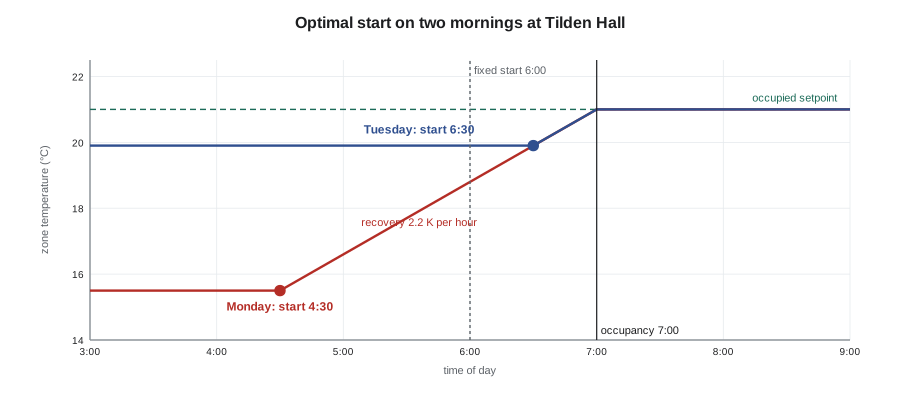
After the weekend, the average Tilden zone is at 15.5 °C (60 °F). The occupied heating setpoint is 21 °C (70 °F). The controller has learned a recovery rate of 2.2 K per hour (4 °F per hour) at the current outdoor temperature. Occupancy begins at 7:00. When should AHU-1 start? On Tuesday the zones are at 19.9 °C (68 °F); when should it start then?
Show solution
- Monday: (21 − 15.5) ÷ 2.2 = 5.5 ÷ 2.2 = 2.5 h before 7:00, so start at 4:30.
- Tuesday: (21 − 19.9) ÷ 2.2 = 1.1 ÷ 2.2 = 0.5 h before 7:00, so start at 6:30.
Answer: 4:30 on Monday and 6:30 on Tuesday. Tilden's fixed 6:00 start was an hour and a half too late on Monday, when the first classes began cool, and half an hour too early on Tuesday. A fixed start early enough for the worst Monday, 4:30, would run two hours too long on a morning like Tuesday's.
Real optimal start algorithms are adaptive. The controller records how long recovery actually took each morning and adjusts its recovery rate, usually as a function of outdoor temperature and of how far the zone is from setpoint. Most also have limits: an earliest start time and a maximum lead time, so that a failed sensor cannot start the building at midnight. Many energy standards require optimum start on larger systems, and Guideline 36 includes an optimal start calculation in its sequences.
During the warm-up, the outdoor air dampers stay closed unless the building needs purging, because nobody is there yet. The warm-up ends at the occupied time, when the dampers open to minimum. Some sequences also hold the cooling coil off during morning warm-up and the heating off during cool-down, to prevent the two from fighting.
There is one caution from BAS-130, and Callie remembered it: Tilden AHU-1's heating loop had wound up overnight while the fan was off, so it slammed open at the 6:00 start. Any start logic, fixed or optimal, has to enable the loops only after the fan is proven.
Optimal stop
Optimal stop is the mirror image: it shuts off the heating or cooling before the end of occupancy, letting the building coast, because the zones will stay within a comfortable band for the last half hour or so. Ventilation must continue until the end of occupancy, so optimal stop turns off heating and cooling but keeps the fan and outdoor air running. Savings are usually smaller than optimal start's and the comfort risk is higher, so it is used with tighter limits.
Night low limit and night purge
Two unoccupied modes run the system on purpose.
- Night low limit (or unoccupied heating) starts heating if any zone falls below the unoccupied heating setpoint, to protect the building and avoid a long recovery.
- Night purge, or night flush, uses cool outdoor air in summer to precool the building structure before morning. It is worth doing only if the outdoor air is well below the space temperature and dry enough, and if the fan energy is less than the cooling saved the next day. Many sequences require an outdoor temperature at least 3 K (5 °F) below the space and a dew point limit.
Night purge is a good example of an energy measure that can lose money if its limits are wrong: running a 30 kW (40 hp) fan all night to save a few minutes of chiller time the next morning is a net loss.
Occupied standby
Occupied standby applies setback during the day to rooms that are scheduled as occupied but are actually empty, detected by occupancy sensors. Guideline 36 includes it for zone groups: the zone's setpoints widen slightly, and its ventilation can be reduced to zero when the room is empty, where the ventilation standard in use allows it. BAS-230 had suggested it for the seminar rooms beside T-120, using the occupancy sensors already installed for the lighting. At Ninefield, the 2019 lighting controls had occupancy sensors on every floor, which made occupied standby one of the cheapest measures in the retro-commissioning proposal.
Ninefield's fixed start
Declan turned to Ninefield. Its air handlers, chillers and podium rooftop units all started at a fixed 6:00 every weekday, all year, for a 7:00 occupancy. In summer that was too early on most days, and it also produced the 820 kW demand spike Callie had seen on the July bill. In winter, with electric perimeter heat in the tower's fan-powered boxes, the morning start caused a different peak, which is the subject of lesson 6.
| Measure | Energy effect | Demand effect |
|---|---|---|
| Optimal start for the penthouse air handlers | Shorter run on most mornings | Spreads starts over the morning |
| Chillers enabled only when the cooling load needs them | Fewer chiller hours | Chiller start removed from the fan start |
| Podium rooftop units on their own optimal start | Shorter run on mild days | Smaller coincident peak |
| Fixed earliest start of 4:30 and latest of 6:45 | Limits prevent runaway starts | Keeps the start predictable |
Declan estimated the optimal start measure at about 18,000 kWh a year, mostly from fan and chiller hours on mild mornings, and noted that it had to be proven with trend data before and after, which is the subject of lesson 9.
Checking schedules for energy
Callie's job after the session was to write a short check she could run on any site. She based it on the runtime report from BAS-320.
| Check | What to look for |
|---|---|
| Runtime against schedule | Equipment running more hours than its schedule plus warm-up |
| Overrides | Schedules or points held at an operator priority; expired timers |
| Calendar | Holidays and closures loaded for at least the next six months |
| Unoccupied dampers | Outdoor air dampers closed during unoccupied and warm-up modes |
| Start times | Optimal start lead times reasonable; no starts before the earliest allowed time |
| Night cycling | Unoccupied heating or cooling cycling more than expected, suggesting a setpoint or envelope problem |
After-hours use and tenant billing
Ninefield's 7th-floor dispute was a scheduling problem dressed up as a billing one. The tenant had asked in September for after-hours cooling on several evenings, the requests had been entered against a shared tenant account, and nobody could later show which hours belonged to whom. The tenant was billed for hours its staff said they never used.
A good after-hours system answers three questions automatically: who requested the operation, for which zones, and for how long it actually ran. Timed requests from a thermostat button or a web form, logged by the BAS with the requester's identity and the actual start and stop times, provide exactly that. The monthly report then lists hours by tenant, multiplied by an agreed rate per hour for each zone group, which is far easier to defend than a manual log.
| Item | Good practice |
|---|---|
| Request | Timed, by a named person or tenant account, through a button, form or app |
| Duration | A fixed block, such as two hours, extendable by a new request |
| Scope | Only the zones and air handlers serving that tenant, where the system allows |
| Record | Requester, zones, start and stop times, kept for at least the billing year |
| Billing | Hours times an agreed rate per zone group, reported monthly |
Declan's proposal included a tenant after-hours module with individual accounts for each tenant contact, so that the next dispute could be settled from the record in a few minutes.
Common mistakes
MistakeHolding a schedule in override for an event.
InsteadUse a timed after-hours request that expires on its own.
MistakeSetting a fixed start time early enough for the worst morning.
InsteadUse adaptive optimal start with an earliest start limit.
MistakeLetting outdoor air dampers open during warm-up or unoccupied mode.
InsteadKeep them closed until occupancy unless purging.
MistakeDeep setback on heat pumps without checking backup heat.
InsteadLimit setback depth or recovery rate so backup heat does not run.
MistakeRunning night purge without temperature and humidity limits.
InsteadPurge only when the outdoor air is cool and dry enough to save more than the fan uses.
Summary and key terms
- Run hours drive most HVAC energy; cutting them is the cheapest saving.
- Use calendars for holidays and timed requests for after-hours use, never held overrides.
- Setback and setup save energy while the building is empty, with outdoor air dampers closed.
- Optimal start calculates the latest start that still reaches setpoint by occupancy, and adapts.
- Optimal stop lets the building coast at the end of the day while ventilation continues.
- Night low limit protects the building; night purge precools it when conditions allow.
- Occupied standby widens setpoints in empty rooms during the day.
- Setback
- Lowering the heating setpoint when the building is unoccupied.
- Setup
- Raising the cooling setpoint when the building is unoccupied.
- Optimal start
- Starting each morning at the latest time that still reaches setpoint by occupancy.
- Recovery rate
- How fast the zone temperature returns to setpoint, in degrees per hour.
- Optimal stop
- Stopping heating or cooling early when the building can coast to the end of occupancy.
- Night purge
- Precooling a building with cool outdoor air overnight.
- Occupied standby
- Setback in an empty room during scheduled occupied hours.
- After-hours request
- A timed request for operation outside the schedule that expires on its own.
Practice problems
Work each problem on paper first, then reveal the answer to check.
A zone is at 17 °C, setpoint 21 °C, recovery rate 2 K/h, occupancy 7:30. When should it start?
Show answer
4 ÷ 2 = 2 h before, at 5:30.
A 15 kW fan runs 3 extra hours a night, 5 nights a week, for 10 weeks. How much energy?
Show answer
15 × 3 × 5 × 10 = 2,250 kWh.
Heating 1,000 L/s of outdoor air from −10 °C to 20 °C: how many kW?
Show answer
1.2 × 1,000 × 30 = 36,000 W = 36 kW.
Why keep outdoor air dampers closed during warm-up?
Show answer
Nobody is there to ventilate, and heating outdoor air is costly.
Name two limits a good optimal start algorithm has.
Show answer
An earliest start time and a maximum lead time.
Lesson quiz · 5 questions
Score 60% or more to complete this lesson.
Create a free account to save your progress, take quizzes and earn a certificate.