
BAS-130 · Lesson 9 of 12 · 24 min
Interlocks and permissives
▶ Video coming soon A video version of this lesson is on the way.
On Monday, October 26, Sophie Aubertin, Quillon's controls programmer, came out to Tilden Hall with Callie and Prakash to walk through AHU-1's start and stop logic line by line. Three weeks earlier, on October 7, Callie had helped rewire AHU-2's freezestat into the fan circuit after finding it wired only to a controller input with a fifteen-minute delay. Gus Thibodeaux had asked Quillon to check every air handler on campus for the same kind of problem, and Sophie wanted Callie to understand not just the safeties but all the conditions that have to be true before a piece of equipment is allowed to run, and what must happen when one of them stops being true. "Loops make things comfortable," Sophie said. "Interlocks keep things from breaking. The second job matters more."
This lesson covers the logic that decides whether equipment may run at all: permissives, which must be satisfied before something starts; interlocks, which tie one piece of equipment to another; proofs, which confirm that a command was obeyed; and safeties, which stop equipment when a dangerous condition appears. It also covers the order in which equipment starts and stops, and the safe positions that valves and dampers take when things go wrong.
The vocabulary
The terms in this area are used loosely in the field, and different sequences use them differently. The definitions below are the ones Quillon used, and they match common practice. What matters most is the distinction between a condition that the controller checks in its program and one that acts by itself, through wiring, whether or not the controller is working.
| Term | Meaning | Example |
|---|---|---|
| Permissive | A condition that must be true before equipment is allowed to start | Outdoor air damper end switch proved open before the supply fan starts |
| Interlock | A link that makes one piece of equipment follow another | Return fan runs only when the supply fan runs |
| Proof | A separate signal that confirms equipment is doing what it was told | Current switch or airflow switch shows the fan is moving air |
| Safety | A device that stops equipment when a dangerous condition occurs, independently of the controller | Freezestat or high static limit wired into the fan circuit |
| Enable | A software condition that allows a loop or sequence to operate | Heating loop enabled only after fan proof |
| Override | A command that takes priority over normal control | Fire alarm shutdown, operator manual command |
Hardwired and software interlocks
An interlock can be made in wiring, by putting a contact in series with a motor starter's control circuit, or in software, by writing a condition into the controller's program. A hardwired interlock works whether the controller is powered, programmed correctly or even present. A software interlock is easier to change and can include timing and logic that wiring cannot, but it depends on the controller, its inputs and its program all working. The rule that BAS-120 lesson 11 set out for safeties applies here too: anything that protects people, the building or the equipment from serious harm must be hardwired so that it acts on its own. The controller can monitor a safety and report it, but must never be the only thing between a fault and damage.
AHU-2's freezestat had been exactly the wrong kind of interlock: a safety implemented in software, with a delay. When the coil was in danger of freezing, the controller would have waited fifteen minutes before acting, and if the controller itself had been offline, nothing would have happened at all. After the rewiring, the freezestat's contact sat in series with the supply fan's starter circuit. If it opened, the fan stopped at once, no matter what the controller thought. The controller still read a second contact on the freezestat so that it could alarm and close the outdoor air damper.
Start-up sequences
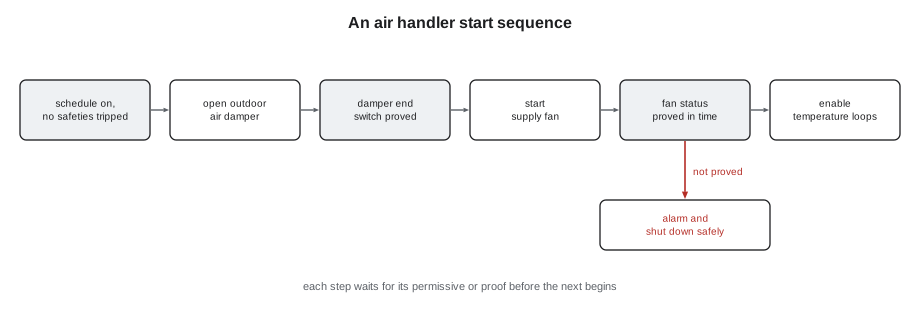
Equipment with several parts must start them in a safe order. An air handler is the standard example. If its supply fan started before its outdoor air damper opened, the fan could pull a strong negative pressure in the intake plenum, enough on some units to collapse ductwork or damage the damper blades. If the heating and cooling loops started before air was moving, they would wind up, as lesson 5 showed. So a typical start-up opens the dampers, proves them, starts the fans, proves the fans, and only then releases the temperature loops and other sequences.
Worked problem
How long AHU-1 takes to start
AHU-1's outdoor air damper actuator takes 90 seconds to stroke fully open, and its end switch closes near the end of travel. Once the switch proves, the supply fan starts. The program allows up to 30 seconds for the fan's current switch to prove. After fan proof, the program waits a further 30 seconds before enabling the temperature loops, so that air has filled the duct and the supply air sensor reads moving air. If everything works on its first try, how long after the start command do the loops take over?
Show solution
- Damper stroke and proof: about 90 s.
- Fan proof: up to 30 s; assume it proves in 10 s.
- Loop enable delay: 30 s.
- Total: 90 + 10 + 30 = 130 s, a little over 2 minutes.
Answer: Just over two minutes. If the morning start time is set for when the building must be comfortable, those two minutes, plus warm-up, must be allowed for.
Delays like these are why Sophie insisted that every delay in a start sequence be written in the sequence of operation and visible on the front end. Technicians troubleshooting a slow start have often blamed a sensor when the program was simply waiting, as designed, for a permissive. On the front end, she showed Callie AHU-1's start status point, which displayed the step the unit had reached: waiting for damper, waiting for fan proof, loops enabled or failed.
Proof and what to do when it fails
Every motor the BAS commands should have a proof that it is running, as BAS-120 explained. Proof logic compares the command with the status. If the command is on and the status does not prove within a set time, or if the status drops out while the command is still on, the program treats it as a failure. What happens next depends on the equipment. A supply fan failure usually shuts down the whole air handler, closes the outdoor air damper and alarms. A pump failure usually starts the standby pump, as lesson 8 showed. A failure of a minor fan may only alarm.
Proof logic also catches the opposite case: status on when the command is off. That can mean someone has put the starter in hand, a contactor has welded shut or a current switch has failed closed. It should alarm, because the controls have lost control of that equipment.
| Command | Status | Meaning | Typical response |
|---|---|---|---|
| On | Proved | Normal running | None |
| Off | Not proved | Normal stopped | None |
| On | Not proved after delay | Failure to start or trip | Alarm; shut down or start standby |
| Off | Proved | Running without command: hand mode, welded contact or failed switch | Alarm |
Shutdown and safe positions
Equipment must also stop safely. When an air handler shuts down, normally or because of a fault, its outdoor air damper should close, its loops should be disabled with their outputs held, and its valves should go to positions that protect the coils and the building. In a cold climate, that last point needs care. A hot water heating coil with its valve closed, sitting behind a closed but leaky outdoor air damper on a −25 °C night, can freeze. Many sequences therefore open the heating valve, keep hot water moving through the coil, or run the coil circulator when the unit is off in cold weather. A chilled water coil that is drained for winter needs none of this; one that is not drained needs freeze protection too.
Each final element also has a fail position: where it goes if it loses power or its control signal. BAS-120 lesson 6 explained spring-return actuators, which drive to a set position on power loss. An outdoor air damper on an air handler in a cold climate is normally spring-return closed. A heating valve may be spring-return open, so that a power failure sends hot water to the coil. These choices are made in design and recorded in the sequence; the controls technician's job is to confirm that the installed actuators actually do what the sequence says.
Worked problem
Checking safe positions on a power failure
Sophie asked Callie to list what AHU-1 should do if the controller lost power on a cold night, according to the sequence: outdoor air damper spring-return closed, heating valve spring-return open, cooling valve fail in place, supply fan starter dropping out because its control relay loses its coil voltage. Which of these protect the coil from freezing?
Show solution
- The outdoor air damper closes, keeping cold outdoor air off the coil.
- The heating valve opens, so hot water from the running plant flows through the coil.
- The fan stops, so no air is drawn through the unit.
- The cooling valve holding its position does not matter for freeze protection if the chilled water coil is drained for winter.
Answer: The damper closing, the heating valve opening and the fan stopping all protect the coil. Callie then tested each one by switching off the controller's power supply with the unit off, and watched each actuator go to its fail position.
Equipment permissives in the plant
Central plant equipment depends on permissives even more than air handlers do. A chiller must not run without chilled water flow, because the water in its evaporator could freeze in minutes, and it must not run without condenser water flow, because its refrigerant pressure would rise until it tripped. Most chillers check both flows themselves with flow switches or differential pressure switches wired into their own control panels, and the BAS adds its own proof before it enables the chiller. A boiler must have water flow, or for a steam boiler a safe water level, and its combustion air must be available. The BAS typically starts the pumps and proves them before it enables the machine, and then leaves the machine's own controller to manage its start-up and safeties.
| Step | Typical BAS action | Typical proof |
|---|---|---|
| 1 | Start chilled water pump | Pump current switch and chilled water flow switch |
| 2 | Start condenser water pump, open tower isolation valve | Pump status and condenser flow switch |
| 3 | Enable chiller and send setpoint | Chiller running status from its own controller |
| 4 | Enable tower fan control | Tower fan status |
| Shutdown | Disable chiller, then run pumps for a set time before stopping them | Chiller off status; pump status off after delay |
The shutdown step in the table shows a detail Prakash pointed out at Ninefield: pumps keep running for a few minutes after a chiller stops, so that the evaporator and condenser are not left with stagnant water while the machine's temperatures settle. Many chillers ask for this in their manufacturer's instructions. Stopping the pumps at the same moment as the chiller is a common mistake in hurriedly written programs.
Life-safety overrides
Some interlocks come from outside the BAS. When the fire alarm system detects smoke, it may shut down air handlers, close smoke dampers or start smoke control fans, depending on the building's fire protection design. These actions are life-safety functions and must take priority over everything the BAS would otherwise do. In practice, the fire alarm system's relays are often wired directly into the fan starter circuits, so that shutdown does not depend on the BAS at all, while the BAS reads the fire alarm signal and puts its own sequences into a matching mode. The design, installation and testing of the fire alarm side belongs to the fire alarm contractor and the building's life-safety program, as BAS-120 explained; the controls technician makes sure the BAS side responds correctly and does not fight it.
In networked systems, commands from different sources are often ranked by priority. BACnet, covered in BAS-310, uses a priority array of 16 levels, with life-safety commands at the highest priorities and normal automatic control near the lowest. An operator's manual override sits in between. When a point will not respond to its loop, a technician's first question should be whether something with a higher priority is holding it.
What Callie found
Working through the campus list with Sophie over the following weeks, Callie found two more air handlers in other buildings whose low-limit thermostats were monitored by the BAS but not wired to stop their fans, and one whose return fan could run when its supply fan had failed. Gus had all three corrected by Harcastle's electrician. Sophie added a line to Quillon's commissioning checklist: for every safety, test it with the controller switched off, because a safety that only works when the controller is on is not a safety.
Common mistakes
MistakeImplementing a life-safety or freeze safety only in software.
InsteadHardwire safeties so they act without the controller, and have the BAS monitor them.
MistakeStarting a fan before its dampers are proved open.
InsteadOpen and prove dampers first, then start the fan.
MistakeEnabling temperature loops before air or water is proved moving.
InsteadRelease loops only after proof, plus a short settling delay.
MistakeIgnoring a status that proves when the command is off.
InsteadAlarm it: the equipment is running outside BAS control.
MistakeStopping pumps at the same moment as a chiller.
InsteadRun pumps for the time the chiller manufacturer specifies after it stops.
MistakeAssuming fail positions match the sequence.
InsteadTest each actuator's fail position by removing its power.
Summary and key terms
- Permissives must be satisfied before equipment starts; interlocks tie equipment together; proofs confirm commands were obeyed; safeties stop equipment on dangerous conditions.
- Safeties must be hardwired so they act without the controller; the BAS monitors and reports them.
- Start sequences open and prove dampers, start and prove fans, then enable loops, with documented delays.
- Proof logic alarms on failure to start and on running without a command.
- Shutdown sequences and fail positions protect coils, especially from freezing in cold climates.
- Plant equipment needs proven flows before it is enabled, and pumps often run on after it stops.
- Life-safety overrides take priority, often by direct wiring, and the BAS must follow rather than fight them.
- Permissive
- A condition that must be true before equipment may start.
- Interlock
- A link that makes one piece of equipment depend on another.
- Proof
- A separate signal confirming that equipment is running or a device has moved.
- Safety
- A device that stops equipment on a dangerous condition, independently of the controller.
- Hardwired interlock
- An interlock made in wiring, which works without the controller.
- Fail position
- The position an actuator takes when it loses power or signal.
- Override
- A command that takes priority over normal control.
- Priority array
- A ranked set of command levels that decides which source controls a point.
Practice problems
Work each problem on paper first, then reveal the answer to check.
Why must an air handler's dampers be proved open before its fan starts?
Show answer
A fan starting against closed dampers can pull or push enough pressure to damage dampers or ductwork.
A pump shows status on while its command is off. Give two possible causes.
Show answer
The starter is in hand, a contactor has welded, or the current switch has failed closed.
Why are temperature loops enabled after a delay once the fan proves?
Show answer
So that air is moving past the sensor and the loops do not act on stale readings or wind up.
How should a freezestat be tested to be sure it is a true safety?
Show answer
With the controller switched off, to confirm it stops the fan on its own.
Why do chilled water pumps often run on after a chiller stops?
Show answer
To keep water moving through the evaporator and condenser while the machine settles, as manufacturers require.
Lesson quiz · 5 questions
Score 60% or more to complete this lesson.
Create a free account to save your progress, take quizzes and earn a certificate.