
BAS-130 · Lesson 4 of 12 · 29 min
Proportional control and offset
▶ Video coming soon A video version of this lesson is on the way.
On Friday, October 2, Nell Nakagawa, Harcastle's chief building operator, joined the Friday loop in the Tilden basement. Prakash had asked her permission to run a small experiment on the hot water converter, the steam-to-hot-water heat exchanger that serves Tilden's radiation and reheat coils. With the plant lightly loaded on a mild afternoon, he set the loop's integral action to zero for half an hour, turning it into a proportional-only loop, and asked Callie to watch the trend. Within a few minutes the hot water supply settled, steady as a rock, about two degrees below its setpoint. "That," said Prakash, "is offset. And it's not a fault. It's what proportional control does." This lesson explains why.
Proportional control is the foundation of modulating control. A proportional controller moves its output in proportion to the error: a small error gives a small correction and a large error a large one. It is a big step up from two-position control, because the output can settle at any position between 0 and 100 in 100 and the process variable can hold steady instead of cycling. Its limitation is the offset Callie saw in the trend, which lesson 5 shows how to remove with integral action.
How proportional control works
A proportional controller calculates its output from the error using a straight line. The output equals a fixed starting value, called the bias, plus the error multiplied by a number called the proportional gain. The bias is the output the controller gives when the error is zero. The gain says how many units of output, in hundredths of full output, the controller adds for each unit of error.
Here u is the output, u₀ is the bias, Kp is the proportional gain and e is the error. For a reverse-acting heating loop, the error as defined in lesson 2 is positive when the process variable is below setpoint, so the output rises as the temperature falls. For a direct-acting loop, the controller uses the opposite sign. Many controllers fix the bias at 50 in 100, the middle of the range; some let it be set, and some call it manual reset, a name from pneumatic days when a technician adjusted it by hand.
Throttling range and proportional band
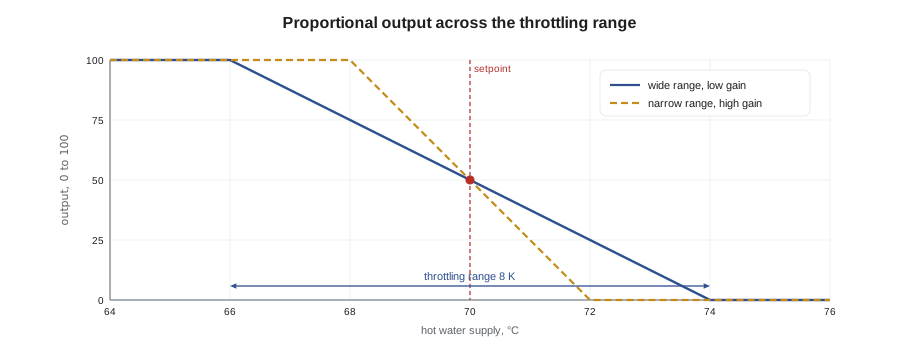
Gain is not the only way to describe a proportional controller. Many controllers and almost all older ones use the throttling range instead: the change in process variable needed to drive the output from 0 to 100 in 100. A heating loop with a throttling range of 8 K moves its valve from fully closed to fully open as the temperature falls by 8 K. Gain and throttling range are two ways of saying the same thing, and one is simply 100 divided by the other.
A related term is proportional band, which some controllers use to mean the throttling range expressed as a fraction of the sensor's full span rather than in engineering units. Vendors use all three terms, sometimes loosely. Callie made a note in her book: before changing any proportional setting, read the manual to find out whether the number is a gain, a throttling range in units, or a proportional band as a fraction of span. A wide throttling range is a low gain, a gentle loop. A narrow throttling range is a high gain, an aggressive loop.
Worked problem
Gain from throttling range
Tilden's hot water converter loop has a throttling range of 8 K. What is its proportional gain, and how far does the steam valve move if the water temperature falls 1.5 K below setpoint?
Show solution
- Gain: 100 ÷ 8 = 12.5 per kelvin, meaning 12.5 hundredths of full output per kelvin of error.
- Change in output: 12.5 × 1.5 = 18.75, about 19 in 100.
Answer: A gain of 12.5 per K; the valve opens about 19 in 100 further than its bias position.
Why proportional control leaves an offset
Here is the important part. A proportional controller produces exactly its bias output only when the error is zero. Any other output requires an error. If the load on the loop needs the steam valve 75 in 100 open to balance it, and the bias is 50, the controller can only produce 75 by having an error large enough to add 25. The loop therefore settles with the process variable away from setpoint by just that much error, and stays there as long as the load stays the same. That steady error is the offset.
Worked problem
Offset on the converter
The converter loop has a setpoint of 70 °C, a throttling range of 8 K and a bias of 50 in 100. On a cold morning the building needs the steam valve 75 in 100 open to hold the water steady. Using proportional control only, where does the hot water temperature settle?
Show solution
- Gain: 100 ÷ 8 = 12.5 per K.
- Extra output needed above the bias: 75 − 50 = 25.
- Error needed to produce it: 25 ÷ 12.5 = 2.0 K.
- Settled temperature: 70 − 2.0 = 68 °C.
Answer: The water settles at 68 °C, an offset of 2 K below setpoint, for as long as the load needs the valve at 75 in 100.
On that mild afternoon the load had needed the valve at about 75 in 100 while the converter was recovering from the start of the test, which is why Callie saw an offset of about two degrees. As the load changed, so did the offset: when an air handler shut down at 16:30 and the load dropped, the water temperature crept up toward setpoint. On a day when the load happened to need exactly 50 in 100, the offset would be zero. That is the only load at which a proportional-only loop holds setpoint.
Narrowing the throttling range: less offset, less stability
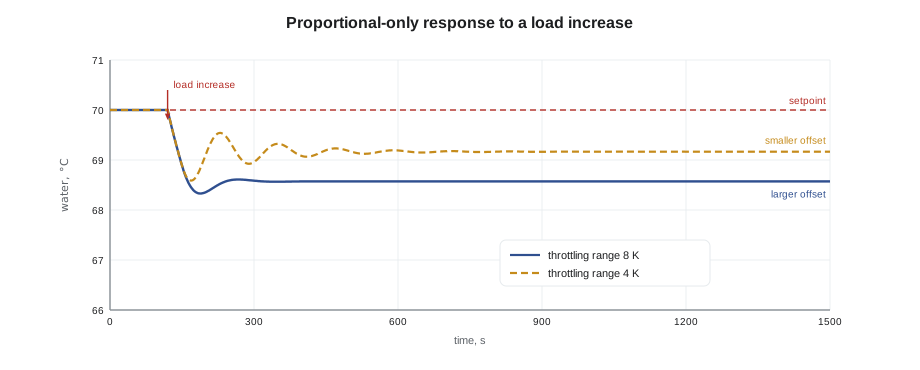
The obvious way to shrink the offset is to narrow the throttling range, raising the gain, so that a smaller error produces the needed change in output. Halving the throttling range halves the offset. But there is a limit. Every real process has lags: it takes time for a valve's change to show up at the sensor. A high-gain controller reacts strongly to what it sees now, and by the time the result arrives it has already gone too far. The loop overshoots, reacts strongly the other way and starts to swing. Push the gain high enough and the swing never dies out.
Worked problem
Trading offset for stability
If the converter's throttling range is narrowed from 8 K to 4 K, what offset results at the same 75 in 100 load? What is the risk?
Show solution
- New gain: 100 ÷ 4 = 25 per K.
- Error needed: 25 ÷ 25 = 1.0 K.
Answer: The offset halves to 1 K, but the doubled gain makes the loop more likely to overshoot and hunt.
This tension is why proportional-only control is rare in modern DDC systems for anything important. A throttling range wide enough to be stable usually leaves too much offset, and a range narrow enough to remove the offset is too nervous. Lesson 5 shows how integral action resolves the dilemma: keep a moderate gain for stability, and let integral action slowly add whatever output is needed to drive the error to zero.
Where proportional-only control is still used
Proportional-only control is still found in a few places. Older pneumatic room thermostats are proportional only, and the offset is part of why rooms on them drift with the seasons. Many self-contained valves, such as thermostatic radiator valves and some self-acting temperature regulators, are proportional. In DDC systems, proportional-only control is sometimes used deliberately as the outer loop of a cascade, where a small offset in the room is acceptable and the extra stability is welcome, or where a loop only needs to keep a value within a band, such as a high limit that throttles back a fan.
| Setting | Wide throttling range (low gain) | Narrow throttling range (high gain) |
|---|---|---|
| Offset | Large | Small |
| Response to upsets | Gentle and slow | Strong and fast |
| Stability | Very stable | Prone to overshoot and hunting |
| Valve and actuator wear | Low | Higher |
| Typical use | Outer loops, forgiving processes | Rarely used alone; paired with integral action |
A direct-acting example
The same arithmetic works for a direct-acting loop, with the output rising as the process variable rises above setpoint. AHU-1's cooling valve is a direct-acting loop on supply air temperature. Its bias is zero: with no error, the controller assumes no cooling is needed. That is a common choice for loops that sit at zero output much of the time, but it means a proportional-only cooling loop would need a sizeable error before it opened at all.
Worked problem
Cooling valve output
AHU-1's cooling valve loop has a supply air setpoint of 13.0 °C, a throttling range of 3 K and a bias of zero. With proportional action alone, what does the loop command when the supply air reads 14.2 °C?
Show solution
- Gain: 100 ÷ 3 = 33.3 per K.
- The air is above setpoint by 14.2 − 13.0 = 1.2 K.
- Output: 0 + 33.3 × 1.2 = 40 in 100.
Answer: The cooling valve is commanded to 40 in 100. If that holds the air at 14.2 °C, the loop has an offset of 1.2 K.
Ending the experiment
At 16:45 Prakash restored the integral setting he had written on the work order before starting, and the trend showed the water temperature climbing back to setpoint over the next ten minutes, with the steam valve opening a little further to get it there. Nell asked why anyone would ever set up a loop without integral. "Sometimes you don't want the loop chasing the last tenth of a degree," Prakash said. "But mostly it's someone in a hurry." Callie wrote down his other rule: always record a setting before you change it, so you can put it back.
Proportional control on a trend
A proportional-only loop has a recognizable signature on a trend. After a load change the process variable moves away from setpoint, the output moves to oppose it, and both settle at new steady values with the process variable sitting parallel to the setpoint line but off it. When the load changes again, the offset changes with it: larger as the load moves further from the bias output, smaller as it moves back. On a heating loop that follows the weather, the offset grows on cold mornings and shrinks on mild afternoons, so the trend shows the process variable drifting through the day in step with the output. A PI loop following the same load shows the output moving just as much, but the process variable returns to setpoint after each change.
Callie found it useful to read a proportional-only trend backwards. If she knew the throttling range and the bias, the offset at any moment told her what output the load needed, and the output told her the same thing from the other side. When the two disagreed, something else was wrong: a sensor reading off, a valve not following its command, or a bias that was not what the configuration said.
Worked problem
Working back from a trend
A proportional-only loop has a throttling range of 5 K and a bias of 50. Its trend shows the process variable settled 1.2 K below setpoint. What output should the trend show, and what would it mean if the trend showed 50?
Show solution
- Gain: 100 ÷ 5 = 20 per K.
- Expected output: 50 + 20 × 1.2 = 74 in 100.
Answer: About 74 in 100. An output of 50 with a steady error would mean the loop is not proportional only, the error is not what the controller sees, or the configuration differs from what was assumed. Each of those is worth checking before any tuning.
Setting a proportional loop by hand
Where a proportional-only loop is used on purpose, such as a forgiving outer loop or a high limit, its throttling range is usually set by judgment rather than by calculation. A good starting point is to ask how much error is acceptable at the largest expected load. If the loop must never be more than 2 K from setpoint when the output is at 100 in 100, and the bias is 50, the throttling range can be no wider than about 4 K, because half of the range must fit inside the allowed error. The technician then checks that the loop is stable at that setting by making a small setpoint change and watching for overshoot. If it swings, the process cannot tolerate that much gain, and the requirement for close control means integral action is needed after all.
Prakash's view was that proportional-only loops are worth understanding mainly because every PI loop contains one. The proportional part sets how firmly a loop reacts to an error the moment it appears; the integral part sets how patiently it works off whatever error remains. Lesson 5 adds the second half.
Common mistakes
MistakeTreating offset on a proportional-only loop as a fault to be fixed by recalibration.
InsteadOffset is built into proportional control; add integral action or accept it.
MistakeMixing up gain, throttling range and proportional band.
InsteadCheck the controller's manual; gain is 100 divided by the throttling range.
MistakeNarrowing the throttling range until the offset disappears.
InsteadHigh gain makes the loop overshoot and hunt; use integral action instead.
MistakeChanging a loop setting without recording the old value.
InsteadWrite the original settings down so they can be restored.
MistakeAssuming the bias is always 50 in 100.
InsteadSome loops, such as cooling valves, use a bias of zero; check the configuration.
Summary and key terms
- A proportional controller's output is the bias plus the gain times the error.
- Throttling range is the change in process variable that moves the output from 0 to 100 in 100; gain is 100 divided by it.
- Proportional band may mean the throttling range as a share of the sensor span; check the manual.
- A proportional-only loop settles with an offset unless the load happens to need exactly the bias output.
- Narrowing the throttling range reduces offset but makes the loop more likely to overshoot and hunt.
- Proportional-only control is used where some offset is acceptable or stability matters most; most DDC loops add integral action.
- Proportional control
- Control in which the output changes in proportion to the error.
- Proportional gain
- The change in output per unit of error.
- Throttling range
- The change in process variable needed to move a proportional output from 0 to 100 in 100.
- Proportional band
- The throttling range, often expressed as a share of the sensor's span.
- Bias
- The output a proportional controller gives at zero error; also called manual reset.
- Offset
- The steady error that a proportional-only loop needs to produce an output different from its bias.
Practice problems
Work each problem on paper first, then reveal the answer to check.
What is the gain of a loop with a 5 K throttling range?
Show answer
100 ÷ 5 = 20 per K.
A P-only heating loop with a 5 K throttling range and 50 bias needs 70 in 100 output. What is the offset?
Show answer
20 ÷ 20 = 1 K below setpoint.
At what load does a proportional-only loop have no offset?
Show answer
When the load needs exactly the bias output.
What happens if the throttling range is made very narrow?
Show answer
Offset shrinks but the loop overshoots and may hunt.
What older name for the bias came from pneumatic controllers?
Show answer
Manual reset.
Lesson quiz · 5 questions
Score 60% or more to complete this lesson.
Create a free account to save your progress, take quizzes and earn a certificate.