
BAS-130 · Lesson 3 of 12 · 25 min
Two-position and floating control
▶ Video coming soon A video version of this lesson is on the way.
On Friday, September 25, the Friday loop moved out of the mechanical room and into Tilden Hall's east stair. The stair halls are heated by small cabinet fan coils, each run by a simple thermostat that switches the fan and a two-way hot water valve together: on or off, nothing in between. On the way back down, Prakash stopped at a VAV box above the second-floor corridor ceiling and showed Callie its reheat valve actuator, which had three wires instead of the two or three she had seen on the modulating actuators at AHU-1. "Two of the oldest ways to control anything," he said. "Still in every building. Still misunderstood." This lesson covers two-position control, where the output is either fully on or fully off, and floating control, where the controller drives an actuator open or closed in short bursts and leaves it where it stops.
Both methods predate modern DDC controllers, and both are still common because they are cheap, robust and good enough for many jobs. A technician needs to know how they behave, how to set them up, and what problems they cause when misapplied. Lesson 4 then moves on to proportional control, which most people mean when they talk about modulating control.
Two-position control
Two-position control, also called on/off control, switches the final control element fully on or fully off. A household thermostat on a furnace is the familiar example. In buildings, two-position control runs small fan coils and unit heaters, electric baseboard heaters, exhaust fans on temperature or carbon monoxide, sump and condensate pumps on level, freeze protection pumps and many alarms. The final element is either a relay-driven device or a valve or damper with a two-position actuator that drives fully open or fully closed.
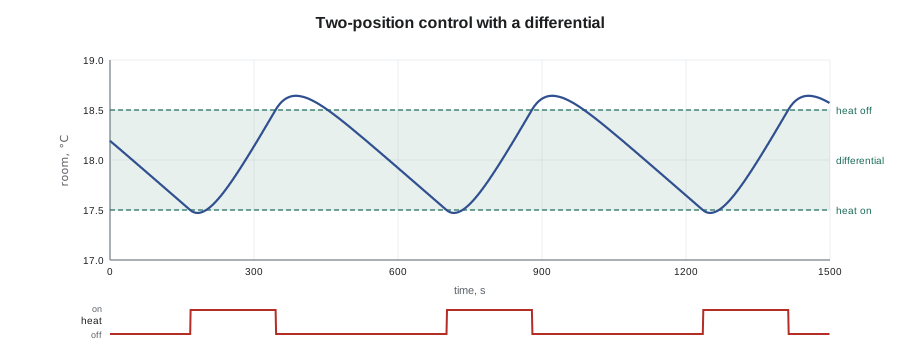
If a two-position controller switched on the instant the temperature fell below setpoint and off the instant it rose above, the equipment would chatter on and off many times a minute. Every two-position control therefore has a differential: a gap between the value at which it switches on and the value at which it switches off. A heating thermostat with a setpoint of 18 °C and a differential of 1 K might switch the heat on at 17.5 °C and off at 18.5 °C, or on at 18.0 and off at 19.0, depending on how the manufacturer defines the setpoint. The documentation says which, and it matters when matching a sequence of operation.
Cycling: the differential sets the rate
Under two-position control, the process variable never settles. It rises while the output is on and falls while it is off, cycling continuously between the switching points. How fast it cycles depends on how quickly the space heats with the equipment on, how quickly it cools with the equipment off, and the size of the differential. A narrow differential gives close control but frequent cycling; a wide one gives fewer starts but bigger swings. The choice is a compromise between comfort and equipment wear.
Worked problem
Cycle rate of a stair hall fan coil
With the fan coil running, the east stair warms at about 0.5 K per minute. With it off, the stair cools at about 0.25 K per minute. The thermostat's differential is 1 K. Ignoring lag, how long is each on period and off period, and how many cycles per hour result? What happens if the differential is widened to 2 K?
Show solution
- On time: 1 K ÷ 0.5 K per minute = 2 minutes.
- Off time: 1 K ÷ 0.25 K per minute = 4 minutes.
- One cycle: 2 + 4 = 6 minutes, so 60 ÷ 6 = 10 cycles per hour.
- With a 2 K differential: on 4 minutes, off 8 minutes, a 12-minute cycle and 5 cycles per hour.
Answer: Doubling the differential halves the number of cycles and doubles the temperature swing. The on fraction, 2 out of 6 minutes, stays the same, because it is set by the load, not the differential.
The last point in the example is worth understanding. The fraction of time the equipment runs is set by the load: on a colder day the stair cools faster with the heat off, so the off periods shorten and the equipment runs a larger fraction of the time. The differential only changes how that running time is chopped up. Callie found it useful to think of two-position control as averaging its output over time to match the load, the same job a modulating valve does continuously.
Lag, overshoot and anticipation
In practice the temperature does not stop exactly at the switching points. When the heat switches off, the coil is still hot, the fan coil's cabinet is warm and the air near the sensor has not yet mixed, so the temperature keeps rising for a while. When the heat switches on, the coil takes time to warm up, so the temperature keeps falling. These lags make the real swing larger than the differential. A sensor that responds slowly, or one mounted where it sees the warm air late, makes the swing worse.
Old electromechanical thermostats used a small heater called an anticipator to warm the sensing element while the heat was on, so that it switched off a little early and cut the overshoot. Electronic two-position controllers do something similar in software, or use a minimum on time and minimum off time to limit cycling. Minimum times matter most for equipment that does not like short runs. Compressors need several minutes off between starts so that pressures can equalize and the motor can cool, and many burners need a minimum run to avoid condensing flue gas in a cold heat exchanger. Those protections are usually built into the equipment's own controls, and the BAS should respect them rather than override them.
| Equipment | Why short cycling is a problem | Typical protection |
|---|---|---|
| Compressor | Motor heating and oil migration; high starting current | Minimum off time of a few minutes in the unit controls |
| Gas burner | Condensation in a cold heat exchanger; ignition wear | Minimum run time and purge sequence |
| Electric heater with contactor | Contact wear | Wider differential or solid-state switching |
| Fan coil valve and fan | Noise and drafts as the fan starts and stops | Wider differential or continuous fan |
Time-proportioning: two-position with a modulating feel
A controller can make a two-position device behave almost like a modulating one by switching it on and off within a fixed cycle time, with the on fraction set by a calculated output. This is called time-proportioning or pulse-width modulation. An electric duct heater switched by a solid-state relay is the common example. If the loop asks for 40 in 100 output and the cycle time is 30 seconds, the heater runs 12 seconds and rests 18. Because the cycle is short compared with how quickly the air temperature can change, the air sees an average. Mechanical contactors wear out quickly at short cycle times, so this method is used with solid-state relays, or with longer cycle times where contactors are fitted.
Worked problem
Time-proportioning an electric heater
A 10 kW electric reheat coil is switched by a solid-state relay on a 30-second cycle. The loop's output is 40 in 100. How long is the heater on in each cycle, and what is its average power?
Show solution
- On time: 0.40 × 30 s = 12 s; off time 18 s.
- Average power: 0.40 × 10 kW = 4 kW.
Answer: On for 12 seconds of every 30, giving an average of 4 kW. The air downstream sees a nearly steady temperature because the coil and duct smooth out the pulses.
Floating control
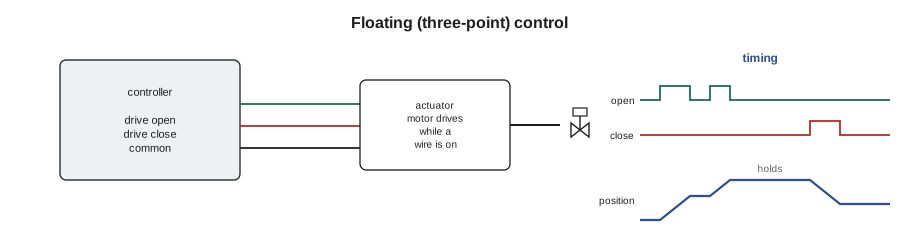
Floating control drives an actuator open, drives it closed, or leaves it where it is. The controller has two outputs, often called drive open and drive close, usually 24 V AC triac outputs, and the actuator has three wires: common, open and close. While the open output is energized, the actuator's motor runs toward open at a constant speed. When neither is energized, the actuator stops and holds its position. This arrangement is also called three-point or tri-state control. The reheat valves on many VAV boxes, including those in Tilden, use floating actuators because they are cheap and need only two binary outputs on a small controller.
The controller decides when to drive by looking at the error. Most floating controllers have a neutral zone around the setpoint, inside which they send no pulses at all, so the actuator rests. Outside the neutral zone the controller sends pulses toward correcting the error, often longer pulses for larger errors. Modern DDC controllers usually run a full proportional-plus-integral calculation and then convert the change in calculated output into pulse time, so the valve moves as if driven by a modulating signal.
Worked problem
Pulse time for a floating actuator
A floating reheat valve actuator takes 90 seconds to travel from fully closed to fully open. The controller believes the valve is 20 in 100 open and its loop now calls for 50 in 100. How long should the drive-open output be on? Later the loop calls for 35 in 100. How long should the drive-close output be on?
Show solution
- Change from 20 to 50 in 100 is 30 in 100 of full stroke: 0.30 × 90 s = 27 s of drive open.
- Change from 50 to 35 in 100 is 15 in 100: 0.15 × 90 s = 13.5 s of drive close.
Answer: About 27 seconds open, then about 13.5 seconds closed. The controller must be configured with the correct stroke time, or every move will be the wrong size.
Floating control's weak point: knowing where the valve is
A floating actuator does not report its position. The controller works out the position by adding up the time it has driven each way, which is only correct if the stroke time in the controller matches the actuator and the actuator moved exactly as commanded. Small errors add up. After hours of small moves, the controller may believe the valve is at 20 in 100 when it is really at 35 or at 5. The usual cure is resynchronization: at regular intervals, or whenever the calculated position reaches 0 or 100, the controller overdrives the actuator fully closed or fully open for longer than the stroke time, which puts both back at a known end.
Callie saw the effect of a wrong stroke time on the trend of a second-floor VAV box that afternoon. The box controller had been configured for a 60-second actuator, but the replacement actuator installed in 2023 took 150 seconds. Every move the loop asked for came out at less than half its intended size, so the reheat loop crept slowly toward what it wanted and the room took most of the morning to warm. After she corrected the stroke time to 150 seconds, the next morning's warm-up took twenty minutes. The same box had been listed for a too-cold complaint the previous winter.
| Symptom on a floating valve | Likely cause |
|---|---|
| Loop slow to respond, valve creeps | Stroke time set shorter than the actuator's real stroke |
| Loop overshoots, valve jumps | Stroke time set longer than the real stroke |
| Calculated position drifts from real position | No resynchronization, or slipped linkage |
| Valve hums at an end of travel | Controller still driving an actuator already at its stop, normal only during resync |
| Valve moves opposite to command | Open and close wires swapped |
Choosing between them
Two-position control is right where the process is slow and forgiving, the equipment tolerates cycling and a swing of a degree or two is acceptable: stair halls, vestibules, storage rooms, garages and mechanical spaces. Floating control is right where the controller has only binary outputs and the actuator is a cheap three-wire type: VAV reheat valves, small fan coil valves and zone dampers. Proportional modulating control, covered next, is the choice where tight control matters and the process is fast: supply air temperatures, duct pressures and hot and chilled water temperatures. In older buildings you will find all three side by side, and part of the controls technician's job is knowing which one is in front of you.
Back in the stair, Prakash showed Callie the cabinet fan coil's thermostat: a differential of 1 K and a sensor on the return air grille at the bottom of the cabinet. The stair cycled about eight times an hour on a mild day, which nobody minded. "Don't fix what's working," he said. "Just know why it works."
Common mistakes
MistakeSetting a two-position differential very narrow for tight control.
InsteadA narrow differential causes rapid cycling and wear; choose a differential the equipment and occupants can live with.
MistakeOverriding a compressor's or burner's minimum run and off times from the BAS.
InsteadRespect the equipment's own protective timers.
MistakeLeaving the default stroke time on a replacement floating actuator.
InsteadEnter the actual stroke time from the actuator's data sheet or by timing it.
MistakeExpecting a floating valve's calculated position to stay accurate forever.
InsteadMake sure the controller resynchronizes at the ends of travel.
MistakeUsing mechanical contactors for fast time-proportioning.
InsteadUse solid-state relays, or a cycle time long enough for contactor life.
Summary and key terms
- Two-position control switches the output fully on or off, with a differential between the switching points.
- The process variable cycles continuously; the differential sets the cycle rate and swing, while the load sets the on fraction.
- Lags make the real swing larger than the differential; anticipation and minimum on and off times limit cycling.
- Time-proportioning switches a device within a fixed cycle so that its average output matches a calculated value.
- Floating control drives a three-wire actuator open or closed in pulses and holds its position in between.
- Floating control depends on a correct stroke time and regular resynchronization, because the actuator does not report position.
- Two-position suits slow, forgiving spaces; floating suits cheap terminal valves; proportional suits fast, critical loops.
- Two-position control
- Control that switches the output fully on or fully off; also called on/off control.
- Differential
- The gap between the switch-on and switch-off values of a two-position control.
- Short cycling
- Starting and stopping equipment too frequently.
- Anticipator
- A device or function that makes a two-position control switch off slightly early to limit overshoot.
- Time-proportioning
- Switching a device on and off within a fixed cycle, with the on fraction set by the loop output.
- Floating control
- Control that drives an actuator open or closed in pulses and leaves it in place between them; also called three-point or tri-state control.
- Neutral zone
- A band around the setpoint in which a floating controller sends no pulses.
- Stroke time
- The time an actuator takes to travel from fully closed to fully open.
- Resynchronization
- Overdriving a floating actuator to an end so that the controller knows its position again.
Practice problems
Work each problem on paper first, then reveal the answer to check.
A space warms at 0.4 K per minute with the heat on and cools at 0.2 K per minute with it off. With a 1 K differential, how many cycles per hour?
Show answer
On 2.5 minutes, off 5 minutes: a 7.5-minute cycle, so 8 cycles per hour.
A floating actuator has a 120-second stroke. How long must it drive open to move from 10 to 40 in 100?
Show answer
0.30 × 120 = 36 seconds.
A 6 kW heater is time-proportioned on a 20-second cycle at 25 in 100. What is its on time?
Show answer
0.25 × 20 = 5 seconds on, 15 off, averaging 1.5 kW.
Why does widening the differential not change how much of the time the heater runs?
Show answer
The on fraction is set by the load; the differential only changes how often it cycles and how far the temperature swings.
A floating valve opens when the controller says close. What is the likely fault?
Show answer
The drive-open and drive-close wires are swapped.
Lesson quiz · 5 questions
Score 60% or more to complete this lesson.
Create a free account to save your progress, take quizzes and earn a certificate.