
BAS-130 · Lesson 7 of 12 · 25 min
Reset schedules and cascading loops
▶ Video coming soon A video version of this lesson is on the way.
By the Friday loop on October 23 the mornings had turned cold, and Nell Nakagawa had asked Quillon to look at the hot water reset schedule on Tilden Hall's converter. The schedule raised the hot water setpoint as the outdoor temperature fell, but it had last been adjusted years before, and on mild afternoons the reheat coils on the VAV boxes were running hotter water than they needed. Prakash used the job to show Callie two ideas that appear in almost every modern sequence of operation: reset, which changes a loop's setpoint automatically as conditions change, and cascade, in which one loop sets the setpoint of another.
Lessons 4 to 6 treated a loop's setpoint as given. This lesson looks at where good setpoints come from. A fixed setpoint must suit the worst conditions the system will ever see, so it is wrong, and usually wasteful, most of the time. Resetting setpoints to match the real load saves energy and often makes control easier. Cascading loops lets a slow loop that measures what really matters, such as a room temperature, steer a fast loop that controls something it can act on quickly, such as a supply air temperature.
Why reset setpoints
Heating and cooling systems are sized for design conditions: the coldest or hottest days the building is expected to see. For most of the year the load is much smaller. A hot water system that runs at its design temperature on a mild day loses more heat from its piping, makes the control valves throttle nearly closed where they control poorly, and in a condensing boiler plant keeps the return water too hot for the boilers to condense. Lowering the hot water temperature as the weather warms reduces all three problems. The same logic applies to supply air temperature, chilled water temperature and duct static pressure: each can be relaxed when the load allows.
A reset can be driven by an outside condition, most often outdoor air temperature, or by demand: signals from the zones or coils that the system serves, saying whether they are getting enough. Outdoor air reset is simple and predictable but does not know about internal loads or sunshine. Demand-based reset responds to what the building actually needs, at the cost of more programming and the need to keep one bad zone from driving the whole system.
An outdoor air reset schedule
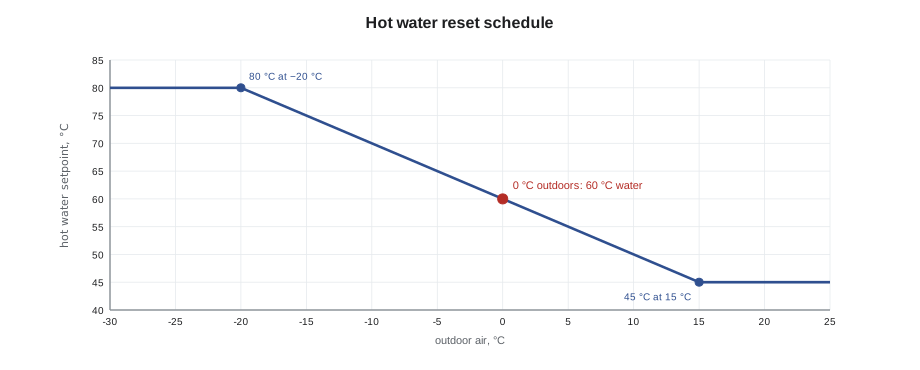
The classic reset schedule is a straight line between two points: a high setpoint at a cold design outdoor temperature and a low setpoint at a mild one, with the setpoint held at its limits beyond them. The controller calculates the setpoint from the outdoor temperature continuously, and the converter's PI loop, tuned in lesson 6, holds the water at whatever setpoint the schedule gives.
Worked problem
Reading the Tilden reset schedule
Tilden's schedule sets the hot water at 80 °C when it is −20 °C outdoors and at 45 °C when it is 15 °C outdoors, in a straight line between. What is the setpoint at 0 °C, at −5 °C and at −12 °C?
Show solution
- Slope: (80 − 45) ÷ (15 − (−20)) = 35 ÷ 35 = 1 K of water per K of outdoor air.
- At 0 °C: 80 − 1 × (0 − (−20)) = 60 °C.
- At −5 °C: 80 − 15 = 65 °C.
- At −12 °C: 80 − 8 = 72 °C.
Answer: 60 °C, 65 °C and 72 °C. Above 15 °C outdoors the setpoint stays at 45 °C; below −20 °C it stays at 80 °C.
Choosing the end points is a mechanical design decision, not a controls one, and a technician should not change them without the designer's or operator's agreement. The low end must still be hot enough for the coils that need the most heat, such as reheat coils serving north-facing rooms or a coil with a freeze risk. The high end must be within what the plant can deliver. Nell's concern turned out to be the mild end: at 15 °C the schedule's 45 °C water was fine for radiation, but several VAV reheat coils had been selected for hotter water, and two north classrooms struggled on cool, cloudy afternoons. The fix she approved was not to raise the whole schedule but to add a demand override, described next.
Demand-based reset
A demand-based reset adjusts a setpoint from signals sent by the equipment the system serves. In a hot water system, each reheat valve can report how far open it is. If any valve stays nearly wide open, the water may be too cool for that zone, and the setpoint is nudged up. If every valve is well below fully open, the water can be cooler, and the setpoint is nudged down. The same idea drives supply air temperature reset from VAV box demand, chilled water reset from cooling coil valve positions, and static pressure reset from VAV damper positions.
A common way to organize demand-based reset is trim and respond. At a fixed interval, the controller counts the requests coming from the zones, where a request means a zone is struggling, for instance a damper at 95 in 100 open or more. If the number of requests is at or below a threshold, called the ignored requests, the controller trims the setpoint a small amount in the energy-saving direction. If there are more requests, it responds by moving the setpoint the other way, by an amount for each request above the threshold, up to a maximum per interval. Ignoring the first few requests keeps one rogue zone, with a stuck damper or a bad sensor, from holding the whole system at its worst setting. ASHRAE Guideline 36, High-Performance Sequences of Operation for HVAC Systems, published in a 2024 edition, sets out trim and respond logic in detail for air handlers and plants, and BAS-230 covers it.
Worked problem
One step of trim and respond
Ninefield's draft retro-commissioning sequence proposes trim and respond on the supply duct static pressure. Using sample values, not those of any standard: every 2 minutes, with 2 ignored requests, trim 12 Pa if requests are 2 or fewer, otherwise respond with +15 Pa per request above 2, but never more than +32 Pa per interval. The setpoint is 300 Pa. What happens with 1 request? With 5 requests?
Show solution
- 1 request is not more than 2, so trim: 300 − 12 = 288 Pa.
- 5 requests is 3 above the threshold: 3 × 15 = 45 Pa, but the maximum is 32 Pa.
- New setpoint: 300 + 32 = 332 Pa.
Answer: With 1 request the setpoint trims to 288 Pa; with 5 it responds to 332 Pa. The setpoint also stays between the minimum and maximum set in the sequence.
Prakash's warning about demand-based reset was that it depends on the zones telling the truth. A VAV box with a failed flow sensor or a stuck damper can generate requests forever. Good sequences let the operator see which zones are sending requests and exclude a zone that is faulty, and they count requests over time so that a technician can find the habitual offenders. The spring retro-commissioning at Ninefield, a plan for 2027, included cleaning up exactly that list.
Supply air temperature reset
Supply air temperature on a VAV air handler is commonly reset between a cold setpoint, used when cooling demand is high, and a warmer one, used when the zones need little cooling or when the air is mostly being reheated. Raising the supply air temperature in mild or cool weather saves cooling energy, reduces reheat and lets the economizer, covered in BAS-230, do more of the work. The trade-off is fan energy: warmer air means more of it is needed for the same cooling, so the reset usually only rises when the fans have spare capacity or when outdoor conditions favour it. Humidity limits matter too: in humid weather the coil must stay cold enough to dehumidify.
| Reset | Usual driver | Saves | Limits to respect |
|---|---|---|---|
| Hot water supply temperature | Outdoor temperature, valve demand | Piping losses, boiler fuel, better valve control | Coils that need hot water, boiler minimums |
| Chilled water supply temperature | Coil valve demand | Chiller energy | Dehumidification, pump energy |
| Supply air temperature | Zone cooling demand, outdoor temperature | Cooling and reheat energy | Humidity, fan capacity |
| Duct static pressure | VAV damper positions | Fan energy | Minimum pressure for the furthest boxes |
| Water differential pressure | Valve positions | Pump energy | Minimum flow through equipment |
Cascade control
In cascade control, the output of one loop becomes the setpoint of another. The outer, or primary, loop controls the quantity that really matters, which is usually slow to respond. The inner, or secondary, loop controls an intermediate quantity that responds quickly and that the inner loop's final element can act on directly. Because the inner loop is fast, it corrects disturbances in its own part of the system before they reach the outer loop. The outer loop then only has to deal with the slower changes in its own load.
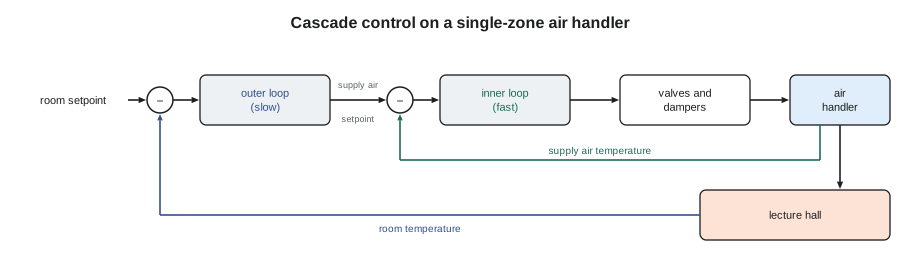
Tilden's AHU-2, the older unit serving the lecture wing, is a good example. It serves a single large zone, the lecture halls, so its supply air temperature should follow what the halls need. The outer loop compares the hall temperature with its setpoint and calculates a supply air setpoint, within limits. The inner loop holds the supply air at that setpoint by moving the heating valve and the dampers. When a cold gust of outdoor air reaches the mixing box, the inner loop sees the supply air drop within a few seconds and corrects it, long before the hall would have noticed. When 120 students arrive for a lecture, the hall warms over several minutes, and the outer loop slowly lowers the supply air setpoint.
Worked problem
Outer loop output to inner loop setpoint
AHU-2's outer loop output, 0 to 100 in 100, is scaled to a supply air setpoint between 13 °C and 30 °C. The outer loop's output is 40. What supply air setpoint does the inner loop receive?
Show solution
- Span: 30 − 13 = 17 K.
- Setpoint: 13 + 0.40 × 17 = 19.8 °C.
Answer: 19.8 °C. The limits of 13 and 30 °C keep the hall from ever receiving air too cold or too hot.
VAV boxes use the same idea. A pressure-independent VAV box has an inner loop that controls airflow, using the flow pickup and K-factor from BAS-120, and an outer loop that controls room temperature by setting the airflow setpoint between a minimum and a maximum. If the duct pressure changes because another box has opened, the inner flow loop corrects the airflow at once and the room never notices. That is what pressure independent means. BAS-220 shows how the two loops are built in a VAV program.
Making cascades work
Three rules make cascade control behave. First, the inner loop must be considerably faster than the outer loop, a rule of thumb being at least three to five times. If the two respond at similar speeds, they fight. Second, tune the inner loop first, with the outer loop in manual, and then tune the outer loop with the inner loop in automatic. Third, the outer loop must know when the inner loop has reached a limit: if the supply air setpoint is already at its maximum and the inner loop's valve is wide open, the outer loop should stop winding up its integral, using the anti-windup methods of lesson 5. Many controllers handle this automatically when loops are linked in a cascade; when they are built from separate blocks, the programmer must provide it.
Cascades are not always worth it. They add a loop to tune and a layer to troubleshoot, and when an outer loop sets a setpoint the technician can no longer judge the inner loop by comparing it with a fixed number. When reading a cascade's trend, Prakash's advice was to trend the outer process variable and setpoint, the inner setpoint the outer loop is producing, the inner process variable and the final output, all on one graph.
Feedforward: helping a loop at a known event
A loop can also be helped by feedforward: adding a known correction to its output when an event happens that will certainly upset it, instead of waiting for the error. Lesson 1 showed Tilden's hot water dipping by a degree for ten minutes when the air handlers started at 6:00. A feedforward term that opens the steam valve a little further when the air handlers' start command goes out, and then fades away, lets the closed loop start from a better position. Feedforward needs a reliable relationship between the event and the needed correction, and it must be added carefully so that it does not cause an overshoot of its own. Nell and Prakash agreed to try it in the new year, a plan rather than a change made that day.
Common mistakes
MistakeChanging a reset schedule's end points without asking the designer or operator.
InsteadEnd points are a design decision tied to coil and plant capacity; agree changes first.
MistakeLetting one faulty zone drive a demand-based reset.
InsteadUse ignored requests and let operators exclude faulty zones.
MistakeBuilding a cascade from two loops of similar speed.
InsteadMake the inner loop several times faster than the outer loop.
MistakeTuning the outer loop of a cascade first.
InsteadTune the inner loop first, then the outer loop.
MistakeForgetting outer-loop anti-windup when the inner loop is at a limit.
InsteadStop the outer loop integrating when the inner loop cannot follow.
Summary and key terms
- Resetting setpoints to match the real load saves energy and often improves control at part load.
- Outdoor air reset uses a straight-line schedule between two end points, held at limits beyond them.
- Demand-based reset uses signals from zones or coils; trim and respond counts requests at intervals and ignores a few to resist faulty zones.
- ASHRAE Guideline 36 sets out high-performance sequences, including trim and respond, for air handlers and plants.
- In cascade control, a slow outer loop sets the setpoint of a fast inner loop that rejects local disturbances.
- Inner loops must be faster than outer loops, tuned first, and protected against outer-loop windup.
- Feedforward adds a known correction at a predictable event to reduce the upset a feedback loop must correct.
- Reset
- Automatic adjustment of a loop's setpoint as conditions change.
- Reset schedule
- A relationship, usually a straight line, that sets one value from another, such as hot water temperature from outdoor temperature.
- Demand-based reset
- Reset driven by signals from the zones or coils a system serves.
- Trim and respond
- A demand-based reset that trims a setpoint toward saving energy unless enough requests arrive, then responds by moving it the other way.
- Ignored requests
- The number of requests a trim and respond reset disregards before responding.
- Cascade control
- An arrangement in which an outer loop's output is the setpoint of an inner loop.
- Feedforward
- A correction added to a loop's output in anticipation of a known disturbance.
Practice problems
Work each problem on paper first, then reveal the answer to check.
A reset schedule gives 75 °C at −15 °C outdoor and 50 °C at 10 °C outdoor. What is the setpoint at −5 °C?
Show answer
Slope 25 ÷ 25 = 1; 75 − 10 = 65 °C.
Why do trim and respond resets ignore the first few requests?
Show answer
So that one faulty or unusual zone cannot hold the whole system at its worst setting.
In a pressure-independent VAV box, which loop is the inner loop?
Show answer
The airflow loop; the room temperature loop is the outer loop that sets the airflow setpoint.
Which loop of a cascade should be tuned first?
Show answer
The inner loop.
Give one reason not to reset hot water too low.
Show answer
Coils that need hot water, such as north-zone reheat coils, may not deliver enough heat.
Lesson quiz · 5 questions
Score 60% or more to complete this lesson.
Create a free account to save your progress, take quizzes and earn a certificate.