
AUTO-420 · Lesson 5 of 12 · 19 min
Adaptive cruise control and automatic emergency braking
Marcus Bell came into the shop with the trial electric van on a Monday and stood by the service desk until Kiran was free. "Friday afternoon, on the ring road, a pickup cut into my lane and braked. Before I even moved my foot, the van braked so hard my coffee hit the windshield. I didn't hit him. I just want to know whether it did that because it was supposed to, or because something is wrong." The same week, Dr. Singh had a complaint that was almost the opposite: twice on the highway, with adaptive cruise on, her car had slowed abruptly for no visible reason as it approached an overpass.
Both complaints were about the forward systems: adaptive cruise control, which holds a speed and a gap to the vehicle ahead, and the collision warning and automatic emergency braking features that act when a crash looks likely. This lesson covers how they work, how they decide when to act, what their limits are, the rules that now govern them, and how Kiran answered each customer.
Adaptive cruise control
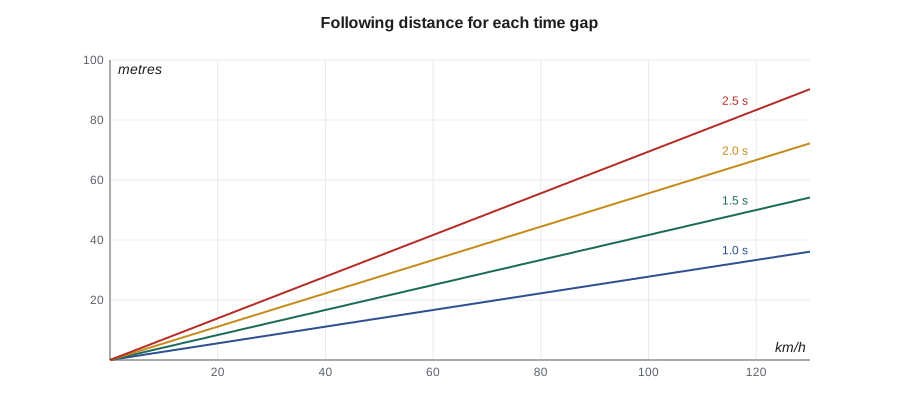
Conventional cruise control holds a set speed. Adaptive cruise control, or ACC, holds a set speed when the road ahead is clear and a set following distance when there is a slower vehicle ahead. The driver chooses the speed and a gap setting, usually three or four steps. The gap is a time gap rather than a fixed distance: at a 2-second setting, the vehicle stays two seconds behind the one ahead, so the distance grows with speed. The forward radar, usually with help from the camera, measures the distance to the lead vehicle and its relative speed, and the ACC module commands the engine or motor and, when needed, the brakes to keep the gap.
Most current systems are full-speed-range ACC: they follow the lead vehicle down to a stop in traffic and, after a short stop, resume automatically or at a tap of a button. Many combine ACC with lane centring to form a level 2 highway assistance feature, and some read speed limit signs or map data to adjust the set speed.
# Adaptive cruise: following distance for each time gap setting
for v in (50, 80, 100, 110):
    ms = v / 3.6
    gaps = []
    for g in (1.0, 1.5, 2.0, 2.5):
        gaps.append(f"{g:.1f} s = {ms * g:5.0f} m")
print(f"{v:3} km/h: " + ", ".join(gaps))50 km/h: 1.0 s = 14 m, 1.5 s = 21 m, 2.0 s = 28 m, 2.5 s = 35 m 80 km/h: 1.0 s = 22 m, 1.5 s = 33 m, 2.0 s = 44 m, 2.5 s = 56 m 100 km/h: 1.0 s = 28 m, 1.5 s = 42 m, 2.0 s = 56 m, 2.5 s = 69 m 110 km/h: 1.0 s = 31 m, 1.5 s = 46 m, 2.0 s = 61 m, 2.5 s = 76 m
ACC has limits that every customer should hear about. It is designed for vehicles moving in the same direction, and many systems do not react to a stopped vehicle that suddenly appears when the car ahead changes lanes, or react late. It may not see motorcycles at the edge of the lane, vehicles cutting in very close, or objects on the road. Its braking is limited, typically to a fraction of the vehicle's full braking capacity, and when it needs more it alerts the driver to take over. And it depends on its sensors: snow on the radar, glare on the camera or heavy rain can switch it off.
Forward collision warning and automatic emergency braking
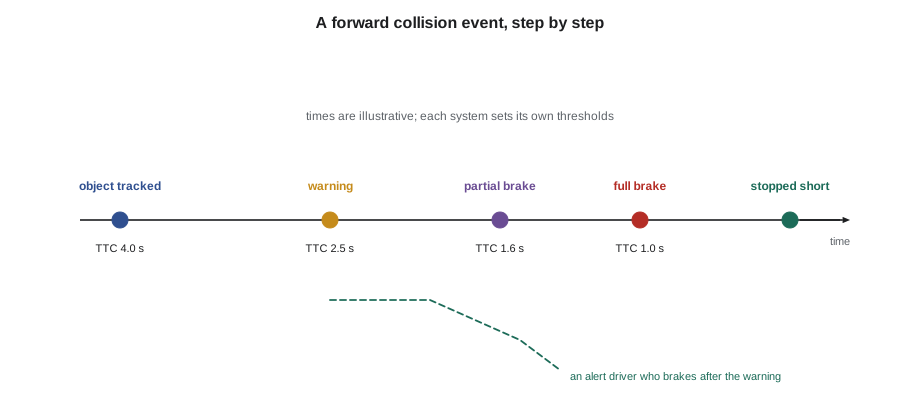
Forward collision warning, or FCW, watches the same sensors as ACC but for a different question: is a collision likely if nothing changes? The module tracks the vehicles, pedestrians and cyclists ahead and calculates a time to collision, the time until impact if both keep their current speeds. When the time to collision falls below a threshold, which depends on speed, the relative speed and the driver's settings, it warns with a chime, a flashing light and on some vehicles a short brake jerk or seat vibration.
Automatic emergency braking, or AEB, acts when the driver does not. If the time to collision keeps falling after the warning and the driver has not braked or steered, the system applies the brakes, often in stages: a partial brake to slow the vehicle and get the driver's attention, then full braking if the collision is still likely. Many systems also add dynamic brake support, which boosts the driver's own braking if the driver brakes too gently. Pedestrian AEB extends the same logic to people walking or cycling, using the camera's recognition of human shapes, often with radar confirmation, and works at lower speeds.
# Time to collision and whether braking can still avoid a crash (illustrative thresholds)
cases = [(60, 50), (25, 45), (12, 50)]
decel = 0.8 * 9.81            # m/s2, full braking on dry pavement
for d, dv in cases:
    dm = d * 1.0; vr = dv / 3.6
    ttc = dm / vr
    need = vr ** 2 / (2 * decel)        # distance needed to cancel the closing speed
    if ttc > 2.6:
        act = "monitor"
    elif ttc > 1.6:
        act = "warn the driver"
    elif need < dm:
        act = "brake automatically: avoidable"
    else:
        act = "brake automatically: reduce impact"
print(f"gap {d:3} m, closing {dv:2} km/h: TTC {ttc:4.1f} s, needs {need:4.1f} m to stop the closing speed -> {act}")gap 60 m, closing 50 km/h: TTC 4.3 s, needs 12.3 m to stop the closing speed -> monitor gap 25 m, closing 45 km/h: TTC 2.0 s, needs 10.0 m to stop the closing speed -> warn the driver gap 12 m, closing 50 km/h: TTC 0.9 s, needs 12.3 m to stop the closing speed -> brake automatically: reduce impact
What happened to Marcus
Kiran's first step with any AEB complaint is to find out what the vehicle recorded. Many modules store event data when they warn or brake: the speed, the distance and relative speed of the object, which sensor saw it, whether the driver was braking or steering, and how hard the system braked. On the trial van, the driver assistance controller had logged an event on Friday at 16:42: speed 72 km/h (45 mph), a vehicle cutting in 14 m (46 ft) ahead and decelerating, a closing speed of about 22 km/h (14 mph), a forward collision warning and, 0.6 seconds later with no driver braking, automatic braking peaking at 0.7 g. Both the camera and the radar had tracked the pickup.
That was the system doing exactly what it was designed to do. A vehicle cutting in close and braking had brought the time to collision below the braking threshold before Marcus could react; the van slowed, the gap opened, and the system released the brakes. Kiran showed Marcus the event record and explained it. She also checked the forward sensors' calibration status and codes, found nothing, and noted the event in the van's file for Hal, who keeps a record of every event on the trial vehicle.
What happened to Dr. Singh
Dr. Singh's complaint was the kind drivers call phantom braking: deceleration for no visible reason. It has several common causes. A radar sees overhead structures, such as bridges and sign gantries, as strong echoes; if its vertical aim is slightly high, or its software classifies such an echo poorly, the system may decide something is in the lane. A camera may misread shadows, a crest in the road or a truck's reflection. A vehicle in the next lane on a curve may appear to be in the vehicle's own lane. And software versions differ: makers have released many updates that change how these situations are handled.
Kiran started with the software. A campaign for Dr. Singh's model updated the driver assistance controller to improve the handling of overhead objects, and her car had not received it. She also checked the radar's vertical aim, because Dr. Singh had mentioned that a garage had recently replaced the front bumper cover after a parking lot scrape. The radar's own data showed a vertical misalignment of 1.1 degrees upward, within its tolerance but at the edge, and the replacement bumper cover was correct for the car but had been refinished with a heavy coat of paint over the radar area. The fix was the software update, a vertical radar aim check and adjustment, and a note to the body shop about the paint thickness limit. The phantom braking did not return.
| Complaint | Common causes | First checks |
|---|---|---|
| Braking with nothing ahead | Overhead structures, shadows, curves, software | Event data, software level, radar vertical aim, bumper repairs |
| No warning or late braking | Blocked or misaligned sensor, feature off, software | Settings, codes, calibration status, sensor view |
| ACC unavailable | Blockage, weather, faults in brakes, steering or sensors | Codes in all related modules, sensor view |
| Strong braking in a cut-in | Usually normal operation | Event data: distance, closing speed, driver input |
What the rules require
In the United States, FMVSS 127, issued by NHTSA in 2024, requires automatic emergency braking on new light vehicles of 10,000 pounds gross vehicle weight rating or less. Systems must warn the driver and brake automatically to avoid a collision with a vehicle ahead at speeds up to 62 mph, must brake automatically to reduce an imminent collision at speeds up to 90 mph, and must detect and brake for pedestrians at speeds up to 45 mph, in daylight and in darkness. Most makers must comply by September 1, 2029. The industry asked NHTSA to reconsider the rule and challenged it in court, and in 2026 the Department of Transportation said it was preparing a proposal to amend parts of it and extend the lead time, so the requirements could still change before they take effect.
In Canada, most new light vehicles already have AEB because makers committed voluntarily to fit it and design the same vehicles for both markets. Transport Canada consulted in 2020 on making automatic emergency braking and pedestrian braking mandatory on new vehicles. For a technician on either side of the border, the practical effect is the same: AEB is now standard equipment that customers rely on, and a repair that leaves it disabled or miscalibrated leaves the vehicle short of how it was built.
Consumer testing adds pressure. IIHS front crash prevention tests now use passenger car, motorcycle and truck targets at speeds up to 70 km/h (43 mph) and test pedestrian detection in daylight and at night, and its 2026 awards required those systems to be standard.
Explaining the features to customers
Kiran's notes for explaining forward systems are short. ACC is a convenience feature, not a safety system: it does not see everything, its braking is limited, and the driver stays responsible. Collision warning and AEB are a safety net, not a substitute for attention: they reduce many crashes but cannot prevent all of them, especially at high speeds, with stopped vehicles revealed late, or in bad weather. Both depend on clean, correctly aimed sensors, so a message that a feature is unavailable deserves attention, and so does any repair near the windshield or the front bumper. And a sudden automatic brake event is worth reporting, because the vehicle often records why it happened.
Worked problem
How long does a driver have?
A car closes on a stopped vehicle at 80 km/h (50 mph). The system warns at a time to collision of 2.5 seconds. How far away is the stopped vehicle at the warning, and can a driver who reacts in 1.0 second still stop, braking at 0.8 g?
Show solution
- Speed: 80 ÷ 3.6 = 22.2 m/s (50 mph × 0.447 = 22.4 m/s).
- Distance at warning: 22.2 × 2.5 = 56 m (22.4 × 2.5 = 56 m (184 ft)).
- Reaction distance: 1.0 s × 22.2 m/s = 22 m. Braking distance: 22.2² ÷ (2 × 7.85) = 31 m.
- Total needed: 22 + 31 = 53 m, just under the 56 m available.
Answer: The stopped vehicle is about 56 m (184 ft) away, and an alert driver reacting within a second can just stop. A slower reaction is where automatic braking matters.
Common mistakes
MistakeTreating every strong automatic brake event as a fault.
InsteadRead the event data first; cut-ins often trigger correct braking.
MistakeReplacing a radar for phantom braking before checking software and aim.
InsteadCheck campaigns, updates, vertical aim and bumper repairs.
MistakeTelling customers ACC will stop for anything.
InsteadExplain its limits: stopped vehicles, cut-ins, limited braking, weather.
MistakeIgnoring paint and filler over the radar area after a bumper repair.
InsteadCheck the body shop's work against the maker's limits.
MistakeForgetting that AEB uses the brakes and stability systems.
InsteadBrake, wheel speed and steering faults can disable it.
Summary and key terms
- Adaptive cruise control holds a set speed and a time gap to the vehicle ahead, using radar and often a camera.
- ACC has limited braking and may miss stopped vehicles revealed late, cut-ins and objects.
- Forward collision warning and AEB use time to collision to decide when to warn and when to brake.
- Pedestrian AEB extends braking to people, mostly using camera recognition.
- Event data often shows why a system braked; cut-in braking is usually correct operation.
- Phantom braking has causes including overhead structures, aim, bumper repairs and software.
- FMVSS 127 will require AEB on new US light vehicles, with dates that may change; Canadian vehicles largely match.
- Adaptive cruise control
- Cruise control that holds a set speed and a time gap to a slower vehicle ahead.
- Time gap
- The following distance expressed as seconds behind the lead vehicle.
- Time to collision
- The distance to an object divided by the closing speed.
- Forward collision warning
- An alert given when a frontal collision looks likely.
- Automatic emergency braking
- Braking applied by the system when a collision is imminent and the driver has not acted.
- Phantom braking
- Automatic slowing or braking for an object that is not a real hazard.
Practice problems
Work each problem on paper first, then reveal the answer to check.
What did the trial van's event data show?
Show answer
A pickup cut in close and braked; the van warned, then braked at 0.7 g when the driver had not reacted.
What three things fixed Dr. Singh's phantom braking?
Show answer
A software update, a radar vertical aim check and adjustment, and a note about paint over the radar area.
At 100 km/h, how long is a 2-second gap?
Show answer
About 56 m (27.8 m/s times 2).
Up to what speed must FMVSS 127 systems avoid a collision with a vehicle ahead?
Show answer
62 mph.
Lesson quiz · 5 questions
Score 60% or more to complete this lesson.
Create a free account to save your progress, take quizzes and earn a certificate.