
AUTO-420 · Lesson 1 of 12 · 24 min
Driver assistance and the road to automation
The Lindqvists' minivan came back to Ridgeline in March, a week after a glass shop across town had replaced its cracked windshield. Erik Lindqvist was polite but puzzled. "The new glass is fine, but now the car tells me lane keeping is unavailable every time we get on the highway, and twice it beeped at a car that wasn't there. The glass shop says the camera is fine." Simone wrote it up, and Marty took one look at the dash message and the bracket behind the mirror. The camera had never been calibrated after the new windshield went in. Ridgeline could read the codes, but it could not do the calibration, so the van went to a dealer two days later.
That afternoon Bev called a meeting. In the past year, Ridgeline had sent away eleven vehicles for driver assistance calibrations: after windshields, after alignments, after a bumper repair and after a suspension job of its own. Each one cost the customer a second appointment and cost the shop the work. "We do the alignments," she said. "We replace the struts. We put the cars back on the road. If those jobs knock a camera or a radar out of calibration, we should be the ones putting it right." By the end of the meeting, Ridgeline had a plan: a calibration area beside the alignment rack, a target kit and a scan tool licence for the makes the shop sees most, and training for Marty and Kiran.
This course follows that plan. Kiran, in her last term at Ridgeline, learns how driver assistance systems sense the road, how they decide when to warn, brake or steer, how they are calibrated, and how to diagnose them when they misbehave. This first lesson sets out what driver assistance is, how it differs from automated driving, the vocabulary the industry uses, and why calibration has become everyday shop work.
What driver assistance systems do
Advanced driver assistance systems, usually shortened to ADAS, are the features that use sensors to watch the area around a vehicle and then warn the driver, or act on the brakes, steering or throttle, to prevent or reduce a crash. Some only inform: a blind spot light in the mirror, a forward collision warning chime, a lane departure buzz. Some intervene: automatic emergency braking stops the car when the driver does not, lane keeping assist nudges the steering back toward the centre of the lane, rear automatic braking stops a reversing car before it hits a post. And some take over part of the driving task for a while: adaptive cruise control holds a speed and a gap to the vehicle ahead, and lane centring steers to keep the car in its lane.
Every one of these features has the same three parts. Sensors gather information: cameras, radar, ultrasonic sensors, sometimes lidar, plus the vehicle's own wheel speed, steering angle and yaw rate sensors. A control module, or several of them, interprets that information: it decides where the lanes are, which objects are vehicles, pedestrians or cyclists, how fast they are moving and whether a collision is likely. Then actuators carry out the decision: the brake control module builds pressure, the electric power steering applies a torque, the engine or motor reduces power, or the instrument cluster shows a message and sounds a chime.
That chain explains most of what a technician does with ADAS. If a sensor is blocked, damaged, loose or aimed in the wrong direction, the module receives bad information and either makes poor decisions or switches the feature off. If the module's view of where the sensor points does not match reality, which is what calibration fixes, the feature works but works wrongly. And because the actuators are the same brakes and steering a technician services every day, an ADAS complaint can begin with a wheel alignment, a steering angle sensor or a brake fault as easily as with a camera.
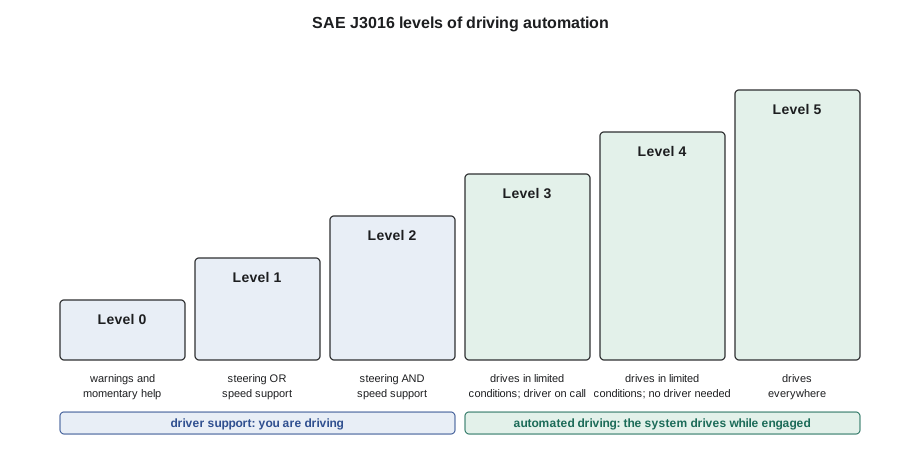
The levels of driving automation
The industry describes how much of the driving a feature does with the levels defined in SAE J3016, the Society of Automotive Engineers' taxonomy of driving automation. The current edition dates from 2021. The levels apply to a feature while it is engaged, not to a whole vehicle, and the important line falls between level 2 and level 3.
| Level | What the feature does | Who is driving | Examples |
|---|---|---|---|
| 0 | Warnings and momentary intervention only | The driver | Forward collision warning, blind spot warning, automatic emergency braking |
| 1 | Steering or speed support, one at a time | The driver | Adaptive cruise control alone, lane keeping assist alone |
| 2 | Steering and speed support at the same time | The driver, who must supervise constantly | Adaptive cruise with lane centring, hands-free highway assist |
| 3 | Drives the vehicle under limited conditions | The system while engaged; the driver must take over when asked | Traffic jam features approved on some roads |
| 4 | Drives under limited conditions without needing a human fallback | The system | Driverless robotaxis in mapped areas |
| 5 | Drives everywhere a human could | The system | None in service |
Nearly everything a shop like Ridgeline services sits at levels 0, 1 and 2. That matters for how Kiran explains the features to customers. A level 2 system that steers and holds speed on the highway can feel as if it is driving, but the driver is still driving: the system can disengage at any time, it may not see a stopped vehicle or debris, and the driver must keep watching the road. SAE calls levels 0 to 2 driver support features and levels 3 to 5 automated driving features. Even automatic emergency braking, which can stop a car entirely, is a level 0 feature, because it acts only momentarily.
Makers give their features brand names, and the same name can cover different behaviour on different models. The service information, not the marketing name, tells a technician what the feature does, which sensors it uses and what calibration it needs. Kiran starts each ADAS job by building a feature list for the vehicle from the service information and the build data, because a customer's description of "the lane thing" might mean lane departure warning, lane keeping assist or lane centring, three features with different sensors and different behaviour.
The common features and their sensors
Most light vehicles sold in Canada and the US in the last few years carry a forward-facing camera behind the windshield and a forward radar behind the grille or bumper cover, and many add corner radars and ultrasonic parking sensors. The table below links the features Kiran will meet most often to the sensors they usually rely on. Real vehicles vary, and many features fuse the data of two or more sensors.
| Feature | Usual sensors | What it does |
|---|---|---|
| Forward collision warning | Forward camera and/or forward radar | Alerts the driver to a likely frontal collision |
| Automatic emergency braking | Forward camera and/or forward radar | Brakes automatically to avoid or reduce a frontal collision |
| Adaptive cruise control | Forward radar, often with the camera | Holds a set speed and a following gap |
| Lane departure warning and lane keeping | Forward camera | Warns of or corrects an unintended lane departure |
| Lane centring | Forward camera, with radar for following | Steers continuously to keep the vehicle centred |
| Blind spot warning | Rear corner radars | Shows a vehicle in the adjacent lane's blind zone |
| Rear cross-traffic alert | Rear corner radars | Warns of traffic crossing behind a reversing vehicle |
| Park assist and rear automatic braking | Ultrasonic sensors, rear camera, sometimes radar | Warns of and brakes for close obstacles at low speed |
| Surround view | Four or more wide-angle cameras | Shows a bird's-eye view of the vehicle's surroundings |
| Driver monitoring | Infrared cabin camera | Checks that the driver is watching the road |
Kiran looks at the shop's regular customers through that table. Gord's old pickup has none of it beyond a backup camera, but the newer pickup he has been talking about buying will have most of it. Ines's hybrid has a forward camera and a forward radar, lane keeping, adaptive cruise and automatic emergency braking. The Lindqvists' minivan adds blind spot radars, ultrasonic parking sensors and a surround view system. Dr. Singh's electric hatchback has a camera, a forward radar, four corner radars and a hands-free highway feature. Hal's courier vans carry a forward camera and radar, and the trial electric van adds corner radars, a driver monitoring camera and a side camera system in place of the passenger mirror.
# Which of Ridgeline's regular customers have which features (from build data)
fleet = {
    "Gord, 2013 pickup":      {"camera": False, "radar": False, "corner": False, "sonar": False},
    "Ines, 2019 hybrid":      {"camera": True,  "radar": True,  "corner": False, "sonar": False},
    "Lindqvists, minivan":    {"camera": True,  "radar": True,  "corner": True,  "sonar": True},
    "Dr. Singh, EV":          {"camera": True,  "radar": True,  "corner": True,  "sonar": True},
    "Courier van, gas":       {"camera": True,  "radar": True,  "corner": False, "sonar": True},
    "Trial electric van":     {"camera": True,  "radar": True,  "corner": True,  "sonar": True},
}
features = {
    "AEB": ["camera", "radar"], "ACC": ["radar"], "lane keeping": ["camera"],
    "blind spot": ["corner"], "park assist": ["sonar"],
}
for car, s in fleet.items():
    have = [f for f, need in features.items() if all(s[n] for n in need)]
    print(f"{car:24} {', '.join(have) if have else 'none'}")
print("vehicles needing a forward camera calibration after a windshield:",
sum(1 for s in fleet.values() if s["camera"]))Gord, 2013 pickup none Ines, 2019 hybrid AEB, ACC, lane keeping Lindqvists, minivan AEB, ACC, lane keeping, blind spot, park assist Dr. Singh, EV AEB, ACC, lane keeping, blind spot, park assist Courier van, gas AEB, ACC, lane keeping, park assist Trial electric van AEB, ACC, lane keeping, blind spot, park assist vehicles needing a forward camera calibration after a windshield: 5
Why calibration became shop work
A camera or radar measures angles and distances relative to its own mounting. The module then turns those measurements into positions relative to the vehicle, and that requires knowing exactly where the sensor sits and which way it points. Calibration teaches the module those facts. A forward camera that is aimed even one degree to the side of where the module thinks it is aimed will place a car 100 metres ahead nearly two metres to one side, which is roughly the difference between a car in your lane and a car in the next one. A radar aimed slightly upward may miss a low obstacle; one aimed slightly down may brake for a manhole cover.
# How far off a sensor's estimate lands when its aim is off by a small angle
import math
for err_deg in (0.25, 0.5, 1.0, 2.0):
    for d in (30, 60, 100):
        off = d * math.tan(math.radians(err_deg))
        print(f"aim error {err_deg:4.2f} deg at {d:3} m: lateral error {off:5.2f} m")
print()aim error 0.25 deg at 30 m: lateral error 0.13 m aim error 0.25 deg at 60 m: lateral error 0.26 m aim error 0.25 deg at 100 m: lateral error 0.44 m aim error 0.50 deg at 30 m: lateral error 0.26 m aim error 0.50 deg at 60 m: lateral error 0.52 m aim error 0.50 deg at 100 m: lateral error 0.87 m aim error 1.00 deg at 30 m: lateral error 0.52 m aim error 1.00 deg at 60 m: lateral error 1.05 m aim error 1.00 deg at 100 m: lateral error 1.75 m aim error 2.00 deg at 30 m: lateral error 1.05 m aim error 2.00 deg at 60 m: lateral error 2.10 m aim error 2.00 deg at 100 m: lateral error 3.49 m
Anything that moves the sensor, its mount or the vehicle's own geometry can upset that relationship. The common triggers are windshield replacement, because the camera is mounted to the glass; removal or replacement of a bumper cover, grille or radar bracket; collision damage, even minor; wheel alignment changes, especially to the thrust angle, because the modules use the thrust line as "straight ahead"; suspension work that changes ride height; and replacement or software updates of the sensor or its module. The makers publish position statements and service procedures saying which events require a calibration, and those documents, not a technician's opinion, decide whether a calibration is done.
Bev's numbers made the business case, but the safety case is simpler. A customer who drives away from an alignment or a windshield job with a mis-aimed camera has a car that may brake for nothing, miss a real hazard or steer toward the edge of the lane. The shop that did the work owns that result, whether or not it owns a target stand.
Rules, ratings and reporting
Driver assistance features started as options and became standard equipment largely through voluntary commitments, consumer ratings and, more recently, regulation. In the United States, NHTSA's FMVSS 127, issued in 2024, will require automatic emergency braking, including pedestrian detection in daylight and darkness, on new light vehicles. Most makers must comply by September 1, 2029; the rule sets demanding tests, including avoiding a collision with a stopped vehicle at speeds up to 62 mph. The industry has challenged the rule, and in 2026 the US Department of Transportation said it was preparing a proposal to amend it and lengthen the lead time, so the final dates and details may change. In Canada, Transport Canada consulted in 2020 on requiring automatic emergency braking and pedestrian detection on new vehicles, and Canadian vehicles largely follow the same designs as US ones, so the features arrive on both sides of the border together.
Consumer ratings push faster than regulation. The Insurance Institute for Highway Safety runs front crash prevention tests with car, motorcycle and truck targets and pedestrian tests in daylight and darkness, and in 2026 its Top Safety Pick awards required those systems to be standard equipment. It also rates the safeguards on partial automation features, such as how well a level 2 system checks that the driver is paying attention.
Crash reporting is the other piece. Under NHTSA's Standing General Order, makers and operators must report crashes in the US that involve level 2 systems engaged shortly before the crash when the crash is serious, for example one involving an airbag deployment, a hospital visit, a fatality or a vulnerable road user. The order was most recently amended in 2025. A repair shop does not file those reports, but the data they produce drives recalls and software updates that end up in the shop as campaigns.
For a technician, the lesson of all this is practical. The features are now standard, customers depend on them, and the rules assume they work as designed. Every repair that touches a sensor or the vehicle's geometry has to end with the system verified, and the repair order has to show it.
How Ridgeline set up for ADAS work
Bev's plan had four parts. First, information: subscriptions to the makers' service information for the brands Ridgeline sees most, plus an aftermarket database and the I-CAR calibration requirements search, so that every job begins with what the maker requires. Second, equipment: a scan tool able to run the makers' calibration routines, a target kit with a frame, a laser alignment system and the target boards for the shop's common makes, and a radar reflector. Third, space: a level, well-lit area beside the alignment rack with enough clear room in front of and around the vehicle, which the calibration basics lesson covers in detail. Fourth, people and paperwork: training for Marty and Kiran, and a standard repair order section recording pre-repair and post-repair scans, the calibrations performed, their results and a road test.
Dale added a fifth part: a rule that no vehicle with an unfinished or failed calibration leaves the lot without the customer being told in writing which features are unavailable. Simone added a sixth: a line on the estimate for every job that could trigger a calibration, so that customers hear about it before the work starts rather than after.
Two months later the calibration area was ready, and the first vehicle through it was the Lindqvists' minivan, back for a scheduled brake job. Kiran used it to check that the dealer's calibration had held and that the van's surround view and parking sensors worked, and she started the shop's ADAS log with it.
Worked problem
Stopping distance at highway speed
Ines drives at 100 km/h (62 mph). Her car's automatic emergency braking can decelerate at about 0.8 g on dry pavement. Ignoring the system's reaction time, how far does the car travel while braking to a stop?
Show solution
- Speed: 100 ÷ 3.6 = 27.8 m/s.
- Deceleration: 0.8 × 9.81 = 7.85 m/s².
- Distance: v² ÷ (2a) = 27.8² ÷ (2 × 7.85) = 49 m, about 162 ft.
Answer: About 49 m (162 ft), before adding any reaction time. That is why the forward sensors need to see, and correctly place, objects well over 100 m ahead.
Common mistakes
MistakeCalling every driver assistance feature "self-driving".
InsteadLevels 0 to 2 are driver support; the driver is always driving.
MistakeTreating a feature's brand name as a description of what it does.
InsteadLook up the feature, its sensors and its calibration in the service information.
MistakeDeciding by judgement whether a calibration is needed.
InsteadFollow the maker's position statement and procedure.
MistakeAssuming the glass shop or body shop handled the calibration.
InsteadCheck the scan data and the repair records; verify every system.
MistakeReleasing a vehicle with a feature unavailable without telling the customer.
InsteadRecord it on the repair order and tell the customer in writing.
Summary and key terms
- Driver assistance features use sensors, control modules and the vehicle's actuators to warn, brake or steer.
- SAE J3016 levels 0 to 2 are driver support features; levels 3 to 5 are automated driving features.
- Forward cameras and radars, corner radars, ultrasonic sensors and surround cameras are the common sensors.
- Calibration tells the module exactly where its sensor points; small aiming errors become large errors at distance.
- Windshields, bumpers, collisions, alignments, ride height changes and sensor replacement can all require calibration.
- Regulations, consumer ratings and crash reporting have made these features standard and expected to work.
- Every ADAS repair ends with a verified system and a record on the repair order.
- ADAS
- Advanced driver assistance systems: features that use sensors to warn the driver or act on the brakes, steering or throttle.
- SAE J3016
- The standard that defines the levels of driving automation from 0 to 5.
- Driver support feature
- A level 0, 1 or 2 feature; the driver is driving and must supervise.
- Calibration
- The procedure that tells a module the exact position and aim of its sensor.
- Position statement
- A vehicle maker's published requirement, for example that a camera must be calibrated after windshield replacement.
- Standing General Order
- NHTSA's order requiring makers and operators to report certain crashes involving driver assistance and automated driving systems.
Practice problems
Work each problem on paper first, then reveal the answer to check.
Which SAE level is adaptive cruise control combined with lane centring?
Show answer
Level 2: steering and speed support together, with the driver supervising.
Why is automatic emergency braking a level 0 feature?
Show answer
It acts only momentarily; the driver is still driving.
How far to the side does a 1 degree aiming error place an object 100 m ahead?
Show answer
About 1.75 m, roughly half a lane width.
What decides whether a calibration is needed after a repair?
Show answer
The vehicle maker's position statement and service procedure.
Lesson quiz · 5 questions
Score 60% or more to complete this lesson.
Create a free account to save your progress, take quizzes and earn a certificate.