
AUTO-420 · Lesson 4 of 12 · 20 min
Lidar, ultrasonic sensors and sensor fusion
Karin Lindqvist brought the minivan in on a Saturday in May with two complaints she was sure were related. Since the family had fitted a bike rack to the trailer hitch, the rear parking sensors beeped constantly whenever the van was in reverse, and twice the van had braked hard on its own while she backed out of the garage. And on a cold morning the week before, the front sensors had chimed at nothing in an empty parking lot. Kiran found that the two complaints were not related at all, and that neither was a fault in the usual sense.
This lesson covers the shorter-range and specialist sensors of driver assistance: ultrasonic parking sensors, which nearly every modern vehicle has, and lidar, which a growing number of premium vehicles use. It then covers sensor fusion, the way modules combine the information from cameras, radars and other sensors into a single picture of the vehicle's surroundings, and why that matters when a technician diagnoses a complaint.
Ultrasonic parking sensors
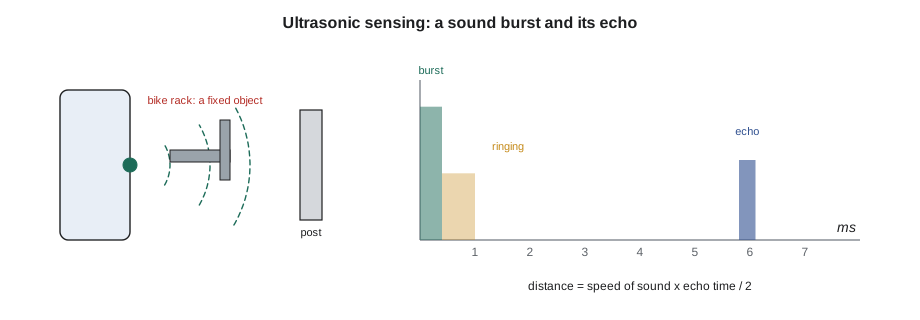
Ultrasonic sensors are the round buttons, about the size of a large coin, set into the front and rear bumper covers. Each contains a piezoelectric element that vibrates at around 40 to 50 kilohertz, well above human hearing, sending out a short burst of sound. The same element then listens for the echo. The time from the burst to the echo, multiplied by the speed of sound and divided by two, gives the distance to the nearest object. A typical system has four to six sensors on each bumper, with ranges from about 20 centimetres to two or three metres, and many vehicles add sensors on the sides of the bumpers for parking assistance and automated parking.
Because the speed of sound depends on air temperature, the system corrects its distance calculation using the outside air temperature. Sound travels about 331 metres per second at 0 °C and about 0.6 metres per second faster for each degree warmer. An uncorrected sensor would misjudge distance by a few percent between a summer afternoon and a winter morning in Calgary (Denver), which is a few centimetres at parking distances.
# Ultrasonic sensor: distance from echo time, corrected for air temperature
def speed_of_sound(t_c):
    return 331.3 + 0.606 * t_c          # m/s
echo_ms = 5.8                            # measured echo time, milliseconds
for t_c in (-30, -10, 0, 20, 35):
    d = speed_of_sound(t_c) * echo_ms / 1000 / 2
    print(f"air {t_c:4} C: object at {d * 100:5.1f} cm")
uncorrected = speed_of_sound(20) * echo_ms / 1000 / 2
true_cold = speed_of_sound(-30) * echo_ms / 1000 / 2
print(f"error if a -30 C reading used the 20 C speed: {(uncorrected - true_cold) * 100:.1f} cm")air -30 C: object at 90.8 cm air -10 C: object at 94.3 cm air 0 C: object at 96.1 cm air 20 C: object at 99.6 cm air 35 C: object at 102.2 cm error if a -30 C reading used the 20 C speed: 8.8 cm
Ultrasonic sensors are simple and cheap, and they work in darkness, but they have their own limits. They see only a short distance. They see poorly at very close range, where the echo returns before the sensor has stopped ringing from its own burst. They miss thin poles, chains and soft objects that absorb sound, and they may not see a low curb. And because the sensing element is behind the outer face of the sensor, anything on that face changes it: ice, snow, mud, a heavy coat of wax, a sticker or several coats of paint.
That explained Karin's cold morning. The night before had been wet, and a thin glaze of ice had formed on the front sensors. Ice on the face of an ultrasonic sensor damps its vibration and creates echoes from inside the ice itself, and the system may read that as an object very close to the bumper. Once the van warmed up and the ice melted, the chimes stopped. There was nothing to repair; Kiran showed Karin the maker's note in the owner's manual about cleaning the sensors in winter.
Parking sensors and towing equipment
The bike rack was another matter. A rack, a hitch-mounted cargo carrier or a trailer sits within a metre of the rear bumper, exactly where the rear sensors look. To the parking system, it is an obstacle that never moves, so the warning tone runs continuously. On vehicles with rear automatic braking, the system may also brake when the driver reverses, because it sees an object closing on the bumper. Most vehicles with these features have a setting to switch off the rear sensors and rear braking when something is mounted on the hitch, and many detect a trailer electrically through the trailer connector and do it automatically. A bike rack has no electrical connection, so the van could not know it was there.
Kiran showed Karin the setting in the van's menu and wrote both the rack and the setting into the van's notes. She also checked the sensors themselves, because a hitch-mounted rack swinging on a rough road can strike the bumper. All four rear sensors passed the scan tool's self-test, and their faces were undamaged.
Lidar
Lidar, short for light detection and ranging, measures distance with pulses of infrared laser light instead of radio waves. A lidar unit fires short pulses, times their echoes and builds a cloud of points, each with a measured distance and direction. Mechanical lidars spin a laser assembly; solid-state lidars steer the beam electronically or with tiny mirrors. Lidar's strength is its resolution: it can measure the shape of objects far more precisely than radar, and unlike a camera it measures distance directly. Its weaknesses are cost, which is falling, and sensitivity to heavy rain, snow, fog and dirt on its window, though less so than a camera in darkness.
On passenger vehicles, lidar appears mostly on premium models with advanced level 2 or level 3 features, usually mounted at the top of the windshield, in the roof line above it or in the front bumper. Driverless robotaxis carry several. None of Ridgeline's regular customers has one yet, but Marty expects to see them within a few years, and the maker's procedures for them follow the same pattern as radars and cameras: keep the window clean and undamaged, keep the mount secure, and calibrate after any disturbance. Lidar lasers are eye-safe in normal use, but service information may prescribe precautions when a unit is powered on the bench, and technicians never look into a lidar window with optical instruments.
| Sensor | Measures | Range | Strengths | Weaknesses |
|---|---|---|---|---|
| Camera | Image: shape, colour, markings | Long (forward) | Classifies objects, reads lanes and signs | Needs light and a clear view; distance inferred |
| Radar | Range, speed, angle | Long | Works in dark and most weather; measures speed directly | Poor at classifying; coarse resolution |
| Lidar | Range and angle as a point cloud | Medium to long | Precise shape and distance | Cost; affected by rain, snow, fog and dirt |
| Ultrasonic | Distance to the nearest echo | Very short | Cheap, simple, good for parking | Short range; misses thin or soft objects; ice and dirt |
Sensor fusion
Each type of sensor sees the world differently and has different blind spots. Sensor fusion is the process by which a module, or a central driver assistance controller on newer vehicles, combines their information into one picture. At its simplest, the camera recognizes that an object ahead is a car and where it sits in the lane, the radar measures how far away it is and how fast it is closing, and the module combines the two into a single tracked object with a type, a position, a speed and a confidence. More advanced systems fuse many sensors, the vehicle's own motion data and sometimes map data, and keep track of dozens of objects at once.
Fusion makes the system more reliable, because one sensor can confirm or contradict another. A radar echo from a steel plate on the road, with no matching vehicle in the camera image, can be given low confidence. A pedestrian seen by the camera at night but not yet confirmed by the radar can be tracked until it is. Many systems require two sensors to agree before they brake hard, but will warn on one. That design choice affects diagnosis: a complaint of a false alert may come from one sensor's error that the other failed to override, and a missing alert may come from a sensor whose information the module trusts too little.
# A simple fusion rule: how agreement between camera and radar changes the response (illustrative)
cases = [
    ("car ahead, both see it",           0.92, 0.95),
    ("steel plate, radar only",          0.05, 0.80),
    ("pedestrian at night, camera only", 0.75, 0.10),
    ("pedestrian at night, both",        0.75, 0.70),
    ("snow on bumper, camera only",      0.90, 0.00),
]
for name, cam, rad in cases:
    fused = 1 - (1 - cam) * (1 - rad)       # chance at least one is right, if independent
    both = cam * rad
    if both > 0.5:
        act = "brake if needed"
    elif fused > 0.7:
        act = "warn only"
    else:
        act = "track, no action"
print(f"{name:34} camera {cam:.2f} radar {rad:.2f} -> {act}")car ahead, both see it camera 0.92 radar 0.95 -> brake if needed steel plate, radar only camera 0.05 radar 0.80 -> warn only pedestrian at night, camera only camera 0.75 radar 0.10 -> warn only pedestrian at night, both camera 0.75 radar 0.70 -> brake if needed snow on bumper, camera only camera 0.90 radar 0.00 -> warn only
The fusion rule above is illustrative, but the pattern is real: the system's response depends on how much each sensor trusts what it sees and whether they agree. When one sensor is blocked, as Hal's radars were in the snow, the system may continue with reduced features on the camera alone or switch the features off entirely, depending on the maker's design.
What fusion means for the technician
On many vehicles built before about 2020, each driver assistance feature had its own module: a camera module for lanes, a radar module for cruise, a separate blind spot module. On many newer vehicles, the sensors feed a central driver assistance controller that does the fusion and decides what each feature does. That changes diagnosis in three ways. A fault in one sensor can affect features that seem unrelated to it, so a technician must know which features use which sensors. The calibration of one sensor can depend on another; some makers require the camera and radar to be calibrated together, or in a set order. And software updates to the central controller can change how features behave, so a complaint may be fixed by an update rather than a part.
Kiran's notes from the Lindqvists' visit sum it up: start from the feature the customer is talking about, find which sensors it uses, check each sensor's view, mounting, wiring and data, and only then decide whether anything is actually wrong. In that visit, nothing was.
Worked problem
Is the sensor seeing the bumper or an object?
A rear ultrasonic sensor reports an echo after 1.2 ms on a 20 °C (68 °F) day. How far away is the object, and could it be a bike rack mounted 40 cm (16 in) behind the bumper?
Show solution
- Speed of sound at 20 °C: 331.3 + 0.606 × 20 = 343.4 m/s.
- Distance: 343.4 × 0.0012 ÷ 2 = 0.206 m, about 21 cm (8 in).
- The rack is 40 cm (16 in) away, so this echo is closer than the rack.
Answer: The object is about 21 cm (8 in) away, closer than the rack. Look for something nearer, such as the rack's hitch bar, a mounting bracket or ice on the sensor face.
Servicing ultrasonic sensors
Ultrasonic sensors are usually replaced as complete units, clipped into a bracket bonded or screwed to the inside of the bumper cover. Many are supplied unpainted and must be painted to match the bumper, but only within the maker's limits: a thin coat applied as the procedure describes, with no primer or filler build-up on the face, because extra paint stiffens the face and changes how it vibrates. After a sensor is replaced, most systems run a self-test at the next start; some need the sensor's position coded in with the scan tool, and a few makes require a learning routine for automated parking. A sensor fitted to the wrong position, or a connector swapped between two sensors during a bumper repair, shows up as an obstacle warning on the wrong side of the display, so Kiran checks each sensor by holding a flat board in front of it in turn and watching the display.
Common mistakes
MistakeTreating constant parking sensor tones with a bike rack as a sensor fault.
InsteadUse the vehicle's hitch or trailer setting; the sensors are seeing the rack.
MistakeIgnoring ice, wax or paint on ultrasonic sensor faces.
InsteadAnything on the face changes the sensor's vibration and echoes.
MistakeAssuming each feature has its own sensor and module.
InsteadFind which sensors and controller each feature uses on that vehicle.
MistakeCalibrating sensors in any order.
InsteadFollow the maker's sequence when sensors depend on each other.
MistakeOverlooking software updates on fused systems.
InsteadCheck for updates and campaigns before replacing parts.
Summary and key terms
- Ultrasonic sensors time the echoes of sound bursts to measure short distances, corrected for air temperature.
- Ice, dirt, paint and stickers on ultrasonic sensor faces cause false readings.
- Hitch-mounted racks and trailers sit in the rear sensors' field; vehicles provide settings to disable rear sensing.
- Lidar builds a precise point cloud with infrared laser pulses and appears mostly on premium and automated vehicles.
- Each sensor type has different strengths and blind spots.
- Sensor fusion combines camera, radar and other data into tracked objects with types, positions, speeds and confidence.
- On fused systems, a fault or calibration in one sensor can affect several features.
- Ultrasonic sensor
- A bumper sensor that measures short distances by timing the echo of a sound burst.
- Lidar
- Light detection and ranging: a sensor that measures distance and shape with laser pulses.
- Point cloud
- The set of measured points, each with a distance and direction, produced by a lidar.
- Sensor fusion
- Combining information from several sensors into one picture of the surroundings.
- Ringing time
- The short period after an ultrasonic burst during which the sensor cannot hear an echo.
- Central controller
- A module that receives data from many sensors and runs several driver assistance features.
Practice problems
Work each problem on paper first, then reveal the answer to check.
Why does the speed of sound matter to a parking sensor?
Show answer
Distance is calculated from echo time, and the speed of sound changes with air temperature.
What caused the Lindqvists' front sensors to chime in an empty lot?
Show answer
A thin glaze of ice on the sensor faces.
Why could the van not detect the bike rack automatically?
Show answer
The rack has no electrical connection, unlike a trailer.
Why do many systems want camera and radar to agree before braking hard?
Show answer
Agreement reduces false braking from one sensor's error.
Lesson quiz · 5 questions
Score 60% or more to complete this lesson.
Create a free account to save your progress, take quizzes and earn a certificate.