
ARCH-520 · Lesson 6 of 12 · 21 min
Staffing and leadership
Adaeze Nwosu returns in the sixth week, this time to talk about people. Her firm has twelve staff, and she says that every important decision she has made as a principal has been, in the end, a decision about people: whom to hire, whom to promote, whom to give the difficult client, how to keep a gifted designer who is thinking of leaving, and once, how to let someone go. Moss adds that salaries and benefits are about two thirds of a firm's net revenue, so staffing decisions are also the largest financial decisions a firm makes. The students' business plans all assume that their firms will grow, and this week they must decide how, when and with whom.
The shape of a firm
Moss returns to the pyramid from the first week. A healthy small firm needs people at several levels: principals who win and lead work, project architects who run projects day to day, architects and interns who develop the design and documents, technologists who produce technical drawings and models, and someone who runs the office. The mix determines what the firm can do. A firm with too many senior people is expensive and may not be able to compete on fees for routine work. A firm with too many junior people cannot supervise them properly, and quality and morale suffer.
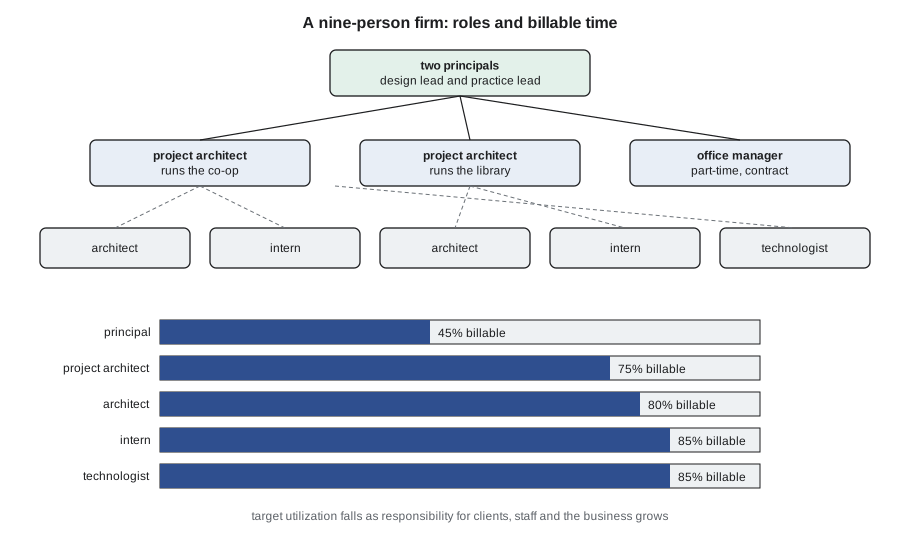
Each role has a target for billable time, which falls as responsibility grows. A principal who spends half her time on projects and half on marketing, management and mentoring is doing her job well. An intern who is billable only half the time is probably not being given enough work, or is being asked to do too much administration. Nwosu tracks each person's billable time monthly, not to judge individuals but to see where the firm's workload is unbalanced.
When to hire
The most common staffing mistake in small firms, Moss says, is hiring at the wrong time: too late, so that the existing staff work overtime for months and the best of them leave, or too early, so that a new person sits idle while the firm waits for a project that is delayed. The answer is to compare the signed work with the firm's capacity, quarter by quarter, and to plan hires against the gap. Nwosu's firm does this every month at a staffing meeting.
# When to hire: signed work against capacity, quarter by quarter, for a nine-person firm (Canadian dollars).
HOURS_Q = 470                                            # paid hours per person per quarter
staff = {"principal": (2, 0.45), "project architect": (2, 0.75), "architect": (2, 0.80),
         "intern": (2, 0.85), "technologist": (1, 0.85)}
cap_q = sum(n * u * HOURS_Q for n, u in staff.values())
signed = {  # project: billable hours in quarters 1-4
    "seniors co-op":      (900, 1_000, 700, 300),
    "infill housing":     (600, 600, 450, 250),
    "library renovation": (0, 400, 1_600, 1_500),
    "clinic fit-up":      (700, 450, 200, 0),
    "small projects":     (650, 600, 600, 550),
}
rate = 135
print(f"billable capacity per quarter: {cap_q:,.0f} hours")
for q in range(4):
    need = sum(h[q] for h in signed.values())
    load = need / cap_q
    note = "hire or subcontract" if load > 1.05 else ("win more work" if load < 0.85 else "balanced")
    print(f"Q{q + 1}: signed {need:>5,} h  load {load:>4.0%}  {note}")
hire = 0.80 * HOURS_Q
cost = 82_000 * 1.2 / 4
print(f"one new architect adds {hire:,.0f} h a quarter, costs {cost:,.0f} and can bill {hire * rate:,.0f}")billable capacity per quarter: 3,078 hours Q1: signed 2,850 h load 93% balanced Q2: signed 3,050 h load 99% balanced Q3: signed 3,550 h load 115% hire or subcontract Q4: signed 2,600 h load 84% win more work one new architect adds 376 h a quarter, costs 24,600 and can bill 50,760
The model, which Nwosu built from a year in her own firm's history with the project names changed, shows a position many small firms recognize. In the first two quarters, signed work fills about 93 to 99% of the billable capacity, which is about right: there is enough slack for proposals, training and holidays. In the third quarter, when the library renovation reaches its documentation phase, signed work exceeds capacity by 15%. In the fourth quarter, as the seniors co-op and the clinic finish, it falls to 84%.
A permanent hire would solve the third quarter, Moss says, and leave the fourth quarter worse. A new architect would add about 376 billable hours a quarter, cost about 24,600 dollars a quarter in salary and benefits and could bill about 50,800 dollars. That is a good return when there is work for her, but a heavy cost when there is not. The better responses to a temporary peak are to move the library's schedule a few weeks if the client agrees, to bring in a contract architect for a few months, or to subcontract part of the documentation to another firm, while the principals spend the third quarter winning the work that will fill the fourth. A permanent hire makes sense when the backlog shows sustained demand, usually two quarters or more above about 95% of capacity with more work in the pipeline.
Hiring well
Nwosu describes her hiring process. She writes a description of the role that states the work, the responsibilities and the experience required, rather than a list of software. She advertises through the schools, the professional associations, her own network and job boards. She reads applications against the description, interviews the strongest candidates twice, once with herself and once with the people they would work with, and asks each to walk through a project they worked on: what they did, what went wrong and what they learned. She checks references by phone. And she makes offers quickly, because good candidates have other options.
She is careful about the law. The Manitoba Human Rights Code prohibits discrimination in employment on grounds including race, sex, age, disability, religion, family status and sexual orientation, and the Employment Standards Code sets minimum requirements for wages, hours, overtime, vacation and termination notice. Many architects and senior staff are paid salaries and work beyond standard hours; Nwosu tells the students that the rules on which employees are entitled to overtime pay depend on the role and the jurisdiction, and that a firm should get advice rather than assume that everyone on a salary is exempt.
Paying people fairly
A firm needs a clear structure for pay. Nwosu's firm has pay bands for each role, based on salary surveys from the professional associations and on what other firms in the region pay. Each person's salary falls within the band for their role, and moves within it according to experience and performance. Once a year the principals review every salary against the bands and against each other, looking for unexplained differences between people doing similar work. Moss reminds the students that in Professional Practice the class found gaps of about two thousand dollars between people in the same role, and that such gaps, once found, should be closed.
Pay is not only salary. Benefits such as health and dental coverage, retirement contributions, paid time off and professional development are a large part of total compensation. Nwosu's firm pays for licensure examinations and for continuing education, gives each person a training budget and allows time off to study. She says that support for licensure costs her firm a few thousand dollars per person but is the benefit staff value most, because it builds their careers.
| Element | What it covers | Why it matters to a small firm |
|---|---|---|
| Pay bands | Salary range for each role | Consistency, fairness and easier budgeting |
| Annual review | Salary, performance and goals | Finds and closes unexplained gaps |
| Benefits | Health coverage, retirement, time off | Competes with larger firms for staff |
| Licensure support | Exam fees, study time, mentoring | Builds careers and loyalty |
| Bonuses or profit sharing | A share of a good year's profit | Rewards the team without fixing costs |
Leading a team
Moss distinguishes management from leadership. Management is making sure the work gets done: schedules, budgets, assignments and quality. Leadership is giving people a reason to do it well: a shared purpose, trust, room to grow and the confidence that they will be treated fairly. Small firms need both, often from the same two or three people. Nwosu says that the principals of a small firm set its culture whether they mean to or not, by what they praise, what they tolerate and how they behave when things go wrong.
She describes four habits that she tries to keep. The first is clarity: every person should know what is expected of them this week and this year. The second is feedback: frequent, specific and private when critical, public when positive. The third is delegation: giving people real responsibility, with support, so that they grow and the principals' time is freed. The fourth is fairness: in assignments, pay, credit and opportunity. She admits that delegation is the hardest for founders, because they started the firm to do the work themselves. A principal who reviews every line on every drawing caps the firm's growth at what one person can review.
Culture, hours and well-being
Architecture has a long tradition of late nights before deadlines, and some firms treat it as a badge of commitment. Moss and Nwosu reject it. Chronic overtime is a sign of poor planning or underpricing, it drives good people out of the profession, and tired people make the mistakes that lead to claims. Nwosu's firm plans projects to normal working hours, tracks overtime and pays for it, and treats a pattern of overtime on a project as a signal to the project manager and the principals that something must change.
Hybrid work has changed how small firms operate. Many now let staff work from home part of the week, with set days in the office for collaboration and mentoring. Nwosu says that it has helped her keep staff with young children and long commutes, but that junior staff learn far more when they sit near experienced colleagues, so her firm asks interns and new graduates to be in the office more often. She also notes that cloud-based design tools have made hybrid work possible, but that they bring security responsibilities the students will meet in a later week.
Mentoring and growth
People stay where they can grow. Nwosu's firm assigns each intern a mentor who is not their supervisor, reviews each person's experience record for licensure twice a year, and makes sure each intern gets experience in every area the licensure program requires, including construction administration, which small firms sometimes neglect. Each year every employee writes a short development plan with the principals: the skills they want to build, the projects that would help, and the steps toward their next role. Moss tells the students that the cost of losing a project architect, counting recruiting, lost productivity and the knowledge that walks out of the door, can approach a year of that person's salary, and that mentoring is the cheapest retention program a firm can run.
When things go wrong
Nwosu talks briefly about the hardest part of the job. Sometimes an employee's performance does not improve despite clear feedback and support, or the firm loses a major project and cannot afford its payroll. In both cases she tells the students to act early, honestly and within the law: document the problems and the support offered, give clear notice of what must change, follow the employment standards on notice and severance, and treat the person with dignity. Firms that avoid these conversations harm everyone, including the employee, who deserves to know where they stand.
Worked problem
Responding to a quarterly peak
A nine-person firm's signed work fills 93%, 99%, 115% and 84% of its capacity in the next four quarters. Should it hire a permanent architect?
Show solution
- Measure the peak: about 470 hours over capacity in the third quarter.
- Check whether it lasts: the fourth quarter drops to 84%, so a permanent hire would be idle part of the year unless more work is won.
- Consider the alternatives: shifting the schedule, a contract architect for one quarter, or subcontracting part of the documentation.
- Use the third quarter to pursue work that would fill the fourth.
- Hire permanently only if the pipeline shows sustained demand above about 95% of capacity.
Answer: Meet the temporary peak with contract help or schedule changes, and hire when sustained demand is confirmed.
Exercise 6: a staffing plan
- Draw your firm's organization chart for year one and year three.
- Compare your signed and expected work with capacity by quarter, and decide when to hire.
- Write a role description for your first hire.
- Describe the culture you want in five sentences, and one practice that would make each sentence true.
Self-check
- Do I plan hires against capacity rather than gut feeling?
- Do I know the employment rules that apply to my firm?
- Is pay in my firm consistent, fair and reviewed annually?
- Do I delegate, give feedback and support growth?
Common mistakes
MistakeHiring permanently for a temporary peak.
InsteadUse contract help or schedule changes, and hire for sustained demand.
MistakeAssuming every salaried employee is exempt from overtime rules.
InsteadGet advice on the rules for each role.
MistakeSetting each salary by negotiation alone.
InsteadUse pay bands and review them annually for unexplained gaps.
MistakeReviewing every detail personally as the firm grows.
InsteadDelegate with support so that the firm can grow beyond one person.
MistakeTreating chronic overtime as commitment.
InsteadTreat it as a sign of poor planning or pricing and fix the cause.
Summary and key terms
- A firm's mix of roles determines what work it can do and at what cost.
- Hires should be planned against signed work and capacity, quarter by quarter.
- Fair pay rests on bands, annual reviews and benefits that support careers, especially licensure.
- Leadership means clarity, feedback, delegation and fairness; principals set the culture.
- Mentoring and growth are the most effective ways to keep good people.
- Capacity
- The billable hours a firm's staff can provide in a period.
- Pay band
- The salary range for a role in a firm.
- Delegation
- Giving a person responsibility for work, with the authority and support to do it.
- Contract staff
- People engaged for a limited period or project rather than as permanent employees.
- Retention
- A firm's success in keeping the people it wants to keep.
Practice problems
Work each problem on paper first, then reveal the answer to check.
A firm has 3,000 billable hours of capacity a quarter and 3,450 hours of signed work. What is its load?
Show answer
115%.
Why might a contract architect be better than a permanent hire for a single busy quarter?
Show answer
Because the work does not continue, and a permanent hire would be idle and costly afterward.
Name two ways a firm can make its pay fairer.
Show answer
Use pay bands for each role, and review all salaries annually for unexplained gaps.
Why is delegation hard for founders?
Show answer
They started the firm to do the work themselves and find it difficult to let others take responsibility.
What is the approximate cost of losing a project architect?
Show answer
It can approach a year of that person's salary, counting recruiting, lost productivity and lost knowledge.
Lesson quiz · 5 questions
Score 60% or more to complete this lesson.
Create a free account to save your progress, take quizzes and earn a certificate.