
ARCH-520 · Lesson 12 of 12 · 22 min
Business plan project
On the last day of the seminar Moss arranges the conference room as she promised in the first week: one table at the front for a panel, four chairs facing it, and the students' folders, now thick with work, on a side table. The panel are people the students know. Elena Sokolova will judge each plan as a banker deciding on a loan. Rosa Delgado will judge it as a client deciding whether to hire the firm. Kevin Marsh will judge it as an insurer deciding whether to cover it. Adaeze Nwosu will judge it as a principal who has done it. Each student has twenty minutes to present and twenty minutes to answer questions. Moss tells them that the panel has agreed to be honest rather than kind, and that the purpose is to find the weaknesses now, when they cost nothing.
The class has chosen Wren's plan as the full capstone case, because it is the most complete. The other three present shorter versions, and the panel's comments on them close the lesson.
What a business plan contains
Before the presentations Moss reviews the contents of a business plan for a practice, built from the eleven weeks of the course.
- Summary: the firm, its clients, its services, its founders and the money it needs, on one page.
- The opportunity: the client need, the evidence from interviews and the competition.
- The business model and position: what the firm sells, to whom, how it is paid and why clients will choose it.
- Marketing and business development: the first clients, the pipeline and the go/no-go criteria.
- Services, fees and project delivery: the scope of typical projects, how fees are set and how projects are managed and checked for quality.
- People: the founders, the shareholders agreement, the hiring plan and the culture.
- Operations and technology: the office, the tools, the AI policy and security.
- Regulation and risk: the regulator's approval, the insurance, the risk register and the contracts.
- Finances: the launch budget, a three-year income forecast, an eighteen-month cash-flow forecast, the financing and the stress tests.
- Milestones: what the founders will have done by launch, at six months, one year and three years, and what would make them change course.
Common Room Architects
Wren presents with the confidence of someone who has been asked hard questions every week for three months. Common Room Architects will design homes for seniors, families on modest incomes and people living with disabilities, for non-profit and co-operative owners who must make public funding go as far as possible. Its founders are Sasha Kowal, a registered architect with nine years in housing who will be the responsible architect; Mateo Ruiz, a technologist; and Wren, who leads design and engagement. The firm will open with two signed projects, a 24-home seniors co-operative and a feasibility study, and a pipeline of small housing projects that larger firms find uneconomic. It will grow from three people to seven by its third year.
Her financial forecast brings together the work of the earlier weeks. Net revenue grows from about 470,000 dollars in the first year, the billings in the cash-flow model, to about 1,060,000 in the third. The founders take modest salaries in the first year and raise them as the firm grows. Employees are added after six months and again as the backlog requires. Other costs include rent, software, insurance, marketing and accounting. Interest comes from the term loan and the line of credit. The forecast then compares what the founders will gain with what they would have earned as employees, and discounts the difference at 12% a year, a rate Sokolova suggests for a small business with real risk. It adds a cautious value for the firm itself after three years, twice its third-year gain to the founders, and tests what happens if fees fall short.
# Common Room Architects: three-year pro forma and the founders' decision (Canadian dollars).
net_revenue = [470_000, 820_000, 1_060_000]               # fees after consultants and expenses
founders_pay = [252_000, 285_000, 310_000]              # three founders together, with benefits
staff_pay = [60_000, 265_000, 405_000]                 # employees, with benefits
other = [96_000, 120_000, 140_000]                     # rent, software, insurance, marketing, accounting
interest = [5_000, 4_000, 2_500]
invest = 75_000                                # founders' cash put into the firm (lesson 11)
employed = 285_000                               # what the three would earn together as employees
r = 0.12

def case(factor, show=False):
    flows = [-invest]
    for y in range(3):
        n = net_revenue[y] * factor
        s = staff_pay[y] * (0.6 + 0.4 * factor)   # a slower year means fewer hires
        profit = n - founders_pay[y] - s - other[y] - interest[y]
        flows.append(profit + founders_pay[y] - employed * 1.04 ** y)
        if show:
            print(f"year {y + 1}: net revenue {n:>10,.0f}  pay {founders_pay[y] + s:>9,.0f}  other {other[y]:>8,.0f}"
                  f"  profit {profit:>9,.0f}  ({profit / n:.0%})")
    terminal = 2 * max(flows[-1], 0)                 # a cautious value for the firm after year 3
    return sum(c / (1 + r) ** t for t, c in enumerate(flows)) + terminal / (1 + r) ** 3, flows

npv, flows = case(1.0, show=True)
print("founders' gain over staying employed:", ", ".join(f"{c:,.0f}" for c in flows))
print(f"net present value at {r:.0%}: {npv:,.0f}")
for f in (0.85, 0.75):
print(f"if fees are {1 - f:.0%} lower every year: net present value {case(f)[0]:,.0f}")year 1: net revenue 470,000 pay 312,000 other 96,000 profit 57,000 (12%) year 2: net revenue 820,000 pay 550,000 other 120,000 profit 146,000 (18%) year 3: net revenue 1,060,000 pay 715,000 other 140,000 profit 202,500 (19%) founders' gain over staying employed: -75,000, 24,000, 134,600, 204,244 net present value at 12%: 489,861 if fees are 15% lower every year: net present value 57,119 if fees are 25% lower every year: net present value -202,540
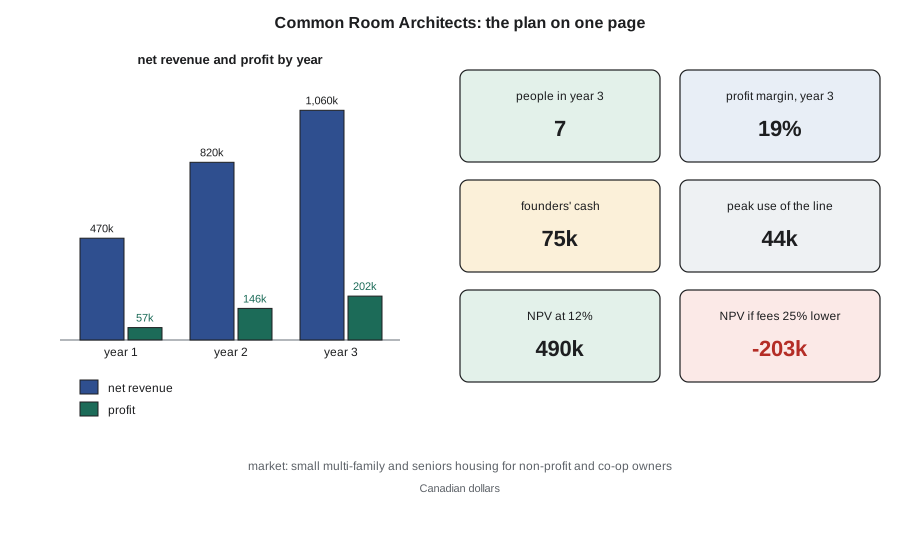
The forecast shows profit of about 57,000 dollars in the first year, 12% of net revenue, rising to about 202,500, or 19%, in the third. In the first year the founders gain about 24,000 dollars over what they would have earned as employees, because the firm's profit more than makes up for their lower salaries. By the third year the gain is about 204,000. Discounted at 12%, and with the cautious firm value, the plan has a net present value of about 490,000 dollars. If fees are 15% lower every year, the value falls to about 57,000. If they are 25% lower, it becomes negative, about −203,000.
The panel's questions
Sokolova goes first. She likes the plan's cash-flow forecast and its stress tests, and the fact that the founders are putting in their own money and launching with signed work. But she points at the third-year margin of 19%. The AIA's survey average is about 13%, and young firms rarely beat the average. She asks Wren to rerun the forecast with a 13% margin in years two and three and show that the firm could still repay its loans. Wren does, and it can, though the founders' gain is much smaller. Sokolova says she would lend, with personal guarantees and a covenant that the founders keep the line of credit below its limit for at least one month each quarter.
Delgado asks as a client. She wants to know who would actually work on her projects, what happens if Sasha leaves, and whether a three-person firm can staff a 24-home building through construction while also pursuing new work. Wren answers with the staffing plan from the sixth week: a project architect hired at six months, a contract architect available for peaks, and a shareholders agreement that requires six months' notice and an orderly transfer of responsibility if a founder leaves. Delgado says she would put the firm on Greenway's list for small projects in its first year and consider larger ones once it has completed one building.
Marsh asks as an insurer. He wants to see the firm's quality plan, its contract policy and its risk register. He is reassured by the independent technical review the firm will buy from an outside architect, by its use of RAIC Document Six and its policy of declining broad indemnities, and by its offline backups. He asks one question that Wren had not considered: the firm plans to offer post-occupancy evaluation, and he asks what it will promise. If it promises that buildings will meet performance targets, it is offering a warranty that its professional liability policy may not cover. Wren agrees to describe the service as a study of performance, not a guarantee of it.
Nwosu asks as a principal. She has one concern: concentration. In the first year more than half of the firm's fees will come from one client, the co-operative, and the housing providers on its list all depend on the same government funding programs. If those programs are cut, every client slows at once. She asks what the firm would do. Wren proposes two responses: to pursue some privately financed rental and seniors housing from the second year, and to develop accessible design as a consulting service for other firms, as Nwosu's own firm did. Nwosu says that is the right instinct, and tells her to set a date for each.
The negative case
Moss draws the class's attention to the most important line in the output. If fees are a quarter lower than planned every year, the founders would have been better off as employees by about 203,000 dollars in present value. The plan is not a sure thing, and Moss says no honest plan is. What makes it sound is not that it cannot fail but that the founders know how it could fail, have chosen responses in advance, and have agreed what would make them change course. Wren's plan includes a review at the end of the first year: if net revenue is below 400,000 dollars and the pipeline is thin, the founders will reduce their salaries further, delay the second hire and consider merging into a larger firm as a housing studio within it, rather than draw the line of credit to its limit.
| Panel member | Main concern | Wren's response |
|---|---|---|
| Banker | Third-year margin above typical results | Reran at 13%; loans still repaid; covenant on the line |
| Client | Staffing and continuity if a founder leaves | Hiring plan, contract help, notice in the shareholders agreement |
| Insurer | Post-occupancy evaluation sounding like a warranty | Describe it as a study, not a guarantee |
| Principal | Dependence on one client and one funding source | Private housing from year two; accessibility consulting |
The other three plans
Callum presents his building performance consultancy. The panel likes its low start-up cost and high rates, but Nwosu warns that his clients are other architecture firms, whose demand for energy modelling rises and falls with their own work and with energy codes. Sokolova asks how he would survive a year in which code changes were delayed. He proposes to sell to owners as well as architects, offering performance audits of existing buildings, and Marsh reminds him that his professional liability policy must cover analysis that clients will rely on for investment decisions.
Ingrid presents her design-build studio for small timber buildings. Delgado likes the idea of one contract for small community buildings. Marsh is the most concerned: the firm would carry construction risk on fixed prices, and a single job that ran over budget could take a year's profit. He asks for a separate company for construction, a construction insurance program, a contingency in every price and a rule against fixed prices before the design is developed. Ingrid adds all four.
Joon-ho presents his rewritten plan, now a ten-year path: five years with a developer, then a first small building with partners, while keeping a design practice separate from the development company, as Brandt advised. Sokolova says that this is the first developer plan by an architecture student she would take seriously, because it starts with learning the business rather than risking money on it.
Moss's closing
Moss closes the seminar by returning to what she said in the first week. Most of the students will not start a firm soon, and some never will. But every one of them will spend their career inside businesses: firms, developers, governments, builders and software companies. Every one of them will write fees, manage projects, lead people, assess risk and decide which work to pursue. The architects who understand these decisions make better buildings, she says, because they can protect the time, money and people that good design needs. She asks each student to keep their business plan and reread it in five years, to see what they got right and what the world taught them.
Worked problem
Responding to a banker's challenge
A banker says that a new firm's forecast third-year margin of 19% is well above the 13% typical of established firms, and asks whether the firm could still repay its loans at 13%. How should the founders respond?
Show solution
- Rerun the forecast with the margin reduced to 13% in years two and three, holding revenue steady.
- Check that the firm's cash flow still covers the term loan payments and that the line of credit is repaid at least once a year.
- Show the effect on the founders' own gain and say what they would do if the lower case occurred.
- Offer the banker reassurance in the form of personal guarantees and reporting each quarter.
- Revise the plan to present the 13% case alongside the base case.
Answer: Accept the challenge, test the lower margin, show that the debts can still be repaid and present both cases.
Exercise 12: your business plan
- Complete a business plan for your practice idea with all ten sections listed in this lesson.
- Build a three-year forecast and an eighteen-month cash-flow forecast, and test each against lower fees and slower payment.
- Present the plan in twenty minutes to a panel playing a banker, a client, an insurer and a principal.
- Record the panel's concerns and revise the plan to answer each one.
Self-check
- Does my plan show evidence for the opportunity, not only belief?
- Have I tested the plan against the cases in which it fails?
- Have I chosen my responses to failure in advance?
- Could I answer a banker, a client, an insurer and a principal?
Common mistakes
MistakePresenting only the base case.
InsteadShow the stress tests and the responses alongside it.
MistakeAssuming a new firm will beat the averages of established firms.
InsteadTest the plan at typical margins and growth.
MistakeOffering services that sound like guarantees.
InsteadDescribe studies and reviews as services, not promises of results.
MistakeIgnoring concentration because the first client is reliable.
InsteadSet dates to diversify clients and funding sources.
MistakeTreating the business plan as finished at launch.
InsteadReview it every year against what actually happened.
Summary and key terms
- A business plan for a practice covers the opportunity, model, marketing, services, people, operations, risk, finances and milestones.
- Forecasts should be tested against lower fees, slower payment and typical margins, with responses chosen in advance.
- A panel of a banker, a client, an insurer and a principal reveals different weaknesses in the same plan.
- A sound plan is not one that cannot fail, but one whose founders know how it could fail and what they will do.
- Business knowledge serves every architect, whether or not they ever found a firm.
- Business plan
- A written description of a firm's opportunity, operations, risks and finances, with forecasts and milestones.
- Net present value
- The value today of future gains and costs, discounted for time and risk.
- Covenant
- A condition in a loan agreement that the borrower must meet, such as keeping debt below a limit.
- Base case
- The forecast based on the most likely assumptions.
- Stress test
- A forecast rerun with less optimistic assumptions to see how the firm would cope.
Practice problems
Work each problem on paper first, then reveal the answer to check.
Why did the panel include a banker, a client, an insurer and a principal?
Show answer
Each judges a different part of the plan: finance, service, risk and management.
What did the forecast show if fees were 25% lower every year?
Show answer
A negative net present value: the founders would have been better off as employees.
Why did Marsh object to promising post-occupancy performance?
Show answer
A promise of results is a warranty that professional liability insurance may not cover.
What were Nwosu's two suggestions for reducing concentration?
Show answer
Pursue privately financed housing and develop accessible design as a consulting service, each with a date.
Why did Sokolova take Joon-ho's revised plan seriously?
Show answer
It began with years of learning the development business before risking money on it.
Lesson quiz · 5 questions
Score 60% or more to complete this lesson.
Create a free account to save your progress, take quizzes and earn a certificate.