
ARCH-520 · Lesson 11 of 12 · 22 min
Entrepreneurship
By the eleventh week the four business plans have taken shape, and Moss turns to the act of starting. Founding a practice, she says, is a different skill from running one. It requires testing an idea before risking savings on it, choosing partners and agreeing how they will share ownership, satisfying the regulator, arranging money and insurance, and winning the first clients without a portfolio of one's own. Theo Brandt, the developer-architect from the first week, and Elena Sokolova, the banker from the fifth, join the class. Between them, Brandt says, they have seen about forty architecture firms start, and perhaps a third of those are still operating ten years later.
Is there an opportunity?
Moss begins with the question entrepreneurs ask first. An opportunity is not an idea a founder likes; it is a need that clients have, are willing to pay to meet, and are not well served in meeting today. Wren's idea, a studio that designs housing for non-profit and co-operative owners, rests on three beliefs: that such owners will build more homes in the next decade, that many of them find existing firms expensive or inexperienced with their kind of project, and that a small, specialized firm could serve them better. Each belief can be tested before the firm exists.
The test is conversation. Moss borrows a method from the start-up world called customer discovery: before building anything, interview the people who would buy it, and listen for evidence rather than politeness. Wren interviews twenty people in a month: development directors at six housing providers, board members of four co-operatives, three municipal housing staff, four architects and three contractors. She asks each what their last project was like, what went well and badly with their architect, how they chose the firm, what they paid and what they wish had been different. She does not pitch her firm. At the end she asks whether they would consider a new firm for a small project, and whom else she should talk to.
The interviews change her plan. She learns that the housing providers care less about design awards than about architects who understand funding programs and their deadlines, and who can lead engagement with residents. She learns that two providers are planning small projects of eight to twelve homes that larger firms find uneconomic. And she learns that one co-operative board, whose chair she met through a friend, would like to talk to her as soon as she has a firm. Moss says that the last finding is worth more than all the others: a likely first client before launch changes everything about the risk.
Founders and partners
Wren cannot found a firm alone. She is about to graduate and will not be registered for several years, and a firm that offers architectural services needs a registered architect who takes professional responsibility for its work. Her plan has three founders. Sasha Kowal is a registered architect with nine years of experience at a housing firm, ready to lead projects and take responsibility for the firm's work. Mateo Ruiz is an architectural technologist who knows building information modelling and construction documents thoroughly. Wren brings design, research and engagement skills and the relationships she has built. Moss says that the combination is a strength: founders with complementary skills and a shared purpose are far more likely to succeed than founders who are all alike.
Brandt warns that partnerships fail more often from disagreement between founders than from lack of work. He insists that every group of founders write a shareholders agreement before they start, while they still like each other. It should cover how much each founder owns and why, what each contributes in money and work, how decisions are made and which decisions need unanimous consent, how much each is paid, what happens if a founder wants to leave, dies or becomes disabled, how shares are valued and paid for in those cases, how new partners can join, and how disputes will be resolved. Many agreements also provide that a founder's shares vest over several years, so that a founder who leaves after six months does not keep a third of the firm.
The regulator's rules shape ownership. In Manitoba a corporation that practises architecture needs a certificate of approval from the Manitoba Association of Architects, and its architectural work must be supervised by a registered architect who takes professional responsibility for it. Wren's firm will hold its certificate through Sasha, who will be the responsible architect. Moss reminds the students that the rules on who may own shares in an architectural corporation differ among provinces and should be checked with the association and a lawyer before shares are issued to Wren and Mateo, who are not registered architects.
Testing before quitting
Moss tells the students that the most dangerous moment in a firm's life is the day the founders resign from their jobs. Before that day, they should test as much as they can. Can they win a first project while still employed, with their employers' knowledge and permission? Can they get a letter of intent from a likely first client? Can they line up the bank financing and the insurance in principle? Brandt began his development business by designing one fourplex in the evenings, for himself, while working in a firm, and only left when the building was under construction and a second site was under contract. He says that his employer knew and supported it, and that he would not have done it otherwise.
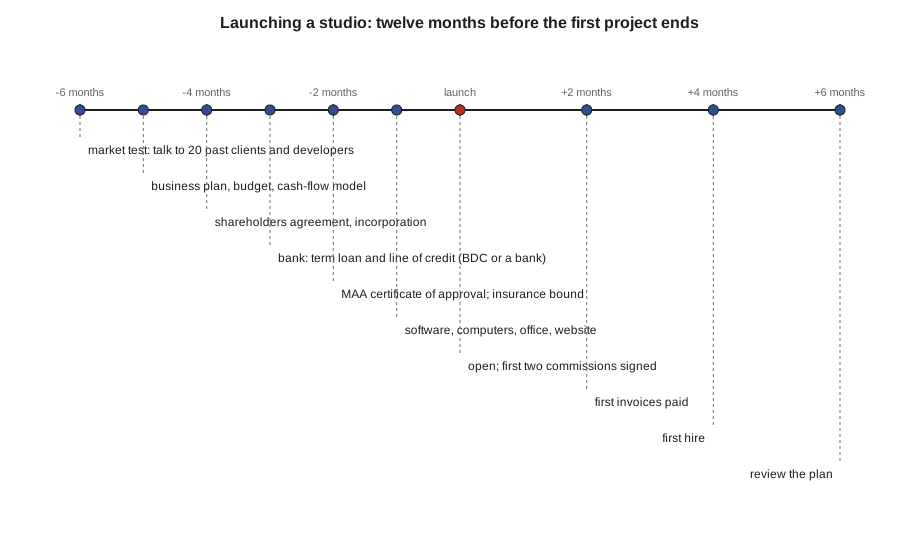
Wren's founders plan their launch over twelve months. The first six are spent on interviews, the business plan, the shareholders agreement, the company, the bank and insurance, and the regulator's approval, all while the founders remain employed. They open with two small projects signed, the co-operative and a feasibility study for one of the housing providers, enough to cover about half of their first year's costs.
Money to start
The founders must find money for two things: the costs of starting, such as legal fees, registration, computers, software, insurance, furniture, a website and a rent deposit, and the working capital to pay salaries and costs until clients pay, which the students modelled in the fifth week. Moss asks Wren to build a launch budget and decide how to pay for it.
# Launch budget and financing for a three-founder studio (Canadian dollars).
launch = {"incorporation, legal and accounting": 6_500, "certificate of approval and registration fees": 2_500,
          "computers and software, first year": 21_000, "professional liability insurance, first year": 9_500,
          "furniture, printer, network": 8_000, "brand, website and first marketing": 7_000,
          "rent deposit and first month": 6_000}
start_cost = sum(launch.values())
founders_cash = 75_000            # savings the three founders put in (25,000 each)
line_peak = 44_000                  # peak use of the line of credit in the cash-flow model
apr, years = 0.0745, 5             # term loan for the start-up cost
m = apr / 12
payment = start_cost * m / (1 - (1 + m) ** (-12 * years))
for item, cost in launch.items():
    print(f"{item:46}{cost:>9,.0f}")
print(f"{'start-up cost, financed by a term loan':46}{start_cost:>9,.0f}")
print(f"monthly loan payment over {years} years at {apr:.2%}: {payment:,.0f}; total interest {payment * 12 * years - start_cost:,.0f}")
print(f"working capital: founders' cash {founders_cash:,.0f} plus up to {line_peak:,.0f} on the line")
print(f"total money the firm needs before it pays its own way: {start_cost + founders_cash + line_peak:,.0f}")incorporation, legal and accounting 6,500 certificate of approval and registration fees 2,500 computers and software, first year 21,000 professional liability insurance, first year 9,500 furniture, printer, network 8,000 brand, website and first marketing 7,000 rent deposit and first month 6,000 start-up cost, financed by a term loan 60,500 monthly loan payment over 5 years at 7.45%: 1,211; total interest 12,152 working capital: founders' cash 75,000 plus up to 44,000 on the line total money the firm needs before it pays its own way: 179,500
The start-up costs come to about 60,500 dollars. The firm will finance them with a five-year term loan, repaid at about 1,211 dollars a month. Working capital comes from the founders' 75,000 dollars of savings and the line of credit, which the forecast in the fifth week showed peaking at about 44,000 dollars. In total the firm needs about 180,000 dollars of money before it pays its own way, less than half of it from the founders.
Sokolova describes the sources of financing available in Canada. The federal Canada Small Business Financing Program helps small businesses borrow from banks and credit unions by sharing the lender's risk; it can finance equipment, leasehold improvements and real property, and lines of credit, with interest rates capped above the prime rate and a registration fee of 2% of the loan. The Business Development Bank of Canada, a federal Crown corporation, lends to small businesses, often on more flexible terms than commercial banks, though some of its start-up products require the business to have begun earning revenue. Commercial banks offer lines of credit and term loans, usually with personal guarantees from the founders. Provincial programs and community lenders add smaller loans and advice. She tells the students that a bank will want to see the business plan, the cash-flow forecast, signed or nearly signed work and the founders' own money at risk.
She adds that borrowing for working capital is normal and healthy, but borrowing to cover losses is not, and that founders should not mortgage their homes to start a professional practice that needs relatively little equipment. Brandt agrees, with the exception of development, where the capital needed is far larger and the risk is of a different kind.
| Source | Typical use | What it costs the founders |
|---|---|---|
| Founders' savings | Working capital, early costs | Their savings at risk; equity in the firm |
| Term loan | Computers, furniture, leasehold improvements | Interest and usually a personal guarantee |
| Line of credit | Timing gaps until clients pay | Interest on what is drawn; personal guarantee |
| Retainers from clients | Cash at the start of each project | Nothing, if the client agrees |
| Outside investors | Rare in professional firms | A share of ownership and control |
The first clients
A new firm's first clients take a risk on it, and they know it. Brandt says that first clients usually come from the founders' relationships: former clients who trust a founder personally, friends and family, colleagues who refer work they cannot take, and small projects that larger firms decline. He advises new founders to do the first projects exceptionally well, to ask each satisfied client for permission to publish the work and to act as a reference, and to resist the temptation to take any project at any fee just to be busy. The first projects define the firm's reputation, and a firm that starts by doing cheap work for difficult clients may find it hard to escape.
Moss adds the ethical point the students met in Professional Practice: founders who leave a firm must not take its clients or confidential information with them. They may tell former clients that they are starting a practice, if their employment agreement allows, but they should not solicit the firm's active projects. A good relationship with the former employer, who may refer work that is too small for them, is worth more than any client taken away.
Name, identity and launch
The founders choose a name, Common Room Architects, which suggests the shared spaces of housing and fits their position. Moss tells them to check that the name meets the regulator's rules, which in most jurisdictions forbid names that mislead the public about who practises in the firm, and that it is not already used by another business. They design a simple identity, build a website with the founders' biographies and the projects they led elsewhere, properly credited, and plan the launch: an announcement to everyone they interviewed, a short article for the professional association's newsletter and an open house in their new office.
The founder's life
Brandt closes with advice about the founders themselves. The first two years are hard. Founders work long hours, earn less than they did as employees, carry personal guarantees and worry about money. Partnerships are strained by stress. He tells the students to agree before launch on what success looks like in two years, and on what would make them close the firm, so that the decision is not made in panic. He also tells them that founding a firm is not the only way to build a meaningful practice, and that some of the best architects he knows have spent their whole careers as partners in firms someone else founded.
Worked problem
Choosing the moment to launch
Wren's founders have a business plan, a shareholders agreement in draft and one likely client, but no signed work. Sasha's employer has offered her a promotion. Should they launch now?
Show solution
- List what is still untested: no signed work, no financing in principle, no regulator approval.
- Estimate the cash needed if launch is followed by three months without a project: the forecast shows the line of credit would approach its limit.
- Agree milestones that would justify launch: two signed projects covering half of the first year's costs, financing approved and approval from the regulator.
- Discuss the promotion openly; Sasha could accept it and launch six months later when the milestones are met.
- Set a date to review progress, and keep building relationships in the meantime.
Answer: Wait until the milestones are met; launch with signed work, financing and approval in place.
Exercise 11: a launch plan
- Conduct five customer discovery interviews for your practice idea and record what you learn.
- List the clauses your shareholders agreement must contain.
- Build a launch budget and decide how to finance it.
- Draw your own launch timeline from twelve months before opening to six months after.
Self-check
- Have I tested my idea with the people who would pay for it?
- Do my founders have complementary skills and a written agreement?
- Do I know the regulator's rules on ownership and responsibility?
- Do I know how much money my firm needs and where it will come from?
Common mistakes
MistakeStarting with a business the founders like rather than a need clients have.
InsteadInterview potential clients before committing.
MistakeFounding a firm without a written shareholders agreement.
InsteadAgree ownership, decisions, exits and disputes before starting.
MistakeResigning before any work is signed.
InsteadTest, win the first projects and arrange financing before leaving employment.
MistakeTaking a former employer's clients or information.
InsteadLeave on good terms and respect the employment agreement.
MistakeAccepting any project at any fee to stay busy.
InsteadChoose first projects that build the reputation the firm wants.
Summary and key terms
- An opportunity is a client need that is unmet and worth paying for; test it through interviews before founding.
- Founders need complementary skills, a registered architect to take responsibility, and a written shareholders agreement.
- The regulator's rules on ownership and responsibility must be checked before shares are issued.
- A new firm needs money for start-up costs and working capital; loans, lines of credit and founders' savings each have a role.
- First clients come from relationships; doing their projects exceptionally well builds the firm's reputation.
- Customer discovery
- Interviewing potential clients to test whether a business idea meets a real need.
- Shareholders agreement
- A contract among the owners of a company setting out ownership, decisions and exits.
- Vesting
- Earning ownership over time, so that a founder who leaves early keeps only part of their shares.
- Letter of intent
- A client's written statement of its intention to engage the firm.
- Personal guarantee
- A founder's promise to repay the firm's loan personally if the firm cannot.
Practice problems
Work each problem on paper first, then reveal the answer to check.
Why did Wren's interviews matter more than her own view of the market?
Show answer
They tested whether clients actually had the need, and they found a likely first client.
Name four things a shareholders agreement should cover.
Show answer
Any four of: ownership, contributions, decisions, pay, departure, death or disability, valuation, new partners, disputes, vesting.
Why does Wren's firm need Sasha as a founder?
Show answer
A firm offering architectural services needs a registered architect to take professional responsibility for its work.
What is a line of credit for, and what is it not for?
Show answer
It is for timing gaps until clients pay, not for covering continuing losses.
Why should founders not take their former employer's clients?
Show answer
It breaches ethics and often their employment agreements, and a good relationship with the former employer is more valuable.
Lesson quiz · 5 questions
Score 60% or more to complete this lesson.
Create a free account to save your progress, take quizzes and earn a certificate.