
ARCH-520 · Lesson 1 of 12 · 25 min
Business models for practice
Hannah Moss begins the graduate seminar in the same conference room at Eberle Moss Architects where the students met for Professional Practice a year earlier, but she has rearranged the furniture. The long table is gone, replaced by four small tables, one for each student. On each table is a folder with a blank cover. Moss explains that this term every student will write a business plan for a practice they might one day start, and that by the twelfth week one of those plans will be tested in front of a panel of a banker, a client, an insurer and a practising principal as if it were real. She is not trying to turn them all into firm owners, she says. Most architects spend their careers in firms that someone else owns. But every architect makes business decisions, and an architect who understands how a practice earns, spends and risks money is a better project manager, a better employee and a better advocate for good design.
The four students choose their starting ideas in the first hour. Wren wants to found a small studio that designs multi-family and seniors housing for non-profit and co-operative owners, building on the work she admired at Greenway Homes. Callum, whose simulation project in Advanced Building Performance went well, wants to explore a consultancy that sells energy modelling and building performance services to other architects. Ingrid, who spent a summer with a builder, wants to test a design-build studio for small timber buildings. Joon-ho wants to be a developer-architect who buys small infill lots, designs fourplexes and sixplexes, and builds them with partners. Moss writes the four ideas on the whiteboard and says that by the end of the morning they will be able to see that these are not four versions of the same business but four different businesses.
What a business model is
A business model describes how an organization creates value for someone, how it delivers that value and how it captures enough of it to survive. For an architecture practice the questions are concrete. Who are the clients, and what problem does the firm solve for them? What exactly does the firm sell: ideas, drawings, coordination, certainty about cost, a finished building? How is it paid: by a share of construction cost, a fixed fee, hourly rates, a share of construction profit or the value of the property it develops? Who does the work, and how many people does each principal lead? And what can go wrong in a way that would sink the firm?
Moss points out that the traditional fee-for-service practice answers these questions in one particular way. The client owns the land and the project, the architect sells professional services and the contractor builds. The architect is paid for time and expertise and carries professional liability for the design, but not the risk of construction cost, market demand or financing. That model has served the profession for well over a century and remains the most common, but it is not the only one, and the alternatives change both the rewards and the risks.
David Maister, whose book on managing professional service firms is still widely read, divided professional work into three kinds. Some projects need brains: new problems that call for the best minds and command high fees, such as a concert hall or a first-of-its-kind research building. Some need experience: problems the firm has solved before, where clients pay for judgement and reliability, such as a fifth seniors residence. Some need procedure: familiar problems handled by efficient systems, such as a chain of clinic fit-ups. Each kind of work implies a different mix of senior and junior staff, a different fee level and a different way of marketing. Moss asks the students which kind of work their plans would sell. Wren says experience; Callum says brains at first and procedure later, once his methods are standard; Ingrid says experience; Joon-ho says that his developer model is not really selling services at all.
Four ways to run a practice
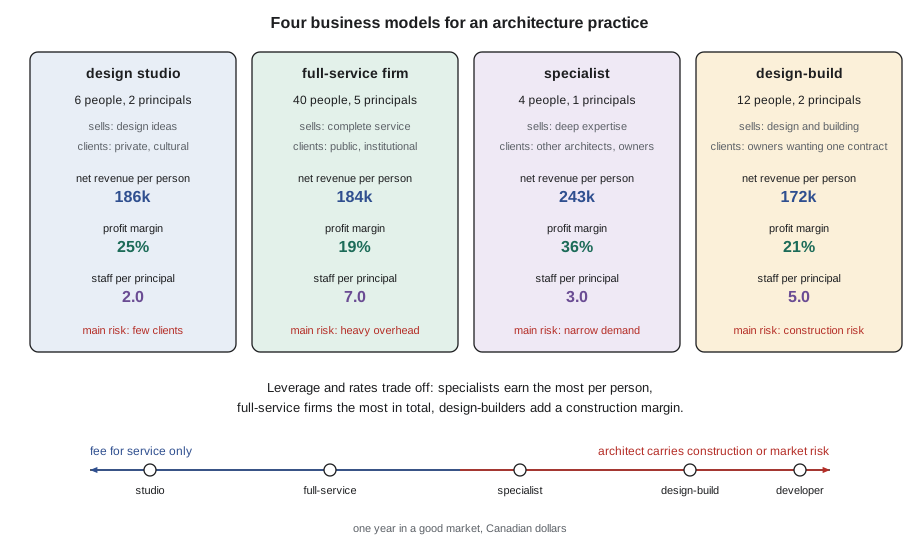
Moss sketches four business models that the students will meet in practice, and later a fifth.
- The design studio. A small firm, often led by one or two principals with a strong design reputation, that wins work through competitions, awards, publications and relationships with private and cultural clients. Its fees are modest relative to the effort it puts in, its staff are few and its risk lies in depending on a handful of clients.
- The full-service firm. A larger firm of dozens or hundreds of people that offers planning, architecture, interiors and often engineering or landscape under one roof, and serves public and institutional clients through formal procurement. It earns less per person than a successful specialist but can take on large, complex projects, and its risk lies in its overhead: when work slows, a large payroll must still be met.
- The specialist consultancy. A small group with deep expertise in one area, such as building envelopes, accessibility, heritage conservation, acoustics or energy modelling, that sells to owners and to other architects. It commands higher rates and higher margins, but its market is narrow and it depends on its few experts.
- Design-build. A firm that designs and builds, either as one company or as a close partnership between an architect and a contractor. The client signs one contract, and the firm earns a construction margin on top of its design fee. The firm controls cost and schedule but carries construction risk: if the building costs more than the price agreed, the firm pays the difference.
The fifth is the developer-architect, who owns or co-owns the project. Instead of a fee, the firm earns the difference between what the building costs to design and build and what it is worth when it is finished or rented. The potential reward is far larger than a fee and so is the risk: the firm must find land, secure financing, obtain approvals, manage construction and sell or lease the result. Joon-ho's plan falls here, and Moss warns him that the skills of a developer, including land, finance, sales and negotiation, are not taught in architecture school.
The numbers behind each model
To make the comparison concrete, Moss builds a small model of one good year for each kind of firm. The inputs are typical rather than exact: the number of people and principals, an average billing rate, the share of paid hours that are billable, the average salary including benefits, and other costs per person for rent, software and insurance. For design-build she adds a construction profit on top of the design fees. The model then calculates net revenue, revenue per person, profit and leverage, the number of staff each principal leads.
# Four ways to run a practice: one year in each (Canadian dollars).
HOURS = 1_880                     # paid hours per full-time person per year
OTHER = 38_000                    # rent, software, insurance and other costs per person
models = {  # name: (people, principals, billing rate, utilization, average salary with benefits)
    "design studio":     (6,  2, 150, 0.66, 102_000),
    "full-service firm": (40, 5, 140, 0.70, 112_000),
    "specialist":        (4,  1, 190, 0.68, 118_000),
    "design-build":      (12, 2, 125, 0.62, 98_000),
}
build_margin = 310_000                # design-build only: construction profit for the year
print(f"{'model':18}{'net revenue':>12}{'per person':>11}{'profit':>11}{'margin':>8}{'staff per principal':>21}")
for name, (n, p, rate, util, pay) in models.items():
    fees = n * HOURS * util * rate
    extra = build_margin if name == "design-build" else 0
    revenue = fees + extra
    profit = revenue - n * pay - n * OTHER
print(f"{name:18}{revenue:>12,.0f}{revenue / n:>11,.0f}{profit:>11,.0f}{profit / revenue:>8.0%}{(n - p) / p:>21.1f}")model net revenue per person profit margin staff per principal design studio 1,116,720 186,120 276,720 25% 2.0 full-service firm 7,369,600 184,240 1,369,600 19% 7.0 specialist 971,584 242,896 347,584 36% 3.0 design-build 2,058,400 171,533 426,400 21% 5.0
The students study the output. The specialist earns the most per person and keeps the largest share of its revenue as profit, because its rates are high and its staff are senior. The full-service firm earns the least per person but by far the most in total, because each principal leads seven people. The design studio sits between them. The design-build firm has the lowest revenue per person from fees, because builders' time is billed at lower rates, but its construction profit lifts its margin. Moss stresses that these are good years. In a bad year the specialist can lose half its work when one large client stops calling, the full-service firm can be forced into layoffs, and the design-builder can lose a year's profit on one job that goes over budget.
| Model | What the client buys | How the firm is paid | Main source of risk |
|---|---|---|---|
| Design studio | Design leadership and ideas | Fee, often a share of construction cost or fixed | Few clients, competition on fees |
| Full-service firm | Complete, coordinated services | Fee by contract, often negotiated or bid | Overhead and staffing when work slows |
| Specialist | Expertise the client lacks | Hourly rates or fixed fees per study | Narrow demand, key people |
| Design-build | One contract for design and construction | Design fee plus construction margin | Construction cost and schedule |
| Developer-architect | A building to rent or sell | Value created minus cost | Land, financing, market and approvals |
Leverage, rates and the shape of a firm
Moss draws a pyramid. At the top are the principals, in the middle the project architects and at the base the architects, interns and technologists. The ratio of staff to principals is called leverage. A firm with high leverage can take on more work for each partner and earn more in total, because the principals' time is multiplied by the work of others. But leverage requires work that can be delegated, which is easier for experience and procedure projects than for brains projects. A design studio that sells its principal's vision cannot multiply that vision indefinitely, and a firm that tries to grow beyond what its leaders can supervise risks both quality and reputation.
The other lever is the billing rate. Rates are set by the market, not by the firm's costs: clients compare fees across firms and judge them against the value they expect to receive. A firm can raise its effective rate in three ways. It can specialize, so that clients pay for expertise they cannot find elsewhere. It can become more efficient, so that the same fee requires fewer hours. Or it can choose clients who value design and are willing to pay for it. Moss tells the students that a firm that competes only on price is in a race no one wins.
Adaeze Nwosu, the principal of a twelve-person firm who visited Professional Practice, joins the class for the afternoon. Her firm began as a design studio, became known for community buildings and is now partly a specialist in accessible and inclusive design, a service it sells to other firms as a consultant. She says that the specialist service now earns about a fifth of the firm's fees but a third of its profit, and that it has smoothed out the gaps between large projects. The lesson, she says, is that a firm's business model is not fixed at founding. It changes as the firm learns what it does best and what clients will pay for.
Design-build and the developer-architect
Marisol Ortiz runs a design-build company of fourteen people that designs and builds cabins, small houses, community buildings and commercial interiors. She trained as an architect and her business partner is a builder. She explains that her clients choose design-build because they want one point of responsibility and a firm price early. Her company earns a design fee and a construction margin, usually a modest share of construction cost, and the margin is where most of the profit comes from. But she also carries the risk that the subcontractors' prices rise, that the weather delays the job, or that something unexpected is found when the old floor is lifted. She keeps a contingency in every price and walks away from projects where the client wants a firm price before the design is clear.
Ortiz adds that a design-build company must be organized carefully under the regulations. In Manitoba an architectural firm must hold a certificate of approval from the Manitoba Association of Architects, and the architectural work must be done under the supervision of a registered architect who takes responsibility for it. A design-build company that is not itself approved typically engages an approved firm for the architectural services, or the architect's firm and the builder form a joint venture with clear allocation of responsibilities. Her company keeps the two roles in separate entities with a written agreement between them. She advises the students to have a lawyer review the structure before signing their first design-build contract.
Theo Brandt, a developer-architect whose firm has built about two hundred homes in small infill buildings, visits for the last hour. He tells Joon-ho that the first project is the hardest because no lender wants to finance an architect with no track record as a developer. His own first building was a fourplex financed by his savings, a family loan and a construction loan that required a personal guarantee. He made money on it but says he could have lost his house if interest rates had risen faster. He now keeps the design practice and the development company as separate businesses, so that the architects are paid for their work whatever happens to the development, and he never develops more than he could afford to lose.
Choosing a model
Moss gives the students a way to choose. A model should fit three things: what the founders are good at and enjoy, what clients in the market need and will pay for, and the risk the founders can carry. A brilliant designer who dislikes administration might thrive in a design studio with a strong practice partner but struggle as the head of a full-service firm. A technically minded architect who enjoys analysis might do well as a specialist. Someone comfortable with risk and negotiation might choose design-build or development. And all of them must ask whether the market in their city can sustain the business: a specialist in acoustics may need clients across a whole region, while a housing studio may find enough work in one city.
She also warns against two common illusions. The first is that a small firm is simpler than a large one. It has fewer people, but each principal must do everything: design, marketing, finance, human resources and technology. The second is that a business model can be copied from a famous firm. The firm that won a major competition with a small team did not succeed because of its size; it succeeded because of years of work, relationships and luck that are not visible from outside.
Worked problem
Matching a plan to a model
Wren's housing studio would have three founders and design multi-family and seniors housing for non-profit and co-operative owners. Which business model is it, and what are its main risks?
Show solution
- Identify the clients: non-profit housing providers and co-operatives, who are repeat clients with modest budgets.
- Identify what they buy: reliable, experienced design of a building type the firm knows well, closer to experience work than brains work.
- Classify the model: a design studio leaning toward a specialist in one building type.
- List the risks: dependence on a few clients and on government housing funding, fees squeezed by tight budgets, and slow payment by non-profits that rely on grants.
- List the responses: build relationships with several providers, track funding programs, and negotiate payment terms before signing.
Answer: A focused design studio with specialist knowledge of housing; its risks are concentration and funding, which the plan must address.
Exercise 1: your business model
- Describe your practice idea in one paragraph: clients, services, how you are paid and who does the work.
- Place it on the line from fee for service to construction or market risk, and explain why.
- Estimate your firm's leverage and average billing rate, and run the model in this lesson with your numbers.
- Name the two risks most likely to sink the firm and one response to each.
Self-check
- Can I describe the five business models and how each one is paid?
- Do I understand leverage and why it depends on the kind of work?
- Can I explain why the regulations matter for design-build and developer models?
- Have I matched my plan to my strengths, the market and the risk I can carry?
Common mistakes
MistakeAssuming the traditional fee-for-service model is the only option.
InsteadCompare the alternatives and choose deliberately.
MistakeCopying the model of a famous firm.
InsteadBuild the model on your own strengths and your own market.
MistakeGrowing leverage faster than the principals can supervise.
InsteadGrow at a pace that protects quality and reputation.
MistakeTaking on construction or development risk without the capital to absorb a loss.
InsteadNever risk more than the firm and the founders can afford to lose.
MistakeIgnoring the regulatory structure of a design-build or development company.
InsteadHave a lawyer review the entities and agreements before the first contract.
Summary and key terms
- A business model explains how a practice creates, delivers and captures value.
- Design studios, full-service firms, specialists, design-builders and developer-architects are paid in different ways and carry different risks.
- Leverage multiplies the principals' time, but only for work that can be delegated.
- Billing rates are set by the market; specialization, efficiency and client choice raise them.
- The right model fits the founders' strengths, the market and the risk they can carry.
- Business model
- How an organization creates value, delivers it and captures enough of it to survive.
- Leverage
- The ratio of staff to principals in a firm.
- Design-build
- A delivery method in which one entity contracts to design and build the project.
- Developer-architect
- An architect who owns or co-owns the projects the firm designs.
- Net revenue
- Fees earned by the firm after the cost of consultants and reimbursable expenses.
Practice problems
Work each problem on paper first, then reveal the answer to check.
A specialist firm earns more per person than a full-service firm. Why might the full-service firm still be the larger business?
Show answer
Its leverage is much higher, so its total revenue and profit are larger even though each person earns less.
Why does a design-build firm keep a contingency in every price?
Show answer
Because it carries the risk that construction costs more than the agreed price.
What are Maister's three kinds of professional work?
Show answer
Brains, experience and procedure: new problems, familiar problems that need judgement, and routine problems handled by systems.
Why did Theo Brandt separate his design practice from his development company?
Show answer
So the architects are paid for their work whatever happens to the development, and the risks of each business stay separate.
Name three ways a firm can raise its effective billing rate.
Show answer
Specialize, become more efficient, and choose clients who value design.
Lesson quiz · 5 questions
Score 60% or more to complete this lesson.
Create a free account to save your progress, take quizzes and earn a certificate.