
ARCH-520 · Lesson 10 of 12 · 21 min
Alternative careers
In the tenth week Moss changes the format. Instead of a single guest, she invites a panel of four people who trained as architects and now work outside traditional practice. Rosa Delgado, whom the students know, studied architecture before becoming development director at Greenway Homes. Neil Haugen, the city planner who reviewed their urban building projects, worked in a firm for six years before joining the city. Bruno Castillo is an owner's representative who manages building projects for a hospital and a university. And Ravi Menon is a product manager at a company that makes software for building design. Moss explains why the session belongs in a course on practice management: a large share of architecture graduates, and many licensed architects, build their careers partly or wholly outside firms, and the skills of practice management, from fees to risk, are exactly the skills those careers value.
Why architects leave practice, and why some return
Each panellist tells their story. Delgado left practice because she wanted to decide what got built rather than respond to someone else's decisions. Haugen wanted regular hours after his first child was born and found that he enjoyed shaping a whole city's rules more than a single building. Castillo was a project architect on a large hospital, worked closely with the owner's project manager and realized he wanted that job. Menon spent his evenings writing scripts to automate tasks in modelling software and was hired by the company whose software he was improving.
None of them regrets studying architecture. All four say that the ability to understand a building as a whole, to draw and think spatially, to balance competing requirements and to present ideas clearly gives them an advantage over colleagues from other backgrounds. Haugen notes that two of his planning colleagues have returned to practice after several years at the city, bringing an understanding of approvals that their firms value highly. Moss tells the students that a career is not a single choice made at graduation but a series of moves, and that experience gained outside a firm can make an architect more valuable when they return.
A map of paths
Moss draws a map of the places an architectural education can lead.
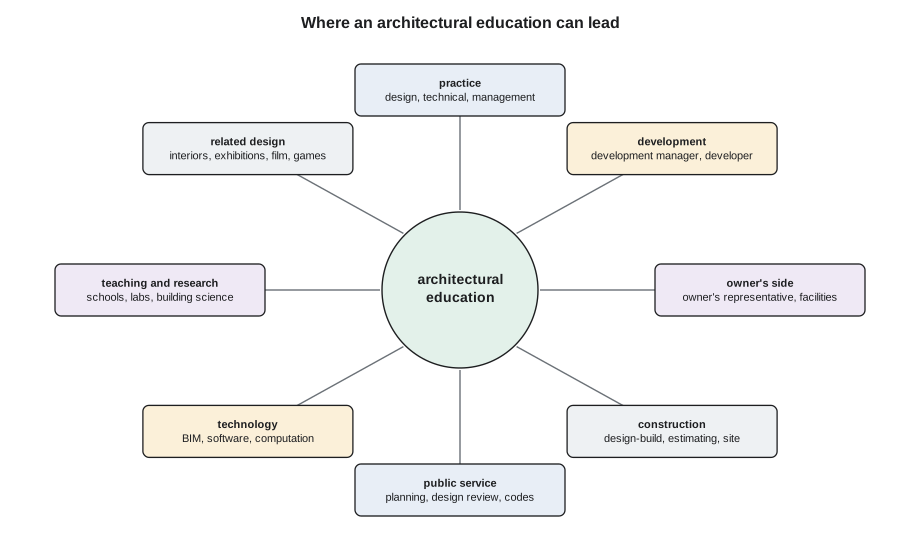
- Development: development managers at housing providers, real estate companies and institutions decide what is built, assemble the land and money, and hire and manage the design and construction teams. Architects bring an understanding of design, cost and approvals.
- The owner's side: owner's representatives and project managers act for hospitals, universities, governments and companies that build regularly, managing their projects from planning to occupancy. Facilities managers run buildings after they are built.
- Construction: design-build firms, general contractors and construction managers hire architects as design managers, estimators, schedulers and site managers.
- Public service: planners, urban designers, heritage officers, building code officials and plan reviewers shape the rules within which buildings are designed.
- Technology: software companies, consultancies in computational design and digital fabrication, and the technology departments of large firms.
- Teaching and research: schools of architecture, building science research institutes and laboratories, and research roles within large firms.
- Related design fields: interiors, exhibitions, set and production design for film and theatre, and environment design for video games.
Moss stresses that some of these paths still count toward licensure and others do not, as the students learned last year. A planner may gain little experience that counts toward the internship, while a design manager at a design-build firm may gain a great deal if supervised by a licensed architect. Anyone considering a move should check the rules first.
What each path pays
The students want to know how the paths compare financially. Moss is cautious: salaries vary widely by city, employer and person, and money is rarely the main reason the panellists chose their paths. But she builds a simple model with typical starting salaries and growth rates for five paths over ten years, and discounts the income at 4% a year to compare paths whose income comes at different times. In the practice path, the architect becomes licensed in the fourth year and receives a raise. In the planning path, the graduate spends a year on a planning master's degree first.
# Ten years of income on five paths for a new graduate (Canadian dollars), discounted at 4% a year.
paths = {  # path: (starting salary, yearly growth, years of unpaid or low-paid study, one-time cost)
    "practice, licensed in year 4":    (62_000, 0.045, 0, 6_000),
    "development manager":             (72_000, 0.055, 0, 0),
    "owner's representative":          (70_000, 0.045, 0, 0),
    "building software product role":  (78_000, 0.050, 0, 0),
    "planning, after a master's":      (68_000, 0.035, 1, 14_000),
}
LICENSE_STEP = 9_000            # raise on registration
r = 0.04
print(f"{'path':34}{'year 1':>10}{'year 10':>10}{'10-year value':>15}")
for name, (start, g, study, once) in paths.items():
    pay, value = start, -once
    year10 = 0
    for y in range(1, 11):
        if y <= study:
            income = 0
        else:
            income = pay
            pay *= 1 + g
            if name.startswith("practice") and y == 4:
                pay += LICENSE_STEP
        value += income / (1 + r) ** y
        if y == 1: year1 = income
        year10 = income
print(f"{name:34}{year1:>10,.0f}{year10:>10,.0f}{value:>15,.0f}")path year 1 year 10 10-year value practice, licensed in year 4 62,000 103,354 648,139 development manager 72,000 116,575 739,014 owner's representative 70,000 104,027 687,827 building software product role 78,000 121,004 783,298 planning, after a master's 0 89,543 541,068
The differences are real but smaller than the students expected. Over ten years, the paths that start higher, a product role in building software and development management, are worth more in present value than practice. On these assumptions, the software role leads practice by about 135,000 dollars, and development management by about 91,000. Planning, after a year of study, starts lowest but offers stability, a pension and regular hours that the model does not value.
Moss lists what the model leaves out. It ignores the chance of becoming a partner or owner in practice, which can raise income far above these figures in the second decade. It ignores the risk of layoffs, which is higher in practice and technology than in public service. It ignores pensions, benefits and hours. And it ignores the most important factor of all, which is whether the person enjoys the work. Castillo says he earns more than most of his classmates who stayed in firms but works longer hours than he expected, and that the right question is not which path pays most but which work you would still want to do on a bad day.
Skills that travel
Menon tells the students which skills employers outside practice value most in architects. The first is synthesis: the ability to combine technical, financial, social and aesthetic requirements into one coherent solution. The second is visual communication: drawing, modelling and presenting so that others understand. The third is project management, which is why the earlier weeks of this course matter for every path. The fourth is comfort with ambiguity, from years of design problems with no single right answer. He adds a fifth that architects often lack: the ability to talk about money and value in the language of business. Graduates who understand fees, budgets, cash flow and return on investment, he says, are far more credible in development, construction and technology roles.
| Path | Skills from architecture that transfer | Skills to add |
|---|---|---|
| Development | Design judgement, approvals, cost awareness | Finance, land, negotiation, sales |
| Owner's representative | Project management, contracts, coordination | Procurement, stakeholder management |
| Construction | Documents, details, sequencing | Estimating, scheduling, site management |
| Public service | Urban design, codes, communication | Policy, law, public process |
| Technology | Design workflows, modelling, scripting | Product management, software development |
| Teaching and research | Design, building science, writing | Research methods, grant writing |
Building a career outside the firm
The panel offers advice for students who are considering these paths. Delgado says to take a job in practice first if possible, for at least a few years, because the credibility of having designed and delivered buildings lasts a whole career. Haugen says to keep the option of licensure open by recording experience carefully and taking the examinations early, even if the student does not plan to practise. Castillo says to learn the vocabulary of the other side: read pro formas, sit in on cost reviews, ask the contractor how they price a job. Menon says to build something: a script, a tool, a study, a small building, anything that shows what the student can do beyond a portfolio of studio projects.
Moss adds that in Canada some of these paths have their own professional credentials, such as registration as a professional planner, certification as a project management professional or designation by the Real Property Institute of Canada, and that architects who move into them often hold both their architectural registration and the second credential. She tells the students to keep their architectural registration current wherever possible, because reinstating it after it lapses can be difficult.
Parallel paths
Not every alternative is a full change of direction. Many architects build careers that combine two paths at once. Some teach a studio or a technical course each term while working in a firm, which keeps them close to new ideas and to the students who may become their employees. Some run a small practice of their own on evenings and weekends, designing houses and renovations for friends and family, while working full-time elsewhere; Moss warns that this requires the firm's permission, the right registration and insurance, and a clear separation from the employer's clients. Some serve on design review panels, heritage committees or the boards of non-profit housing providers, which builds relationships and understanding that later lead to work. And some move between roles over a career, from a firm to an owner, back to a firm as a principal, and later into teaching.
Delgado says that her years on the board of a small housing co-operative, while she was still in practice, taught her more about development than any course, and led directly to her job at Greenway Homes. Haugen says that the planners he hires most readily are those who have spent time on both sides of the counter. Moss adds that parallel paths are also a way to test an idea before committing to it: Joon-ho could take on a single small infill project with a partner while working for a developer, learning the business before he risks his savings on it.
The four students' plans, revisited
Moss asks the students how the panel changed their thinking about the business plans they are writing. Joon-ho says that Delgado convinced him to work for a developer for a few years before trying to become one, and that he will rewrite his plan as a ten-year path rather than a business he starts at graduation. Callum says Menon made him wonder whether his performance consultancy should eventually build its own software tools, and Moss tells him to keep that idea in the plan as a later stage. Ingrid says Castillo made her realize that design-build firms need architects who understand owners' priorities, and that she wants experience on the owner's side as well. Wren says nothing changed her plan to found a housing studio, but that she now sees Delgado's job as a possible later step, and that the business skills she is learning will serve her in either role.
Worked problem
Comparing two job offers
A graduate has two offers: an intern architect in a small firm at 62,000 dollars, and a project coordinator for a developer at 72,000 dollars. How should she decide?
Show solution
- Compare the ten-year income on realistic assumptions, including a raise on licensure in the firm.
- Check what experience each job would count toward licensure, and whether the developer has a licensed architect who could supervise her.
- Compare the skills each job would build and how they fit her long-term goal.
- Ask about hours, benefits, mentoring and the stability of each employer.
- Decide on the work she would want to do on a bad day, and keep the other path open.
Answer: Weigh licensure, skills, stability and the work itself as well as pay, and keep the other path open.
Exercise 10: a ten-year career map
- Draw a map of three possible ten-year careers starting from your graduation, with the roles and moves in each.
- Run the income model with salaries you research for your city.
- For each path, list the licensure experience it would provide and the skills you would need to add.
- Interview one architect who works outside practice and summarize what you learn.
Self-check
- Do I know the main paths outside traditional practice?
- Do I understand what the income model includes and leaves out?
- Am I keeping licensure open, whatever path I choose?
- Can I explain my skills in terms employers outside practice understand?
Common mistakes
MistakeChoosing a path only by starting salary.
InsteadConsider licensure, skills, stability, hours and the work itself.
MistakeLetting the record of licensure experience lapse after leaving practice.
InsteadRecord experience and keep registration current wherever possible.
MistakeTreating a move outside practice as permanent.
InsteadSee a career as a series of moves; outside experience can add value on return.
MistakeDescribing skills only in design terms.
InsteadLearn to talk about money, value and projects in business terms.
MistakeAssuming a model's numbers are the whole story.
InsteadList what the model leaves out, such as ownership, risk and benefits.
Summary and key terms
- Architectural education leads to development, the owner's side, construction, public service, technology, teaching and related design fields.
- Some paths count toward licensure and some do not; check before moving.
- Higher starting salaries outside practice are offset by ownership opportunities, stability, benefits and the nature of the work.
- Synthesis, visual communication, project management and comfort with ambiguity transfer to every path; business literacy must often be added.
- A career is a series of moves, and experience outside a firm can make an architect more valuable inside one.
- Owner's representative
- A person who manages building projects on behalf of the owner.
- Development manager
- A person who leads the planning, financing and delivery of new buildings for a developer or institution.
- Present value
- The value today of income received in the future, discounted for time.
- Transferable skill
- A skill that is valuable in more than one career.
- Design manager
- A person who manages design work within a construction or design-build company.
Practice problems
Work each problem on paper first, then reveal the answer to check.
Why did Moss discount future income at 4% a year?
Show answer
To compare income received at different times on an equal basis.
Name two factors the income model leaves out.
Show answer
Any two of: ownership or partnership income, risk of layoffs, pensions and benefits, hours, enjoyment of the work.
What did Delgado advise students who want to work outside practice?
Show answer
Work in practice first, for at least a few years, because the credibility lasts a career.
What skill did Menon say architects often lack?
Show answer
The ability to talk about money and value in business terms.
Why should an architect who becomes a planner keep their registration current?
Show answer
Because reinstating it after it lapses can be difficult, and they may return to practice.
Lesson quiz · 5 questions
Score 60% or more to complete this lesson.
Create a free account to save your progress, take quizzes and earn a certificate.