
ARCH-350 · Lesson 9 of 12 · 20 min
Rating systems: LEED, Passive House, Living Building Challenge
The hub's board has a question for the students: which certification should the building pursue? The city wants LEED, because its policy for public buildings mentions it. Priyanka Sethi, the energy modeller, favours Passive House, because it sets clear performance targets. Rita Moreau has read about the Living Building Challenge and likes its ambition. A board member who manages buildings for a living asks whether any of them is worth the fees. Reinholt sets the students to work. 'A rating system is a tool,' he tells them, 'and like any tool it is good for some jobs and bad for others. Learn what each one measures, what it ignores and what it costs, and then you can advise your client honestly.' This lesson compares the main rating systems and the ideas behind them.
What rating systems do
A green building rating system defines a set of criteria for sustainable performance, assesses buildings against them and certifies those that meet them, usually at several levels. Rating systems serve several purposes at once. They give owners and designers a structured checklist so that important issues are not forgotten. They provide a common language for comparing buildings. They give owners a credible way to communicate their commitments to tenants, funders and the public. They have pushed whole industries to change: the demand for low-emitting paints, certified wood and efficient fixtures grew in large part because rating systems rewarded them. And they increasingly appear in policy: many governments require certification for their own buildings or offer incentives for it.
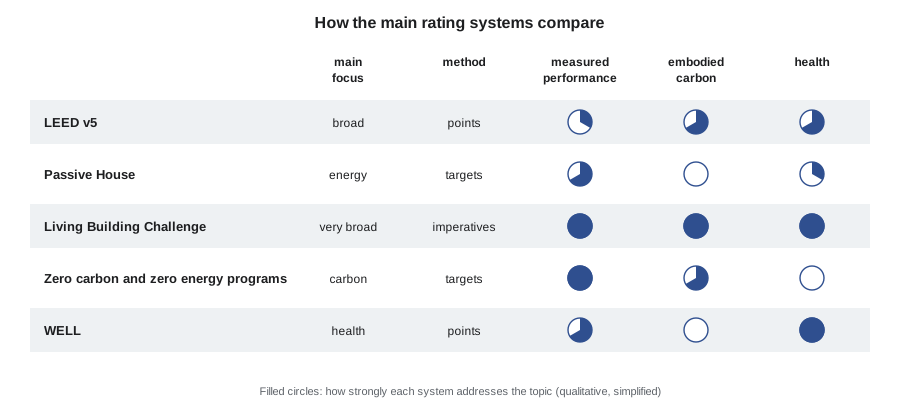
Rating systems differ in what they measure. Some are broad, covering energy, water, materials, health, site and more, with points for each. Some are focused, setting strict targets for one aspect, such as energy or carbon. Some certify a design; others require proof of performance after occupancy. These differences matter more than the brand.
LEED
Leadership in Energy and Environmental Design (LEED), created by the US Green Building Council in 1998, is the most widely used green building rating system in the world, and the Canada Green Building Council administers it in Canada. LEED awards points across categories such as location and transportation, sustainable sites, water efficiency, energy and atmosphere, materials and resources, indoor environmental quality and innovation. Projects must meet a set of prerequisites and then earn points toward one of four levels: Certified, Silver, Gold and Platinum.
LEED version 5, ratified by USGBC members in April 2025, is the most significant revision in a decade. It places decarbonization at the centre, with greater weight on operational and embodied carbon, electrification and refrigerant management, and it gives more emphasis to quality of life, including health, resilience and equity, and to ecological conservation. It retains the points structure that makes LEED flexible and familiar.
LEED's strengths are its breadth, its recognition and its adaptability to many building types. Its weaknesses are the other side of its flexibility. Because points are tradable, a project can earn certification while doing little in an area that matters greatly, such as energy, by collecting easier points elsewhere: the practice known as point chasing. And because most LEED certifications are based on design and construction rather than operation, a certified building can perform worse than predicted. LEED for operations and maintenance, and performance-based recertification, address this partly.
Passive House
Passive House (Passivhaus in German) is a performance standard developed by Wolfgang Feist and Bo Adamson and first applied in a row of houses in Darmstadt, Germany, in 1991. It is administered internationally by the Passive House Institute (PHI). It focuses almost entirely on energy, through a few demanding targets.
- Space heating demand of no more than 15 kWh per m² of treated floor area per year, or a peak heating load of no more than 10 W per m².
- Airtightness of no more than 0.6 air changes per hour at a test pressure of 50 pascals.
- Limits on total renewable primary energy demand, which in the Classic class is 60 kWh per m² per year, with higher classes, Plus and Premium, for buildings that also generate renewable energy.
- Comfort criteria: no more than 10% of hours above 25 °C (77 °F), and interior surface temperatures warm enough to avoid drafts and condensation.
In North America, Phius, formerly the Passive House Institute US, offers its own standards, Phius CORE and Phius ZERO, with targets that vary by climate zone and building type. Both organizations rely on detailed energy modelling with their own tools and on on-site verification, including a blower door test.
Passive House's strengths are its clarity and its results: monitored Passive House buildings generally perform close to their predictions, because the targets are strict, the modelling is detailed and the airtightness is tested. Its weaknesses are its narrowness, saying little about materials, water, health or site, and the demanding design and construction skills it requires, though those skills are spreading quickly. In the Prairies, Passive House has a long history: the Saskatchewan Conservation House in Regina, completed in 1977, anticipated many of its ideas.
Reinholt asks Sethi to check the hub against the Passive House Classic criteria.
# Does the hub meet the Passive House Classic criteria?
criteria = {
    # name: (hub value, limit, unit)
    "space heating demand": (20, 15, "kWh per m2 per year"),
    "airtightness": (1.0, 0.6, "air changes per hour at 50 Pa"),
    "renewable primary energy": (58, 60, "kWh per m2 per year"),
    "overheating frequency": (4, 10, "% of hours above 25 C"),
}
failed = []
for name, (value, limit, unit) in criteria.items():
    ok = value <= limit
    print(f"{name:26s} {value:6.2f} vs limit {limit:6.2f} {unit}: {'meets' if ok else 'misses'}")
    if not ok:
        failed.append(name)
# heating demand scales roughly with heat loss; how much must heat loss fall to meet the limit?
hd, hl, _ = criteria["space heating demand"]
if "space heating demand" in failed:
    print(f"heat loss must fall by about {(1 - hl / hd) * 100:.0f}% to meet the heating limit")
print("criteria missed:", ", ".join(failed) if failed else "none")space heating demand 20.00 vs limit 15.00 kWh per m2 per year: misses airtightness 1.00 vs limit 0.60 air changes per hour at 50 Pa: misses renewable primary energy 58.00 vs limit 60.00 kWh per m2 per year: meets overheating frequency 4.00 vs limit 10.00 % of hours above 25 C: meets heat loss must fall by about 25% to meet the heating limit criteria missed: space heating demand, airtightness
The hub comes close but misses two criteria: its heating demand is a quarter above the limit, and its airtightness target of 1.0 air changes per hour is less strict than Passive House requires. Sethi estimates that reaching the standard would require thicker roof insulation, better window frames, a more careful air barrier strategy at the timber connections and a heat recovery ventilator with higher efficiency, at a modest additional cost. The question for the board is whether the certification is worth the extra effort, or whether the hub should simply adopt the targets without certifying.
The Living Building Challenge
The Living Building Challenge (LBC), launched in 2006 by Jason McLennan and the Cascadia Green Building Council and now administered by the International Living Future Institute, is the most demanding mainstream program. Its current version, 4.1, is organized into seven petals: Place, Water, Energy, Health and Happiness, Materials, Equity and Beauty, each with imperatives that a project must meet. Among them: the project must produce more renewable energy than it uses, on site; it must supply its own water and treat its wastewater, or work toward that goal where regulations prevent it; it must avoid Red List chemicals; it must reduce and offset its embodied carbon; it must provide equitable access and support fair labour practices; and it must include design features intended for beauty and delight.
The Challenge is distinctive in two ways. It contains no points: imperatives are requirements, not options. And certification is awarded only after twelve consecutive months of occupancy and measured performance, so a project cannot be certified on its design alone. Projects can pursue full Living certification, Petal certification for some petals, or the related Zero Energy, Zero Carbon and Core certifications. Relatively few buildings have achieved full certification, among them the Bullitt Center in Seattle, completed in 2013, and the Kendeda Building at Georgia Tech, completed in 2019. The Challenge's influence comes less from the number of certified buildings than from showing what is possible and from tools such as the Red List and Declare labels that the whole industry now uses.
Other systems
Several other systems are common. The Canada Green Building Council's Zero Carbon Building Standards (Lesson 4) certify carbon performance in design and operation. BOMA BEST, from the Building Owners and Managers Association of Canada, is widely used for existing buildings. Green Globes is a lighter alternative to LEED. WELL, from the International WELL Building Institute, focuses on health and wellbeing: air, water, light, movement, thermal and acoustic comfort, materials and mind. Fitwel offers a lighter health certification. SITES applies a similar approach to landscapes.
Choosing a system
Reinholt offers the students a set of questions for advising a client.
- What are the client's goals? A school district aiming for low operating costs may want Passive House; a developer marketing to tenants may want LEED or WELL; a client seeking leadership may aim for the Living Building Challenge.
- What does policy require or reward? Public owners often must certify; some incentives are tied to specific programs.
- What does the system actually measure? Choose one whose criteria match the project's priorities, or combine a broad system with a focused one.
- Does it require measured performance? Systems that verify operation are more credible than those based only on design.
- What does it cost? Fees, modelling, commissioning, documentation and design time; compare these with the value of certification and with the cost of simply adopting its targets.
Reinholt adds a caution. Certification can become the goal instead of the means, and teams can spend more effort on documentation than on design. 'Use the rating system to raise your ambitions and check your work,' he says. 'Never let it do your thinking.'
Worked problem
Advising the hub's board
The students must recommend a certification strategy for the hub. What do they advise?
Show solution
- Pursue LEED v5 to meet the city's policy, aiming for Platinum, which the hub's design largely supports already.
- Adopt the Passive House targets for heating demand and airtightness, and certify through PHI if the board agrees to the modest additional cost; the targets make the energy model credible and the airtightness test catches construction defects.
- Pursue ZCB-Performance certification after the first year of operation, to verify the net-zero carbon claim the board has adopted.
- Use the Living Building Challenge's Materials petal and Red List as the materials standard without pursuing full certification, since the hub's water and site constraints make full Living certification impractical.
- Budget for commissioning, metering and a post-occupancy evaluation regardless of the certifications chosen.
Answer: The board accepts the strategy but asks for a single dashboard that reports the hub's performance against all the targets each year, so the public sees results, not logos.
Exercise 9: certification strategy
- Assess your studio building against the main criteria of LEED v5, Passive House and the Living Building Challenge.
- Identify which criteria it already meets, which it could meet with modest changes and which would require major changes.
- Estimate the additional cost and effort of each certification.
- Write a one-page recommendation to the client, with reasons.
Self-critique checklist
- Have I matched the system to the client's goals rather than choosing the best-known brand?
- Have I considered whether performance will be measured after occupancy?
- Have I been honest about costs and benefits?
- Have I avoided letting the checklist replace design thinking?
Common mistakes
MistakeTreating all rating systems as equivalent.
InsteadCompare what each measures, whether it verifies performance, and what it ignores.
MistakePoint chasing.
InsteadPrioritize the criteria that matter most for the project's impact, especially energy and carbon.
MistakeAssuming certification guarantees performance.
InsteadVerify with commissioning, metering and post-occupancy evaluation.
MistakeIgnoring the cost of certification.
InsteadCompare the fees and documentation effort with the value, and with simply adopting the targets.
MistakeLetting the checklist drive the design.
InsteadUse the system to raise ambitions and check the work, not to replace design thinking.
Summary and key terms
- Rating systems provide checklists, common language, credibility and market change; they differ in breadth, method and verification.
- LEED is broad and points-based; LEED v5 (2025) puts decarbonization at the centre; its flexibility allows point chasing.
- Passive House sets strict energy targets: heating demand of 15 kWh/m² per year, airtightness of 0.6 air changes per hour at 50 Pa, and renewable primary energy limits.
- The Living Building Challenge 4.1 has seven petals of imperatives and requires twelve months of measured performance.
- Other systems include Zero Carbon Building, BOMA BEST, WELL, Fitwel, Green Globes and SITES.
- Choose a system by the client's goals, policy, what it measures, whether it verifies performance and what it costs.
- LEED
- Leadership in Energy and Environmental Design, a points-based green building rating system.
- Point chasing
- Earning certification points that are easy rather than those that matter most.
- Passive House
- A performance standard with strict targets for heating demand, airtightness and primary energy.
- Blower door test
- A test that pressurizes a building to measure its air leakage.
- Living Building Challenge
- A demanding program of imperatives in seven petals, certified after a year of measured performance.
- Petal
- One of the seven performance areas of the Living Building Challenge.
- WELL
- A rating system focused on the health and wellbeing of building occupants.
Practice problems
Work each problem on paper first, then reveal the answer to check.
A building's heating demand is 22 kWh/m² per year. By about how much must its heat loss fall to meet the Passive House limit?
Show answer
1 − 15 ÷ 22 = 32%.
Why does the Living Building Challenge require twelve months of occupancy before certification?
Show answer
So that certification is based on measured performance, not design predictions.
What is point chasing, and why is it a problem?
Show answer
Earning easy points instead of important ones; it lets a building be certified while doing little in areas that matter greatly, such as energy.
Name the seven petals of the Living Building Challenge.
Show answer
Place, Water, Energy, Health and Happiness, Materials, Equity and Beauty.
Why do monitored Passive House buildings usually perform close to their predictions?
Show answer
Strict targets, detailed modelling and tested airtightness reduce the gap between design and reality.
Lesson quiz · 5 questions
Score 60% or more to complete this lesson.
Create a free account to save your progress, take quizzes and earn a certificate.