
ARCH-350 · Lesson 5 of 12 · 20 min
Water
In early February, Reinholt takes the class to the city's water treatment plant. The plant manager shows them the intake, the settling basins, the filters and the pumps that push clean water through hundreds of kilometres of pipe to every tap in the city, and then, on the drive back, the outfall where the combined sewer overflows into the river after a heavy rain. 'Every litre that flushes a toilet in the hub,' Reinholt says on the bus, 'was pumped from a lake or river, treated to drinking quality, pumped across the city, used once for a few seconds, and sent to another plant to be cleaned again. Water is the resource that architects most often forget, because it seems so cheap. It is not cheap to the river.' This lesson is about water in and around buildings: how much they use, how to use less, how to harvest and reuse it, and how to manage the rain that falls on the site.
The water cycle of a building
A building takes in potable water, treated to drinking quality, and uses it for drinking, cooking, washing, cleaning, flushing toilets, irrigation and sometimes cooling. It sends out wastewater: greywater from sinks, showers and laundry, which is lightly contaminated, and blackwater from toilets and kitchen sinks, which carries pathogens and organic matter. Separately, it sheds stormwater: the rain and snowmelt that fall on its roof and site.
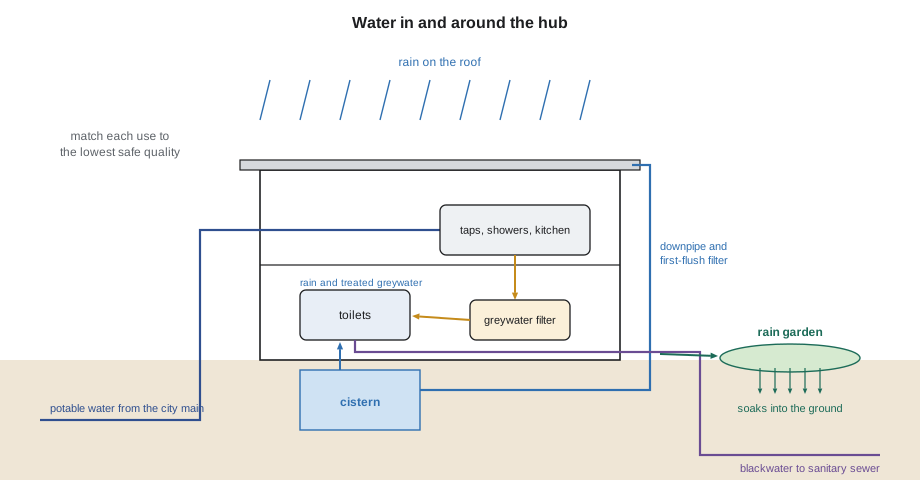
The principle Reinholt teaches is simple: match each use to the lowest quality of water that is safe for it. Drinking, cooking and washing need potable water. Toilet flushing, irrigation and some cooling do not. In a typical office or community building, toilet and urinal flushing is the largest single use of water, so supplying it with harvested rain or treated greywater can cut potable demand by a third or more.
Reducing demand
As with energy, the first step is to use less. Modern plumbing fixtures use a fraction of the water of older ones.
- Toilets: older toilets use 13 to 20 litres per flush; current high-efficiency models use 4.8 litres or less, and dual-flush models less again.
- Urinals: high-efficiency models use 0.5 litres or less per flush, and waterless urinals none.
- Faucets and showers: aerators and low-flow heads reduce flow to about 1.9 litres per minute for public lavatory faucets and 6.6 to 7.6 litres per minute for showers, with sensor or metered controls in public washrooms.
- Appliances: efficient dishwashers and clothes washers, and kitchen equipment such as connectionless steamers.
- Landscape: native and adapted planting that needs no irrigation once established, rather than lawn.
Hot water is also an energy issue. In an efficient building, heating domestic hot water can be one of the largest remaining energy uses, so every litre of hot water saved also saves energy and, where water is heated with fuel, carbon. Short pipe runs from the water heater to the fixtures, small-diameter pipes and insulated lines reduce the water wasted while waiting for it to run hot.
Rainwater harvesting
Rainwater harvesting collects rain from roofs and stores it for non-potable uses. A system has a catchment (usually the roof), gutters and downpipes, a first-flush diverter that discards the dirtiest first few millimetres of each storm, filters, a storage tank or cistern, a pump and a separate distribution system, clearly labelled and protected from cross-connection with potable water. Plumbing codes in Canadian provinces and in Manitoba's adoption of the National Plumbing Code now permit rainwater for toilet flushing and irrigation, with requirements for treatment, backflow protection, signage and maintenance.
The volume a roof can collect in a period equals its plan area A times the rainfall depth R times a runoff coefficient C, which accounts for losses to evaporation, splashing and the first-flush diverter. For a smooth roof, C is about 0.8.
The climate sets the limits. Winnipeg receives about 520 mm of precipitation a year, much of it in summer thunderstorms, and a fifth of it as snow that melts in spring. In winter, a cistern must be indoors or buried below frost, and roof drains and filters must be designed so that ice does not block them. Reinholt asks Wren to test how much of the hub's flushing demand its roof could supply.
# Rainwater harvesting for the hub's toilet flushing: monthly tank balance
ROOF = 1450          # catchment area, m2
C = 0.8                # runoff coefficient for a smooth roof
rain = [20, 14, 24, 31, 58, 90, 79, 77, 46, 37, 25, 20]          # monthly precipitation normals, mm (approximate)
cold = [1, 1, 1, 0, 0, 0, 0, 0, 0, 0, 1, 1]       # months when snow and ice halve the yield
days = [31, 28, 31, 30, 31, 30, 31, 31, 30, 31, 30, 31]
DEMAND = 2400         # flushing demand, litres per day (about 250 visitors, two flushes each, plus staff)
for tank in [10000, 20000, 40000, 80000]:   # tank size, litres
    stored, supplied, used = 0.0, 0.0, 0.0
    for year in range(2):                     # second year starts with the tank as the first year left it
        supplied = used = 0.0
        for m in range(12):
            inflow = ROOF * rain[m] * 1 * C * (0.5 if cold[m] else 1.0)
            need = DEMAND * days[m]
            stored = min(tank, stored + inflow)
            take = min(stored, need)
            stored -= take
            supplied += take
            used += need
    print(f"tank {tank:6,} litres: rain supplies {supplied:9,.0f} of {used:9,.0f} litres, {supplied / used * 100:3.0f}% of flushing")
yield_year = sum(ROOF * rain[m] * 1 * C * (0.5 if cold[m] else 1.0) for m in range(12))
print(f"most the roof can collect in a year: {yield_year:9,.0f} litres, {yield_year / used * 100:3.0f}% of flushing")tank 10,000 litres: rain supplies 118,120 of 876,000 litres, 13% of flushing tank 20,000 litres: rain supplies 199,740 of 876,000 litres, 23% of flushing tank 40,000 litres: rain supplies 335,700 of 876,000 litres, 38% of flushing tank 80,000 litres: rain supplies 485,660 of 876,000 litres, 55% of flushing most the roof can collect in a year: 544,620 litres, 62% of flushing
With a 10,000-litre tank the roof supplies only about an eighth of the flushing water; with 40,000 litres, nearly 40%; with 80,000 litres, about 55%, close to the limit of about 62% set by what the roof can collect in a year. Beyond that point a larger tank adds almost nothing, because the roof cannot collect more water than falls on it. Reinholt points out a limit of the model itself: it works month by month, so a tank can fill only once a month. In reality, storms refill a tank several times a month, so a daily simulation with real rainfall records would show small and mid-sized tanks doing better than this. The students learn the shape of the trade-off all the same: storage costs rise steadily with size while the benefit levels off at the roof's annual yield. Wren proposes a mid-sized cistern in the mechanical room, under the hall's stage, with an overflow to the rain garden, and asks Sethi for a daily simulation before the size is fixed.
Greywater and blackwater
Greywater reuse treats water from showers, bathtubs, laundry and bathroom sinks for flushing or subsurface irrigation. It is most useful in buildings with many showers, such as housing, gyms and hotels, where the supply of greywater matches the demand for flushing. Systems range from simple filters and disinfection for flushing to biological treatment. They need regular maintenance, and untreated greywater must not be stored for long, because it quickly turns septic. For the hub, with few showers, greywater adds little; for Greenway Homes, across the greenway, it could supply most of the flushing water.
Blackwater systems go further. Composting toilets treat human waste on site without water; they have been used successfully in a few public buildings, such as the Bullitt Center in Seattle. Some districts treat all wastewater locally in small plants or constructed wetlands and reuse it for flushing and irrigation. These systems face regulatory barriers and require careful operation, but they are central to the most ambitious targets, such as the Living Building Challenge's goal of net positive water, in which a project supplies all its own water from rain and treats all its wastewater on site.
Stormwater
When rain falls on a natural landscape, most of it soaks into the ground or evaporates; only a small share runs off. When it falls on roofs and paving, most of it runs off, quickly and carrying pollutants, into storm sewers or, in older cities, into combined sewers that also carry sewage. Winnipeg's older neighbourhoods are served by combined sewers that overflow into the Red and Assiniboine rivers several times a year, and the city is under provincial orders to reduce those overflows. Heavier rainstorms, more frequent in a warming climate, overwhelm pipes designed for the storms of the past.
Green infrastructure manages stormwater close to where it falls: green roofs that hold and evaporate rain, rain gardens and bioswales that let it soak in, permeable paving, trees whose canopies intercept rain, and cisterns that store it for use. The hub's site design includes a rain garden at the end of the greenway and permeable paving in the bicycle courtyard. The students size them to hold the first 25 mm of a storm from the roof and paving, which typically captures most of the rainfall events of a year and much of the pollution, which arrives in the first flush.
Worked problem
Water budget for the hub
The hub's board asks how much potable water the building will save compared with a typical community building of the same size. How should Wren answer?
Show solution
- Estimate a baseline: a typical building with standard fixtures and an irrigated lawn, using occupancy and fixture flow rates.
- Apply the fixture choices: high-efficiency toilets and urinals, low-flow sensor faucets and efficient kitchen equipment. These alone cut indoor potable use by roughly 35 to 45%.
- Apply the rainwater system: from the tank study, the cistern supplies part of the remaining flushing water, more in summer than in winter.
- Apply the landscape: native planting on the site needs no irrigation after the first two years, so irrigation demand falls to almost zero.
- Report the result as a share of the baseline and in absolute terms, and state the assumptions: occupancy, fixture use and rainfall.
Answer: Wren estimates that the hub will use roughly 55 to 65% less potable water than the baseline. She adds a water meter on the rainwater system so that the board can see the real figure.
Exercise 5: water strategy
- Estimate the potable water demand of your studio building by use, with standard and efficient fixtures.
- Size a rainwater system for one non-potable use, testing at least three tank sizes with monthly rainfall.
- Assess whether greywater reuse makes sense for the building, and why.
- Design site measures to hold the first 25 mm of rainfall, and show them on a site plan and section.
Self-critique checklist
- Have I matched each use to the lowest safe water quality?
- Have I reduced demand before adding harvesting or reuse?
- Have I designed for winter: frost, ice and snowmelt?
- Have I planned the maintenance that every water system needs?
Water and energy together
Reinholt asks the students to notice how closely water and energy are linked. Treating and pumping a city's water and wastewater uses a significant share of a municipality's electricity, so every litre saved in a building saves energy at the plants as well. Heating water uses even more, at the building. Conversely, generating electricity in thermal power plants consumes large volumes of cooling water, which is one reason a clean, renewable grid also eases pressure on rivers. A building that saves hot water, harvests rain for flushing and manages stormwater on site therefore helps the climate and the river at once. The students add an estimate of the energy embedded in the hub's potable water use to their energy model, and find that it is small compared with the building's own use but not negligible for the city.
Common mistakes
MistakeSizing a rainwater tank for the largest storm.
InsteadTest several sizes with rainfall records, and check the roof's annual yield, which caps the benefit.
MistakeForgetting frost in a northern climate.
InsteadPut tanks indoors or below frost and design drains to resist ice.
MistakeProposing greywater reuse where there is little greywater.
InsteadUse it where showers and laundry produce enough to match flushing demand.
MistakeTreating stormwater as someone else's problem.
InsteadHold and infiltrate rain on site with green infrastructure.
MistakeIgnoring maintenance.
InsteadSpecify access, filters, signage and a maintenance plan for every system.
Summary and key terms
- Buildings use potable water, produce greywater and blackwater, and shed stormwater.
- Match each use to the lowest safe water quality; toilet flushing is often the largest use in public buildings.
- Efficient fixtures and native planting reduce demand first; saving hot water also saves energy.
- Rainwater harvesting yields roof area times rainfall times a runoff coefficient; tank size has diminishing returns.
- Greywater reuse suits buildings with many showers; blackwater treatment supports the most ambitious goals.
- Green infrastructure holds and infiltrates stormwater close to where it falls.
- Potable water
- Water treated to drinking quality.
- Greywater
- Lightly used water from showers, baths, laundry and bathroom sinks.
- Blackwater
- Wastewater from toilets and kitchen sinks.
- First-flush diverter
- A device that discards the first, dirtiest runoff of each storm.
- Runoff coefficient
- The share of rainfall on a surface that runs off.
- Combined sewer
- A sewer carrying both sewage and stormwater, which can overflow in heavy rain.
- Green infrastructure
- Planted and permeable systems that manage stormwater where it falls.
- Net positive water
- A goal in which a project supplies its own water and treats its wastewater on site.
Practice problems
Work each problem on paper first, then reveal the answer to check.
A roof of 600 m² receives 30 mm of rain with a runoff coefficient of 0.8. How much water can it collect?
Show answer
600 × 0.030 × 0.8 = 14.4 m³, or 14,400 litres.
Why do larger rainwater tanks give diminishing returns?
Show answer
A mid-sized tank already captures most storms, and no tank can store more than the roof collects in a year, so the benefit levels off while the cost keeps rising.
Which uses can be supplied with harvested rainwater?
Show answer
Non-potable uses such as toilet flushing, irrigation and some cooling, with treatment and backflow protection.
Why is greywater reuse more useful in housing than in a library?
Show answer
Housing has many showers and much laundry, producing enough greywater to meet flushing demand.
What does a rain garden do?
Show answer
It holds stormwater from roofs and paving and lets it soak into the ground, removing pollutants and reducing runoff.
Lesson quiz · 5 questions
Score 60% or more to complete this lesson.
Create a free account to save your progress, take quizzes and earn a certificate.