
ARCH-350 · Lesson 6 of 12 · 21 min
Materials and health
Joon-ho's specification for the daycare floor calls for a vinyl sheet product. It is durable, easy to clean and inexpensive, and the daycare director, Rita Moreau, likes its bright patterns. Reinholt asks him to find out what is in it. Two days later Joon-ho reports back, looking uneasy. The product is made of polyvinyl chloride with plasticizers, and the manufacturer's disclosure lists a phthalate plasticizer among its ingredients, the family of chemicals that many health agencies have restricted in toys because of concerns about hormone disruption. 'Children will crawl on this floor for eight hours a day,' Reinholt says. 'They breathe closer to it than anyone. Is it the right floor?' This lesson is about the health of the people who use buildings, and of the people who make their materials.
Why materials matter to health
People in North America spend about 90% of their time indoors, so the air they breathe and the surfaces they touch are mostly inside buildings. Building products can release chemicals into indoor air: volatile organic compounds (VOCs) from paints, adhesives, sealants and composite wood, and semi-volatile compounds such as plasticizers and flame retardants that migrate slowly into household dust. Some of these chemicals are known or suspected to cause cancer, disrupt hormones, irritate airways or affect children's development. Children, pregnant people, older people and those with asthma are most vulnerable.
Health effects reach beyond the building. The manufacture of some materials exposes workers and nearby communities to hazardous chemicals, and the disposal of others releases pollutants when they are burned or landfilled. The production of PVC, for example, uses chlorine and vinyl chloride, and burning PVC waste can release dioxins. A material that is safe in the room may still carry harm along its supply chain, and a sustainable architect considers the whole chain.
History offers warnings. Lead paint and lead pipes, asbestos insulation and fireproofing, and polychlorinated biphenyls (PCBs) in sealants were all once considered safe and modern. All were later found to be harmful, and all are still being removed from older buildings at great cost, a subject the students will meet in adaptive reuse. Canada banned most uses of asbestos in 2018. Reinholt draws the lesson: when there is credible evidence of harm, it is wiser to avoid a chemical than to wait for proof.
Chemicals of concern
Several groups of chemicals appear again and again on lists of concern for building products.
- Formaldehyde, used in some resins for plywood, particleboard, insulation and adhesives, is a known human carcinogen. Products made with no added formaldehyde, or with ultra-low-emitting resins, are widely available.
- Halogenated flame retardants, added to some foam insulations and furnishings, persist in the environment and accumulate in people. Several have been phased out; others remain in use.
- Phthalates, used as plasticizers in flexible PVC, are associated with hormone disruption.
- Per- and polyfluoroalkyl substances (PFAS), the 'forever chemicals' used for stain and water resistance in carpets, fabrics and coatings, persist almost indefinitely and are found in the blood of nearly everyone. Canada has moved toward restricting PFAS as a class under the Canadian Environmental Protection Act.
- Heavy metals such as lead and cadmium, still found in some imported products and old coatings.
- Isocyanates, used in spray foam and some adhesives, which can cause asthma in installers if handled without protection.
Not every chemical in these groups is equally harmful, and some have essential uses, such as fire safety. The point is not to fear every ingredient but to know what is in a product and to choose safer alternatives where they exist.
Lists, disclosure and certification
Several tools help designers see inside products.
- The Red List of the International Living Future Institute names chemicals and chemical classes that projects pursuing the Living Building Challenge must avoid, with limited exceptions. It includes PVC, phthalates, halogenated flame retardants, added formaldehyde, PFAS, lead and others.
- Declare labels, also from the Institute, list a product's ingredients and say whether it is free of Red List chemicals.
- Health Product Declarations (HPDs), a standard format developed by the HPD Collaborative, disclose a product's ingredients and their known hazards.
- Emissions certifications, such as products tested to the California Department of Public Health's standard method for VOC emissions, show that a product releases little into indoor air. Many rating systems accept them.
- Multi-attribute certifications, such as Cradle to Cradle Certified, assess material health together with recycling, energy, water and social fairness.
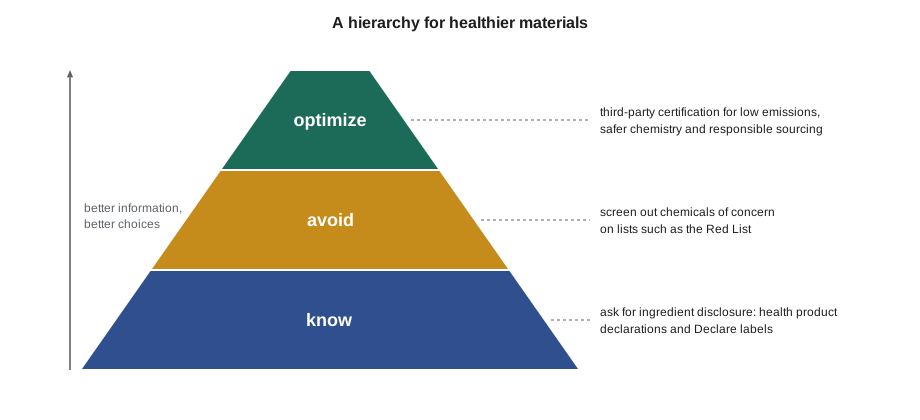
Reinholt teaches a three-step hierarchy. First, know: ask for ingredient disclosure for the products that matter most, those that are large in area, in contact with people, or used in sensitive spaces. Second, avoid: screen out products containing chemicals of concern. Third, optimize: among the remaining products, prefer those with low emissions, safer chemistry and responsible sourcing, verified by third parties. Disclosure itself is valuable: manufacturers who know that architects read their ingredient lists have reasons to improve them.
Joon-ho screens the hub's main interior products against the Red List classes and against an emissions requirement.
# Screen the hub's interior products against chemicals of concern and an emissions test
CONCERN = {"PVC", "phthalate", "halogenated flame retardant", "added formaldehyde", "PFAS", "lead", "cadmium"}
products = [
    # name, share of interior finish budget, known ingredients of concern, passes VOC emissions test
    ("vinyl sheet floor, daycare", 0.09, {"PVC", "phthalate"}, True),
    ("linoleum floor, daycare", 0.10, set(), True),
    ("carpet tile, library", 0.12, {"PFAS"}, True),
    ("carpet tile, PFAS-free option", 0.12, set(), True),
    ("vinyl wall base", 0.02, {"PVC"}, True),
    ("rubber wall base", 0.02, set(), True),
    ("gypsum board", 0.15, set(), True),
    ("interior paint, zero VOC", 0.06, set(), True),
    ("acoustic ceiling tile", 0.10, set(), True),
    ("plywood millwork, standard resin", 0.08, {"added formaldehyde"}, False),
    ("plywood millwork, no added formaldehyde", 0.09, set(), True),
    ("sealants and adhesives, low VOC", 0.03, set(), True),
    ("stain-repellent upholstery", 0.05, {"PFAS"}, True),
]
for name, share, flags, voc_ok in products:
    hits = flags & CONCERN
    verdict = "pass" if not hits and voc_ok else "replace"
    reason = ", ".join(sorted(hits)) + ("" if voc_ok else (", " if hits else "") + "high emissions")
    print(f"{name:40s} {verdict}" + (f": {reason}" if reason else ""))
# the first design used the problem products; the revised design uses the alternatives
first = ["vinyl sheet floor, daycare", "carpet tile, library", "vinyl wall base", "gypsum board", "interior paint, zero VOC",
         "acoustic ceiling tile", "plywood millwork, standard resin", "sealants and adhesives, low VOC", "stain-repellent upholstery"]
revised = ["linoleum floor, daycare", "carpet tile, PFAS-free option", "rubber wall base", "gypsum board", "interior paint, zero VOC",
           "acoustic ceiling tile", "plywood millwork, no added formaldehyde", "sealants and adhesives, low VOC"]
info = {p[0]: p for p in products}
for label, scheme in (("first design", first), ("revised design", revised)):
    total = sum(info[n][1] for n in scheme)
    clean = sum(info[n][1] for n in scheme if not (info[n][2] & CONCERN) and info[n][3])
print(f"{label}: {clean / total * 100:3.0f}% of the finish budget passes the screen")vinyl sheet floor, daycare replace: PVC, phthalate linoleum floor, daycare pass carpet tile, library replace: PFAS carpet tile, PFAS-free option pass vinyl wall base replace: PVC rubber wall base pass gypsum board pass interior paint, zero VOC pass acoustic ceiling tile pass plywood millwork, standard resin replace: added formaldehyde, high emissions plywood millwork, no added formaldehyde pass sealants and adhesives, low VOC pass stain-repellent upholstery replace: PFAS first design: 49% of the finish budget passes the screen revised design: 100% of the finish budget passes the screen
The screen shows that the first design's problems are concentrated in a few products: the daycare floor, the library carpet with its PFAS stain treatment, the vinyl wall base, the millwork plywood and the upholstery. Each has a widely available alternative: linoleum, made from linseed oil, wood flour and jute; PFAS-free carpet; rubber base; plywood with no added formaldehyde; and untreated upholstery chosen for durability. In the revised design, all the screened products pass. The alternatives cost a little more in some cases and less in others; linoleum, for example, is more expensive than vinyl but lasts longer.
Indoor air beyond materials
Healthy materials are one part of indoor environmental quality. The others were covered in Environmental Systems I and include ventilation with enough outdoor air, filtration, thermal comfort, daylight and acoustic comfort. Source control comes first: a material that emits nothing needs no ventilation to dilute it. Ventilation then removes what people and activities produce. During construction, a flush-out or a period of high ventilation before occupancy removes many emissions from new finishes. Wildfire smoke, which reached Winnipeg repeatedly in 2025, adds a new requirement: filters rated MERV 13 or higher on the ventilation system, airtight envelopes and the ability to reduce outdoor air temporarily during the worst episodes.
Cleaning and maintenance products matter too. A building with healthy finishes can still be filled with harsh cleaning chemicals and air fresheners. The hub's operations plan specifies certified low-toxicity cleaning products and avoids fragrances, a requirement Rita Moreau welcomes for the daycare.
Responsible sourcing and equity
Material choices affect people far from the site. Timber should come from forests certified as sustainably managed and, in Canada, harvested with the consent and participation of the First Nations on whose territories the forests stand. Stone, metals and minerals can come from mines with poor safety or human rights records; some solar panel supply chains have been linked to forced labour. Rating systems increasingly ask projects to trace the origins of key materials and to prefer manufacturers with transparent labour practices. Reinholt asks the students to include a sourcing question in every product review: who made this, where, and under what conditions?
Worked problem
Choosing the daycare floor
Joon-ho must replace the vinyl sheet in the daycare. Rita Moreau wants a floor that is soft underfoot, easy to clean, durable and cheerful. How should he choose?
Show solution
- List the performance requirements: resilience for children playing on the floor, cleanability, slip resistance when wet, durability under heavy use, acoustic softness and appearance.
- List the candidates: linoleum, rubber, cork, wood and PVC-free resilient sheet.
- Screen them: check ingredient disclosures and emissions certification for each; reject any with chemicals of concern.
- Compare performance: linoleum is durable, naturally antibacterial in use and available in many patterns; rubber is very resilient but can smell when new; cork is warm and soft but less durable in wet areas.
- Compare life cycle cost and carbon: linoleum's bio-based content gives it relatively low embodied carbon, and its long life offsets its higher first cost.
- Choose linoleum for the playrooms, with rubber in the wet entry vestibule, and ask for samples to show Moreau.
Answer: Moreau chooses a linoleum in three warm shades for the playrooms. Joon-ho records the decision, with the ingredient disclosures, in the project's materials log.
Exercise 6: materials health review
- List the twenty products that cover the most area in your studio building's interiors.
- Obtain ingredient disclosures for at least ten of them and screen them against a list of chemicals of concern.
- Propose alternatives for any that fail, comparing performance, cost, carbon and appearance.
- Write a short sourcing note for the timber and one other material: where it comes from and under what conditions.
Self-critique checklist
- Have I prioritized the products with the greatest contact and area, especially in sensitive spaces?
- Have I asked for disclosure rather than relying on marketing claims?
- Have I checked emissions as well as ingredients?
- Have I considered workers and communities along the supply chain?
Writing materials requirements
Good intentions about materials are lost if they do not reach the specification. Joon-ho drafts a materials section for the hub's specifications that turns the review into requirements contractors must follow. It requires ingredient disclosure for listed product types, lists the chemical classes that must be avoided, sets emissions testing requirements for interior finishes and adhesives, and requires the contractor to submit disclosures and test reports for approval before ordering. It also controls substitutions: a contractor who proposes a cheaper product must show that it meets the same health requirements. Reinholt notes that specifications are where many green buildings quietly lose their ambitions, when substitutions are approved in a hurry during construction.
Common mistakes
MistakeAssuming a product is safe because it is sold legally.
InsteadMany chemicals of concern are legal; ask what is in the product.
MistakeRelying on 'green' marketing words.
InsteadAsk for ingredient disclosure and third-party certification.
MistakeScreening only for VOCs.
InsteadCheck persistent and semi-volatile chemicals such as PFAS, phthalates and flame retardants too.
MistakeChoosing healthy finishes but harsh cleaning products.
InsteadSpecify low-toxicity cleaning and maintenance products in the operations plan.
MistakeIgnoring the supply chain.
InsteadAsk who made the product, where and under what conditions.
Summary and key terms
- People spend most of their time indoors, so building products affect their health through air, dust and contact.
- Chemicals of concern include formaldehyde, halogenated flame retardants, phthalates, PFAS, heavy metals and isocyanates.
- Tools include the Red List, Declare labels, Health Product Declarations, emissions certifications and multi-attribute certifications.
- The hierarchy is to know what is in products, avoid chemicals of concern and optimize for low emissions, safer chemistry and responsible sourcing.
- Indoor air quality also depends on ventilation, filtration, flush-out and cleaning practices.
- Responsible sourcing extends health and fairness to the workers and communities who make materials.
- VOC
- Volatile organic compound: a carbon-based chemical that evaporates readily into indoor air.
- Red List
- A list of chemicals and chemical classes that Living Building Challenge projects must avoid.
- HPD
- Health Product Declaration: a standard disclosure of a product's ingredients and their hazards.
- Declare label
- An ingredient label for building products issued by the International Living Future Institute.
- PFAS
- Per- and polyfluoroalkyl substances: persistent chemicals used for stain and water resistance.
- Precautionary principle
- Avoiding a substance when there is credible evidence of harm, without waiting for proof.
- Flush-out
- A period of high ventilation before occupancy to remove emissions from new materials.
Practice problems
Work each problem on paper first, then reveal the answer to check.
Name three chemicals or chemical classes of concern in building products.
Show answer
Any three of formaldehyde, halogenated flame retardants, phthalates, PFAS, lead, cadmium and isocyanates.
Why are children especially vulnerable to chemicals in floor finishes?
Show answer
They spend time close to the floor, breathe more air for their size, put their hands in their mouths and are still developing.
What is the difference between a Health Product Declaration and an emissions certification?
Show answer
An HPD discloses ingredients and hazards; an emissions certification shows how much a product releases into indoor air in a test.
A product covers 0.12 of the finish budget and fails the screen; the others pass. What share of the budget passes?
Show answer
1 − 0.12 = 0.88, or 88%.
Why does source control come before ventilation?
Show answer
A material that emits nothing needs no ventilation to dilute its emissions; ventilation then deals with what people and activities produce.
Lesson quiz · 5 questions
Score 60% or more to complete this lesson.
Create a free account to save your progress, take quizzes and earn a certificate.