
ARCH-230 · Lesson 8 of 12 · 21 min
Columns and buckling
For the eighth class Szymańska stands a short stick of spaghetti on the table and presses down on it with a finger. It holds a surprising amount before it crushes into fragments. Then she stands a full-length strand on the table and presses on its top. Long before it could crush, it bows sideways into a curve and snaps. Then she pinches the long strand at its middle with her other hand and presses again; it bows into a double curve and holds about four times as much before it fails. 'Short columns crush,' she says. 'Long columns buckle. And a long column that is held at its middle behaves like two short ones. That third fact is worth more to architects than any formula in this course.'
Crushing and buckling
A column is a member that carries load mainly in compression along its length. If it is short and stocky, it fails by crushing, when the compressive stress, the load divided by the area, reaches the material's strength. If it is long and slender, it fails at a much lower load by buckling: it bows sideways, and once it starts to bow, the load acts with a lever arm about the bent axis, which bends it further. Buckling is a failure of stiffness, not strength. A buckled steel column may not be stressed anywhere near its yield point at the moment it begins to bow.
The Swiss mathematician Leonhard Euler found the load at which an ideal, perfectly straight, pin-ended elastic column becomes unstable in the eighteenth century. The Euler buckling load depends on the column's stiffness, E times I, and on its length squared. It does not depend on the material's strength at all.
Here L is the column's unbraced length and K is the effective length factor, which depends on how its ends are held. Because the length appears squared, a column twice as long buckles at a quarter of the load, and a column braced at its midpoint, so that its unbraced length is halved, carries four times as much before it buckles, exactly what the spaghetti showed.
Slenderness
Columns are compared by their slenderness ratio, KL divided by r, where r is the radius of gyration of the section, the square root of I divided by A. The radius of gyration measures how far, on average, the area lies from the axis of bending. Dividing the Euler load by the area gives the Euler stress, which depends only on the modulus and the slenderness.
A column always buckles about the axis with the smallest radius of gyration, unless it is braced about that axis. A rectangular wood column buckles across its thinner dimension; a steel W shape, whose flanges make it much stiffer about one axis than the other, buckles about its weak axis unless that axis is braced. For this reason, hollow square and round sections, which have the same stiffness in every direction, make efficient columns. Steel standards in Canada limit the slenderness of compression members to 200, and wood design limits a column's slenderness, its effective length divided by its least dimension, to 50.
End conditions
The way a column's ends are held changes the shape it buckles into, and therefore its effective length. A column pinned at both ends bows into a single half-wave and has K equal to one. A column fixed at both ends bends into an S-shape with an effective length of half its actual length. A column fixed at its base and free at its top, like a flagpole or a sign post, bows into a quarter wave and has an effective length of twice its actual length, so it buckles at a quarter of the load of the same column pinned at both ends. A column fixed at one end and pinned at the other falls between, at about 0.7.
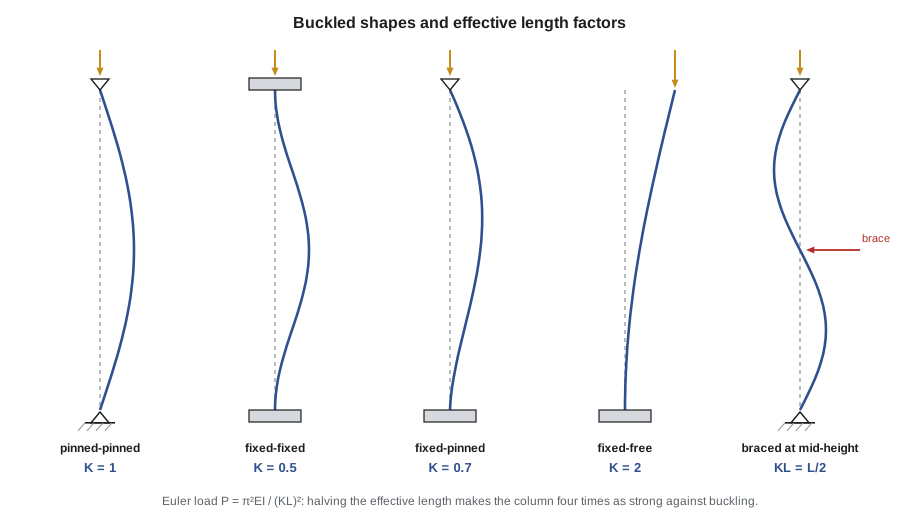
Real connections are never perfectly fixed, so engineers use slightly larger design values than these theoretical ones, about 0.65 instead of 0.5, 0.8 instead of 0.7 and 2.1 instead of 2.0. Most building columns, connected to beams with simple shear connections and held in place at each floor by a braced structure, are designed with K equal to one between floors. A column in an unbraced frame that can sway sideways is a different matter: its effective length can be much greater than its height, which is why frames that rely on rigid joints for lateral stability need careful analysis.
Real columns
Euler's formula describes ideal columns. Real columns are never perfectly straight, their loads are never perfectly centred, and steel sections contain residual stresses from rolling and welding. Real columns therefore fail at loads below both the crushing load and the Euler load, especially at intermediate slenderness, where the two failure modes interact. Material standards give column curves, based on tests, that blend the two.
CSA S16 gives the factored compressive resistance of a steel column as \(C_r = \phi A F_y (1 + \lambda^{2n})^{-1/n}\), where \(\lambda\) is a non-dimensional slenderness equal to KL/r times the square root of \(F_y/\pi^2 E\), n is 1.34 for most hot-rolled and hollow sections, and \(\phi\) is 0.9. For wood, CSA O86 multiplies the crushing resistance by a slenderness factor, \(K_c\), which falls from one for a short column towards zero for a very slender one. In all of these, the designer's key decisions are the same: the section, the length between braces and the end conditions.
# The double-height column at the commons: steel HSS, unbraced or braced at the mezzanine
import math
A, r = 3610, 59.4                          # area (mm2) and radius of gyration (mm)
Fy, E = 350, 200000                        # (MPa)
Pf = 400                                # factored load from the commons beams (kN)
def steel(KL):
    s = KL / r
    Fe = math.pi ** 2 * E / s ** 2       # Euler stress
    lam = s * math.sqrt(Fy / (math.pi ** 2 * E))
    cap = 0.9 * A * Fy * (1 + lam ** 2.68) ** (-1 / 1.34) / 1000
    return s, Fe * A / 1000, cap
print("Unbraced length   KL/r   Euler load   design resistance")
for L in (3.0, 4.0, 6.0, 8.0, 10.0):
    s, Pe, cap = steel(L * 1000)
    flag = "ok" if cap >= Pf else "too small"
    print(f"  {L:>5} m     {s:6.1f}   {Pe:8.0f} kN   {cap:8.0f} kN  {flag}")
print(f"Factored load {Pf} kN: the full-height column fails; braced at mid-height it carries "
f"{steel(4.0 * 1000)[2]:.0f} kN")Unbraced length KL/r Euler load design resistance
3.0 m 50.5 2794 kN 911 kN ok
4.0 m 67.3 1571 kN 750 kN ok
6.0 m 101.0 698 kN 476 kN ok
8.0 m 134.7 393 kN 307 kN too small
10.0 m 168.4 251 kN 209 kN too small
Factored load 400 kN: the full-height column fails; braced at mid-height it carries 750 kNThe commons is two storeys high with a mezzanine along one side. Its tallest column, a hollow structural section 152 by 152 by 6.4 mm, carries a factored load of 400 kN from the long glulam beams over the commons. At its full height of 8 m it is far too slender: its design resistance is about 307 kN, less than the load, even though the same section 4 m long would carry about 750 kN. Callum has two options: a bigger column, or a brace at mid-height. The mezzanine's floor beam runs past the column at exactly that height, so he connects them, halving the unbraced length and more than doubling the capacity. The column stays slender, as he wanted, and the mezzanine now does two jobs.
Wood columns
Wood columns follow the same logic, with two differences. Wood's low modulus means that wood columns become slender sooner than steel ones of similar strength, and wood's strength depends on load duration and moisture. Wood columns are usually square or rectangular solid sections, in sawn lumber for small loads and glulam for large ones, and their slenderness is expressed as effective length divided by the least dimension of the section.
# Interior glulam column in the wing: choose the smallest section that works
import math
Pf = 600                              # factored load from roof and library floor (kN)
Le = 4200                              # unbraced length (mm)
Fc, E = 25.2, 9700                      # typical glulam column grade (MPa)
E05 = 0.87 * E                        # lower-bound modulus used for stability
for b, d in [(175, 190), (215, 228), (215, 266), (265, 266)]:
    Cc = Le / min(b, d)
    k = 1 / (1 + Fc * Cc ** 3 / (35 * E05))       # slenderness factor Kc
    cap = 0.8 * Fc * b * d * k / 1000
    flag = "ok" if cap >= Pf else "too small"
    print(f"  {b} x {d} mm: slenderness {Cc:4.1f}, factor {k:.2f}, resistance {cap:6.0f} kN  {flag}")
    if cap >= Pf:
break175 x 190 mm: slenderness 24.0, factor 0.46, resistance 308 kN too small 215 x 228 mm: slenderness 19.5, factor 0.61, resistance 604 kN ok
The interior column of the wing, which carries the roof and the library floor over a full 7.2 by 7.0 m bay, needs a factored resistance of about 600 kN. The calculation in Lesson 9 traces where that load comes from. The search above finds the smallest glulam section that carries it over the 4.2 m storey height. The slenderness factor for each section shows how much buckling reduces the crushing capacity: for the sections that work it takes away about a third of the crushing capacity, and for the more slender ones more than half.
Columns that also bend
Many columns carry bending as well as axial load: a column at the edge of a building carries beams from one side only, so their reactions act off-centre; a column in a rigid frame resists wind by bending; a column with a bracket for a crane or a canopy is loaded eccentrically. Such members, called beam-columns, are checked with an interaction equation that adds the fraction of the axial capacity used to the fraction of the bending capacity used. A simple form requires the sum to be no more than one; the standards add factors that amplify the moment because the axial load increases the bending as the column deflects.
For architects, the main lesson is that eccentric loads are expensive. A beam bearing on a column cap centres its load; a beam hung off a bracket on the column's face bends the column. A canopy cantilevered from a column's side can double the column's size. Wherever possible, loads should be brought onto columns concentrically, and connections should be drawn to show it.
Worked problem
A sign post in the wind
The warming hut's new sign post is a HSS 102 by 102 by 6.4 mm steel tube 3.6 m tall, fixed into a concrete footing and free at its top, carrying a factored vertical load of only 4 kN. Using the theoretical effective length factor for a flagpole, what is its slenderness, and what does the result say about such posts? Take r as about 39 mm.
Show solution
- Effective length: K = 2.0, so KL = 2 × 3,600 = 7,200 mm.
- Slenderness: 7,200 ÷ 39 = 185, close to the limit of 200.
- Euler stress: π² × 200,000 ÷ 185² = 58 MPa, a small fraction of the yield stress.
- The vertical load is tiny, so buckling under it is not a problem, but the post is very flexible and the wind's moment at its base, not its axial load, governs its design.
- A cantilevered post is slender for its height because its top is free: the same tube pinned at both ends would have a slenderness of only about 92.
Answer: Its slenderness is about 185, near the limit; a fixed-base post with a free top is very slender, so bending from wind and its stiffness govern, not its small axial load.
Exercise 8: columns
- Load spaghetti or balsa columns of three lengths to failure, and compare the failure loads with the ratio predicted by Euler's formula.
- Find the slenderness of every column in your studio project, and identify any that exceed 150.
- Redesign one slender column by adding bracing at mid-height, and compare its capacity before and after.
- Draw the connection at the top of one column, showing how the beams deliver their loads concentrically.
Self-check
- Have I found the unbraced length about both axes of each column?
- Have I used the right effective length factor for each end condition?
- Are my column loads concentric, or have I allowed for bending?
Common mistakes
MistakeChecking columns only for crushing.
InsteadCheck buckling, which governs most columns of normal height.
MistakeUsing the strong-axis stiffness of a W shape or rectangle.
InsteadUse the least radius of gyration unless the weak axis is braced.
MistakeForgetting that a flagpole column has an effective length of twice its height.
InsteadUse K of about 2 for a column fixed at its base and free at its top.
MistakeDrawing tall, slender columns in double-height spaces without bracing.
InsteadBrace them at intermediate levels, or size them for their full height.
MistakeHanging beams off the faces of columns without need.
InsteadBear beams on the column centreline, or design the column for the eccentric moment.
Summary and key terms
- Short columns fail by crushing; long columns fail at lower loads by buckling, a failure of stiffness.
- Euler's buckling load is π²EI divided by the square of the effective length, so halving the unbraced length quadruples the buckling load.
- Slenderness, KL/r, governs column behaviour; columns buckle about their weakest axis unless it is braced.
- End conditions set the effective length factor, from 0.5 for fixed ends to 2 for a flagpole.
- Design standards blend crushing and buckling in column curves, and beam-columns are checked with interaction equations.
- Buckling
- Sudden sideways bowing of a compression member, governed by its stiffness and length.
- Euler load
- The theoretical buckling load of an ideal elastic column.
- Effective length
- The length of a pin-ended column with the same buckling load, KL.
- Radius of gyration
- The square root of I divided by A; a measure of a section's resistance to buckling.
- Slenderness ratio
- Effective length divided by radius of gyration, KL/r.
- Beam-column
- A member that carries axial load and bending together.
Practice problems
Work each problem on paper first, then reveal the answer to check.
A pin-ended column 3 m tall is braced at mid-height. By what factor does its Euler buckling load increase?
Show answer
Its unbraced length halves, so its buckling load becomes four times as large.
What is the radius of gyration of a rectangular section about its weak axis, in terms of its thickness t?
Show answer
r = t ÷ √12, about 0.29t.
What effective length factor applies to a column fixed at its base and free at its top?
Show answer
Theoretically 2.0; in design about 2.1.
A glulam column 190 mm thick is 4.75 m tall. What is its slenderness as used in wood design?
Show answer
4,750 ÷ 190 = 25.
Why are hollow square or round sections efficient as columns?
Show answer
They have the same stiffness about every axis, so there is no weak axis to buckle about.
Lesson quiz · 5 questions
Score 60% or more to complete this lesson.
Create a free account to save your progress, take quizzes and earn a certificate.