
APT-330 · Lesson 9 of 12 · 22 min
Financial statements for parts managers
▶ Video coming soon A video version of this lesson is on the way.
On the sixth working day of every month, the dealership's controller, Lucinda Farrowby, closes the books for the month before and sends Tessaro the dealer's monthly financial statement. Rolf gets the parts department's pages the same afternoon. For the ninth session he brought October's statement and the year-to-date figures, and invited Lucinda to join for the first half hour. "Imani knows every part on our shelves," Rolf told her. "I want her to know every line on this page."
The dealer financial statement
Most makers require their dealers to send a monthly financial statement in the maker's standard format. It is longer than an ordinary company's accounts because it breaks the dealership into departments. Its main sections are:
- The balance sheet: what the dealership owns (assets such as cash, receivables, vehicle and parts inventory, equipment) and owes (liabilities such as the vehicle floor plan, payables and loans), and the owners' equity.
- The income statement, summarized for the whole dealership and then broken down by department.
- Departmental pages: for parts, the sales and gross profit by sale type, and the department's expenses.
- Supporting schedules: inventory, receivables aging, staffing and other details the maker uses to compare dealers.
The maker uses the statements to compare its dealers, spot problems early and set targets, and returns a composite or benchmark report comparing each dealer with a group of similar ones. Lucinda reminded Imani that the statement is confidential to the dealership and the maker, and that the parts pages are only as accurate as the parts department's own records.
The parts department's income statement
The parts department's page follows the same structure as any income statement, set out by the dealership's chart of accounts:
Expenses on the dealer statement are usually grouped into three kinds:
- Personnel expenses: salaries, wages, bonuses, benefits and payroll costs for the department's staff.
- Semi-fixed expenses: costs that rise and fall with activity, such as delivery vehicle costs, supplies, freight not recovered from customers, training, inventory adjustments and policy work (goodwill).
- Fixed expenses: costs that don't change much from month to month, such as the department's share of rent, utilities, insurance, equipment depreciation and the dealer management system.
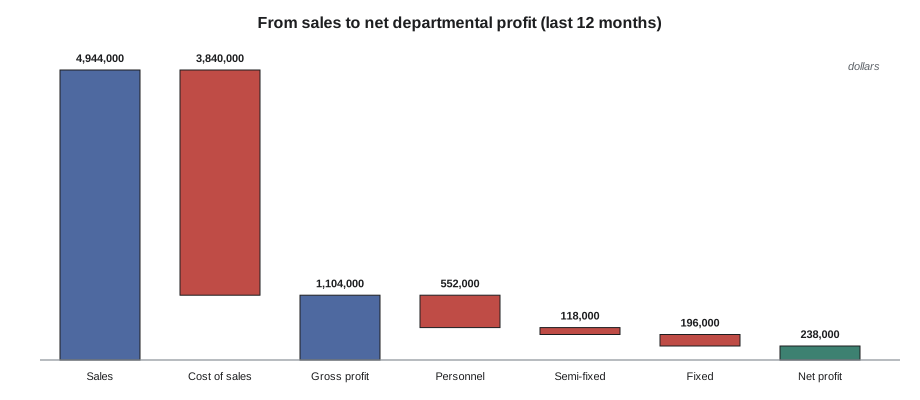
Rolf showed Imani the last 12 months:
| Line | Last 12 months (dollars) | Share of sales | Share of gross profit |
|---|---|---|---|
| Sales | 4,944,000 | 100 percent | |
| Cost of sales | 3,840,000 | 77.7 percent | |
| Gross profit | 1,104,000 | 22.3 percent | 100 percent |
| Personnel expenses | 552,000 | 11.2 percent | 50.0 percent |
| Semi-fixed expenses | 118,000 | 2.4 percent | 10.7 percent |
| Fixed expenses | 196,000 | 4.0 percent | 17.8 percent |
| Total expenses | 866,000 | 17.5 percent | 78.4 percent |
| Net departmental profit | 238,000 | 4.8 percent | 21.6 percent |
Worked problem
Reading the department's profit
Using the table, what share of gross profit goes to personnel, and what is the net departmental profit as a share of sales?
Show solution
- Personnel ÷ gross profit = 552,000 ÷ 1,104,000 = 0.50, or 50 percent.
- Net departmental profit = 1,104,000 − 866,000 = 238,000 dollars.
- Net ÷ sales = 238,000 ÷ 4,944,000 = 0.048, or 4.8 percent.
Answer: Half of every dollar of gross profit pays for the department's people, and the department keeps about 4.8 cents of each sales dollar as net profit before the dealership's general overhead and taxes.
Lucinda explained that dealers watch expenses as a share of gross profit, not of sales, because gross profit is the money the department actually has to spend. If personnel costs climb toward 60 percent of gross profit, the department either has too many people for its business or isn't earning enough from the people it has.
Reading one month
A single month is noisier than the year, but it is where problems show first. October's parts page read:
| Line | October (dollars) | Notes |
|---|---|---|
| Sales | 418,600 | About 1.6 percent above the October target |
| Cost of sales | 325,900 | Includes the October cycle count adjustments |
| Gross profit | 92,700 | 22.1 percent of sales |
| Personnel | 46,200 | Includes Saturday overtime in the tire change weeks |
| Semi-fixed | 9,700 | Includes the Cairnmore training days |
| Fixed | 16,300 | |
| Net departmental profit | 20,500 | 4.9 percent of sales |
Imani spotted the margin first: 22.1 percent, slightly under the 22.3 percent average. Rolf asked her to find the reason before he told her. She checked the sales by type and found it: wholesale had been strong in October, which lowered the blended margin, and the cycle count adjustments had added a little to cost of sales. Neither was a problem, but both were worth a sentence in Rolf's one-page summary to Walter.
Rolf's rule for monthly statements is to compare each line three ways: with the target, with the same month last year, and with the last three months. A line that is off target but in line with last year may be seasonal. A line that has moved three months in a row is a trend.
The balance sheet items a parts manager owns
The parts manager doesn't control the whole balance sheet, but several lines depend directly on the department:
- Parts inventory. The largest asset the department controls, 640,000 dollars on average at cost. It is money the dealership has spent and not yet recovered. APT-210 covered how turns, GMROI and carrying cost measure it.
- Obsolescence reserve. Many dealers set aside an allowance against old stock that may never sell, so that the balance sheet doesn't overstate the inventory's value. Linmore's policy reserves half the value of parts with no sale in 12 months. With 38,400 dollars of non-moving stock, the reserve is 38,400 × 0.5 = 19,200 dollars. When old parts are written off, the loss comes out of the reserve rather than appearing as a surprise in one month.
- Accounts receivable. Money owed by wholesale and fleet customers on account. The receivables aging report shows how much is current, 30, 60 and 90 days old.
- Cores and warranty receivables. Core charges and warranty claims owed by suppliers and the maker, which need to be followed up until they are paid.
Receivables are where a busy wholesale business can quietly lose money. Lucinda showed Imani the measure she watches.
Worked problem
How fast wholesale customers pay
Parts receivables at the end of October were 210,000 dollars. Credit sales to wholesale and fleet accounts run about 147,000 dollars a month. What is the days sales outstanding (DSO)?
Show solution
- Annual credit sales = 147,000 × 12 = 1,764,000 dollars.
- DSO = 210,000 ÷ 1,764,000 × 365 = 43.5 days.
Answer: About 43.5 days. On terms of net 30, customers are paying, on average, about two weeks late. Every extra day of DSO is roughly 1,764,000 ÷ 365 = 4,833 dollars of the dealership's money sitting with its customers.
Ruth Brennagh in accounts receivable chases overdue accounts, but the parts manager decides who gets credit and on what terms. The credit hold on Orland Courier in November, when its September invoice passed 60 days, was the right decision, Rolf said, even though it was uncomfortable. A customer that doesn't pay is not a customer; it is a loan the dealership never agreed to make.
How the department's numbers fit the dealership
Lucinda finished her part of the session by showing how the parts page connects to the rest. The parts department's gross profit feeds the fixed absorption rate (lesson 1). Its inventory and receivables tie up cash the dealership could use elsewhere, and in many dealerships the general manager watches working capital, current assets minus current liabilities, against the maker's guide. Its expenses include an allocation of the building, so a decision to expand the parts warehouse shows up as higher fixed expenses for years.
She also explained why the controller sometimes changes the parts manager's numbers. Inventory adjustments from cycle counts, write-offs of obsolete stock, accruals for supplier rebates and credits, and corrections to parts charged to the wrong repair order all go through accounting. A parts manager who understands those entries can explain the statement to the general manager; one who doesn't is left guessing.
Using the numbers to make decisions
After Lucinda left, Rolf showed Imani three decisions from the past year that came straight from the statement.
- Adding Anouk. Personnel expenses were 50 percent of gross profit. A second apprentice would add cost before adding much gross profit, so Rolf showed Walter how the extra counter time would be used: the Saturday rush, the morning runner and wholesale growth. Walter approved the hire with a review after six months.
- The delivery van. Semi-fixed expenses included the van's fuel, maintenance and lease. Rolf compared the cost per delivery stop with the gross profit per wholesale account, and changed the route for two accounts that cost more to deliver than they earned.
- The obsolescence reserve. When Sasha and Talia's review of aisle G on November 11 sorted 214 non-moving parts, most went back to suppliers, to sister stores or onto the dealer locator, and the 19 that were written off came out of the reserve, so November's profit wouldn't take an unexpected hit.
The lesson for Imani was that the statement is not a report card that arrives once a month. It is a tool for deciding what to change. "If you can explain every line," Rolf said, "you can defend every decision."
Building the expense budget
The sales target from lesson 3 has a partner: the expense budget. Rolf builds it line by line from the last 12 months, the same way as the sales budget. Personnel costs come from the staff plan: current wages, planned raises, the second apprentice, bonuses at target and the cost of benefits and payroll taxes. Semi-fixed costs follow activity: delivery costs rise with wholesale growth, training costs follow the training matrix, and supplies follow sales. Fixed costs come mostly from the controller, who allocates the building, utilities, insurance and systems to each department.
Rolf then checks the budget against two ratios. Personnel should stay near half of gross profit, and total expenses near 78 percent, leaving the department's net profit at or above last year's. If the first draft misses, he looks for savings or for more gross profit before sending it to Walter. A budget that shows a falling profit without a plan to fix it, he said, is just a forecast of bad news.
Break-even for a new cost
Many decisions come down to one question: how much more gross profit does this cost need to pay for itself? Rolf showed Imani with a simple example. A second delivery van would cost about 3,000 dollars a month to lease, insure, fuel and staff part-time. At the department's wholesale margin of about 12 percent, it would need 3,000 ÷ 0.12 = 25,000 dollars a month of extra wholesale sales just to cover its cost. Rolf thought the extra van could bring perhaps half that in its first year, so he decided against it for now and changed the routes instead. The arithmetic doesn't make the decision, but it shows the size of the bet.
The same method works for any cost. A new staff member, a new system, a larger warehouse: divide the cost by the margin of the sales it is meant to bring in, and ask whether those sales are realistic. It is one of the most useful calculations a manager can make, and it takes less than a minute.
Talking about money with the general manager
Walter reads every department's statement, and he asks hard questions. Rolf's advice to Imani was to know the answers before the questions come. Read the statement as soon as it arrives, find every line that moved, and prepare a one-sentence explanation for each. Bring the bad news first and bring it with a plan. Never guess at a number: if you don't know, say so and find out the same day. And keep the conversation about the business, not about blame.
Imani asked whether she would need to read the whole dealership statement or only the parts pages. Rolf's answer was both, eventually. The parts pages show how the department is doing; the rest shows how the dealership is doing, and a department's requests are judged against the whole business. A new parts counter is easier to approve in a year when the dealership is profitable than in one when it is not.
Common mistakes
MistakeJudging expenses as a share of sales only.
InsteadCompare expenses with gross profit, the money the department actually earns.
MistakeReading one month in isolation.
InsteadCompare each line with target, the same month last year and the last three months.
MistakeIgnoring receivables because accounting collects them.
InsteadWatch DSO and the aging report, and use credit holds when accounts fall behind.
MistakeWriting off old stock without a reserve.
InsteadBuild an obsolescence reserve so write-offs don't distort a single month.
MistakeTreating accounting adjustments as someone else's business.
InsteadLearn the entries that affect the parts page so you can explain the statement.
Summary and key terms
- The dealer financial statement includes a balance sheet, an income statement and departmental pages in the maker's format.
- Net departmental profit = gross profit − personnel, semi-fixed and fixed expenses.
- Expenses are best judged as a share of gross profit; personnel is usually the largest share.
- The parts manager's balance sheet items are inventory, the obsolescence reserve, receivables and core and warranty receivables.
- DSO = receivables ÷ annual credit sales × 365 shows how fast customers pay.
- Income statement
- A report of sales, cost of sales, gross profit, expenses and profit for a period.
- Balance sheet
- A report of what a business owns and owes, and its equity, at a point in time.
- Net departmental profit
- A department's gross profit minus its own expenses.
- Obsolescence reserve
- An allowance against old stock that may not sell, so inventory is not overstated.
- Days sales outstanding (DSO)
- Receivables divided by annual credit sales, times 365: the average days customers take to pay.
- Working capital
- Current assets minus current liabilities.
Practice problems
Work each problem on paper first, then reveal the answer to check.
Sales are 300,000 dollars and cost of sales 234,000 dollars. What are the gross profit and margin?
Show answer
66,000 dollars; 66,000 ÷ 300,000 = 22 percent.
Gross profit is 80,000 dollars and expenses 62,000 dollars. What is the net departmental profit, and what share of gross profit do expenses take?
Show answer
18,000 dollars; 62,000 ÷ 80,000 = 77.5 percent.
Receivables are 150,000 dollars and annual credit sales 1,200,000 dollars. What is the DSO?
Show answer
150,000 ÷ 1,200,000 × 365 = 45.6 days.
Non-moving stock is 50,000 dollars and the policy reserves 40 percent. What is the reserve?
Show answer
50,000 × 0.40 = 20,000 dollars.
Name the three groups of expenses on a dealer's departmental page.
Show answer
Personnel, semi-fixed and fixed.
Lesson quiz · 5 questions
Score 60% or more to complete this lesson.
Create a free account to save your progress, take quizzes and earn a certificate.