
APT-330 · Lesson 12 of 12 · 22 min
Turning around a parts department
▶ Video coming soon A video version of this lesson is on the way.
On Monday, November 9, Rolf drove to Linmore Tessaro Brantford with Talia to look at the sister store's parts department, which Tessaro's district parts manager, Clementine Kesterton, had flagged on the quarterly review. APT-210 told the story of that visit from the inventory side: too much stock, the wrong stock, broken processes, and a written plan Rolf would send Fergus Amberley and Clementine on November 16. Two days after the visit, at the Wednesday session on November 11, Rolf put his notes from that day in front of Imani. "The inventory plan is done," he said. "But inventory is only one of six things that are wrong there. Walter wants a plan for the rest by the first week of December. You're going to write it, and I'm going to check it."
This lesson follows that work. It is the course's capstone: a turnaround uses every part of the manager's job, pricing, targets, people, training, suppliers, service, customers, financials, controls and technology, at once, in a department where most of them have failed.
Step 1: read the numbers
Imani started where Rolf always starts, with the financial statement. Fergus had sent the sister store's last 12 months:
| Line | Sister store (dollars) | Share of sales | Linmore for comparison |
|---|---|---|---|
| Sales | 1,890,000 | 100 percent | 4,944,000 |
| Cost of sales | 1,476,000 | 78.1 percent | 3,840,000 |
| Gross profit | 414,000 | 21.9 percent | 1,104,000 (22.3 percent) |
| Personnel | 290,000 | 15.3 percent | 11.2 percent of sales |
| Semi-fixed | 61,000 | 3.2 percent | 2.4 percent |
| Fixed | 88,000 | 4.7 percent | 4.0 percent |
| Total expenses | 439,000 | 23.2 percent | 17.5 percent |
| Net departmental profit | −25,000 | −1.3 percent | 238,000 (4.8 percent) |
Worked problem
Where the sister store stands
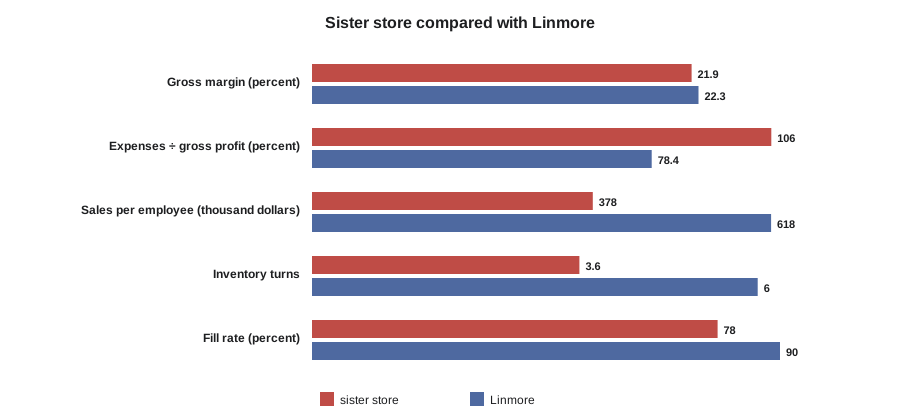
Using the table, what are the sister store's expenses as a share of gross profit, and its inventory turns and GMROI on an average inventory of 410,000 dollars?
Show solution
- Expenses ÷ gross profit = 439,000 ÷ 414,000 = 1.06, or 106 percent.
- Turns = cost of sales ÷ average inventory = 1,476,000 ÷ 410,000 = 3.6.
- GMROI = gross profit ÷ average inventory = 414,000 ÷ 410,000 = 1.01.
Answer: Expenses take 106 percent of gross profit, so the department loses 25,000 dollars a year. Its stock turns 3.6 times against Linmore's 6.0, and each dollar of inventory earns only 1.01 dollars of gross profit.
Two numbers stood out. The gross margin, 21.9 percent, wasn't far from Linmore's, so the problem wasn't mainly price. But personnel expenses took 15.3 percent of sales, against Linmore's 11.2. The sister store has five people, Fergus and four staff, for sales of 1,890,000 dollars: 378,000 dollars per person against Linmore's 618,000. "Either they have too many people," Imani said, "or not enough sales for the people they have." Rolf asked which she thought it was. She checked the visit notes: the counter had been busy, customers had waited, and the warehouse was behind. "Not enough sales," she said. "And too much of their time goes into fixing their own mistakes."
Step 2: find the causes
From the numbers, the visit notes and a long phone call with Fergus on November 12, Imani listed what was wrong outside the warehouse. She grouped the problems by the six areas of the manager's job from lesson 1:
- Sales and pricing. Every wholesale account was on list less 30, whatever its size or payment record, because the previous manager had used discounts to win accounts and never reviewed them. Price overrides had no limit and no reasons; Fergus estimated about 9,600 dollars a year of reductions.
- People. Two of the four staff had joined in the last year and had no training plan. No one had a written job description. The schedule left the counter with one person during the morning peak twice a week.
- Inventory. Covered by Rolf's plan: settings, returns, overstock, re-slotting and processes.
- Internal customers. There was no regular meeting with the service manager. The technicians, frustrated by parts not in stock, had started buying from a local aftermarket store; Fergus estimated six technicians were spending around 1,100 dollars a month each outside the department, about 79,200 dollars a year of lost internal sales.
- External customers. The store's last Tessaro survey score was well below the district, with most comments about parts not in stock and calls not returned. There was no complaint log.
- Money and controls. The return windows had not been used for two years, the co-op funds had never been claimed, and the store wasn't registered for Tessaro's wholesale growth program. Receivables had no regular review.
Rolf read the list twice. "Good. Now ask the question that matters: which of these are causes and which are symptoms?" Imani thought about it. The technicians buying elsewhere was a symptom of poor stock and slow service. The survey scores were a symptom of the same thing. The causes were the broken processes, the untrained staff, the lack of measures and a manager who until the summer had been left alone with all of it.
Step 3: set the targets
A turnaround plan needs targets that are ambitious, believable and measured. Imani proposed 12-month targets, building on Rolf's inventory plan:
| Measure | Now | 12-month target |
|---|---|---|
| Sales | 1,890,000 dollars | 2,003,400 dollars (up 6 percent) |
| Gross margin | 21.9 percent | 23.5 percent |
| Gross profit | 414,000 dollars | 470,800 dollars |
| Total expenses | 439,000 dollars | 430,000 dollars |
| Net departmental profit | −25,000 dollars | about 40,800 dollars |
| Average inventory | 410,000 dollars | about 330,000 dollars (Rolf's plan) |
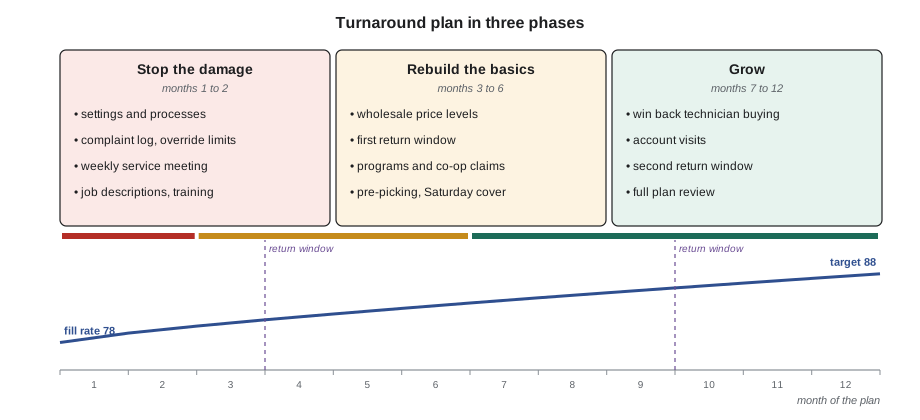
| Fill rate | 78 percent | 88 percent |
| Turns / GMROI | 3.6 / 1.01 | about 4.5 / 1.25 (Rolf's plan) |
She showed Rolf where the extra gross profit would come from, with each estimate rounded and each tied to a specific action:
Worked problem
Building the gross profit target
The plan aims to raise gross profit from 414,000 to about 470,800 dollars, an increase of 56,800 dollars. Imani's estimates: moving about half the wholesale accounts from list less 30 to list less 25, worth 18,600 dollars; recovering half of the 79,200 dollars of internal sales lost to outside stores, 39,600 dollars at about 30 percent margin; halving the 9,600 dollars of overrides; growing other sales by the remaining 73,800 dollars at the current 21.9 percent margin; and Tessaro's wholesale growth program and co-op claims, about 5,300 dollars. Check that the pieces add up.
Show solution
- Recovered internal sales: 39,600 × 0.30 = 11,880, about 11,900 dollars.
- Fewer overrides: 9,600 ÷ 2 = 4,800 dollars.
- Other growth: 73,800 × 0.219 = 16,162, about 16,200 dollars.
- Total = 18,600 + 11,900 + 4,800 + 16,200 + 5,300 = 56,800 dollars.
- Sales check: 39,600 + 73,800 = 113,400 dollars of extra sales, and 1,890,000 + 113,400 = 2,003,400 dollars.
Answer: The pieces add up to 56,800 dollars, bringing gross profit to about 470,800 dollars, 23.5 percent of 2,003,400 dollars of sales. Expenses fall by about 9,000 dollars net: about 20,000 dollars of lower carrying cost from the smaller inventory, less about 11,000 dollars of new spending on training and Saturday cover. Net departmental profit moves from −25,000 to about +40,800 dollars.
Rolf tested each estimate. The wholesale price change was the riskiest: some accounts would leave. Imani had already allowed for that by moving only the accounts that bought steadily, paid on time and used delivery, and by keeping list less 30 for the two largest accounts on a reviewed contract price. The internal sales estimate depended on the fill rate improving first, so she put it in the second half of the year. Rolf was satisfied that each number had a reason behind it.
Step 4: plan the actions
Imani arranged the actions in three phases, because some changes depend on others:
- First 60 days (December and January): stop the damage. Rolf's settings and process changes, planned for the end of November; same-day receiving; a complaint log; override limits with reasons; a weekly meeting between Fergus and the service manager; written job descriptions; and a training plan for the two newest staff, starting with the counter procedures Linmore already uses.
- Months 3 to 6: rebuild the basics. Wholesale account reviews and the new price levels, account by account, with a call from Fergus to each customer before the change; the first return window; registering for Tessaro's wholesale growth program and claiming co-op funds; morning pre-picking for the service shop; Saturday staffing reviewed against ticket counts.
- Months 7 to 12: grow. Win back the technicians' purchases as the fill rate rises; visit the wholesale accounts with the delivery driver; a customer survey follow-up; the second return window; and a full review of the plan with Walter and Clementine.
Each action had an owner and a date. Most owners were Fergus or his staff; Rolf and Imani's role was to help with training and to check progress, not to run the store.
Step 5: measure and report
Rolf's inventory plan already asked Fergus to report six inventory measures monthly and four weekly numbers. Imani added the business measures: sales and gross profit by market, expenses against budget, override total, complaints logged, technician outside purchases (from a monthly check with the service manager), and staff training sign-offs. Every month, Fergus would send Walter and Clementine a one-page summary in the format from lesson 3: results, measures, explanations, actions and requests.
She also set early warning points, so that the plan would be changed before it failed: if wholesale sales fell more than 10 percent in the two months after the price change, the account levels would be reviewed again; if the fill rate hadn't reached 82 percent by month six, the stocking settings would be checked with Clementine's help; if personnel costs rose without sales following, the schedule would be reviewed.
Step 6: lead the people
Rolf reminded Imani of what he had told Talia on the way back from the visit: nothing at the sister store was complicated. Every problem was something Linmore did every day. The hard part of a turnaround isn't the plan; it's the people. Fergus's staff had worked for two years in a department that was failing, and many of the problems had become normal. They would need to see quickly that the changes made their days easier.
That is why the plan started with the changes the staff themselves had asked for during Rolf's visit, such as same-day receiving, and why it included training before new targets. Imani added three leadership actions for Fergus: a fifteen-minute team huddle every Monday, recognition of each early win in front of the team, and a one-to-one with each person every month. She also suggested that one of Fergus's counter staff spend two days at Linmore in January, working beside Teodor and Maribel, to see the procedures working.
Rolf added one more point, about Fergus himself. A manager who inherits a failing department needs support, not blame. The plan was Fergus's, Rolf said, and the credit for it should be too. Linmore's part was to help, and then to step back.
What happens next
Imani's draft went to Rolf on Friday, November 13. He returned it with a dozen comments, most of them questions, and she revised it over the weekend of November 14 and 15. Rolf planned to send it to Walter and Fergus in the first week of December, alongside his inventory plan, so that Fergus could present the combined plan at Clementine's quarterly review in January. If Walter approved, Imani would take up the role of assistant parts manager at Rymal Road on January 4, 2027, and the sister store's training would be one of her first projects.
Whether the plan would work would depend, as Rolf said of the inventory plan, on a hundred small habits. But Imani now knew what those habits were, why each one mattered and how to measure it. At the end of the session, Rolf added the last page to her binder: a copy of her plan, with his comments, and a note at the top. It said: "Ready."
What a turnaround is not
Rolf ended with three warnings from other turnarounds he had seen. A turnaround is not a clearance sale: dumping old stock at any price can make one quarter look busy and leave the department with a write-off and no plan. It is not a staff purge: replacing people before the processes work only brings in new people to the same broken system. And it is not a one-time event: a department that recovers and then stops measuring will drift back within a couple of years. The plan's monthly report and the quarterly reviews were there to make sure the sister store's recovery lasted, not just that it started.
Common mistakes
MistakeStarting a turnaround with targets instead of causes.
InsteadRead the numbers, find the causes, then set targets tied to specific actions.
MistakeTreating symptoms such as low survey scores as the problem.
InsteadTrace each symptom to the process behind it and fix that.
MistakePlanning every change at once.
InsteadPhase the actions: stop the damage, rebuild the basics, then grow.
MistakeMaking estimates without a reason behind each number.
InsteadTie every estimate to an action and check that the pieces add up.
MistakeRunning the department for the struggling manager.
InsteadSupport the manager with training and checks, and let the plan be theirs.
Summary and key terms
- A turnaround starts with the financial statement and the main measures, compared with a healthy department.
- Problems are sorted by area of the manager's job and separated into causes and symptoms.
- Targets should be ambitious, believable and built from specific, checked estimates.
- Actions are phased, each with an owner and a date, and progress is reported monthly with early warning points.
- The people side decides the result: start with changes the team wants, train before setting new targets, and support the manager.
- Turnaround
- A planned recovery of a department or business that is failing to meet its targets.
- Symptom
- A visible sign of a problem, such as low survey scores, caused by something deeper.
- Root cause
- The underlying process or decision that produces a problem.
- Early warning point
- A level of a measure that triggers a review of the plan before it fails.
- Phase
- A stage of a plan with its own goals and actions.
Practice problems
Work each problem on paper first, then reveal the answer to check.
A department's gross profit is 300,000 dollars and its expenses are 315,000 dollars. What are expenses as a share of gross profit, and the net result?
Show answer
315,000 ÷ 300,000 = 105 percent; a loss of 15,000 dollars.
Sales of 1,500,000 dollars with five staff. What are sales per employee?
Show answer
1,500,000 ÷ 5 = 300,000 dollars.
Recovering 30,000 dollars of sales at a 30 percent margin adds how much gross profit?
Show answer
30,000 × 0.30 = 9,000 dollars.
Why did Imani schedule the internal sales recovery for the second half of the year?
Show answer
It depends on the fill rate improving first, so technicians have a reason to buy from the department again.
Give one early warning point from the plan.
Show answer
If wholesale sales fall more than 10 percent in the two months after the price change, review the account levels again.
Lesson quiz · 5 questions
Score 60% or more to complete this lesson.
Create a free account to save your progress, take quizzes and earn a certificate.