
APT-330 · Lesson 8 of 12 · 23 min
Customer satisfaction and loyalty
▶ Video coming soon A video version of this lesson is on the way.
Tessaro sends a short survey to a sample of every dealer's parts customers each quarter, and the results arrive in the parts manager's inbox with a district comparison. The third-quarter report came in the first week of November. Rolf printed it for the eighth session, together with the department's own complaint log for October and a list of wholesale accounts whose purchases had fallen. "The counter's job is to satisfy the customer in front of them," he told Imani. "The manager's job is to make sure the department does that for everyone, every day, and to know when it isn't."
Why loyalty is worth managing
A satisfied customer comes back. A loyal customer comes back even when a competitor is cheaper or closer, recommends the department to others and forgives the occasional mistake. Rolf put a value on that for one wholesale account.
Worked problem
What a wholesale account is worth
Bramhall Auto Service buys about 96,000 dollars of parts a year from the department at an average margin of 12 percent. What gross profit does the account bring each year, and over five years?
Show solution
- Yearly gross profit = 96,000 × 0.12 = 11,520 dollars.
- Over five years, with no growth = 11,520 × 5 = 57,600 dollars.
Answer: About 11,520 dollars a year and 57,600 dollars over five years, before counting the service work Bramhall sends to the dealership. Losing the account over one bad week would cost far more than the week's problem.
Most customers who leave don't complain first. They simply buy elsewhere. That is why a manager can't rely on complaints alone to know how the department is doing.
Measuring satisfaction
Rolf uses four sources, each showing something the others miss:
- The maker's survey. A sample of retail and wholesale customers rate the department on courtesy, knowledge, availability, accuracy and speed. Results are compared with the district and with the previous quarter.
- A loyalty question. Many surveys, including Tessaro's, ask how likely the customer is to recommend the department, on a scale of 0 to 10. This is the basis of the Net Promoter Score (NPS).
- The complaint log. Every complaint, by phone, at the counter or online, is recorded with the date, customer, problem, cause and resolution.
- Account trends. Monthly purchases by wholesale account, so that a falling account is noticed before it is lost.
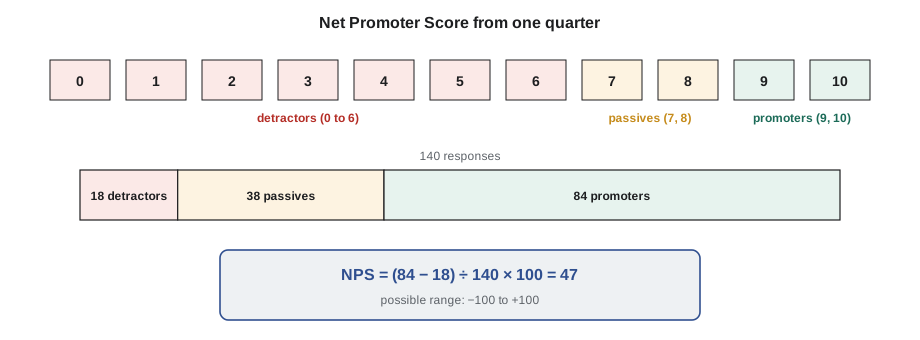
The Net Promoter Score groups answers into promoters (9 or 10), passives (7 or 8) and detractors (0 to 6), and subtracts the share of detractors from the share of promoters.
Worked problem
The department's Net Promoter Score
In the third quarter, 140 customers answered the recommendation question: 84 promoters, 38 passives and 18 detractors. What is the NPS?
Show solution
- Promoters minus detractors = 84 − 18 = 66.
- Divide by responses: 66 ÷ 140 = 0.471.
- Multiply by 100: about 47.
Answer: An NPS of about 47. The score can run from −100 to +100; the trend over several quarters and the comments behind it matter more than one number.
Rolf read the comments aloud. Most praised named staff: Imani's knowledge, Gideon's punctuality, Teodor's patience on the phone. Most of the criticism concerned two things: parts not in stock when promised, and long waits at the front counter on Saturday mornings. "Both of those are management problems," he said. "Not counter problems."
The complaint log
In October, the department recorded 23 complaints, out of about 4,980 counter tickets and repair order requests, a rate of 23 ÷ 4,980 × 1,000 = 4.6 complaints per thousand. Rolf sorted them by cause, because the cause decides the fix:
| Cause | Complaints | Example | Fix |
|---|---|---|---|
| Part not in stock or late | 8 | A hub assembly promised for Thursday arrived Monday | Stocking review; honest arrival times |
| Wrong part | 5 | A water pump for the wrong engine size | VIN lookup on every sale; double-check rule |
| Waiting time | 4 | Twenty minutes at the Saturday counter | Saturday staffing changed |
| Price | 3 | A garage found a lower price elsewhere | Account review; override rules |
| Returns and credits | 2 | A refund taking two weeks | Credit memo process shortened |
| Delivery | 1 | A missed stop on the 2 p.m. run | Driver route check |
Rolf showed Imani that the complaint log is a list of opportunities. Each complaint handled well can increase loyalty, because the customer sees the department fix its mistake. The counter's LAST method from APT-130, listen, acknowledge, solve, thank, handles the customer. The manager's job is to fix the cause so the complaint doesn't happen again.
He also set a rule for which complaints come to him: any complaint the counter can't resolve on the spot, any complaint from a wholesale account, and any complaint involving safety, a legal issue or a refund above the counter's limit. He calls those customers back himself, the same day when he can.
Fixing the Saturday problem
The Saturday waits were the clearest example. The department's Saturday hours, 8 a.m. to 1 p.m., had two people on the counter, usually one experienced person and one apprentice. Since September, Saturday retail traffic had grown with the fall tire and battery season, and the survey comments and four complaints showed it.
Rolf and Imani looked at the ticket counts by hour for the last six Saturdays. Between 9 and 11 a.m., the counter averaged 31 tickets an hour; at about four minutes a ticket, that is over two hours of counter work in each hour. Two people couldn't keep up. The fix had three parts: a third person from 8:30 to 11:30 on Saturdays from mid-November, rotating among the counter staff; a quick-sale lane for customers buying items off the display, such as wipers, bulbs and fluids; and a note on the website and the counter showing the busiest Saturday hours, so customers who could come earlier did.
Imani asked whether the extra person was worth the cost. Rolf worked it out: three hours a Saturday at about 26 dollars an hour is 78 dollars, plus the share of overtime it might cause. Against one lost wholesale account worth 11,520 dollars a year, or even a handful of retail customers who don't return, it was an easy decision.
Keeping wholesale accounts
Wholesale customers are businesses, and they judge the department on what helps their business: having the part, getting it to them fast, getting it right, and fixing problems without arguments. Rolf keeps them with a short routine:
- Watch the trend. Every month, Rolf checks each account's purchases against the same month last year. An account down more than about 20 percent gets a call.
- Visit. Rolf or Imani rides with Gideon to visit a few accounts every month, not to sell, but to ask how the department is doing.
- Solve problems fast. A wrong part or a missed delivery for a wholesale account is fixed the same day, with an apology and a note of what changed.
- Make buying easy. Clear statements, correct invoices, online ordering for regular accounts and one phone number answered quickly.
- Help them grow. Training nights on new models, technical help from the department's experienced staff, and early notice of Tessaro programs.
In October the trend report showed one account down by a third: a small garage that had begun buying brake parts from an aftermarket chain because the chain delivered twice as often. Rolf visited with Gideon the following week. The garage didn't want a lower price; it wanted a morning delivery. Rolf moved the stop onto the 10 a.m. run, and by November the garage's purchases had recovered.
Customer information, surveys and the law
Customer surveys and follow-up messages use personal information, and the department must follow privacy and anti-spam law.
Under the federal Personal Information Protection and Electronic Documents Act (PIPEDA), the dealership needs the customer's consent to collect and use personal information, must use it only for the purposes it gave, and must protect it. Canada's Anti-Spam Legislation (CASL) requires consent, clear identification and an unsubscribe method for commercial electronic messages such as promotional emails; a survey about a recent purchase is usually treated differently from a promotion, but the safest practice is to send only what the customer agreed to. Ontario's consumer protection law also governs refunds, warranties and the information given to consumers.
Rolf's practical rule: collect only the customer information the department needs, ask before adding anyone to a mailing list, and never let a promotional message go out without the opt-out.
A department customers recommend
Rolf closed the session with his own definition of a department that customers recommend. It answers the phone within four rings. It greets a waiting customer within 30 seconds. It has the part, or says honestly when it will. It gets the part right the first time. It fixes mistakes without making the customer argue. And its people know their regular customers by name.
None of those, he pointed out, depends on price. The department can't always be the cheapest, and doesn't try to be. It can always be the most reliable. Imani wrote the list on a card and put it in her binder, then added one of her own: tell the customer what happened next, even if it isn't good news.
Handling a difficult customer as a manager
Some complaints reach the manager because the counter couldn't solve them. Rolf's approach to those calls is the same every time. He listens to the whole story without interrupting, then repeats it back to show he has understood. He finds out what the customer wants: a refund, a replacement, an apology or simply to be heard. He checks the facts with the staff involved before deciding. And he decides quickly, explains the decision clearly, and follows through on whatever he has promised.
He told Imani about a customer the previous winter who had bought a battery that failed after a month. The customer was angry and threatening to post a review. The battery tested good after charging, so it wasn't a warranty failure; the cause was a faulty charging system on the vehicle. Rolf explained the test results, offered a free charging system check in the service shop, and gave the customer a direct phone number. The check found a failing alternator, which the customer had replaced at Linmore. The review, when it came, was positive.
Not every story ends that well. Some customers want something the department can't give, such as a refund on a part that was installed and damaged. Rolf's rule is to be firm about the policy, polite about the person, and to offer whatever reasonable alternative exists. A manager who gives in to every demand teaches customers to shout; one who never bends loses customers who deserved better.
Online reviews
Public reviews on search and map sites now shape how new customers choose a parts counter. Rolf checks them weekly. He answers every negative review politely, without arguing or sharing private details, and invites the customer to contact him directly. He thanks people for positive reviews. And he never writes reviews for the department or asks staff to, because fake reviews mislead customers and break the rules of the review sites and consumer protection law. The best way to improve reviews, he said, is to improve the service and then ask satisfied customers if they would mind sharing their experience.
Satisfaction inside the dealership
The service shop, the used vehicle department and the sales team are customers too. Twice a year, Rolf asks Priyanka and the other managers to rate the parts department on speed, accuracy, communication and attitude, and to name one thing to improve. The answers are discussed at the Monday meeting and the managers' meeting. The internal survey is short and informal, but it shows problems the external survey never will, such as a counter person who is helpful to customers but short with technicians.
Imani asked how often the department should survey its own customers beyond Tessaro's quarterly sample. Rolf preferred small, frequent checks: a two-question card at the counter for a week each quarter, and a phone call to five wholesale accounts a month. Small samples aren't precise, he said, but they are fast, and fast information is what lets a manager fix a problem before it becomes a pattern. The cards from October's week had already pointed to the Saturday waits before the survey confirmed them.
Rolf's last point on measurement was about honesty. The department never coaches customers on how to answer the maker's survey and never offers anything in exchange for a high score. A score earned that way tells the manager nothing, and makers treat survey manipulation as a breach of their programs. The only reliable way to raise the score is to give customers a reason to choose a 9 or a 10 on their own.
Common mistakes
MistakeTreating silence as satisfaction.
InsteadMeasure satisfaction with surveys, complaint logs and account trends, because most unhappy customers simply leave.
MistakeFixing the complaint but not the cause.
InsteadSort complaints by cause and change the process behind them.
MistakeReading the NPS without the comments.
InsteadUse the score's trend and the comments together.
MistakeWaiting for a falling wholesale account to call.
InsteadCheck account trends monthly and visit accounts that are slipping.
MistakeAdding customers to promotional mailings without consent.
InsteadFollow privacy and anti-spam rules: consent, identification and an easy opt-out.
Summary and key terms
- Loyal customers are worth far more than a single sale; a wholesale account's value runs over years.
- Satisfaction is measured with the maker's survey, a loyalty question, the complaint log and account trends.
- NPS = (promoters − detractors) ÷ responses × 100, on a scale from −100 to +100.
- Complaints sorted by cause show what to fix; the manager fixes the cause while the counter fixes the moment.
- Customer information in surveys and messages must follow privacy and anti-spam law.
- Net Promoter Score (NPS)
- A loyalty measure: the share of promoters minus the share of detractors, times 100.
- Promoter
- A survey respondent who rates the department 9 or 10 on likelihood to recommend.
- Detractor
- A survey respondent who rates the department 0 to 6.
- Complaint log
- A record of each complaint with its cause and resolution.
- Account trend
- A comparison of a customer's purchases over time, used to spot falling accounts.
Practice problems
Work each problem on paper first, then reveal the answer to check.
A survey has 200 responses: 110 promoters, 60 passives, 30 detractors. What is the NPS?
Show answer
(110 − 30) ÷ 200 × 100 = 40.
An account buys 60,000 dollars a year at a 15 percent margin. What is its yearly gross profit?
Show answer
60,000 × 0.15 = 9,000 dollars.
A department has 12 complaints from 3,000 tickets. What is the rate per thousand?
Show answer
12 ÷ 3,000 × 1,000 = 4 per thousand.
Why does Rolf visit wholesale accounts that are not complaining?
Show answer
Most unhappy customers leave without complaining; visits reveal problems early.
Name two things CAN-SPAM or CASL requires in a promotional email.
Show answer
Clear sender identification and a working way to unsubscribe (and, under CASL, consent).
Lesson quiz · 5 questions
Score 60% or more to complete this lesson.
Create a free account to save your progress, take quizzes and earn a certificate.