
APT-330 · Lesson 10 of 12 · 23 min
Audits, controls and policies
▶ Video coming soon A video version of this lesson is on the way.
At the tenth session, Rolf put three printouts on the desk: October's price override log, the summary of Tessaro's last warranty parts audit, and the year-end count reconciliation from the year before. "A parts department handles hundreds of thousands of dollars of other people's money every month," he said. "Most of the people who touch it are honest, and most mistakes are innocent. Controls protect both: they catch the mistakes, and they make dishonesty hard. And when the maker's auditor arrives, they're the difference between a polite visit and a large cheque going back to Tessaro."
What internal controls are for
An internal control is a routine that makes sure transactions are real, authorized, correctly recorded and protected. In a parts department, controls guard four things:
- Inventory: parts must not leave without being sold, issued or transferred, and the book must match the shelf.
- Cash and credit: every payment is recorded, every refund approved, every drawer balanced.
- Prices and credits: discounts, overrides and credit memos follow policy.
- Claims: warranty, return and program claims meet the rules of the maker or supplier.
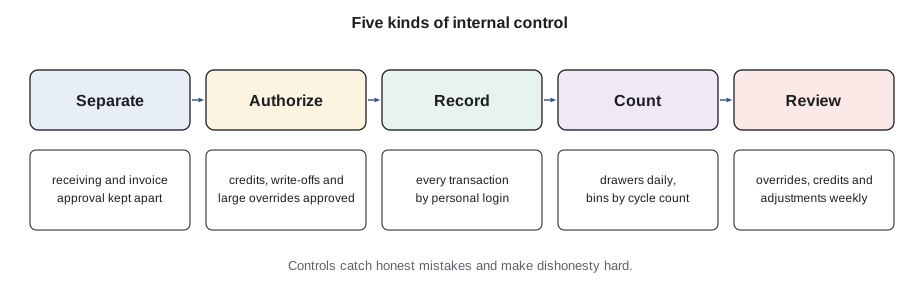
Rolf summarized the main kinds of control in five words: separate, authorize, record, count and review.
- Separate duties. The person who receives parts shouldn't be the only person who approves the supplier's invoice; the person who issues a credit shouldn't be the person who handles the refund cash.
- Authorize. Overrides above a limit, credit memos, write-offs and new account terms need a named approver.
- Record. Every transaction goes through the system with the employee's login; no paper workarounds.
- Count. Cycle counts of the inventory and daily counts of the cash drawers compare what is there with what the record says.
- Review. The manager reads the exception reports, overrides, credits, adjustments, sales below cost, every week.
Cycle counts and shrinkage
APT-210 explained how cycle counting works. For a manager, the counts are also a control. Rolf's recent results:
- Accuracy: 186 of 200 bins matched on the last accuracy sample, 93 percent, against a target of 95.
- Shrinkage: the gap between the book value and the counted value at the year-end count. It was 3,900 dollars on 640,000 dollars of inventory at the last full count, or 3,900 ÷ 640,000 = 0.61 percent, and fell to 1,850 dollars the following year, about 0.29 percent, after blind counts and better receiving.
Shrinkage has several causes: receiving errors, parts issued to the wrong repair order or not issued at all, damaged parts thrown away without a record, returns not processed, and theft. Most of it, in Rolf's experience, is process error, and the fix is the same as for accuracy: scan everything, count blind, receive the same day, and investigate every large variance. Theft is rarer but real, and the controls that catch errors also catch it.
Rolf showed Imani how a large variance is investigated, using the caliper bracket from Talia's cycle count on November 3, where the book showed two more brackets than the shelf, 82.40 dollars. Before adjusting, Sasha checked the part's recent receipts, issues and returns, and found that two brackets had gone to the shop the day before under a similar part number. The fix was a correction to the shop ticket, not a write-down. Had the stock simply been adjusted, the book would have been wrong twice: once for the bracket and once for the part charged by mistake.
Cash drawers, refunds and credits
Every drawer is counted at the close by the person who used it and checked by a second person. Differences above a small amount are explained in writing. Talia's first close on November 10 was 10 dollars short because a clip refund hadn't been recorded. The investigation took ten minutes because the refund log existed; the procedure was changed so that the refund log is checked before the count.
Credits and refunds need the strongest controls, because a credit memo creates money. Linmore's policy:
- Retail refunds above the counter limit need the manager's or assistant manager's approval, with the original receipt or a lookup of the sale.
- Wholesale credit memos are issued only for parts physically returned and checked by the warehouse, or for an approved pricing correction.
- Every credit carries a reason code, the employee's login and the approver's name.
- The manager reviews the credit report weekly, looking for patterns: many credits by one employee, credits without returns, or repeated credits to one account.
Price overrides
Lesson 2 explained why the department allows price overrides with a reason. Rolf showed Imani October's log.
Worked problem
What the override log showed
In October, counter staff made 46 price overrides that reduced prices by a total of 1,380 dollars. What was the average override, and what should the manager check?
Show solution
- Average = 1,380 ÷ 46 = 30.00 dollars per override.
- The total is about 1.5 percent of October's 92,700 dollars of gross profit.
Answer: 30.00 dollars on average. Rolf sorted the log by reason and employee: most were competitor price matches on brake parts for two wholesale accounts, which pointed to a pricing problem in that band rather than a staff problem. Eight overrides had no reason entered, and those became a coaching point.
The log turned an invisible cost into a decision. Rolf reviewed the brake band of the matrix and the two accounts' price levels, and changed the counter's override limit so that larger reductions needed approval.
The maker's audits
Makers audit dealers to check that claims for warranty, returns and programs follow their rules. A parts manager should expect:
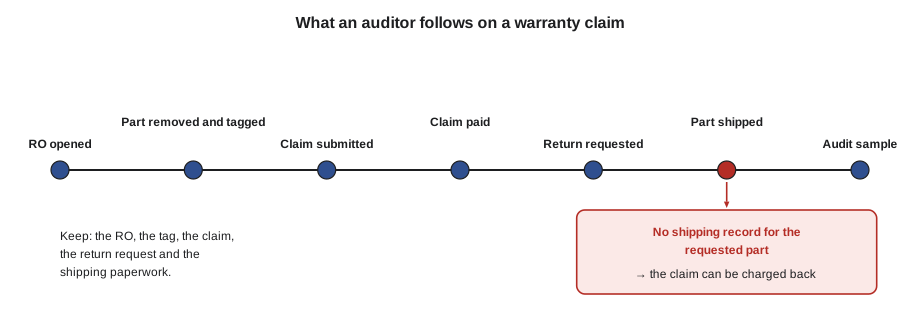
- Warranty parts audits. The auditor samples paid claims and checks that the right parts were used and issued to the RO, failed parts were tagged, kept and returned when requested, and the records match. A claim that fails can be charged back.
- Return program audits. Checks that returned parts were eligible, in saleable condition and in original packaging.
- Program and incentive audits. Checks that wholesale program sales went to qualifying customers and that co-op claims match real advertising.
The audit period and rules are set out in the dealer agreement and the maker's policy manuals, and in some places by law. Rolf's advice was to treat every day as audit day: keep the warranty area organized, keep the records complete, and correct problems as soon as they are found.
Worked problem
A warranty chargeback
Tessaro's auditor sampled 60 paid warranty claims. Three had no record of the failed part being returned when requested, and each claim's parts payment averaged 186.40 dollars. What was charged back for the parts, if only the parts payment is reversed?
Show solution
- Chargeback = 3 × 186.40 = 559.20 dollars.
Answer: 559.20 dollars for parts alone, and in practice the labour on those claims is often charged back too. The fix was a weekly check of return requests against the warranty area, assigned to Sasha.
The year-end count
Many dealerships do a full physical count of the parts inventory once a year, usually at the fiscal year end, even when cycle counts are good, because the accountants and tax authorities rely on it to value the inventory. APT-210 covered the tax rules for valuing inventory. The manager's job is to plan the count so that it is accurate:
- Prepare. Receive and put away everything, process all returns and cores, issue every open repair order part, and clean the bins in the weeks before.
- Freeze the movement. Stop receiving and issuing during the count, or separate them clearly.
- Count in teams. One person counts and one records, using the system's count sheets or scanners, with an independent recount of high-value parts.
- Reconcile. Investigate large variances before the adjustment is posted, and explain the final shrinkage to the controller.
The Canada Revenue Agency expects businesses to keep records that support their inventory value, and a well-documented year-end count is the strongest support. Rolf keeps the count sheets, the variance investigation and the reconciliation in the year's audit file.
Policies
Controls work only if everyone knows them. The department's policy manual is a short binder, about 30 pages, with one page for each policy: returns, special orders, deposits, credit memos, overrides, cash handling, account opening, warranty parts, core returns, cycle counts, receiving, dangerous goods, forklift use and customer information. Each page states the rule, who it applies to, who approves exceptions and the date it was last reviewed.
Rolf reviews the manual every January and whenever a problem shows a gap. New staff read it in their first week and sign that they have; the counter keeps a copy within reach. Imani's task for the winter was to rewrite three pages that had grown out of date: the return policy, to match the restocking fee practice from APT-130; the special order policy, to add the 7, 14 and 30 day follow-up; and the credit memo policy, to add reason codes.
Rolf's final point was about tone. Controls aren't a sign of distrust. "The best counter people I've known liked controls," he said, "because when a drawer was short or a part went missing, the records proved it wasn't them."
Special orders and the unclaimed shelf
Special orders are a common source of loss, because a part ordered for one customer can sit on a shelf for months if nobody follows up. APT-210 described the department's follow-up at 7, 14 and 30 days. As a control, Rolf adds two checks. Every month he runs a report of special orders over 30 days old, with the customer, the deposit and the last contact. And every special order must be linked to a customer and a deposit in the system before it is placed, so that an order with no customer can't exist. At the sister store, unclaimed special orders without customer names were one of the first things Rolf found on November 9.
Cores and returns to suppliers
Money owed to the department by suppliers is easy to lose. Cores sent back, warranty parts returned and stock returns all create credits that should appear on the supplier's statement. If a credit never arrives and nobody checks, the department has paid for parts it gave back. Sasha keeps a log of every return shipment with its authorization number, and each month she matches the log to the supplier statements. Unmatched returns older than 60 days go to Rolf. In November, the core statement showed 18 cores sent, 16 accepted and two rejected, and Sasha's log made it easy to see why.
Policies for gifts and conflicts of interest
Suppliers sometimes offer gifts, meals or trips to the people who choose what to buy. Linmore's policy, like many dealerships', allows small courtesies such as a lunch at a product training session, but not gifts of real value or anything offered in exchange for orders. Any offer outside the policy is reported to the manager. Staff must also tell the manager if they have a personal interest in a supplier or a customer, such as a family member who runs a garage that buys on account. Rolf explained why: buying decisions must be made for the department, and must be seen to be. A rebate paid to the department is a business term; the same money paid to an employee is something else entirely.
Investigating a problem
When a control does catch something serious, such as a pattern of credits to one account without returns, the manager's job is to investigate fairly and quietly. Rolf's steps are to secure the records, to talk to the controller and the general manager before talking to the employee, to get the facts from the system rather than from rumours, and to follow the dealership's policy and legal advice. Most investigations end with an innocent explanation or a training issue. A few don't, and those must be handled by the book, both to protect the dealership and to be fair to the person involved.
Rolf ended with a short list Imani could use as a weekly control routine: read the override and credit reports, check the drawer differences, look at the cycle count variances above the investigation limit, review special orders over 30 days and unmatched supplier credits over 60 days, and walk the warranty area to see that every part is tagged. It takes about an hour each Friday and, in his experience, prevents most of the problems an auditor would otherwise find.
Imani asked how strict the department should be with long-serving staff. Rolf said the rules apply the same way to everyone, including himself: his own price overrides and credits appear on the same reports and Walter reviews them.
Common mistakes
MistakeLetting one person receive parts, approve invoices and adjust stock.
InsteadSeparate those duties, or have the manager review each one.
MistakeIssuing credit memos without a returned part or an approved reason.
InsteadRequire a checked return or an approved correction, a reason code and an approver.
MistakeAllowing price overrides without reasons or review.
InsteadLog every override, set limits and review the log weekly.
MistakeTreating the maker's audit as a once-a-year event.
InsteadKeep warranty, return and program records complete every day.
MistakePosting year-end count adjustments without investigation.
InsteadInvestigate large variances before posting and document the reconciliation.
Summary and key terms
- Internal controls make sure transactions are real, authorized, recorded and protected: separate, authorize, record, count and review.
- Cycle counts and the year-end count measure accuracy and shrinkage; most shrinkage is process error.
- Cash drawers, refunds and credit memos need two-person checks, approvals and weekly review.
- The override log shows hidden price reductions and points to pricing or coaching problems.
- Makers audit warranty, return and program claims; missing records lead to chargebacks.
- Internal control
- A routine that makes sure transactions are real, authorized, correctly recorded and protected.
- Separation of duties
- Dividing tasks so that no one person controls a whole transaction alone.
- Shrinkage
- The loss of inventory value between the book and the count, from errors, damage or theft.
- Credit memo
- A document that reduces what a customer owes, for a return or a correction.
- Exception report
- A report of transactions outside normal rules, such as overrides, credits and adjustments.
- Policy manual
- The department's written rules, with approvers and review dates.
Practice problems
Work each problem on paper first, then reveal the answer to check.
Shrinkage is 2,400 dollars on an inventory of 500,000 dollars. What is it as a percentage?
Show answer
2,400 ÷ 500,000 = 0.48 percent.
An override log shows 30 overrides totalling 750 dollars. What is the average override?
Show answer
750 ÷ 30 = 25.00 dollars.
Four warranty claims averaging 210.00 dollars of parts are charged back. What is the parts chargeback?
Show answer
4 × 210.00 = 840.00 dollars.
Give an example of separation of duties at the parts counter.
Show answer
The person who issues a credit memo is not the person who handles the refund cash, or receiving and invoice approval are done by different people.
Why should the year-end count include an independent recount of high-value parts?
Show answer
Errors on high-value parts have the biggest effect on the inventory value, so a second count catches them.
Lesson quiz · 5 questions
Score 60% or more to complete this lesson.
Create a free account to save your progress, take quizzes and earn a certificate.