
APT-330 · Lesson 11 of 12 · 21 min
Technology and e-commerce for parts
▶ Video coming soon A video version of this lesson is on the way.
In early November, Tessaro's district office asked every dealer to report how its parts department planned to sell online in 2027. The question arrived the same week a customer ordered a bumper cover through Linmore's online store and the department had to work out how to pack and ship it in a hurry. Rolf decided the eleventh session would be about technology: the systems the department already runs on, the online store it had started almost by accident, and how a manager decides what to buy next.
The systems a parts department runs on
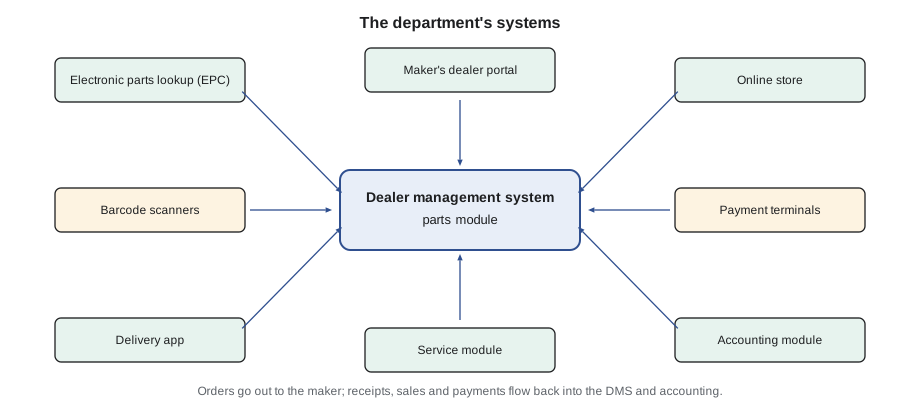
Rolf listed the department's systems on the whiteboard, from the oldest to the newest:
- The dealer management system (DMS). The dealership's main system. Its parts module holds the inventory, prices, sales, purchase orders, receiving, cycle counts, special orders and lost sales, and connects to service repair orders and accounting. Almost every report in this course comes from it.
- The electronic parts catalogue (EPC). Tessaro's catalogue, looked up by VIN, with diagrams, supersessions and fitment notes. Aftermarket suppliers have their own catalogues, mostly using the industry's standard vehicle and product data.
- The maker's dealer portal. Ordering, order status, back-order reports, the dealer locator for finding parts at other dealers, warranty parts returns and program bulletins.
- Barcode scanners and label printers. For receiving, put-away, picking, issuing to repair orders and counting. Scanning is the single biggest accuracy control in the department.
- Payment terminals. Card and contactless payments at the counter, linked to the DMS so that each payment matches a ticket.
- Delivery tools. Route planning and proof of delivery on the driver's phone.
- The online store. A web shop for retail customers and an ordering portal for wholesale accounts.
Each system costs money every month, needs training and must be kept secure. Rolf's view was that technology is worth buying when it saves staff time, improves accuracy or wins sales, and that the manager's job is to prove which one before signing.
Getting more from the systems already in place
Before buying anything new, Rolf asks what the existing systems can already do. He showed Imani three examples from the past year:
- Lost sales entry. The DMS had always had a lost sales screen, but staff found it slow. A shortcut key and a short list of reason codes made it take ten seconds, and entries tripled.
- Pre-picking. The DMS could print a pick list of parts for the next day's service appointments; nobody had used it. It became the basis of the morning pre-pick in lesson 7.
- Automatic replenishment. The suggested stock order had been edited by hand line by line. After the stocking settings were reviewed, Rolf trusted the suggestions and reviewed only the exceptions, saving about two hours each order day.
"Most departments use a third of their system," Rolf said. "Ask the vendor's trainer to spend a day with you once a year. It's the cheapest upgrade there is."
Why sell parts online
Parts buyers have moved online in three ways, and each needs a different response:
- Retail customers search for a part by vehicle, compare prices and order for pickup or delivery. They expect to see a price, an availability date and a clear return policy.
- Repair shops order from online portals run by aftermarket chains and by makers' wholesale programs, often comparing several sellers on one screen. They expect live stock, fast delivery and their own account price.
- Marketplaces let dealers list genuine parts on large online stores that reach buyers across the country, in exchange for fees.
Linmore had started its online store two years earlier, mostly for accessories and maintenance parts. In October it took 210 orders worth 9,800 dollars, including Lena Ilsley's wiper blade order on October 23 and a few larger orders such as the bumper cover. Rolf wanted to know whether it was worth expanding, so he worked out its contribution: the gross profit left after the costs the online store adds.
Worked problem
Does the online store pay its way?
In October the online store sold 9,800 dollars of parts in 210 orders, at a 28 percent gross margin. Card payment fees were 2.9 percent of sales plus 0.30 dollars per order. The department paid 3.50 dollars toward shipping on 140 orders, and the platform cost 120 dollars a month. What did the store contribute?
Show solution
- Gross profit = 9,800 × 0.28 = 2,744.00 dollars.
- Payment fees = 9,800 × 0.029 + 210 × 0.30 = 284.20 + 63.00 = 347.20 dollars.
- Shipping subsidy = 140 × 3.50 = 490.00 dollars.
- Contribution = 2,744.00 − 347.20 − 490.00 − 120.00 = 1,786.80 dollars.
Answer: About 1,787 dollars a month before the staff time to pick, pack and answer questions. The average order was 9,800 ÷ 210 = 46.67 dollars. Small orders with shipping subsidies are the weak point; a free-shipping minimum would help.
Rolf also counted the staff time. Picking and packing an online order took about eight minutes, and answering questions about fitment and delivery another few minutes per order on average. At 210 orders, that was close to 40 hours a month, the equivalent of a full week of one person's time. The store paid its way, but only just, and it would need better processes before it grew.
Making online orders work
Rolf and Imani listed what the online store needed to do as well as the counter:
- Fitment. Every listing tied to the catalogue so that customers choose their vehicle, or enter a VIN, before buying. Most online returns are wrong-fit parts.
- Live stock and honest dates. The store shows stock from the DMS, with the date a special-order part would ship.
- Clear prices and policies. The price, shipping charge, taxes and return policy shown before the customer pays, with no surprise fees.
- Fast handling. Orders printed at the counter as they arrive, picked and packed by the 4:00 p.m. cut-off for Brackenly Express's afternoon pickup, as APT-220 set up.
- Packing to suit the part. Large or fragile parts such as bumper covers and glass need proper packaging or freight shipping, and dangerous goods such as airbags, batteries and some aerosols follow the transport rules or aren't sold online at all.
- Returns. A simple return process, with the restocking policy shown on the order.
Taxes on online sales depend on where the customer is.
In Canada, the GST/HST charged depends on the province where the part is delivered: a part shipped from Hamilton to Winnipeg is charged GST, plus Manitoba's provincial sales tax if the seller is registered for it, while one shipped within Ontario is charged the 13 percent HST. The department's system needs the delivery address to apply the right tax.
Websites must also be usable by people with disabilities.
Ontario's accessibility law (AODA) requires private organizations with 50 or more employees in Ontario to make their public websites meet the WCAG 2.0 Level AA standard, with some exceptions. Rolf asked the platform vendor for its accessibility statement before renewing.
Security and fraud
A parts department handles payment cards, customer information and supplier payments, which makes it a target. Rolf's rules:
- Logins. Every person has their own login with the access their job needs; passwords aren't shared; logins of people who leave are closed the same day.
- Card payments. Card data stays in the payment terminal and the payment provider's systems; the department never writes down card numbers.
- Online fraud checks. Large online orders shipped to an address different from the card's billing address, or several failed payment attempts, are held and checked before shipping.
- Supplier payment changes. A request to change a supplier's bank details, even one that looks like it came from the supplier, is confirmed by phone using a number already on file, never the number in the request.
- Breaches. Any suspected breach goes to the dealership's manager and IT provider immediately.
Under PIPEDA, an organization must report to the Privacy Commissioner of Canada, and notify the people affected, any breach of security safeguards involving personal information that creates a real risk of significant harm, and keep a record of every breach.
Choosing new technology
Tessaro's question about 2027 needed an answer, so Rolf showed Imani how he evaluates a new system, using the wholesale ordering portal the district office was promoting.
- Start with the problem. Wholesale accounts phone in most orders; at peak times calls wait and the counter is interrupted. The portal would let garages order by VIN from their own screen.
- Estimate the benefit. If half of the department's wholesale phone orders moved to the portal, Rolf estimated it would free about 25 counter hours a month and cut wrong-part errors, because the garage selects the vehicle itself.
- Count all the costs. Setup, monthly fees, training, staff time to load account prices, and support.
- Check it with users. Ask two or three garages, including Bramhall, whether they would use it.
- Pilot before committing. Start with a few accounts for three months and measure.
- Plan the change. Train staff, update the policy manual and tell customers what changes for them.
Rolf's answer to the district office proposed a three-month pilot of the portal with five wholesale accounts from February 2027, and a review of the online store's shipping rules in January. Imani would lead the pilot.
Data quality
Every system in the department is only as good as the data in it. Wrong bin locations send pickers to the wrong shelf. Missing supersessions sell an old part number that the maker no longer supplies. Customer accounts with old addresses send deliveries to the wrong place. Rolf keeps a short list of data checks that run every month: parts with no bin location, parts with stock but no sale or receipt in two years, customer accounts with no activity in a year, and price records that haven't changed since the last price file. Each check takes a few minutes, and fixing the results prevents dozens of small errors at the counter.
When the system goes down
A parts department that depends on its systems must be able to work without them for a few hours. Internet outages, power cuts and system failures happen. Linmore's downtime procedure is a single page at the counter: write every sale on a numbered paper ticket with the part number, quantity, price and customer; take card payments on the terminal's offline mode only up to its limit, and cash otherwise; record every part issued to the shop by repair order number; and enter everything into the system as soon as it is back, with a second person checking. Rolf tests the procedure once a year on a quiet afternoon. The first test, he admitted, found that nobody knew where the paper tickets were kept.
Using data to decide what to stock
The department's systems hold years of sales, lost sales and vehicle data, and the maker's portal can show which models are on the road in the dealership's area. Rolf uses that information to look ahead, not just back. Before the electric Marlo's first deliveries, he asked Tessaro's district office for the maker's recommended stock list for an electric vehicle launch, compared it with Linmore's expected sales, and started with a smaller list of parts likely to be needed in the first year: cabin filters, wiper blades, tires, 12-volt batteries and a few common body parts. High-voltage parts would be ordered as needed. Data doesn't replace judgment, he said, but it means the judgment starts from facts.
Imani noticed that every topic in the session came back to the same idea as the earlier lessons: the right part, the right information, at the right time. Technology just made it possible to do that for more customers, faster.
Training people on new systems
New technology fails more often because of people than because of software. Staff who aren't shown how to use a new screen go back to the old way, and the system's benefits never arrive. Rolf's rule is that every new system or feature comes with a short written procedure, a training session for every user, a named person who answers questions for the first month, and a check after a few weeks that people are actually using it. When the lost sales shortcut was introduced, he checked the entries by person every week for a month and spoke to anyone who wasn't using it. Entries tripled, and stayed up.
Common mistakes
MistakeBuying new technology before using the existing system fully.
InsteadAsk what the current system can already do and get the vendor's trainer to show you.
MistakeMeasuring the online store by sales alone.
InsteadWork out its contribution after payment fees, shipping, platform costs and staff time.
MistakeListing parts online without fitment checks.
InsteadTie every listing to the catalogue, with vehicle or VIN selection before purchase.
MistakeChanging a supplier's bank details because an email asked.
InsteadConfirm any payment change by phone using a number already on file.
MistakeApplying one tax rate to every online order.
InsteadCharge tax according to the delivery location and the rules that apply there.
Summary and key terms
- A parts department runs on the DMS parts module, the electronic catalogue, the maker's portal, scanners, payment terminals, delivery tools and an online store.
- Using existing systems fully is often the cheapest improvement.
- An online store should be judged on its contribution after fees, shipping, platform costs and staff time.
- Online sales need fitment checks, live stock, clear prices and policies, fast handling, safe packing and correct taxes.
- Security rules cover logins, card data, fraud checks, payment changes and breach reporting; new systems should be piloted before full rollout.
- Dealer management system (DMS)
- The dealership's main business system, including the parts module.
- Electronic parts catalogue (EPC)
- The maker's VIN-based catalogue of parts, diagrams and supersessions.
- Contribution
- Gross profit left after the costs directly added by an activity.
- Fitment
- Whether a part fits a particular vehicle.
- Pilot
- A limited trial of a new system or process before full rollout.
Practice problems
Work each problem on paper first, then reveal the answer to check.
An online store sells 6,000 dollars at a 30 percent margin, with fees of 250 dollars and shipping subsidies of 300 dollars. What is its contribution before staff time?
Show answer
6,000 × 0.30 = 1,800; 1,800 − 250 − 300 = 1,250 dollars.
Card fees are 2.9 percent plus 0.30 dollars per order. What is the fee on 100 orders totalling 5,000 dollars?
Show answer
5,000 × 0.029 + 100 × 0.30 = 145 + 30 = 175 dollars.
What is the most common cause of online parts returns?
Show answer
Wrong fitment: the part doesn't fit the customer's vehicle.
An email from a supplier asks to change its bank account for payments. What should the department do?
Show answer
Confirm the request by phone using a number already on file before changing anything.
Why should a new system be piloted?
Show answer
To measure its real benefits and problems with a few users before committing the whole department.
Lesson quiz · 5 questions
Score 60% or more to complete this lesson.
Create a free account to save your progress, take quizzes and earn a certificate.