
APT-330 · Lesson 7 of 12 · 23 min
Working with the service department
▶ Video coming soon A video version of this lesson is on the way.
Every Monday at 8:15, Rolf and Priyanka Rautela meet for twenty minutes in her office, with coffee, two printouts and a standing agenda. In October, Rolf began bringing Imani. At the seventh Wednesday session, he explained why that meeting mattered more than any other in his week. "The service shop buys almost half of everything we sell. Their technicians can't bill an hour unless we hand them the part. If parts and service fight, both lose, and the customer in the waiting room loses most."
How parts flows through a repair order
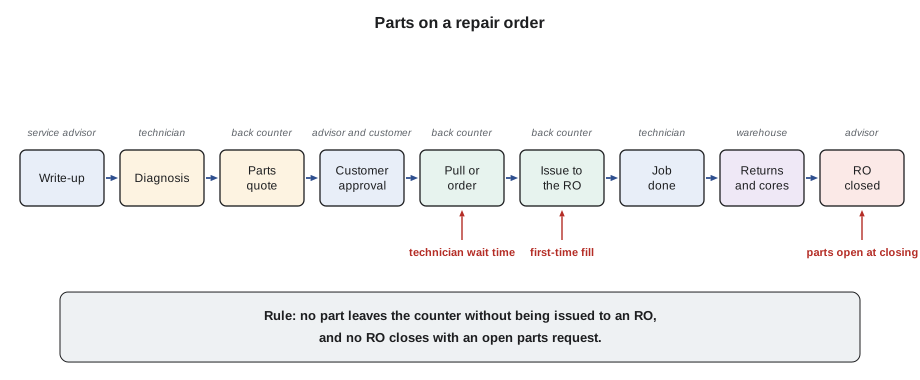
A repair order (RO) is the document that controls every job in the shop. Parts touch it at several points:
- Write-up. The service advisor records the customer's concern and any work already known, such as a scheduled maintenance service. For known jobs, the advisor or the parts counter can check stock and reserve the parts before the vehicle arrives.
- Diagnosis. The technician finds the cause and lists the parts needed. The back counter looks them up by VIN, checks stock, prices them and gives the advisor a quote and an arrival time.
- Approval. The advisor gets the customer's approval. Parts in stock are pulled; parts not in stock are ordered and the RO is marked as waiting for parts.
- Issue. Parts are issued to the RO by scanning, so that the RO shows exactly what was used and the stock record is updated.
- Returns and cores. Unused parts come back to stock and are credited to the RO; cores and warranty parts are tagged and stored.
- Closing. The RO is closed only when every part is issued, priced and accounted for. An RO closed with parts missing means lost sales; one closed with parts issued but not used means a stock error.
Rolf's rule for the back counter is simple: no part leaves the counter without being issued to an RO, and no RO closes with an open parts request.
Technician wait time
The service department sells technician time. Every minute a technician waits at the parts counter is a minute the shop can't bill. Rolf and Priyanka measured it in October with a simple log at the back counter.
Worked problem
What waiting costs
The shop has 14 technicians. In October each waited an average of 12 minutes a day at the back counter, over 22 working days. The shop's labour rate is 165 dollars per hour. How many hours were lost, and what were they worth?
Show solution
- Minutes lost per day = 14 × 12 = 168 minutes, or 168 ÷ 60 = 2.8 hours.
- Hours lost in the month = 2.8 × 22 = 61.6 hours.
- Value at the labour rate = 61.6 × 165 = 10,164 dollars.
Answer: About 62 technician hours, worth about 10,164 dollars of labour sales the shop could not bill in one month. Not all of that is recoverable, but every minute saved is worth something.
The fixes came from both departments:
- Pre-pick scheduled work. For appointments booked the day before, the back counter pulls the parts for known jobs into labelled bins by RO number before 7:30 a.m.
- Request by system, not by walking. Technicians send parts requests from their bay terminals, and the back counter calls them when the parts are ready.
- A runner at the peak. Between 7:30 and 9:30, one person delivers parts to the bays instead of the technicians collecting them.
- Stock the shop's parts. The service department's own lost sales and emergency orders feed the stocking review, so that the parts the shop uses most are always on the shelf.
By the second week of November, the log showed waiting down to about 8 minutes per technician per day. Priyanka thanked the counter team at her own staff meeting, which Rolf said was worth more than any bonus.
Pricing internal sales
Parts sold to the service department are priced by type of repair order, under a written policy agreed by the general manager:
- Customer-pay repairs use the retail price, list or matrix, because the customer pays for both parts and labour. Rolf and Priyanka agree when a discount is allowed, for example for a goodwill repair approved by the service manager.
- Warranty and recall repairs are paid by the maker under its warranty policy, at a rate the policy sets.
- Internal repairs to used vehicles being reconditioned for sale, and to the dealership's own vehicles, are charged at a lower internal price, often cost plus a small markup, so that the used vehicle department isn't overcharged.
- Shop supplies, such as rags, cleaners and small fasteners, come from a cabinet charged monthly to the service department at an agreed amount, as Rolf and Priyanka arranged after the APT-210 review.
Over the last 12 months, an average month's internal sales of 188,000 dollars split roughly into 96,000 dollars of customer-pay parts, 58,000 dollars of warranty parts and 34,000 dollars of internal and reconditioning parts. Each earned a different margin: about 30 percent on customer-pay, 27.5 percent on warranty and 12 percent on internal work. Imani noticed that a used vehicle reconditioning job and a customer-pay brake job could use the same pads and earn very different margins. Rolf agreed. "That's why we track them separately. If reconditioning grows, our margin falls and nobody did anything wrong."
Warranty parts
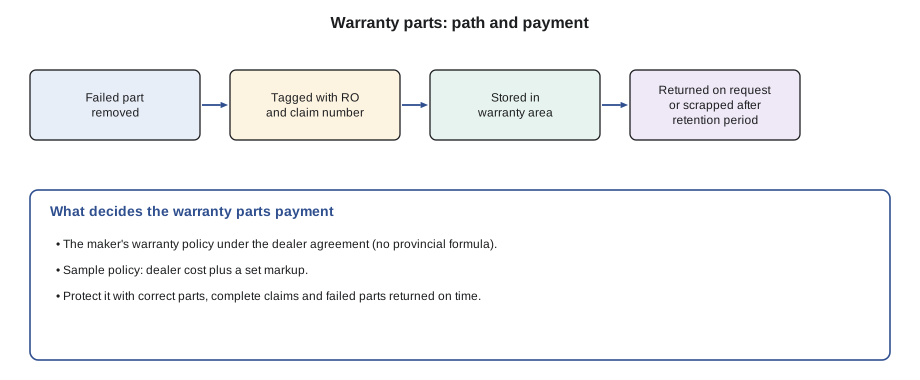
Warranty work is a large share of a dealership parts department's business, and it has its own rules. The maker pays for the parts and labour on approved warranty repairs, but only if the dealer follows the warranty policy exactly. The parts department's part of that work:
- Use the correct part listed for the repair, issued to the warranty RO.
- Tag and keep failed parts for the period the policy requires, in a separate, labelled area, and return them when the maker asks.
- Record the claim information: the part number, the failed part's details and any return authorization.
- Return parts on time with the correct paperwork, because a part not returned when requested can turn a paid claim into a chargeback.
How much the maker pays for warranty parts depends on the warranty policy and, in some places, on law.
In Ontario, the payment for warranty parts is set by Tessaro's warranty policy under the dealer agreement. Tessaro's sample policy pays dealer cost plus a fixed markup, reviewed by the maker from time to time. Because there is no provincial formula, the dealer's best tools are accurate claims, prompt parts returns and good records, so that every claim is paid in full the first time.
Worked problem
Checking the warranty margin
In an average month, warranty parts sales are 58,000 dollars, paid at dealer cost plus 38 percent under the policy. What is the cost of those parts and the gross profit they earn?
Show solution
- Cost = 58,000 ÷ 1.38 = 42,028.99 dollars.
- Gross profit = 58,000 − 42,028.99 = 15,971.01 dollars.
- Margin = 15,971.01 ÷ 58,000 = 27.5 percent.
Answer: About 42,029 dollars of cost and 15,971 dollars of gross profit, a 27.5 percent margin. The way to protect it is to get every claim paid: correct parts, complete records, failed parts kept and returned on time.
Rolf added a caution that applies everywhere: warranty claims are audited (lesson 10). A department that cuts corners to process claims faster will pay for it later in chargebacks.
The Monday meeting
Rolf and Priyanka's meeting follows the same agenda every week:
- ROs waiting for parts: every open RO with a part on order, its expected date and the customer's situation, such as a rental car or a waiting customer.
- Warranty parts: any returns requested, parts past their retention date and claims rejected for parts reasons.
- The week ahead: large jobs booked, recall campaigns starting, and any parts that need to be ordered early.
- Problems from last week: wrong parts, waiting time, missed add-ons, each discussed as a process, not a person.
- One improvement: a single change both agree to try, such as the morning runner.
The meeting is short because both arrive prepared. Rolf prints the open parts report; Priyanka prints the open RO report. When the two lists don't match, they find out why.
When parts and service disagree
Friction between the counter and the shop is common in dealerships. Technicians feel the parts counter is slow; counter staff feel technicians ask for parts without proper information. Rolf listed the typical disputes and how he handles them:
- "The part was wrong." The back counter checks the VIN lookup, the technician's request and the part itself. If the lookup was wrong, the counter fixes its process. If the request was incomplete, Priyanka coaches the technician. Either way, it's settled with facts.
- "You charged too much." Prices follow the written internal policy. If the policy is wrong, Rolf and Priyanka change it with Walter, not at the counter.
- "Technicians are buying parts elsewhere." Sometimes a technician buys an aftermarket part from a local store because it is faster. That is lost sales and a quality risk. The fix is better stocking and faster service, plus a clear policy that parts for the shop come through the parts department.
- "The RO was closed with parts open." The two managers check the cause and correct the process, and the accounting office fixes the record.
Imani asked what to do when a technician lost his temper at the counter. Rolf's answer was to stay calm, solve the immediate problem, and talk about the behaviour later in private, with Priyanka if needed. "Never argue in front of a customer, and never let one bad morning become a feud."
Planning for recalls and campaigns
When the maker launches a safety recall or a service campaign, the parts department and the service shop have to plan together. Tessaro sends a bulletin listing the affected vehicles, the parts needed and how they will be allocated to dealers. Some recalls start before enough parts exist, and the maker sends parts in batches. Rolf and Priyanka look at how many affected vehicles are likely to come to Linmore, how many parts the department will receive in each batch, and how appointments should be booked so that customers aren't turned away. Parts for recalls are kept separately and issued only to recall repair orders, because the maker checks that every recall part went into an affected vehicle.
Customers with a recall notice often call the parts counter by mistake. The counter's job is to take the VIN, confirm whether the vehicle is affected, and transfer the customer to a service advisor with the information. A recall is a safety matter and a chance to earn a customer's trust, so it is never brushed off.
Used vehicle reconditioning
The used vehicle department is the parts department's other internal customer. Every vehicle taken in trade is inspected and reconditioned before it goes on sale: tires, brakes, wipers, filters, sometimes body parts and keys. Speed matters, because a used vehicle earns nothing while it waits for parts, and every day in reconditioning costs the dealership money. Rolf agreed with the used vehicle manager on three things: a standard reconditioning parts list for common jobs kept in stock, a daily list of vehicles waiting for parts, and the internal price policy. The arrangement keeps the internal margin low, about 12 percent on average, but adds volume and speeds up the whole dealership's sales.
Communication between the counters and the shop
Rolf told Imani that most problems between parts and service come from missing information rather than bad intentions. A technician who doesn't know a part is on back order keeps coming to the counter to ask. A counter person who doesn't know a vehicle is booked for tomorrow can't pre-pick its parts. The fixes are mostly simple: the back counter updates the RO with every part's status and expected date, so the advisor can tell the customer without asking; the service schedule is visible to the back counter; and the technicians' requests include the VIN and the exact part or symptom, not just "brakes for the Vela in bay 6".
He also asked Imani to spend one morning a month in the shop, watching how technicians work and how they use the parts the department supplies. It is the fastest way, he said, to learn which kits, fasteners and fluids should be stocked together, and it builds trust with the people the department serves most.
Common mistakes
MistakeLetting parts leave the counter without being issued to a repair order.
InsteadScan every part to an RO, and close no RO with an open parts request.
MistakeTreating technician wait time as the shop's problem.
InsteadMeasure it together and fix it with pre-picking, system requests and a runner at peak times.
MistakePricing internal sales case by case at the counter.
InsteadFollow a written internal pricing policy agreed with the general manager.
MistakeStoring failed warranty parts loosely or scrapping them early.
InsteadTag them, store them separately and keep them for the full retention period.
MistakeSettling disputes with the shop by argument.
InsteadUse facts, a regular meeting and agreed processes.
Summary and key terms
- Parts touch every stage of a repair order, from write-up to closing.
- Technician waiting time costs the shop billable hours; pre-picking, system requests and runners reduce it.
- Internal sales are priced by repair order type under a written policy: customer-pay, warranty, internal and shop supplies.
- Warranty parts payment in Ontario is set by the maker's warranty policy under the dealer agreement; complete claims and timely parts returns protect it.
- A short weekly parts and service meeting with a standing agenda keeps both departments working from the same facts.
- Repair order (RO)
- The document that controls a job in the service shop, including the parts used.
- Customer-pay
- Repair work paid by the vehicle owner rather than by a warranty or the dealership.
- Technician wait time
- Time technicians spend waiting for parts instead of working on vehicles.
- Pre-picking
- Pulling and labelling the parts for scheduled jobs before the vehicles arrive.
- Chargeback
- A deduction from a paid warranty or program claim after an audit finds it did not meet the rules.
Practice problems
Work each problem on paper first, then reveal the answer to check.
Ten technicians each wait 15 minutes a day for 20 days at a labour rate of 150 dollars an hour. What is the lost labour worth?
Show answer
10 × 15 = 150 minutes = 2.5 hours a day; 2.5 × 20 = 50 hours; 50 × 150 = 7,500 dollars.
Warranty parts sales are 40,000 dollars at cost plus 25 percent. What is the cost?
Show answer
40,000 ÷ 1.25 = 32,000 dollars.
Customer-pay repair orders show parts sales of 15,000 dollars and parts cost of 10,500 dollars. What is the markup?
Show answer
15,000 ÷ 10,500 − 1 = 0.429, or about 42.9 percent.
Why are internal reconditioning parts usually priced lower than customer-pay parts?
Show answer
So the used vehicle department is not overcharged; the dealership's total profit is shared between departments.
Name three items on the Monday parts and service agenda.
Show answer
Repair orders waiting for parts, warranty parts returns and the week's large jobs (also last week's problems and one improvement).
Lesson quiz · 5 questions
Score 60% or more to complete this lesson.
Create a free account to save your progress, take quizzes and earn a certificate.