
APT-320 · Lesson 9 of 12 · 23 min
Recreational and marine parts
▶ Video coming soon A video version of this lesson is on the way.
In the middle of October, Linmore Parts Supply's marine counter had its busiest fortnight of the year. Wexmoor Marina was hauling out boats for the winter, and Colm Fairweather's crew needed fuel stabilizer, fogging oil, non-toxic antifreeze, gear lube, impellers, anodes and shrink wrap by the case. In the same fortnight, a boat owner walked in with the starter from a gasoline inboard engine and a printout of an automotive starter that looked the same and cost much less. Yusuf Halloran, who runs the marine counter, set the two side by side and pointed to the marking on the old one. "This one is ignition protected. That one could set off fuel vapour in your engine compartment." The customer bought the marine starter. Talia saw some of the marina's orders go out during her late-October shift at the store's small-engine counter, and Yusuf later wrote up both cases for Hamish's binder.
The recreational market
Recreational vehicles and boats are a large and seasonal parts market. The main groups:
- Powersports: all-terrain vehicles (ATVs), side-by-side utility vehicles, snowmobiles, dirt bikes and motorcycles, and personal watercraft.
- Marine: outboard engines, sterndrives (an inboard engine driving an outdrive through the transom), inboards with a propeller shaft, jet drives, and the boats' own systems.
- Trailers for boats, snowmobiles and ATVs.
- Small engines on mowers, generators and outdoor power equipment, covered in APT-230.
Each has its own identification: a vehicle identification number or hull identification number, a model year, the maker's model code, and for engines, the engine's own model and serial number. Marine engines are often identified by the engine's serial number rather than the boat's, because the same boat may have been sold with several engines, and the engine may have been replaced.
In southern Ontario, the season shapes demand: spring commissioning of boats and the start of ATV season, summer service, a fall rush of winterizing for boats and pre-season service for snowmobiles, and quiet winters broken by snowmobile repairs.
Powersports parts
Common powersports parts and what to ask:
- CVT drive belts: most ATVs, side-by-sides and snowmobiles use a continuously variable transmission with a wide rubber drive belt between two clutches. Belts are model-specific by width, length and construction; a belt that is even slightly wrong changes engagement and top speed or fails quickly. Ask what caused the failure; a glazed or burned belt points to clutch problems or to driving at low speed under heavy load.
- Snowmobile wear parts: the track, sized by width, length and lug height, with optional traction studs; ski runners or carbides; slide rails (hyfax) that the track runs on; and suspension parts.
- Engine oils: two-stroke snowmobile and ATV engines use oil injection with two-stroke oils specified by the maker, and four-stroke engines use their own oils, often with specific wet-clutch requirements on motorcycles and some ATVs.
- Batteries, often AGM or lithium in small sizes, plus chargers and maintainers for winter storage (APT-310).
- Brakes, tires, spark plugs, filters and cables, by model and year.
Powersports customers include dealers and repair shops, rental and tour operators, farms and municipalities using utility vehicles for work, and private owners doing their own service.
Marine engine parts
Boats spend their lives in water, and marine parts are built for it.
- Water pump impellers: the rubber impeller in the raw-water pump pushes cooling water through the engine. Impellers wear and harden with age, and a failed impeller overheats an engine in minutes. Many makers recommend inspection or replacement every year or two; marinas often replace them at each spring commissioning. Impellers are specific to the pump, and kits include the gasket and wear plate.
- Anodes: sacrificial metal blocks that corrode instead of the engine's aluminum or steel parts. The metal is chosen for the water: magnesium for fresh water, aluminum alloy for fresh, brackish or salt water, and zinc for salt water. Boats on the Great Lakes and inland waters usually run magnesium or aluminum. Replace anodes when they are about half consumed.
- Gear lube for outboard and sterndrive lower units, and the seals and drain screw washers that go with it. Milky gear lube means water has entered, usually past a seal.
- Propellers, identified by diameter × pitch, such as 14 × 19 (diameter and pitch in inches, the convention in both countries), the rotation (right-hand or left-hand), the material, and the hub kit that fits the engine's propeller shaft. Pitch is the distance the propeller would move forward in one turn if it did not slip.
- Fuel filters: marine engines use water-separating fuel filters, often rated around 10 micrometres, because water in fuel is common in boats. Filters are matched to the engine maker's specification.
- Thermostats, exhaust risers and manifolds on sterndrives and inboards, which corrode internally and are replaced on a schedule.
Worked problem
Propeller slip
A runabout's outboard has a gear ratio of 2.0:1 and a 19-inch-pitch propeller. At 5,500 rpm, the boat makes 64 km/h on the GPS. What is the propeller's theoretical speed, and how much does it slip? (Theoretical speed in km/h = pitch in inches × engine rpm ÷ gear ratio × 0.001524.)
Show solution
- Theoretical speed:
- \[19 \times \frac{5{,}500}{2.0} \times 0.001524 \approx 79.6 \text{ km/h}\]
- Slip:
- \[1 - \frac{64}{79.6} \approx 0.20\]
Answer: About 20 in 100 slip, a common figure for a recreational runabout. If an owner asks for a different pitch, a propeller supplier's guide uses the engine's recommended full-throttle rpm range: more pitch lowers rpm, less pitch raises it. The figures are teaching values.
Ignition protection
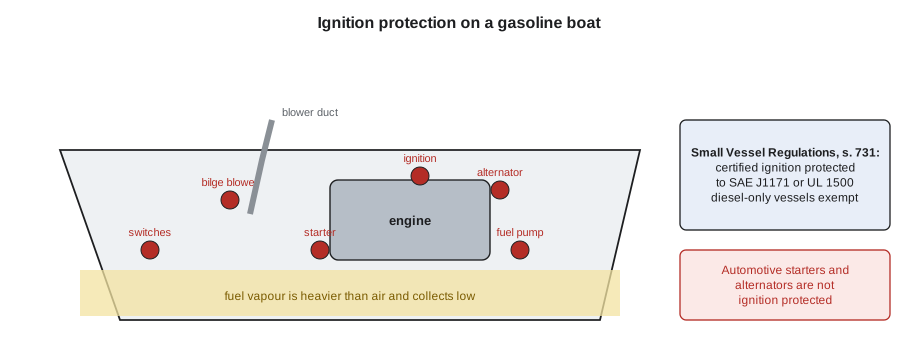
Gasoline vapour is heavier than air and collects in the bilge and engine compartment of a boat. A spark from a starter's brushes, an alternator, a distributor, a relay or a blower motor can ignite it. For that reason, electrical components installed where gasoline vapour can collect on a gasoline-powered boat must be ignition protected: designed so that they will not ignite the vapour around them.
In Canada, section 731 of the Small Vessel Regulations requires these electrical components to be certified as ignition protected by a product certification body or testing laboratory, to SAE J1171 or UL 1500. Vessels whose only fuel is diesel are exempt, and so are components isolated from fuel sources. Marine starters, alternators, distributors, fuel pumps, bilge blowers and many switches are built and marked to meet the requirement. Automotive versions are not, even when they bolt on.
The same caution applies to fuel system parts: marine fuel hose must be the rated type for its location, typically marked to SAE J1527, and fuel tanks, fittings and anti-siphon valves are built to marine standards. Many boats also need a working bilge blower, run before starting, to clear vapour from the engine compartment.
Fuel and storage
Most outboards and sterndrives built in recent decades are approved by their makers for gasoline with up to 10 in 100 ethanol (E10). Gasoline with 15 in 100 ethanol (E15) is not approved for marine engines; it is sold at some US stations under labels saying it must not be used in boats and small engines. Ethanol blends absorb water, and in storage they can phase separate: a layer of water and ethanol settles to the bottom of the tank. Marina customers buy fuel stabilizer, water-separating filters and, for long storage, fill tanks to limit condensation.
Winterizing a boat in a cold climate typically includes stabilizing the fuel and running it through the engine, fogging the cylinders with fogging oil on some engines, changing the engine oil and the lower unit gear lube, draining or filling the cooling system with antifreeze as the maker specifies, removing or maintaining the battery, and covering or shrink-wrapping the boat. For plumbing and fresh-water systems, marinas use propylene glycol antifreeze sold as non-toxic for RV and marine use, never the ethylene glycol coolant sold for cars.
Worked problem
A marina's winterizing order
Wexmoor winterizes 46 boats. Colm estimates two 3.78 L jugs of non-toxic antifreeze per boat on average, one bottle of fuel stabilizer for every four boats, and one gear lube pump kit per outdrive or outboard, about 40. How many jugs and bottles does he need?
Show solution
- Antifreeze:
- \[46 \times 2 = 92 \text{ jugs}\]
- Stabilizer:
- \[\frac{46}{4} = 11.5, \text{ rounded up to } 12 \text{ bottles}\]
Answer: 92 jugs of antifreeze, about 348 L, 12 bottles of stabilizer and about 40 gear lube kits. Yusuf added a case of impellers for the boats due in spring and confirmed the order a week before the haul-out began, so the stock arrived before it was needed.
Marine batteries and electrical parts
Boats use starting, deep-cycle and dual-purpose batteries. Starting batteries are rated in cranking amps; marine batteries also show marine cranking amps (MCA), measured at 0 °C (32 °F), which are higher than the cold cranking amps measured at a lower temperature. Deep-cycle batteries power trolling motors and house loads and are rated in reserve capacity or ampere-hours; lithium iron phosphate batteries are common for trolling motors and require compatible chargers. Marine wiring uses tinned copper wire and sealed connectors to resist corrosion, and marine switches, breakers and fuse blocks are rated for the damp, vibrating environment. Battery switches, chargers and isolators are counter items in spring.
Trailers
Boat, snowmobile and utility trailers bring their own steady sales:
- Hubs and bearings: most small trailers use inch tapered roller bearings in the hub, with a grease seal and a dust cap or a bearing protector that keeps grease under slight pressure. Boat trailer hubs are dunked in water, and a hot hub cooling suddenly can draw water past the seal. Sell bearings, cups, seals and grease together, and suggest checking the spindle for wear.
- Lights: submersible LED lamps and sealed wiring harnesses hold up best on boat trailers. Lamps must carry the required markings under CMVSS 108.
- Brakes: larger trailers have surge brakes (a hydraulic actuator on the tongue) or electric brakes. Provincial law sets the weight above which a trailer needs its own brakes, and also requires safety chains and a breakaway system on many trailers. Surge brake systems use brake fluid and corrode quickly on boat trailers; disc brake kits with stainless or coated parts are common upgrades.
- Hitch parts: couplers sized to the ball (such as 2 in or 2-5/16 in), balls with the right rating, safety chains, jacks, winch straps and tie-downs.
Trailer parts are sold to private owners who may not service their trailers often, so the counter's questions matter: when were the bearings last packed, does the hub get hot after a drive, and does the trailer go into the water?
Identifying outboards and getting the details right
Outboard engines carry a serial plate on the transom clamp bracket or the swivel bracket, with the model, the serial number and often the model year code. The counter needs that plate for almost every engine part, because the same horsepower rating can come in several model versions with different parts. A few outboard details that trip up the counter:
- Shaft length: outboards come with different shaft lengths to suit the transom height, commonly 381, 508 and 635 mm (15, 20 and 25 in), often called short, long and extra long. Lower unit parts, driveshafts and some trim parts differ by shaft length.
- Counter-rotating models: on twin-engine boats, one engine often turns the opposite way. Its propeller, and some gears, are left-hand.
- Two-stroke or four-stroke: different oils, different filters, and for older two-strokes, oil injection or premix.
- Power trim and tilt fluid is specified by the maker, and seal kits are specific to the unit.
Sterndrives add the outdrive, identified by its own serial number separate from the engine, with bellows, gimbal bearings, U-joints, shift cables and water pump kits that are replaced on a schedule.
Snowmobile pre-season
As boats come out of the water, snowmobiles come out of storage. Pre-season work brings in drive belts (a spare belt carried on the machine is common practice), spark plugs, chaincase oil, slide rails, ski runners, track studs, battery maintainers and fuel stabilizer for the end of the season. Snowmobile clubs and trail grooming operators also buy parts for their groomers and drags. The binder noted that the marine counter's busiest month and the snowmobile counter's first busy month overlap in November, so the two parts of the store share staff and shelf space as the season turns.
Common mistakes
MistakeSelling an automotive starter, alternator or blower for a gasoline boat's engine compartment.
InsteadSell ignition-protected marine parts certified to SAE J1171 or UL 1500.
MistakeChoosing a zinc anode for a boat used only in fresh water.
InsteadUse magnesium or aluminum in fresh water; zinc is for salt water.
MistakeSelling car coolant to winterize a boat's fresh-water system.
InsteadUse propylene glycol antifreeze sold as non-toxic for RV and marine use, as specified.
MistakeOrdering a propeller by diameter and pitch alone.
InsteadAlso match rotation, material and the hub kit for the engine's shaft.
MistakeRecommending E15 fuel for a marine engine.
InsteadE15 is not approved for marine engines; follow the maker's fuel specification.
Summary and key terms
- Recreational parts cover powersports, marine engines and boats, and trailers, with strongly seasonal demand.
- Powersports CVT belts, tracks and wear parts are model-specific; ask what caused a failure.
- Marine parts include impellers, anodes chosen for the water, gear lube and seals, propellers by diameter, pitch and rotation, and water-separating fuel filters.
- Electrical components in gasoline engine spaces must be ignition protected to SAE J1171 or UL 1500; automotive parts are not.
- Boats are winterized with stabilizer, fogging oil, lubricant changes and non-toxic antifreeze; trailer hubs, lights and brakes need marine-grade parts.
- Ignition protected
- Designed and certified so that the component will not ignite flammable vapour around it.
- Impeller
- The flexible rubber rotor in a boat engine's raw-water cooling pump.
- Anode
- A sacrificial metal block that corrodes to protect the engine and drive.
- Propeller pitch
- The distance a propeller would advance in one turn without slip.
- Phase separation
- Settling of water and ethanol out of an ethanol-blended fuel in storage.
- Marine cranking amps
- A battery's cranking rating measured at 0 °C (32 °F).
Practice problems
Work each problem on paper first, then reveal the answer to check.
Which anode metal suits a boat kept in a fresh-water lake?
Show answer
Magnesium, or aluminum alloy.
A 14 × 21 propeller: which number is pitch?
Show answer
21 (inches); 14 is the diameter.
Which test standards certify ignition protection?
Show answer
SAE J1171 and UL 1500.
A boat makes 60 km/h where the theoretical speed is 75 km/h. What is the slip?
Show answer
1 − 60 ÷ 75 = 0.20, or 20 in 100.
What antifreeze is used for a boat's fresh-water system?
Show answer
Propylene glycol antifreeze sold as non-toxic for RV and marine use.
Lesson quiz · 5 questions
Score 60% or more to complete this lesson.
Create a free account to save your progress, take quizzes and earn a certificate.