
APT-320 · Lesson 12 of 12 · 23 min
Supplying a farm at harvest
▶ Video coming soon A video version of this lesson is on the way.
The last tab of Hamish's binder was the thickest. It held Joelle Strand's notes from one week of corn harvest at Dunmarrow Farms, Monday, October 19 to Saturday, October 24, with every call, part, time and invoice number. Hamish's cover note said only: "Everything in the other eleven tabs happened in this one week, on one farm." On Sunday, November 15, Talia read it at her kitchen table with a highlighter, marking each place where a lesson from the binder showed up. This capstone follows that week.
The farm and the plan
Dunmarrow Farms grows corn, soybeans and winter wheat on about 1,400 hectares (3,500 acres). By the week of October 19 the soybeans were in, and the corn harvest was about a third done. The farm ran two combines with eight-row corn heads, two grain carts, three tractors, a farm-owned tractor-trailer hauling grain to the elevator, and its own grain dryer and bins with a bucket elevator leg. Gerrit Vandersluis ran one combine, Bram the other, and Lotte managed the dryer, the trucking and the books. In a good week the farm worked from first light until the dew came down, often past midnight.
Joelle had prepared in the summer. Using Dunmarrow's early order from the winter (Lesson 4) and the branch's sales history, she had stocked the farm's critical parts: feederhouse chain and slats for both combines, the most common belts and bearings, knife sections and guards for the soybean heads, snapping roll and gathering chain parts for the corn heads, hydraulic hose and fittings, filters and fluids. The binder's week shows how that preparation played out.
Monday: a bent slat
At 7:05 a.m. on Monday, Gerrit called: a rock had bent two slats on the feederhouse chain of his combine, and the chain had jumped a sprocket. He had the combine's serial number on a sticker inside his phone case. Joelle confirmed the slat and connector part numbers, checked the sprocket listing and asked whether the sprocket teeth were damaged. They were not. She had the slats, connectors and two spare chain links on the shelf, and Gerrit's hired hand picked them up at 7:40. Joelle added a note to check the feederhouse chain's adjustment and wear at the winter inspection, because a chain that jumps once often has worn sprockets or stretched links (Lesson 7).
The parts cost less than 200 dollars. The value was in having them on the shelf at 7 a.m. in October, the result of a stocking decision made in July.
Tuesday: the dryer drive
On Tuesday evening, Bram brought in the drive belts from the grain dryer's fan and a bearing from the dryer's unload auger, which had begun to squeal. The belts were a matched set of three B-section belts, two of them cracked. The bearing was a two-bolt flange unit with an inch bore and an eccentric locking collar, its insert number partly readable. Joelle sold a full matched set of three belts, not one (Lesson 7), and measured the shaft-end photos Bram had taken to confirm the bore. She found the flange unit in the interchange guide by its housing style, bore and locking method (Lesson 6), and noticed from the photo that the old set collar had been tightened against rotation, so she showed Bram the direction to turn it on the new one. She sold a tube of the grease the farm used everywhere else, after checking that it was compatible with the bearing maker's grease.
Bram asked whether a cheaper single belt would do until the end of harvest. Joelle explained why a new belt beside two stretched ones would carry most of the load and fail first, probably in the middle of a night of drying. He bought the set.
Wednesday: the grain cart hose
At 2:30 p.m. on Wednesday, a hose on one of the grain carts burst at the auger fold cylinder, spraying oil across the cart's front shield. Lotte called. Kip Lindqvist drove out with the hose bench's mobile kit and a seat angle gauge. The old hose's fittings turned out to be different at each end: an O-ring face seal at the cylinder and a JIC 37° fitting at the valve block (Lesson 5). Kip measured the length and phase angle, built the hose at the bench, and was back at the farm by 4:15. While installing it, the farm's hired hand reached toward another wet-looking hose with the tractor running. Kip stopped him, shut the tractor down, relieved the pressure and checked the hose with cardboard. It was only spilled oil from the first failure, but Kip explained why he would never check it by hand.
The failed hose had rubbed through its cover against a bracket. Kip fitted a protective sleeve on the new hose and showed Lotte where the rub had been, so the farm could reroute or clamp it during the winter rebuild.
Thursday night: combine down
At 9:30 p.m. on Thursday, Joelle's on-call phone rang. Bram's combine had broken a main drive belt in the middle of a field. The belt was a machine-specific banded belt that the branch did not stock, because it was a combine maker's part rather than an all-makes one, and Dunmarrow's combine maker was not a line the branch sold. It was a machine-down order (Lesson 11). Joelle ran the first-call checklist: serial number, the belt's part number from the maker's parts book, the condition of the sheaves and idler, and whether anything else was damaged. The idler bearing was rough, so she added it. She then checked the combine maker's dealers through Bram's own dealer, which had an on-call parts person. The nearest dealer, about 60 km away, had the belt and an idler bearing. Its on-call parts person agreed to meet Bram at 10:45.
Joelle did not sell the belt, because it came from another dealer, but she stayed on the phone with Bram until he had the dealer's address, the part numbers and the meeting time, and she gave him a common idler bearing from her own van stock in case the other dealer's turned out to be different. The combine was running again at 7:00 on Friday. Joelle's note: "Not our sale. Still our customer."
Worked problem
What the night was worth
Bram's combine harvests about 36 hectares (90 acres) of corn on a full day of about 12 working hours. If the belt had waited for the branch to open and order it, the combine would have lost about 10 working hours Friday before a next-day delivery. The farm estimates the cost of a combine standing idle in harvest, including the operator, the grain cart and trucks waiting, the risk of weather and field losses, at about 450 dollars an hour. What did the night-time pickup save, if Bram's trip and the other dealer's after-hours call cost the farm about 300 dollars?
Show solution
- Downtime avoided:
- \[10 \times 450 = 4{,}500 \text{ dollars}\]
- Net saving:
- \[4{,}500 - 300 = 4{,}200 \text{ dollars}\]
Answer: About 4,200 dollars, and roughly 30 hectares (75 acres) of corn harvested on Friday that would otherwise have waited. The hourly figure is the farm's own rough estimate, a teaching value; at harvest, many farmers would put it higher if rain was forecast.
Friday: the grain truck
On Friday afternoon, Lotte's daily inspection of the farm's tractor-trailer found that the right rear brake on the trailer's second axle was out of adjustment, and when she looked closer, the brake chamber's spring housing was badly corroded. Under Ontario's rules, a farm-plated truck over 4,500 kg still needs a CVOR and must meet the inspection standards (Lessons 2 and 10), and a corroded spring brake is a hazard in its own right. Marek Dunsford on the truck counter took over the farm's call. He identified the chamber as a type 30/30 long-stroke unit from the old chamber's tag and the trailer's build information, and sold the chamber with a new automatic slack adjuster, after asking about the camshaft bushings and confirming that the farm's mechanic had found the cause of the adjustment problem: a seized adjuster. He reminded Lotte that the old chamber had to be caged with its release bolt before removal and before it came back for disposal.
The truck was hauling again by Saturday morning. The farm's mechanic had been planning to wait until winter; the inspection, and a counter that knew the parts, kept a dangerous brake off the road during the busiest week of the year.
Saturday: the week in numbers
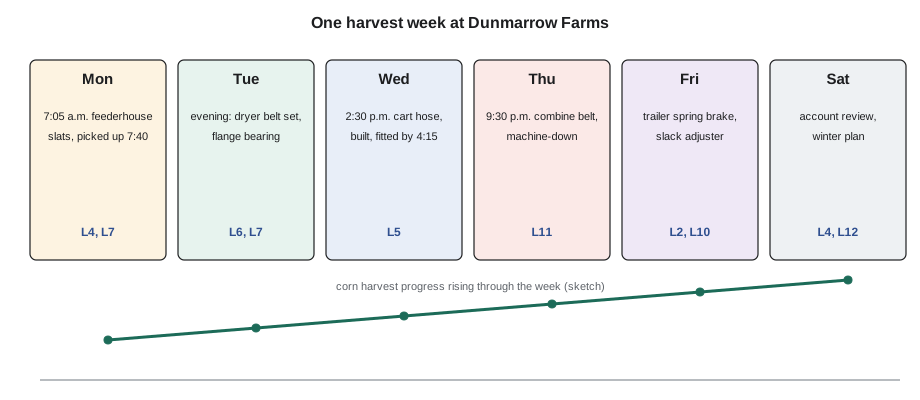
On Saturday, Joelle reviewed the week with Lotte, who looks after the farm's account. Joelle's summary:
| Day | Request | Lessons | Filled from stock? |
|---|---|---|---|
| Mon | Feederhouse slats, connectors, links | 4, 7 | Yes |
| Tue | Matched belt set; flange bearing; grease | 6, 7 | Yes |
| Wed | Grain cart hose assembly with sleeve | 5 | Yes (built) |
| Thu | Combine main drive belt, idler bearing | 11 | No (other dealer) |
| Fri | Spring brake chamber, slack adjuster | 2, 10 | Yes |
| All week | Filters, oil, grease, knife sections, lamps, fuses | 1 to 9 | Mostly |
Worked problem
First-time fill for the week
Over the week, Dunmarrow asked the branch for 41 different part lines. Thirty-seven were filled from the branch's stock on the first request, two were built at the hose bench, and two (the combine belt and its idler bearing) came from another dealer. Counting the hose assemblies as filled, what was the branch's first-time fill rate for the farm that week?
Show solution
- Lines filled by the branch:
- \[37 + 2 = 39\]
- First-time fill:
- \[\frac{39}{41} \approx 0.95\]
Answer: About 95 in 100, above the branch's target of 92 in 100 for its farm accounts. The two lines it could not fill were for a make the branch does not sell. Joelle added the combine's main drive belt to the list of parts Dunmarrow should keep on the farm itself during harvest, a suggestion Lotte accepted for next year.
Planning the winter
Before Lotte left, she and Joelle set dates for the winter work. The plan, made in late October, was:
- After harvest, in November: a walk around each machine with the farm's mechanic to list rebuild work, using Joelle's notes from the week.
- By December 1: the early order for next season's wear parts, under the supplier's early order program (Lesson 4).
- January to March 2027: combine and planter rebuilds in the farm's shop, with parts kitted by machine and delivered by job, including the feederhouse chain and sprockets, the grain cart hose reroute, and the dryer's other drive bearings.
- Before next harvest: a farm-held kit of the combine-maker parts the branch cannot supply, so a night like Thursday's does not happen again.
The plan showed the pattern Lesson 1 described: the counter thinking about what the machine will need next, and making sure it is on the shelf.
What the week shows
Talia's highlighter marked nearly every page. The habits she listed at the end of the binder were the ones the course has followed:
- Identify exactly: serial numbers, component plates, measurements and part numbers, never guesses (Lessons 1, 5 and 6).
- Think in downtime: a 40-dollar part can stop a combine worth half a million, and the value of good service is the downtime it prevents (Lessons 1 and 11).
- Stock for the season: the parts were on the shelf because someone planned for October in July (Lesson 4).
- Sell the whole job: matched sets, seals with pumps, bearings with sprockets, slack adjusters with chambers, and the cause of the failure (Lessons 2, 6 and 7).
- Keep people safe: cardboard for leaks, caged spring brakes, planned lifts and secured loads (Lessons 2, 5 and 10).
- Help even when it is not your sale: the customer remembers who answered the phone at 9:30 p.m.
Talia planned to give the binder back to Rolf on Monday with one question written on the last page for Hamish: whether she could spend a few Saturdays at the equipment counter in the spring, when the planters come in.
The account side of the week
Lotte's review covered the money as well as the parts. Dunmarrow's account showed each invoice with the farm's own job reference (combine 1, combine 2, cart, dryer, truck), so she could see what each machine cost to keep running that week. Two invoices carried the farm-use tax treatment, with the farm's certificate on file. The core charge for the old slack adjuster was waiting for its return, and the spring brake chamber had come back caged for disposal. Joelle had already noted that the Thursday night belt and bearing were bought from the other dealer, so Lotte would not look for them on the branch's statement.
Common mistakes
MistakeWaiting until harvest to stock a farm's critical parts.
InsteadStock them before the season from the early order and sales history.
MistakeSelling one belt from a matched set to save the customer money.
InsteadSell the full set and explain why.
MistakeBuilding a replacement hose without fixing the rub that destroyed the old one.
InsteadAdd a sleeve or guard and tell the customer about the routing.
MistakeEnding a machine-down call because the part is from a make you do not sell.
InsteadHelp the customer find it elsewhere; they remain your customer.
MistakeLetting a corroded spring brake wait for the off-season because the truck is busy.
InsteadTreat it as a safety repair now, with the chamber caged before removal.
Summary and key terms
- A farm at harvest uses every part of the trade at once: combines, carts, dryers, trucks and hydraulics.
- Preparation before the season, from early orders and sales history, puts critical parts on the shelf when they are needed.
- Each request draws on exact identification, matched sets, sound hose practice and safe handling of spring brakes.
- Machine-down service means helping the customer get running, even when the part comes from someone else.
- Reviewing the week turns emergencies into stocking decisions and a plan for winter rebuilds and next season.
- Critical stock
- Parts kept on hand for a customer because their absence would stop a machine at a critical time.
- Feederhouse
- The conveyor that carries crop from a combine's head into the threshing system.
- Grain leg
- A bucket elevator that lifts grain into bins or a dryer.
- Farm-held kit
- A set of parts the farm keeps on site for parts the dealer cannot supply quickly.
- First-time fill
- The share of requested lines supplied from stock on the first request.
Practice problems
Work each problem on paper first, then reveal the answer to check.
A combine costs a farm 400 dollars an hour idle in harvest. A night pickup costing 250 dollars avoids 8 hours of downtime. What is the net saving?
Show answer
8 × 400 − 250 = 3,200 − 250 = 2,950 dollars.
A farm asks for 50 lines in a week and 46 are filled from stock first time. What is the first-time fill?
Show answer
46 ÷ 50 = 0.92, or 92 in 100.
Which two fitting types did the grain cart hose have, and why does it matter?
Show answer
ORFS at the cylinder and JIC at the valve; each end must match its own port and seal.
Why did Joelle add an idler bearing to the combine belt order?
Show answer
The technician reported it was rough; a machine-down order should cover every related part.
What must happen to the old spring brake chamber before it is removed?
Show answer
It must be caged with its release bolt.
Lesson quiz · 5 questions
Score 60% or more to complete this lesson.
Create a free account to save your progress, take quizzes and earn a certificate.