
APT-320 · Lesson 1 of 12 · 22 min
Parts beyond the passenger car
▶ Video coming soon A video version of this lesson is on the way.
A week after Talia's Saturday morning at Linmore Truck and Equipment, Hamish Corrigall sent Rolf a thick ring binder with a note clipped to the cover: "For Talia, when she has time. Every case in here happened at our counter this fall. The parts are bigger and the customers are different, but the questions are the same ones she asks every day." Rolf read the note aloud and handed the binder across the counter. The first tab was labelled *Who we sell to*. It held a single sheet: a list of the branch's twenty largest accounts that autumn. There was a freight company running 48 tractors, an excavating contractor, a limestone quarry, a grain and cash-crop farm, a packaging plant, and, through the group's aftermarket store, a marina. Not one of them was a passenger car owner. This course follows that binder, case by case, through the parts that keep trucks, machines, farms and plants running.
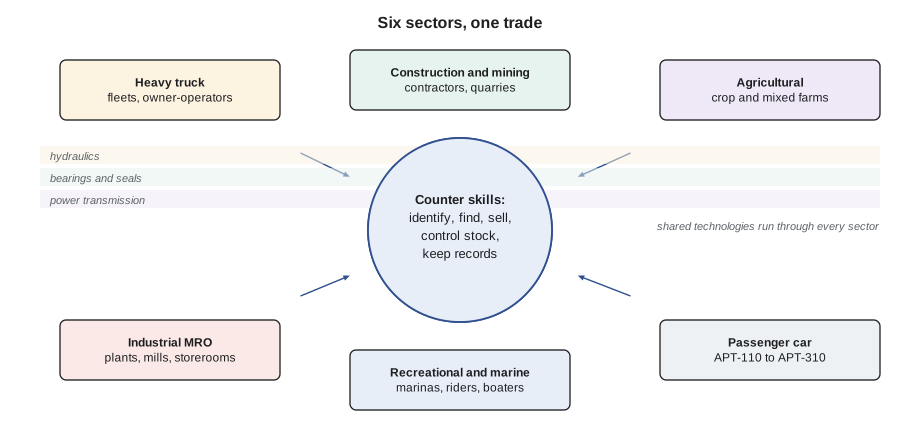
Six sectors, one trade
The Red Seal description of the parts technician trade lists workplaces in motive power, heavy duty equipment, farm machinery, marine equipment, mining, manufacturing, warehousing and tool cribs, not just car dealerships. In the United States, ASE offers a separate test for the heavy side, P1 Medium-Heavy Truck Parts Specialist, beside the P2 automobile test Talia is aiming for. The core skills are the same everywhere: identify the part, find it, sell or issue it, control the stock, and keep the records. What changes from sector to sector is the equipment, the customers and the cost of getting it wrong.
The sectors this course covers:
- Heavy truck and trailer. Class 8 tractors, straight trucks, trailers and buses, sold to fleets, owner-operators and municipalities. Lesson 2.
- Construction and mining equipment. Excavators, dozers, loaders, graders, compact track loaders and haul trucks. Lesson 3.
- Agricultural equipment. Tractors, combines, planters, sprayers, balers and grain handling, sold to farms whose demand follows the seasons. Lessons 4 and 12.
- Industrial maintenance, repair and operations (MRO). Bearings, seals, belts, chain, couplings, hydraulics and supplies for plants, mills and warehouses. Lessons 5 to 8.
- Recreational and marine. Snowmobiles, all-terrain vehicles, boats, outboard and sterndrive engines, and trailers. Lesson 9.
- The cross-cutting work: handling large and heavy parts and supplying customers whose machine is down. Lessons 10 and 11.
Hydraulics, bearings and power transmission appear in every one of those sectors. A hydraulic hose fails on a quarry loader, a combine and a plant's baler press; a 6205 bearing turns in a conveyor idler, a grain auger and a boat trailer's winch. That is why the middle of the course treats them as their own subjects.
What changes when the customer is a business
Talia's counter serves mostly individual drivers and the dealership's own service department. Hamish's customers are almost all businesses, and that changes the work in five ways.
- Downtime has a price. When a car breaks down, its owner is inconvenienced. When a tractor-trailer, a loader or a combine stops, the business loses revenue every hour, and often pays a crew that cannot work. Customers measure parts service in hours, not days.
- Identification goes by serial number and component. A heavy truck can be built with one of several engines, transmissions, axles and brake systems. A machine model can change in the middle of a production run. Parts are looked up by the serial number (or product identification number) and by the component maker's own part numbers on the engine, axle or pump. Hamish's rule from APT-120 still stands: no machine part is quoted without the serial number.
- Usage is counted in hours. Machines and many trucks carry an hour meter. Service intervals, warranties and wear predictions are expressed in engine hours as well as distance.
- Parts are bigger, heavier and costlier. A final drive, a track group or a combine's rotor can weigh more than a small car's engine and cost more than many cars. Handling, shipping and stocking decisions carry more weight. Lesson 10 is about that.
- Customers buy on account, in volume, on a schedule. Fleets and plants plan preventive maintenance (PM) and order the same kits again and again. They expect account pricing, delivery, reports and sometimes stock held for them. Farms buy heavily for a few months and hardly at all for others.
Who sells heavy and industrial parts
A parts person entering this side of the trade meets several kinds of business:
- Equipment and truck dealers, like Linmore Truck and Equipment, which sell the maker's genuine parts and usually some all-makes lines. Dealers have the maker's catalogue, service information and warranty programs, and access to the maker's parts distribution centres.
- All-makes heavy-duty distributors, which sell brake, suspension, filter, electrical and driveline parts for many makes of truck and trailer, often from component makers' catalogues.
- Agricultural parts suppliers: the farm equipment dealers, plus all-makes stores that carry wear parts, belts, bearings, hydraulics and twine for any brand.
- Bearing and power transmission distributors (often called BPT or industrial distributors), which supply plants with bearings, seals, belts, chain, sprockets, couplings, motors, gearboxes and lubrication. Many add hydraulics, hose assembly, pneumatics and safety supplies.
- Hydraulic specialists, with hose assembly shops, cylinder repair and mobile hose service trucks.
- Marine and powersports dealers and stores, plus the marine counter at general aftermarket stores such as Linmore Parts Supply.
- Industrial tool cribs and stores rooms inside large plants and mines, where a parts technician issues parts to the plant's own trades rather than selling them.
The Linmore group covers several of these at once. Linmore Truck and Equipment, on the South Service Road in Stoney Creek, sells and services heavy trucks and a line of compact construction equipment made by Vestrand, and runs an all-makes counter for brakes, filters, bearings, hydraulic hose and agricultural wear parts. Linmore Parts Supply, the group's aftermarket store, has a small-engine and marine counter. Between them they reach every sector in this course.
The people in Hamish's binder
Hamish runs a counter of six. Three of them appear often in the cases that follow:
- Marek Dunsford, who handles the truck counter and the fleet accounts. He came from a trailer repair shop and can identify a brake chamber across the room.
- Joelle Strand, the equipment and agricultural specialist. She grew up on a dairy and cash-crop farm and still helps at harvest. Farmers ask for her by name.
- Kip Lindqvist, the parts runner. He drives the branch's service pickup, builds hydraulic hoses at the hose bench, and takes the late calls when a machine is down.
The customers recur too. Ridgeholt Freight runs 48 tractors and about 90 trailers from a terminal on the edge of the city; Ines Kowalczyk is its maintenance manager. Pellmore Excavating, owned by Dougal Pellmore, runs two excavators, a dozer, three compact track loaders and a loader backhoe. Kessock Aggregates operates a limestone quarry on the escarpment in Flamborough, with maintenance planned by Faisal Rahimi. Dunmarrow Farms, run by Gerrit and Lotte Vandersluis and their son Bram, grows corn, soybeans and winter wheat on about 1,400 hectares (3,500 acres) in Glanbrook. Quellmont Packaging runs a corrugated box plant whose maintenance supervisor is Renata Szabo. Wexmoor Marina, owned by Colm Fairweather, buys from Linmore Parts Supply's marine counter.
Equipment identification in practice
The binder's second sheet was a photocopy of a machine serial plate with Hamish's handwriting around it. A machine's identification usually includes:
- Model (such as a Vestrand compact track loader model) and serial number or product identification number (PIN). The serial number tells the dealer the exact build, including running changes partway through production.
- Engine serial number and model, often on a separate plate or tag on the engine itself. Engines in machines are frequently made by a separate engine maker.
- Component plates or tags on the transmission, axles, hydraulic pumps, motors and cylinders. A pump can be identified from its own plate even when the machine's records are lost.
- Attachment serial numbers: buckets, forks, mowers and headers are separate products with their own numbers.
- Hour meter reading, which tells the counter how worn the machine is likely to be and whether it is inside a warranty period.
Heavy trucks carry a 17-character VIN like a car, but the VIN alone rarely tells the whole story. The truck's build record or spec sheet, kept by the dealer and often by the fleet, lists every major component: engine model and serial number, transmission, front and rear axles with their ratios, brake type, suspension and so on. Fleets often keep the component details for each unit in their maintenance software and include the unit number on every order.
When the plate is gone, painted over or unreadable, the counter falls back on the part itself: its cast-in numbers, its dimensions and its mounting. Lessons 5 to 7 show how to measure hoses, fittings, bearings, seals, belts and chain from the part alone. Measuring is a core skill on the heavy side, because a part from a machine built thirty years ago may have no listing at all, but a bearing or a seal with standard dimensions can still be found.
Worked problem
Comparing the cost of downtime
Pellmore Excavating has a crew of four on a site, paid an average of 48 dollars an hour each, and an excavator that would earn the company 210 dollars an hour on the job. The excavator is down for a hydraulic hose. If the hose arrives in 2 hours, the crew can keep working on other tasks for about half of that time. If it arrives the next morning, the job loses 8 working hours. Roughly what does each outcome cost in lost machine time and idle crew time?
Show solution
- Two-hour outcome, machine time:
- \[2 \times 210 = 420 \text{ dollars}\]
- Two-hour outcome, idle crew time for half of 2 hours:
- \[4 \times 48 \times 1 = 192 \text{ dollars}\]
- Next-morning outcome, machine time:
- \[8 \times 210 = 1{,}680 \text{ dollars}\]
- Next-morning outcome, idle crew time, assuming about half the day is lost:
- \[4 \times 48 \times 4 = 768 \text{ dollars}\]
Answer: About 612 dollars against about 2,448 dollars. A hose that costs 140 dollars is worth a delivery trip, and that arithmetic is behind the service levels heavy-side customers expect. The figures are typical teaching values, not Pellmore's actual rates.
Service levels the heavy side expects
Because downtime is expensive, heavy and industrial customers judge a supplier on a few measures:
- First-time fill: the part is on the shelf when asked for. For wear and PM parts the target is high, often over 90 in 100 lines.
- Response time on a machine-down order: how quickly the counter confirms the part, finds it and gets it moving. Lesson 11 covers this.
- Delivery on a fixed schedule for routine orders and on demand for emergencies.
- Accuracy: the right part the first time. A wrong part delivered to a job site an hour away costs two more hours.
- Technical help: measuring a part, interpreting a worn component, or suggesting a better-wearing option.
- Account services: monthly statements, purchase order numbers on every invoice, unit numbers, usage reports, and sometimes stock held on consignment or managed by the supplier (Lesson 8).
Hamish told Talia that his best counter people think like the customer's maintenance manager: what will this machine need next, and is it on the shelf?
Genuine, all-makes and will-fit parts
The heavy side uses a vocabulary that sounds familiar from APT-120 but with some differences:
- Genuine or OEM parts come from the equipment or truck maker's own parts system. Some carry the maker's number on a part made by a component supplier.
- Component maker parts come directly from the maker of the axle, brake, pump or engine under its own number. On a heavy truck these are often the same part the truck maker installs.
- All-makes or will-fit parts are aftermarket parts made to fit equipment from several makers. In wear parts such as bucket teeth, cutting edges, undercarriage and combine sections, will-fit lines are a large share of the market.
- Remanufactured components, such as engines, transmissions, pumps, injectors, turbochargers and DPFs, are sold on exchange with a core charge, just as starters and alternators are on the car side.
Choosing among them is a customer decision based on price, wear life, warranty and availability. The counter's job is to explain the options honestly. Joelle's rule is to ask what the customer needs the part to do: a contractor finishing one job before trading in a machine may choose a lower-priced will-fit part, while a quarry running two shifts a day may want the longest-wearing part regardless of price.
Safety on the heavy side
Every safety rule from APT-110 still applies, and the heavy side adds hazards a car counter seldom meets. Parts can weigh hundreds of kilograms. Hydraulic systems run at pressures that can inject oil through skin. Spring brake chambers and track adjusters store enormous energy in springs and grease. Counter staff who visit job sites, farms and quarries need the personal protective equipment those sites require, and they follow the site's rules: sign in, wear the hard hat, high-visibility vest and boots, stay out of the swing radius of machines, and never walk behind a machine whose operator has not seen them. Quarries add their own site orientation under the safety rules for pits and quarries, which a delivery driver may need before entering the pit. The following lessons point out the specific hazards as they come up.
Common mistakes
MistakeQuoting a machine part from the model number alone.
InsteadGet the serial number or PIN, and the component plate for engines, pumps and axles.
MistakeTreating a truck VIN as the whole description of a heavy truck.
InsteadCheck the build record or spec sheet for the actual engine, transmission, axle and brake components.
MistakeJudging an urgent order by the price of the part.
InsteadJudge it by the cost of the customer's downtime; a small part can stop a large machine.
MistakeRecommending the cheapest will-fit part without asking how the machine is used.
InsteadAsk about hours, conditions and plans, then explain the wear and warranty trade-offs.
MistakeVisiting a job site or quarry without its protective equipment or orientation.
InsteadFollow the site's rules and stay clear of operating machines.
Summary and key terms
- Parts technicians work across heavy truck, construction and mining, agricultural, industrial MRO and recreational and marine sectors, using the same core skills.
- Heavy-side customers are businesses that measure service by the cost of downtime.
- Machines are identified by model, serial number or PIN, engine and component plates, attachment numbers and the hour meter; trucks by VIN plus the build record.
- Genuine, component maker, will-fit and remanufactured parts are all common; the customer chooses on price, wear life and availability.
- Service levels are measured in first-time fill, response time, delivery, accuracy, technical help and account services.
- Serial number (PIN)
- The unique number of a machine, which identifies its exact build and running changes.
- Component maker
- The company that makes an engine, axle, brake, pump or other major component installed by the truck or equipment maker.
- Hour meter
- A meter that records engine operating hours, used for service intervals, warranty and wear.
- Build record
- The dealer's or fleet's record of a truck's major components, also called a spec sheet.
- Will-fit
- An aftermarket part made to fit equipment from several makers.
- MRO
- Maintenance, repair and operations: the parts and supplies used to keep a plant running.
Practice problems
Work each problem on paper first, then reveal the answer to check.
Name three things on a machine besides the main serial plate that may carry their own identification.
Show answer
The engine, the hydraulic pumps and motors, the axles or transmission, and attachments such as buckets.
Why does a heavy truck counter often ask for the unit number as well as the VIN?
Show answer
Fleets track each truck's components and history by unit number, and it links the order to the fleet's records.
A crew of three earning 40 dollars an hour each stands idle for 3 hours. What does the idle time cost?
Show answer
3 × 40 × 3 = 360 dollars.
What is the difference between a genuine part and a component maker part on a heavy truck?
Show answer
A genuine part comes through the truck maker's parts system under its number; a component maker part comes from the axle, brake or pump maker under its own number, and may be the same part.
Why are measuring skills more important on the heavy and industrial side?
Show answer
Old or modified equipment may have no listing, but standard parts such as bearings, seals, belts, chain and fittings can be found by their dimensions.
Lesson quiz · 5 questions
Score 60% or more to complete this lesson.
Create a free account to save your progress, take quizzes and earn a certificate.