
APT-320 · Lesson 8 of 12 · 23 min
Industrial maintenance and MRO supply
▶ Video coming soon A video version of this lesson is on the way.
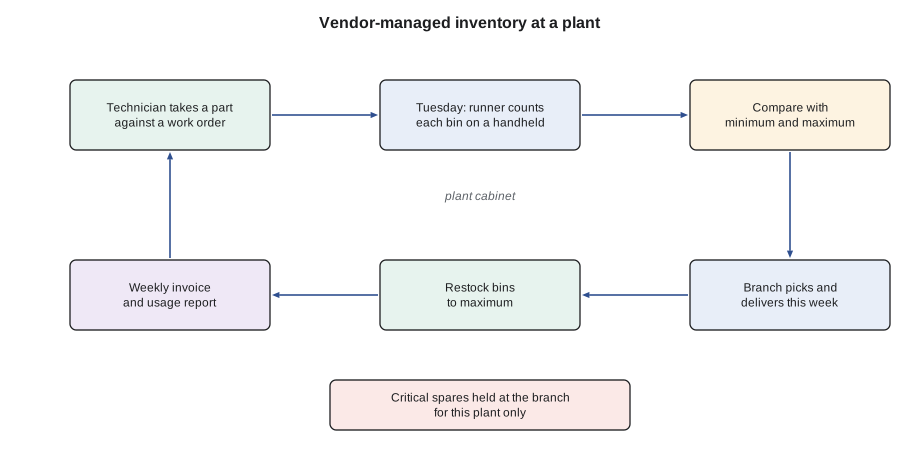
Renata Szabo's bearing in October was one of more than two hundred orders Quellmont Packaging placed with Linmore Truck and Equipment that year, most of them small: a few V-belts, a box of O-rings, a coupling spider, a case of grease, safety glasses. On Monday, November 2, she and Hamish signed an agreement that changed how the plant buys those parts. The branch would set up a supplier-managed cabinet in Quellmont's maintenance shop, stocked with 140 agreed part numbers. Kip would visit every Tuesday, count what had been used, restock to agreed levels and send one invoice a week. Critical spares for the corrugator, a short list of bearings, belts and a gearbox, would be held at the branch for Quellmont alone. "I want my technicians fixing machines," Renata wrote in her email, "not standing at a counter." Hamish put the email at the front of the binder's eighth tab.
What MRO means
MRO, maintenance, repair and operations, covers the parts and supplies a plant uses to keep running but does not build into its products. A plant's MRO spending typically includes:
- Bearings and power transmission: bearings, belts, chain, sprockets, couplings, gearboxes and motors (Lessons 6 and 7).
- Fluid power: hydraulic and pneumatic hoses, fittings, cylinders, valves, filters and fluids (Lesson 5).
- Fasteners and hardware: bolts, nuts, washers, anchors and pins.
- Lubricants and lubrication equipment.
- Electrical parts: fuses, relays, motor starters, sensors, cable and lamps.
- Safety supplies: gloves, glasses, hearing protection, lockout devices, spill kits and first aid supplies.
- Tools, abrasives and cutting tools, plus janitorial and shop supplies.
MRO buying has a typical shape: thousands of different items, most bought rarely and in small quantities, with a few high-value critical parts. Processing a purchase order for a 9-dollar coupling spider can cost the plant more than the part. Much of the supplier's value lies in making that buying easier.
How plants maintain equipment
A plant's maintenance approach decides what it buys and when:
- Reactive maintenance fixes equipment when it breaks. Simple, but every failure is an emergency and a production loss.
- Preventive maintenance services and replaces parts on a schedule, by time or operating hours, like the PM programs in Lesson 2.
- Predictive or condition-based maintenance measures the equipment's condition and replaces parts when the measurements show wear: vibration analysis on bearings and gearboxes, thermography on electrical panels and bearings, oil analysis on gearboxes and hydraulics, and ultrasound for leaks and bearing lubrication.
- Reliability-centred programs combine these, choosing the right approach for each machine based on how critical it is and how it fails.
Most plants run a computerized maintenance management system (CMMS) that schedules work orders, records repairs and lists the parts each machine uses. A well-kept CMMS bill of materials, showing which bearing, belt and seal each machine uses, is a gift to the supplier: it turns a vague request into an exact part number.
The storeroom and critical spares
Large plants and mines keep a storeroom or tool crib, sometimes run by parts technicians on the plant's own staff. The storeroom issues parts against work orders, keeps bin locations and counts (APT-210 applies directly), and kits parts ahead of planned shutdowns.
Some parts are held even though they rarely move, because without them a critical machine would stop for days. These are critical spares or insurance spares: a main drive gearbox, a large motor, a special bearing with a long lead time, or a corrugator's unique roll bearings. Plants rank equipment by criticality, the effect of its failure on safety, production and cost, and use it to decide which spares to stock. A critical spare that is not stocked is a risk the plant has chosen to accept; the supplier's job is to make sure the plant knows the true lead time.
Critical spares need care in storage: large bearings kept in their wrapping and lying flat, motors with their shafts turned by hand every few months to keep the bearings from flat-spotting, rubber parts kept away from heat, light and ozone, and shelf-life items like some seals and adhesives rotated first in, first out.
Ways to supply a plant
Distributors offer plants several supply models, often in combination:
- Transactional buying: the plant orders part by part, by phone, email or the counter. Flexible but slow and costly to process.
- Blanket purchase orders and price agreements: one purchase order covers a year's buying of agreed items at agreed prices, with releases against it.
- Electronic ordering: the plant's purchasing system links to the distributor's catalogue (a punch-out), or orders flow by EDI, with the plant's approval rules built in.
- Vendor-managed inventory (VMI): the distributor monitors stock in the plant's storeroom or cabinet and replenishes it to agreed minimum and maximum levels. The plant usually owns the stock once it is delivered.
- Consignment: the distributor keeps ownership of the stock in the plant until it is used, and invoices only what is taken.
- Industrial vending machines: locked dispensers for gloves, glasses, cutting tools and small parts, which issue items to employees by badge and report usage automatically.
- Two-bin (kanban) systems: each item has two bins; when the first is empty, it signals a reorder while the second bin covers the lead time.
- Integrated supply: the distributor runs the plant's whole storeroom with its own staff on site.
Quellmont's cabinet is a VMI arrangement with weekly service. The 140 part numbers came from two years of Quellmont's purchase history with the branch, Renata's CMMS bills of materials and a walk through the plant.
Worked problem
Setting minimum and maximum levels
One item in the Quellmont cabinet is a jaw coupling spider used on the plant's pumps. The plant uses about 6 a month. The branch restocks the cabinet weekly, and the spider's supplier lead time to the branch is 2 weeks, but the branch keeps stock, so the cabinet only has to cover the time between visits plus a safety margin. Hamish sets the minimum to cover two weeks of use and the maximum to add one month's use on top. What are the minimum and maximum?
Show solution
- Weekly use:
- \[\frac{6 \times 12}{52} \approx 1.4\]
- Minimum, two weeks of use, rounded up:
- \[2 \times 1.4 = 2.8, \text{ rounded up to } 3\]
- Maximum, minimum plus one month:
- \[3 + 6 = 9\]
Answer: A minimum of 3 and a maximum of 9. When Kip finds 3 or fewer on a Tuesday, he restocks up to 9. Levels like these are reviewed after a few months of actual usage, and items that never move are removed from the cabinet.
Standardizing and cross-referencing
A plant that has grown over decades often stocks the same part under several numbers: one bearing bought under three equipment makers' part numbers, two brands of the same belt, and identical O-rings in five kits. Standardizing reduces the number of items the plant stocks, frees money and shelf space, and makes shortages less likely. The distributor helps by cross-referencing each machine maker's part number to the standard industry part it really is. A conveyor maker's bearing number often turns out to be a common 6206-2RS; a gearbox maker's seal may be a standard 40 × 62 × 8 lip seal.
Cross-referencing has limits. A machine maker may have chosen a special version, such as a bearing with a particular clearance, cage material or grease, or a seal with a special lip, for a reason. Where the machine is critical or under warranty, the substitute is checked against the maker's specification before it is adopted, and the decision is recorded.
Obsolescence is the other side of the same work. When a motor, gearbox or valve is discontinued, the counter helps find an equivalent by matching its nameplate data, mounting, shaft and connections, and warns the plant when the replacement differs, such as a motor frame size that has changed.
Fasteners
Fasteners are the most numerous MRO items and the easiest to get wrong. Key points:
- Inch bolts are graded by markings on the head: Grade 5 has three radial lines and Grade 8 has six. Threads are UNC (coarse) or UNF (fine), such as 1/2-13 UNC or 1/2-20 UNF.
- Metric bolts are marked with a property class on the head, such as 8.8 or 10.9, with matching nut classes. Threads are coarse or fine pitch, such as M12 × 1.75 coarse or M12 × 1.25 fine.
- Never mix inch and metric threads or coarse and fine pitches. Some sizes are close enough to start by hand and then strip.
- Use the grade the equipment maker specifies. A higher grade is not always better; some applications, like shear bolts (Lesson 7), depend on a bolt breaking at a set load.
- Plated high-strength fasteners can suffer from hydrogen embrittlement if made or plated incorrectly; buy from reputable suppliers with traceable lots for critical applications.
Thread pitch gauges, bolt gauges and calipers belong on every industrial counter.
Safety and records in MRO supply
Plants work under strict safety programs, and their suppliers do too. Delivery and VMI staff follow the plant's sign-in, protective equipment and traffic rules, stay out of production areas unless escorted, and never enter a locked-out area. The counter sells the plant lockout devices, padlocks and tags, though the plant's own procedures govern their use. Lubricants, solvents, adhesives and aerosol products come with safety data sheets under WHMIS, which the supplier provides with the first delivery and on request.
Records are part of the service. A VMI program sends the plant regular usage reports: what was used, by item and by month, the value of stock in the cabinet, items that have not moved and any stockouts. Those reports help the plant's reliability team see patterns, such as Renata's repeated bearing failures in October, that would be invisible in a pile of small invoices.
Worked problem
What consignment saves the plant
Quellmont's storeroom holds about 60,000 dollars of MRO stock that the plant owns. Its finance department uses a carrying cost of 25 in 100 a year (APT-210). If the branch took 18,000 dollars of the fast-moving items onto consignment, so that Quellmont paid for them only when used, how much carrying cost would the plant save in a year?
Show solution
- Carrying cost saved:
- \[18{,}000 \times \frac{25}{100} = 4{,}500 \text{ dollars a year}\]
Answer: About 4,500 dollars a year, for the plant. The branch now carries that cost instead, so consignment is offered where the account's volume and margins justify it, and the agreement sets who pays for lost or damaged stock. The figures are teaching values.
A Tuesday at the cabinet
Kip made the first two service visits to Quellmont's cabinet on Tuesday, November 3, and Tuesday, November 10. His routine, which the branch wrote into the agreement:
- Sign in at the plant's gate, wear the plant's required protective equipment, and walk the marked route to the maintenance shop.
- Scan each bin with the handheld and count what is left. The handheld shows the minimum and maximum for each item and calculates the quantity to restock.
- Check for problems: parts put back in the wrong bin, opened packages, damaged labels, and items taken without being recorded. Kip notes them for Renata rather than correcting the plant's records himself.
- Restock from the van for common items, and order the rest for delivery later the same week.
- Review with the maintenance planner: upcoming shutdowns that will need extra parts, new equipment that may add items, and items that are not moving.
- Send the weekly report: usage by item, restocked quantities, cabinet value and any exceptions.
The first visit found one surprise: eleven coupling spiders used in a week against an expected one or two. Renata traced it to a pump whose motor had been reset badly after a repair, chewing through spiders every few hours. A laser alignment fixed it (Lesson 7). The cabinet had made the problem visible because every part was counted every week.
VMI service is routine work, and its value depends on that routine never slipping. A missed visit means a stockout, and a stockout in a plant that has given up its own stock control is worse than one in a plant that still keeps a back-up. For that reason the agreement names a back-up person for Kip's visits, and the branch reviews the cabinet's service level each month: how many items ran out between visits, and why.
Common mistakes
MistakeTreating a plant's small orders as unimportant.
InsteadSmall orders add up; making them easy to place is much of the supplier's value.
MistakeCross-referencing a critical machine's special bearing to a standard one without checking.
InsteadCheck clearance, cage, grease and other features against the maker's specification and record the decision.
MistakeSetting cabinet levels once and never reviewing them.
InsteadReview min and max against actual usage and remove items that never move.
MistakeSelling a Grade 8 bolt where the maker specifies a shear bolt or a lower grade.
InsteadUse the specified grade.
MistakeEntering a plant's production area or a locked-out area during a delivery.
InsteadFollow the plant's sign-in and safety rules and stay where you are allowed.
Summary and key terms
- MRO covers the parts and supplies that keep a plant running: bearings, PT, fluid power, fasteners, lubricants, electrical, safety and tools.
- Plants use reactive, preventive, predictive and reliability-centred maintenance, managed in a CMMS.
- Critical spares are held for machines whose failure would stop production; criticality decides what to stock.
- Supply models include blanket orders, electronic ordering, VMI, consignment, vending, two-bin systems and integrated supply.
- Standardizing and cross-referencing reduce stock, but critical substitutions are checked; fasteners are matched by grade or class and thread.
- Vendor-managed inventory (VMI)
- Stock at the customer's site that the supplier counts and replenishes to agreed levels.
- Consignment
- Stock held at the customer's site but owned by the supplier until used.
- Critical spare
- A part held because the failure of the machine it serves would stop production.
- CMMS
- Computerized maintenance management system: software for work orders, maintenance records and parts lists.
- Predictive maintenance
- Replacing parts based on measured condition, such as vibration or oil analysis.
- Property class
- The strength marking on a metric bolt or nut, such as 8.8 or 10.9.
Practice problems
Work each problem on paper first, then reveal the answer to check.
A plant uses 4 filters a month. With weekly visits and a minimum of two weeks' use and a maximum of minimum plus one month, what are the levels?
Show answer
Weekly use ≈ 0.9; minimum 2 (rounded up from 1.8); maximum 2 + 4 = 6.
What markings show a Grade 8 inch bolt?
Show answer
Six radial lines on the head.
Who owns consigned stock before it is used?
Show answer
The supplier.
Name two predictive maintenance techniques.
Show answer
Vibration analysis, thermography, oil analysis, ultrasound.
Why might a plant hold a gearbox it may not use for years?
Show answer
It is a critical spare with a long lead time; without it the line would stop for days.
Lesson quiz · 5 questions
Score 60% or more to complete this lesson.
Create a free account to save your progress, take quizzes and earn a certificate.