
APT-320 · Lesson 4 of 12 · 23 min
Agricultural equipment parts and seasons
▶ Video coming soon A video version of this lesson is on the way.
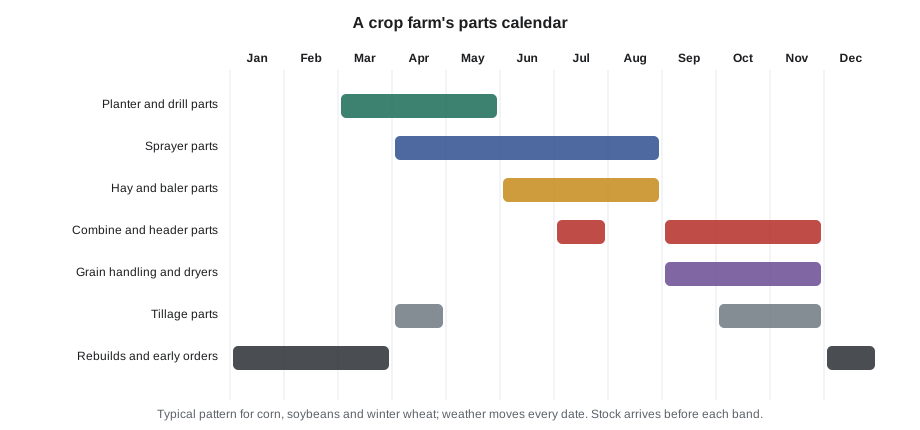
Joelle Strand keeps a wall calendar behind the equipment counter with no appointments on it, only crops. March says *planter clinic*. April and May say *planting, spraying*. June says *first-cut hay*. July says *wheat*. September says *beans*, and October and November say *corn, dryers*. December to February says *rebuilds, early orders*. When a farmer calls, she glances at it. "If it's May and Gerrit calls, it's a planter or a sprayer. If it's October, it's the combine, the grain cart or the dryer, and he needs it tonight." The third tab of Hamish's binder was about that calendar, and about the way a farm's year shapes every decision the counter makes, from what to stock to when to send a bill.
The machines on a crop farm
A cash-crop farm like Dunmarrow Farms runs a fleet of machines, many of them used for only a few weeks a year:
- Tractors, from small utility tractors to large four-wheel-drive and tracked tractors. They power implements through the power take-off (PTO), usually at a standard 540 or 1,000 rpm, through the three-point hitch, sized by category, and through hydraulic remotes with standard agricultural quick couplers. Their parts include filters, belts, PTO and hitch parts, hydraulic couplers and hoses, lights, seats, cab filters and tires.
- Combines, which cut, thresh and clean grain. Heads are changed for the crop: a flexible draper or auger head for soybeans and wheat, a corn head with row units for corn. Combines are full of wear parts: knife sections and guards, feederhouse chains, rotor or cylinder rasp bars, concaves, sieves, augers, belts, chains, sprockets and bearings.
- Planters and seed drills, whose row units carry seed meters, disc openers, gauge wheels, closing wheels, seed tubes and sensors. Accuracy at planting decides the crop, and farmers rebuild row units every winter.
- Sprayers, self-propelled or pulled, with pumps, booms, valves and nozzles.
- Tillage tools: discs, chisel plows, cultivators and vertical tillage tools, with disc blades, shovels, sweeps, points and bearings.
- Hay and forage equipment on mixed farms: mowers and mower-conditioners, rakes, tedders and balers, with knives, teeth, belts, knotter parts, twine and net wrap.
- Grain handling and drying: grain carts, augers, conveyors, bucket elevators, bin fans and dryers, with flighting, bearings, belts, chain, elevator cups and motors.
Most farms run several makes, and many machines are old: a well-kept combine can be twenty or more years old, and a tractor much older. All-makes wear parts, bearings, belts and hydraulics are a large share of agricultural parts sales for that reason.
The farm year
In southern Ontario, with corn, soybeans and winter wheat, the year typically runs like this. Weather moves every date.
- Winter (December to March): machines come into the shop or the farm's own shed for rebuilds. Planters, drills and combines are inspected and repaired. Farmers place early orders for the coming season's parts and supplies.
- Spring (April to May): tillage, planting and the first spraying. Breakdowns are urgent because planting windows are short; a planter down for two days of good weather can cost yield.
- Early summer (June): spraying, side-dressing fertilizer, and first-cut hay on mixed farms.
- July: winter wheat harvest and straw baling, then more spraying and second-cut hay.
- Harvest (September to November): soybeans usually from late September into October, corn from October into November, along with grain drying, hauling and storage. Combines, grain carts, augers and dryers run long hours, and the counter's evening and weekend service matters most.
- After harvest: fall tillage, manure application and fertilizer, then machines are cleaned, inspected and put away, and the cycle starts again.
Stocking for the seasons
Seasonal demand turns inventory control (APT-210) on its head. A combine part that sells twice from January to June may sell forty times from September to November. The counter's stock plan has to anticipate that.
- Build before the season. Seasonal parts arrive before demand begins, sized from last year's sales, the number and age of machines in the customer base, and the dealer's knowledge of who is rebuilding what.
- Watch the weather and the crop. A wet spring compresses planting into fewer days; a big crop or a wet harvest means more hours and more wear.
- Use supplier programs. Many agricultural suppliers offer early order programs with discounts, extended dating (payment due later, sometimes after harvest), and the right to return a share of unsold seasonal stock.
- Run down after the season. As harvest ends, the stock order shifts to winter rebuild parts, and slow seasonal parts are reviewed for return before they become non-moving stock.
- Hold critical parts. A few parts are stocked even when they rarely sell, because without them a combine stops in the middle of harvest: feederhouse chains, key belts, common bearings, hydraulic hoses and fittings, and sickle sections and guards.
Worked problem
Seasonal stock for knife sections
Joelle's counter sells about 1,200 sickle knife sections a year for drapers and flex heads, and about 70 in 100 of them sell from July to October. How many sections sell in that four-month period, and what is the average monthly demand in season and out of season?
Show solution
- In season:
- \[1{,}200 \times \frac{70}{100} = 840 \text{ sections}\]
- Average per month in season:
- \[\frac{840}{4} = 210\]
- Out of season (the other 360 over 8 months):
- \[\frac{1{,}200 - 840}{8} = 45\]
Answer: About 210 a month in season against 45 a month out of season, nearly five times as many. A reorder point based on the yearly average, about 100 a month, would run out in August and overstock in February. Joelle sets a seasonal stock level from June and lowers it in November. The quantities are teaching values.
Early orders and dating
Each winter, Dunmarrow Farms sits down with Joelle to plan the season's wear parts: knife sections, guards, rasp bars, feederhouse chain, planter discs and seed tubes, sprayer tips, belts and bearings. The branch passes on the supplier's early order terms.
Worked problem
What an early order saves
Dunmarrow's early order comes to 18,400 dollars at regular price. The supplier's early order program gives 8 in 100 off orders placed by December 1, with payment due the following September. How much does the farm save, and what does it pay?
Show solution
- Discount:
- \[18{,}400 \times \frac{8}{100} = 1{,}472 \text{ dollars}\]
- Amount paid:
- \[18{,}400 - 1{,}472 = 16{,}928 \text{ dollars}\]
Answer: The farm saves 1,472 dollars and pays 16,928 dollars nine months later, after much of the crop has been sold. The program terms are an invented example; real programs vary by supplier and year. For the branch, the early order fixes much of its seasonal stock in advance.
Identifying farm equipment parts
Agricultural parts are identified the same way as construction parts: model and serial number, plus the parts of the machine that have their own identity. A few farm-specific points:
- Heads and implements are separate machines with their own model and serial numbers. A combine's corn head is ordered by the head's serial number, not the combine's.
- Row units on planters and corn heads are often a separate design from the frame, and parts may change by model year of the row unit.
- Bearings, belts, chain and hydraulics are standard parts and can be identified by their numbers or measurements when the machine is old or its records are gone (Lessons 5 to 7).
- Sprayer nozzle tips follow a colour code tied to flow size under ISO 10625, so an 02 tip is yellow and an 04 tip is red, whatever the brand. The size number is the flow in US gallons per minute at 2.8 bar (40 psi); an 02 tip flows 0.2 gallons per minute at that pressure, about 0.8 L/min at 3 bar. The tip's spray pattern, angle and droplet size also matter, and the farmer usually chooses them for the product and drift rules.
- Knife sections come with different serrations and hardness, and guards in different styles. Match the section to the knife back and the guard, and ask about the crop.
Farmers know their machines very well and often bring in the worn part. Look at it carefully, measure it, and compare it with the new one before the farmer leaves.
Farm customers
Farm customers are business owners, and many are the third or fourth generation on the same land. A few features of the relationship:
- Long days in season. At harvest, farmers work from early morning to late at night and through weekends. Their calls come at 7 p.m. on a Saturday. Many dealers extend hours in season or keep a parts person on call.
- Accounts and terms. Farms usually buy on account. Income arrives when crops are sold, so terms and dating matter, and so does a clear monthly statement.
- Tax treatment. Some purchases for farm use qualify for sales tax relief when the farm provides the registration or exemption certificate the province requires. The counter follows the store's tax procedure and keeps the certificate on file; it does not guess which items qualify.
- Do-it-yourself repairs. Many farms do much of their own repair work and need the counter to explain a part, supply the bearing puller or the seal driver, or point them to the service manual.
- Neighbours talk. A farmer who is helped well on a Saturday night tells the neighbours, and so does one who is not.
Safety at the farm counter
Farm machinery causes serious injuries every year, and some parts the counter sells are safety parts in their own right:
- PTO shaft guards and shields. An unguarded PTO shaft can catch clothing and cause fatal injuries. Guards, bearings, shields and the safety chains that keep the guard from turning are sold as parts and should be replaced when damaged. A customer who asks for a driveline without its guard should hear why it matters.
- Slow-moving vehicle emblems and lighting for road travel, which provincial law requires on farm machinery moving on public roads.
- Hydraulic safety. Farm hydraulic systems also run at pressures high enough to inject oil through the skin (Lesson 5).
- Harvest fatigue. A farmer at the counter at 10 p.m. after sixteen hours in a combine is a tired customer. Double-check the part, repeat the details back, and send them off with exactly what they need.
Tillage, hay and other wear parts
Beyond the combine, a crop or mixed farm wears out parts on almost every implement:
- Tillage wear parts: shovels, sweeps, points and spikes on cultivators and chisel plows, and disc blades on discs and vertical tillage tools. Disc blades are identified by diameter, thickness, edge (smooth or notched), concavity and centre hole (round or square, with its size). A blade with the right diameter but the wrong centre hole will not fit the gang bolt.
- Planter wear parts: seed disc openers, which wear smaller in diameter and are replaced when they fall below the maker's limit; gauge wheel tires; seed tubes and their guards; closing wheels; and seed meter parts such as brushes and discs for each crop.
- Hay and forage parts: mower knives and their mounting bolts or quick-change clips, rake and tedder teeth, baler pickup teeth, knotter parts for small square balers, belts and rollers for round balers, and shear bolts for each drive.
- Twine and net wrap: baler twine is sold by its type (sisal or plastic), its length per unit weight, and its knot strength, and net wrap by its width and length. Using a twine with the wrong length per weight changes how many bales a box will tie; using one too weak causes broken bales.
- Grain handling parts: auger flighting, which is sold by diameter, pitch and hand; bucket elevator cups and bolts; conveyor chain; bin fan motors and their belts; and bearings.
Many of these parts are the farm's own preventive work: replacing openers, knives and teeth before they fail, in the winter. Joelle's counter tracks which farms rebuild which machines each winter, so it can have the parts on hand when the shop work begins.
Farm customers also ask for help reading a worn part. Bring the worn part next to a new one and compare edges, diameters and hole positions. A sweep worn to half its width or a disc blade a few centimetres under its new diameter shows the farmer what a season costs, and helps them decide whether to stock spares for harvest or planting.
Common mistakes
MistakeSetting reorder points for seasonal parts from the yearly average.
InsteadSet seasonal stock levels before each season and lower them after it.
MistakeOrdering a corn head part by the combine's serial number.
InsteadUse the head's own model and serial number.
MistakeSelling sprayer tips by colour alone.
InsteadMatch the size, but also the pattern, angle and droplet size the farmer needs.
MistakeSupplying a PTO driveline without its guard because the customer says it's quicker.
InsteadExplain the hazard and supply the guard and its safety chains.
MistakeWaiting until harvest to stock critical combine parts.
InsteadBuild stock before the season and hold critical parts even if they sell rarely.
Summary and key terms
- Crop farms run tractors, combines, planters, sprayers, tillage tools, hay equipment and grain handling, many of them old and of several makes.
- The farm year runs from winter rebuilds and early orders through planting, hay, wheat and the fall harvest.
- Seasonal stock is built before demand and reduced after it, using early order programs, dating and returns.
- Heads, implements and row units have their own serial numbers; nozzle tips follow the ISO 10625 colour code.
- Farm customers work long hours in season, buy on account and often repair their own equipment; PTO guards are safety parts.
- PTO
- Power take-off: a shaft that drives an implement from the tractor, usually at 540 or 1,000 rpm.
- Three-point hitch
- The tractor's rear lifting linkage, sized by category.
- Early order program
- A supplier program offering discounts and dating on seasonal parts ordered in advance.
- Dating
- Extended payment terms with the invoice due at a later date.
- Row unit
- One planting or harvesting unit on a planter or corn head.
- Sickle section
- A replaceable triangular knife blade riveted or bolted to a cutterbar knife.
Practice problems
Work each problem on paper first, then reveal the answer to check.
A part sells 600 a year, 75 in 100 of them in a three-month season. What is the average monthly demand in season?
Show answer
600 × 0.75 = 450; 450 ÷ 3 = 150 a month.
What colour is an ISO 04 spray tip?
Show answer
Red.
Name two critical combine parts a counter might stock even when they sell rarely.
Show answer
Feederhouse chain, key drive belts, common bearings, hydraulic hoses and fittings, knife sections and guards.
An early order of 9,000 dollars gets 5 in 100 off. What is paid?
Show answer
9,000 − 450 = 8,550 dollars.
Whose serial number do you need for a corn head row unit part?
Show answer
The corn head's, and possibly the row unit's model year.
Lesson quiz · 5 questions
Score 60% or more to complete this lesson.
Create a free account to save your progress, take quizzes and earn a certificate.