
APT-320 · Lesson 2 of 12 · 24 min
Heavy truck parts and fleet customers
▶ Video coming soon A video version of this lesson is on the way.
The second tab in Hamish's binder held the notes from a meeting on Tuesday, October 6. Ines Kowalczyk, maintenance manager at Ridgeholt Freight, came to Linmore Truck and Equipment with a laptop and a list. Ridgeholt runs 48 tractors and about 90 trailers, and its shop does its own preventive maintenance. Ines wanted the branch to plan the next twelve months of PM parts with her: filters, brake parts, air dryer cartridges, wheel seals, lamps and diesel exhaust fluid. "I don't want to call you when we run out," she told Marek Dunsford. "I want you to know before I do." Marek spent the afternoon with her building a forecast from her mileage records and her PM schedule. By the end of it the branch knew which kits to stock, how many, and when Ridgeholt would need them. Hamish's note on the cover said it was the most valuable afternoon of the quarter.
What makes a truck heavy
Trucks are grouped into weight classes by their gross vehicle weight rating (GVWR), the most the loaded vehicle may weigh as rated by its maker. In North America the familiar scale runs from Class 1, light pickups, to Class 8, trucks rated over 14,969 kg (33,000 lb). Class 8 includes the highway tractors that pull semi-trailers, dump trucks, refuse trucks, concrete mixers and heavy straight trucks. Classes 6 and 7 are medium-duty: delivery trucks, school buses and smaller straight trucks. Parts people often split the market into medium duty and heavy duty, and many counters serve both.
A tractor pulling a loaded semi-trailer can weigh about 36 tonnes or more, depending on the province's weight limits and axle configuration, and covers 150,000 to 200,000 km (90,000 to 125,000 miles) or more a year in long-haul service. Everything on it is built for that load and that distance, and its parts wear on a predictable schedule.
Preventive maintenance schedules
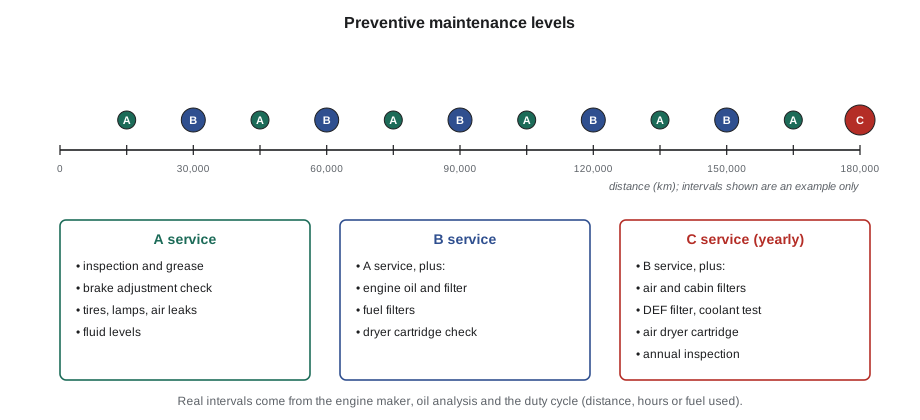
Fleets keep trucks on the road by servicing them before they fail. A typical PM program has levels, often called A, B and C services, each adding work to the one before:
- A service: a safety and lubrication inspection, chassis grease, fluid checks, brake adjustment check and a look at tires, lamps and air leaks.
- B service: the A service plus engine oil and filter change, fuel filters and often the air dryer cartridge check.
- C service: a yearly or major service: coolant and transmission tests or changes, valve adjustment where needed, air filter, cabin filter, DEF filter and the annual inspection.
Intervals depend on the engine maker's recommendations, the oil used, oil analysis results and the duty cycle. A long-haul truck on highway runs may go 50,000 to 80,000 km (30,000 to 50,000 miles) or more between oil changes, while a refuse truck that idles and stops constantly is serviced by engine hours instead. Lesson 1's warning applies: the counter should ask how the fleet counts, by distance, hours or fuel used, before forecasting.
Fleets buy PM parts as kits built for each truck spec: the oil filter, fuel filters, air filter and any gaskets needed for one B service, packed under one kit number. Kits save the fleet's technicians time and make the parts usage easy to forecast. The dealer's job is to make sure the kit matches the truck's actual engine and filter configuration, which can differ between units of the same model year.
Worked problem
Forecasting a fleet's oil services
Ridgeholt's 48 tractors average 180,000 km a year each, and Ines changes the oil every 60,000 km. Each oil service uses one B-service filter kit. How many kits will Ridgeholt need in a year, and about how many a month?
Show solution
- Total distance:
- \[48 \times 180{,}000 = 8{,}640{,}000 \text{ km}\]
- Oil services:
- \[\frac{8{,}640{,}000}{60{,}000} = 144\]
- Per month:
- \[\frac{144}{12} = 12\]
Answer: 144 kits a year, about 12 a month. Marek set a stock level of 12 kits with a reorder point of 6, because the supplier delivers weekly. Trucks are not serviced evenly, so the stock level also covers a month when more trucks come due.
Air brake parts in depth
APT-230 introduced air brakes. On the heavy truck counter, air brake parts are among the highest-volume lines, and their identification is precise.
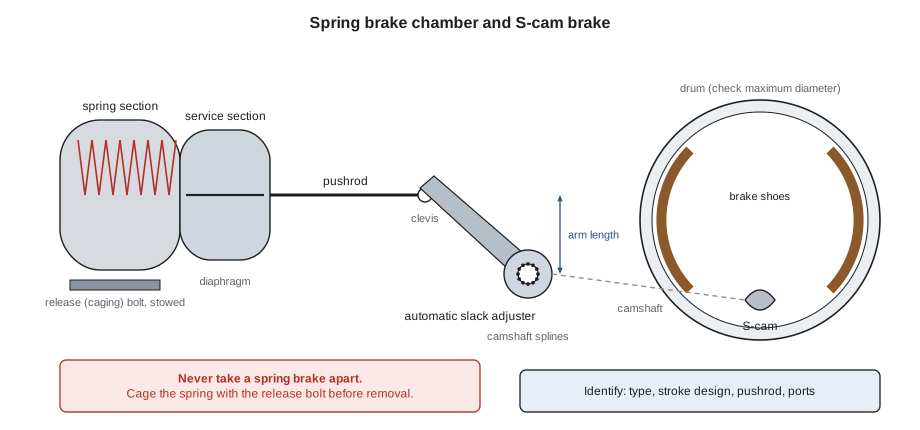
Brake chambers. Chambers are identified by type, the effective area of the diaphragm in square inches: type 16, 20, 24 and 30 are common on trucks and trailers, with type 36 on some heavy axles. A spring brake chamber is described by both sections, such as 30/30 (service/spring). The counter also needs the stroke design, standard stroke or long stroke; the pushrod length or clevis style; the port positions; and whether the chamber is a piggyback spring section that bolts onto a service chamber. Long-stroke chambers are marked by the maker, often with square air ports or a tag, and a standard-stroke chamber must never replace one, because the brake adjustment limits differ.
Never take apart a spring brake chamber. The spring inside is under very high force. A chamber being replaced is caged first: a release bolt is screwed in to hold the spring compressed, following the maker's procedure. Damaged or corroded chambers can fail violently. When old spring brakes come back as cores or for disposal, they must stay caged, and many counters require the release bolt to be installed before accepting one.
Slack adjusters. An automatic slack adjuster is identified by its arm length (the distance from the camshaft centre to the clevis pin hole, commonly about 140 or 150 mm (5.5 or 6 in)), the spline count and diameter of the camshaft it fits, and the maker's model. Some fleets standardize on one adjuster maker. When a technician asks for an adjuster to replace one that "kept going out of adjustment", ask whether the cause was found; APT-230 explained why a worn camshaft bushing or foundation brake parts often cause the problem.
Foundation brake parts. S-cam brake shoes are sold relined or as new shoes with lining, by the industry's brake shoe designation (a four-digit number such as 4707 for a common drive axle size) and by the lining's friction rating. Replacement linings should be marked as meeting the truck's braking standard, and the same lining should go on both sides of an axle. Drums are sold by diameter and width, such as 419 × 178 mm (16.5 × 7 in), and must be checked against the maximum diameter cast into them. Brake hardware kits include springs, rollers, pins and bushings; camshaft and cam bushing kits are a regular repair.
Air disc brakes use calipers, pads and rotors and are now common on steer axles and on many drive and trailer axles. Pads are specific to the caliper maker and model, often with wear sensors, and are sold as axle sets.
Air supply and controls. Air dryer cartridges (some with a coalescing filter for oil), governors, relay valves, quick-release valves, gladhands and seals, air lines and fittings, and tanks with drain valves.
ABS. Air-braked trucks and trailers built since the late 1990s have antilock brakes. The US standard, FMVSS 121, required ABS on truck tractors built from March 1997 and on other air-braked trucks, buses and trailers from March 1998, and Canada's CMVSS 121 also requires it. ABS parts include wheel speed sensors and their clips, tone rings, modulator valves, the electronic control unit and the cables. Trailers have their own ABS, powered through the tractor's lighting connection. Newer tractors also carry electronic stability control and collision mitigation systems, whose sensors and calibration are the dealer's domain.
Wheel ends
The wheel end is the hub, bearings, seal, lubricant and fasteners at each wheel. Heavy trucks use tapered roller bearings (Lesson 6), sealed by a wheel seal and lubricated by oil (an oil bath with a sight-glass hubcap) or semi-fluid grease. Many newer trucks and trailers use pre-adjusted or pre-set hub systems, where bearing spacers set the bearing adjustment when the spindle nut is torqued to specification. The counter needs to know which system the axle has, because the bearings, seals, spacers and spindle nuts differ, and a pre-set hub assembled with the wrong parts will not hold its adjustment.
Wheels on modern trucks are mostly hub-piloted: the wheel is centred on the hub's pilot pads and clamped by ten flange nuts on M22 × 1.5 studs. Older stud-piloted wheels use different nuts and are not interchangeable. Wheel nut torque is high, typically around 610 to 680 N·m (typically around 450 to 500 lb·ft) for hub-piloted wheels, and retorquing after the first short distance is standard practice; the counter supplies the nuts, studs and wheel-end kits, not the torque values, which come from the wheel and axle makers.
Engines, filters and aftertreatment
Heavy diesel engines use large spin-on or cartridge filters for oil, fuel and coolant, plus big air filters. Fuel systems usually have a primary filter with a water separator and a secondary filter. The engine maker and engine serial number decide the filter numbers, and filter brands cross-reference widely; Lesson 5 of APT-230 showed why the anti-drainback valve and bypass valve settings matter.
Exhaust aftertreatment adds a steady stream of parts:
- Diesel exhaust fluid (DEF), the urea solution for the SCR system, sold in jugs, drums, totes of about 1,000 L (275 gal), and bulk. DEF must meet ISO 22241 and is often sold with the API DEF certification mark. It is kept clean, in sealed containers, away from direct sun and heat, and above its freezing point of about −11 °C (12 °F) for dispensing; it is not a dangerous good.
- DEF filters, dosing modules and DEF heaters, which are regular service and repair parts.
- DPF cleaning and exchange. A diesel particulate filter collects ash that regeneration cannot burn off. Fleets send DPFs for cleaning, or buy cleaned exchange units with a core charge, at intervals set by the engine maker.
- NOx sensors, temperature sensors and pressure sensors, which are high-value and often returned as cores or for warranty.
The rules on DEF systems have been changing in the United States. In August 2025 the EPA issued guidance asking makers to revise software on existing trucks and equipment to reduce sudden DEF-related derates, and in March 2026 it said NOx sensors may replace the separate urea quality sensors under existing rules. In July 2026 it proposed amendments to the 2027 heavy-duty rules, including removing DEF derates for new engines; those changes were not final as of the fall of 2026. Canadian on-road emission standards are aligned with the US standards, but changes in the US do not automatically change the Canadian rules, so the counter follows the engine maker's current software and service bulletins. None of this makes removing or disabling emission equipment legal. Delete kits, tuning that disables aftertreatment and DPF or SCR "delete pipes" are illegal to sell or install under federal and provincial law, and Linmore does not sell them.
Fleet accounts
A fleet like Ridgeholt is a different customer from a passing retail buyer. The account usually includes:
- Account pricing, often a discount from list by product group, sometimes with fixed prices on PM kits for a year.
- Purchase order and unit numbers on every invoice, so the fleet can charge the parts to the right truck.
- Delivery on a schedule, with emergency delivery for trucks down at the terminal or on the road.
- Core tracking for remanufactured parts: water pumps, air compressors, brake shoes, DPFs and more.
- Warranty claims handled through the dealer or the component maker, with the failed part, the unit's details and the mileage or hours.
- Usage reports: what the fleet bought by part group, by month and by unit, which help both sides plan.
- Sometimes stock held for the fleet: a few critical parts the dealer keeps for one customer, or a supplier-managed cabinet in the fleet's shop (Lesson 8).
Marek's forecast for Ridgeholt covered the PM kits, brake shoe and drum sets for the trailers, air dryer cartridges for the tractors (one a year each), wheel seals, LED lamps and DEF. For DEF he worked from fuel use.
Worked problem
Estimating DEF for a fleet
Each Ridgeholt tractor uses about 36 L of diesel per 100 km and travels 180,000 km a year. The engines use DEF at about 2.5 L per 100 L of diesel. How much DEF does the fleet of 48 trucks use in a year, and about how many 1,040 L totes is that?
Show solution
- Diesel per truck:
- \[180{,}000 \times \frac{36}{100} = 64{,}800 \text{ L}\]
- DEF per truck:
- \[64{,}800 \times \frac{2.5}{100} = 1{,}620 \text{ L}\]
- Fleet:
- \[48 \times 1{,}620 = 77{,}760 \text{ L}\]
- Totes:
- \[\frac{77{,}760}{1{,}040} \approx 74.8\]
Answer: About 77,800 L a year, or roughly 75 totes, a little over six a month. DEF use varies with the engine and duty cycle; the 2.5 figure is a typical teaching value. Ridgeholt chose a bulk tank with delivery instead, which the branch arranges through its DEF supplier.
Inspections drive parts sales
Commercial vehicles must pass periodic inspections and roadside checks. In Ontario, trucks over 4,500 kg need a CVOR and an annual or semi-annual safety inspection at a licensed station, and drivers complete daily inspections under the National Safety Code standards. Brake adjustment, air leaks, lamps, tires and wheel ends are among the most common defects found. Each inspection season, and each roadside blitz, brings orders for chambers, adjusters, lamps and hoses. A truck put out of service at the roadside becomes a machine-down order (Lesson 11).
Common mistakes
MistakeReplacing a long-stroke chamber with a standard-stroke chamber because the type number matches.
InsteadMatch type, stroke design, pushrod or clevis and ports; long-stroke chambers are marked.
MistakeAccepting an uncaged spring brake chamber at the counter.
InsteadRequire it to be caged with the release bolt; never take one apart.
MistakeSelling an automatic slack adjuster without asking why the old one failed.
InsteadAsk about the camshaft bushings and foundation brake; find the cause.
MistakeMixing pre-set hub parts with conventional bearing and seal parts.
InsteadIdentify the wheel-end system and sell the matching kit.
MistakeSelling an emission delete kit or tune because a customer is fed up with DEF faults.
InsteadNever; tampering is illegal. Sell the correct repair parts and the maker's updates.
Summary and key terms
- Class 8 trucks are rated over 14,969 kg (33,000 lb) GVWR and work on predictable wear schedules.
- Fleets plan A, B and C services, buy PM kits and expect the supplier to forecast their needs.
- Brake chambers are identified by type, stroke design, pushrod and ports; spring brakes are always caged and never opened.
- Slack adjusters are identified by arm length and camshaft splines; shoes by designation and lining; drums by size and maximum diameter.
- DEF must meet ISO 22241 and be kept clean; emission tampering parts are illegal and never sold.
- GVWR
- Gross vehicle weight rating: the maximum loaded weight set by the maker.
- Class 8
- The heaviest truck class, rated over 14,969 kg (33,000 lb) GVWR.
- PM kit
- A set of filters and parts for one preventive maintenance service on one truck specification.
- Spring brake chamber
- A brake chamber with a powerful spring that applies the brake when air pressure is released.
- Long-stroke chamber
- A brake chamber with longer pushrod travel, which has its own adjustment limits.
- Hub-piloted wheel
- A wheel centred on the hub's pilot pads and clamped by flange nuts.
- DEF
- Diesel exhaust fluid: the urea solution used by SCR systems, made to ISO 22241.
Practice problems
Work each problem on paper first, then reveal the answer to check.
A fleet of 30 trucks runs 150,000 km each a year with a 50,000 km oil interval. How many oil services is that a year?
Show answer
30 × 150,000 ÷ 50,000 = 90 services.
A technician asks for a 30/30 spring brake. What else must you know?
Show answer
Standard or long stroke, pushrod length or clevis, port positions, and whether it is a piggyback or complete unit.
Why must the same lining go on both sides of an axle?
Show answer
Different friction on each side would make the truck pull and brake unevenly.
Why is DEF kept in sealed containers?
Show answer
Contamination damages the SCR system; DEF must stay clean and meet ISO 22241.
Which wheel-end detail must the counter identify before selling bearings and seals?
Show answer
Whether the hub is a conventional adjusted system or a pre-set hub, and whether it runs on oil or grease.
Lesson quiz · 5 questions
Score 60% or more to complete this lesson.
Create a free account to save your progress, take quizzes and earn a certificate.