
APT-320 · Lesson 11 of 12 · 20 min
Machine-down orders and emergency service
▶ Video coming soon A video version of this lesson is on the way.
At 7:10 on Thursday morning, November 12, Dougal Pellmore phoned the equipment counter from a site where his crew was digging a sewer connection. His larger excavator had lost most of its hydraulic power overnight; his technician had found metal in the pump case drain filter and said the main pump had failed. Joelle Strand took the call. Within twelve minutes she had the machine's PIN, the pump's own part number from the technician's photo of its plate, and a list of the other parts the technician wanted: the pump's seal kit and O-rings, the case drain filter, return filters and 80 L (20 gal) of hydraulic oil. The branch had the filters, oil and O-rings, but not the pump. By 8:00 she had found three options and had called Dougal back with the price and the arrival time for each. He chose a remanufactured pump from the maker's distribution centre, sent by a dedicated courier that afternoon. It reached the branch at 9:40 p.m. Kip Lindqvist, on call that week, had it on the site at 7:00 the next morning, and the excavator was digging again before noon on Friday. The binder entry ended with Joelle's call log, timed to the minute.
What a machine-down order is
A machine-down order (also called unit down, vehicle off road or VOR on the truck side) is an order for a part without which a customer's machine or vehicle cannot work. It gets priority over routine orders because, as Lesson 1 showed, downtime costs the customer far more than the part. Dealer parts systems usually have a special order type for it, which tells the maker's distribution centre to pick and ship the order ahead of stock orders, often for an extra charge.
Not every urgent order is machine-down, and the label loses its meaning if it is used for everything. Hamish's branch uses it when a machine is stopped, a truck is out of service, or a plant line is down, and it records each one.
The first call
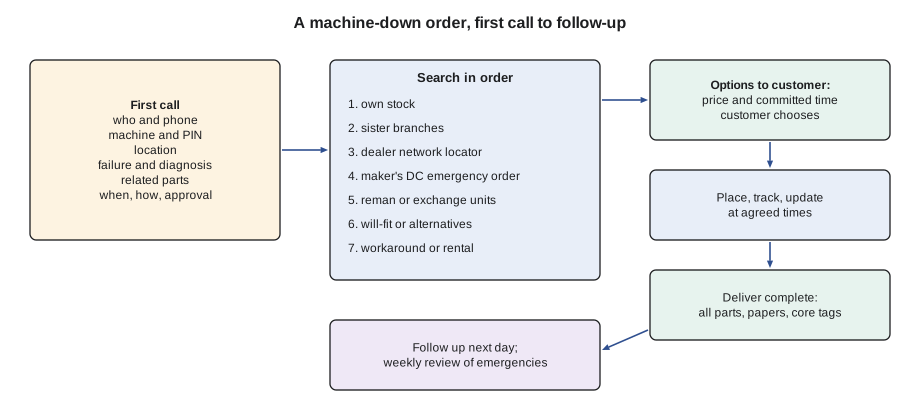
The first few minutes decide how fast the part arrives. Joelle's checklist for the first call:
- Who is calling, and the best number to reach them all day.
- Which machine: model, serial number or PIN, and for trucks the VIN and unit number.
- Where it is: shop, yard, job site or roadside, with directions or a site contact.
- What failed and who diagnosed it. A technician's diagnosis, with photos of the part and its plate, is worth far more than a guess.
- What else the job needs: seals, gaskets, O-rings, filters, fluid, hardware and anything that is replaced "while you're in there". An emergency pump with no seal kit is still an emergency.
- When they need it and how it should arrive: picked up, delivered by the branch, or shipped to the site.
- Approval: who can approve the extra freight or expedite charges, and the purchase order number.
Write it down as the call happens and read the key details back: "PIN ending 4417, main pump, part number from the plate as you read it to me, plus the seal kit, case drain filter, two return filters and 80 litres of oil. You'll approve the freight. I'll call you by eight."
Finding the part
Search in a set order, recording what each source says:
- Own stock, including stock committed to other orders that could be borrowed and replaced.
- Sister branches in the same dealer group, which can often send a part the same day.
- Other dealers' inventory, through the maker's dealer network locator, where dealers can see and buy each other's stock.
- The maker's parts distribution centres, with an emergency order and the fastest shipping method.
- Remanufactured or exchange components from the maker's reman program or an independent rebuilder.
- Alternatives: a will-fit part, a component maker's direct part, or a part from a different but compatible model, confirmed by the technician.
- Workarounds: a temporary repair the technician approves, or a rental machine to keep the job going while the part comes. Pellmore keeps a relationship with a rental yard for exactly this.
A good search finishes with options, not one answer. Each option has a price, including freight, and a realistic arrival time.
Getting it there
Emergency freight choices, roughly from slowest to fastest:
- Standard ground or LTL freight, next day or later. Cheapest, and fine when the customer has a workaround.
- Guaranteed or expedited LTL with a set delivery time.
- Overnight courier for small and medium parts.
- Same-day courier or dedicated vehicle (often called a hotshot): a driver and vehicle carrying only this order, door to door.
- Airline counter-to-counter service for small, light parts between cities with direct flights.
- Customer pickup: sometimes the fastest way is for the customer's own driver to collect from the distribution centre or another dealer.
Hotshot and dedicated deliveries are expensive, and the customer decides whether the saving in downtime is worth it. Joelle put the three options to Dougal like this.
Worked problem
Choosing an emergency option
Dougal's excavator earns about 210 dollars an hour, and his crew can do other work for part of the day. Joelle offers: (A) a new pump from the distribution centre by next-day LTL, 85 dollars freight, arriving Friday afternoon, losing about 14 more working hours; (B) the remanufactured pump by dedicated courier, 640 dollars freight for the 450 km round trip, arriving Thursday night, losing about 6 working hours; (C) a rebuilt pump from an independent shop, 1,900 dollars less than the new pump, but available Monday, losing about 26 working hours. Comparing freight plus lost machine time, which is cheapest overall if the pumps cost the same?
Show solution
- Option A:
- \[85 + 14 \times 210 = 3{,}025 \text{ dollars}\]
- Option B:
- \[640 + 6 \times 210 = 1{,}900 \text{ dollars}\]
- Option C, ignoring its lower price:
- \[26 \times 210 = 5{,}460 \text{ dollars}\]
- Option C with its saving:
- \[5{,}460 - 1{,}900 = 3{,}560 \text{ dollars}\]
Answer: Option B costs about 1,900 dollars in freight and lost machine time, against about 3,025 for A and about 3,560 for C even after its lower price. Dougal chose B. A customer with a rental machine on site, or with no deadline, might choose differently, which is why the counter presents options rather than deciding. The rates and hours are teaching values.
Keeping the customer informed
A machine-down customer is anxious and busy. The counter keeps them informed without making them chase:
- Give times you can keep. Quote the arrival time the carrier commits to, and say plainly what could change it. Never guess to sound helpful.
- Agree on update times, such as when the part ships, when it reaches the branch and when it leaves for the site.
- Track the shipment and call before the customer does if anything slips.
- Hand over the order complete: the main part, every related part, the paperwork, any core return instructions and the warranty information.
- Follow up the next day: is the machine running, was anything missing, and has the core been tagged for return?
Joelle's call log for Pellmore showed seven calls in twenty-six hours, each one short and each one with news.
After hours
Machines break at night and on weekends, especially during harvest and the construction season. Branches handle after-hours emergencies in several ways: extended counter hours in season, an on-call parts person reachable by phone, and arrangements with the maker's distribution centre for emergency orders outside business hours. The on-call person needs secure access to the building and the parts system, a vehicle, and a way to record the sale.
After-hours work brings its own safety rules. The on-call person tells someone where they are going and when they expect to be back; does not enter a job site, farm or quarry without the customer's contact meeting them; follows the site's rules in the dark; and does not drive when too tired to do so safely. A parts runner driving a vehicle that counts as a commercial vehicle follows the hours-of-service rules for commercial drivers as well. No machine is worth a crash on the way to it.
Honesty under pressure
Emergencies tempt shortcuts, and the counter must resist them:
- Do not send a part you are not sure of "to get them going". A wrong part delivered to a site wastes hours and can damage the machine.
- Be truthful about availability. If the part cannot arrive until Monday, say so, and help the customer plan a rental or a workaround.
- Charge fairly. Pass on the real freight and expedite costs that the customer has approved, as the account's terms allow; do not add charges because the customer has no choice.
- Flag warranty. If the machine is under warranty, involve the service department before parts are sold, because a warranty repair follows the maker's process.
Learning from emergencies
Every machine-down order is information. Hamish reviews them each week with the counter:
- Which parts caused emergencies, and should any of them be stocked? A part that caused three emergencies in a season probably belongs on the shelf.
- Which customers had the most emergencies, and would a PM program, a critical spares agreement (Lesson 8) or a consignment stock help them?
- How long did each order take from first call to delivery, and where were the delays?
- Did the branch keep its promised times?
After the Pellmore pump, the branch added the excavator's case drain and return filters to Pellmore's stocking list, and Dougal agreed to a hydraulic oil analysis program on his two excavators, which can show wear metals in the oil before a pump fails.
A truck out of service
On the truck side, a vehicle off road often begins at the roadside. On Monday, October 26, a Ridgeholt tractor was stopped at a roadside inspection with an air leak at a trailer service line and a spring brake chamber whose pushrod stroke was over the limit. The inspector placed the trailer out of service until it was repaired. The driver called Ridgeholt's dispatch, and Ines Kowalczyk called Marek Dunsford at 10:20 a.m.
Marek's call followed the same checklist as Joelle's, adapted to the truck side:
- Unit number, trailer number and VIN, so he could pull the trailer's build record and brake configuration.
- The inspector's findings as written on the inspection report, which told him exactly what had to be fixed before the trailer could move.
- Where the truck was, and who would do the repair: Ridgeholt's own road service truck.
- What else to send: Marek added gladhand seals, a spare service line, hose clamps and air line fittings, because the road technician would not want to make a second trip.
He had the 30/30 long-stroke chamber, a slack adjuster of the right arm length and spline count, and the air line on the shelf. Ridgeholt's road technician collected them at 11:05, and the trailer was repaired and released at the roadside by early afternoon.
Marek's note in the binder made a point about the paperwork: the repaired defects had to be recorded so Ridgeholt could show the inspection was cleared, and the old chamber came back caged, tagged with the unit number, for disposal. A roadside out-of-service order is the truck side's machine-down call, and the same habits apply: identify exactly, send everything the repair needs, give times you can keep, and follow up.
Emergency kits for customers
One way to cut emergencies is to put the most likely emergency parts where the customer can reach them. Hamish's counter builds emergency kits for some accounts: a box of common hydraulic hoses and fittings, belts and a few bearings for a contractor's service truck; air brake fittings, chambers and lamps for a fleet's road service truck; and the combine belts and bearings that Lesson 12 describes for a farm. The kit is invoiced when it is set up or on consignment, and restocked after each use. It turns a midnight call into a part pulled from the customer's own truck.
Common mistakes
MistakeTaking a machine-down call without the PIN and the technician's diagnosis.
InsteadGet the machine's identity, the failed part's identity and the diagnosis before searching.
MistakeOrdering only the main component.
InsteadAsk for every related part: seals, O-rings, filters, fluid and hardware.
MistakeGiving the customer one option with a guessed arrival time.
InsteadOffer options with prices and carrier-committed times, and let the customer choose.
MistakeSending a doubtful part to keep the customer happy.
InsteadConfirm the part; a wrong part costs more hours.
MistakeTreating each emergency as a one-off.
InsteadReview machine-down orders weekly and adjust stock and programs.
Summary and key terms
- Machine-down orders get priority because downtime costs far more than parts; they use special order types and are recorded.
- The first call captures who, which machine, where, what failed, the diagnosis, every related part, timing and approval.
- Searches run from own stock through sister branches, dealer networks, the maker's distribution centre, reman units and alternatives to workarounds.
- Customers choose among options with prices and committed times; the counter tracks, updates and follows up.
- After-hours service needs safe practices, and every emergency is reviewed to improve stock and programs.
- Machine-down order
- An order for a part without which a customer's machine or vehicle cannot work.
- VOR
- Vehicle off road: a truck-side term for a vehicle stopped for lack of a part.
- Hotshot
- A dedicated same-day delivery by a vehicle carrying only one urgent order.
- Dealer network locator
- A maker's system that lets dealers see and buy each other's stock.
- On call
- Available outside business hours to handle emergency orders.
Practice problems
Work each problem on paper first, then reveal the answer to check.
A machine earns 180 dollars an hour. Option X costs 120 in freight and 10 lost hours; option Y costs 700 and 4 lost hours. Which costs less overall?
Show answer
X: 120 + 1,800 = 1,920; Y: 700 + 720 = 1,420. Y costs less.
Name four things to capture on a machine-down call.
Show answer
Caller and number, machine and PIN, location, failed part and diagnosis, related parts, timing, delivery method, approval and PO.
Why offer options rather than choose for the customer?
Show answer
The customer knows their downtime costs, workarounds and deadlines.
What should the on-call parts person do before going to a site at night?
Show answer
Tell someone where and when, arrange to meet the customer's contact, and follow site rules.
A part caused three emergencies in one season. What should the branch consider?
Show answer
Stocking it, or a critical spares agreement with the customer.
Lesson quiz · 5 questions
Score 60% or more to complete this lesson.
Create a free account to save your progress, take quizzes and earn a certificate.