
APP-420 · Lesson 5 of 12 · 35 min
Review: refrigerant handling and the ODP course
▶ Video coming soon A video version of this lesson is on the way.
On Sunday, October 25, the practice exam session (lesson 11) had a second student. Kiran Beaulac, one week into his apprenticeship, sat at the far end of the bench with the refrigerant section of Dee's practice test. His ODP course was booked for Saturday, December 5. "You'll be handling refrigerant before you've done anything else on your own," Dee told him, "so this is the first certificate you'll need. Eamon has had his card since 2022, and it's due for renewal next year, so this is review for both of you."
This lesson reviews the refrigerant handling rules that APP-110, APP-210 and APP-330 applied, in the form the ODP course teaches them. Refrigerant recovery is also task 19 on the Red Seal exam, with 5 of the 120 questions, and the reasons behind the rules appear in sealed-system questions throughout block F.
What the ODP card is
In Ontario, Regulation 463/10 under the Environmental Protection Act controls ozone-depleting substances and other halocarbons, which includes the CFC, HCFC and HFC refrigerants used in older and current appliances. Anyone who services, installs, repairs or disposes of refrigeration and air conditioning equipment containing those refrigerants must hold an ozone depletion prevention (ODP) card. The card is earned by taking a one-day course and passing its test with at least 75 in 100, and it is valid for five years, after which it is renewed. Equipment owned by the federal government and federal works is covered instead by the federal Ozone-depleting Substances and Halocarbon Alternatives Regulations, but the practices are the same.
Two points about the card's scope come up again and again. First, the regulation covers halocarbons, which includes R-12, R-22, R-134a and R-410A and other HFCs, but not hydrocarbon refrigerants such as R-600a and R-290. Hydrocarbon systems are governed instead by product safety standards and the maker's procedures, as APP-210 explained. Second, the card is a personal certificate: an apprentice who has not yet taken the course may not handle regulated refrigerant, even under supervision, so Kiran's December course matters before he can take part in recovery on his own calls.
Ozone, climate and the history of the rules
Both the course and the exam begin with why the rules exist. Chlorofluorocarbons (CFCs) such as R-12, used in household refrigerators until the early 1990s, release chlorine when they reach the stratosphere, and chlorine destroys ozone, which shields the Earth from ultraviolet radiation. Hydrochlorofluorocarbons (HCFCs) such as R-22 do less damage but still some. The Montreal Protocol of 1987, signed by Canada and the United States, phased out CFCs and then HCFCs. Hydrofluorocarbons (HFCs) such as R-134a contain no chlorine and do not deplete ozone, but they are strong greenhouse gases, and the Kigali Amendment of 2016 added a phase-down of HFCs.
The measure of a refrigerant's climate effect is its global warming potential (GWP), the warming it causes compared with the same mass of carbon dioxide over 100 years. APP-110 used the figures for the refrigerants in Penfold's November haul-away units: CFC-12 about 10,900 and R-134a about 1,430. Hydrocarbons such as R-600a have a GWP of only about 3. That is why the newest refrigerators use R-600a, and why APP-210 and APP-330 described limits of 150 GWP for new household refrigerators and 700 for new room air conditioners and dehumidifiers in the United States, with a similar 150 limit for residential refrigeration in Canada.
Worked problem
Comparing the climate effect of two old charges
Penfold's 1992 chest freezer held 250 g of CFC-12 and its 2009 refrigerator held 150 g of R-134a. Using GWP values of 10,900 and 1,430, how many kilograms of carbon dioxide would each charge be equivalent to if released?
Show solution
- CFC-12:
- \[0.250 \times 10{,}900 = 2{,}725 \text{ kg CO}_2\text{e}\]
- R-134a:
- \[0.150 \times 1{,}430 = 214.5 \text{ kg CO}_2\text{e}\]
Answer: About 2.7 tonnes for the old freezer and about 215 kg for the 2009 refrigerator. CFC-12 also destroys ozone, which R-134a does not. Recovering both charges is required and keeps that harm out of the air.
Venting, recovery and recovery equipment
Releasing a regulated refrigerant to the air, except for the tiny amounts that escape when hoses are connected and disconnected with good practice, is prohibited. Before a regulated system is opened for repair or an appliance is disposed of, the refrigerant is recovered into an approved recovery cylinder with recovery equipment. The ODP course covers the three terms the exam uses: recover means to remove the refrigerant and store it in a container; recycle means to clean it for reuse, usually in the same owner's equipment; and reclaim means to process it to the purity of new refrigerant, which is done at a reclamation facility.
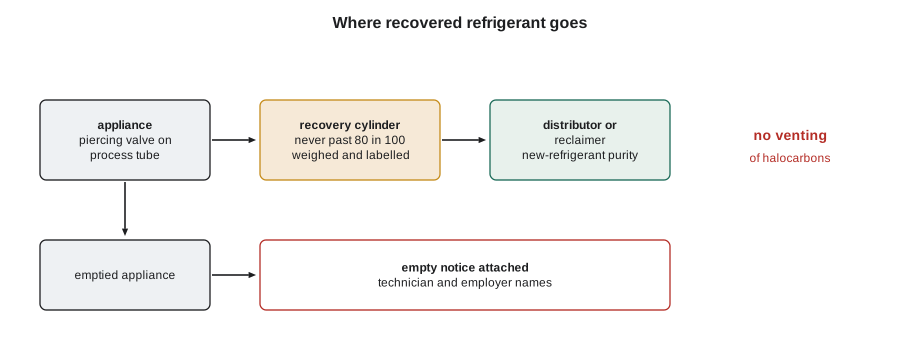
For household refrigerators, the usual recovery method is to fit a piercing valve to the process tube and draw the refrigerant out with a recovery machine into a recovery cylinder. Recovery cylinders are designed and labelled for the purpose, and are never filled beyond 80 in 100 of their capacity, so that the liquid has room to expand if the cylinder warms. The amount recovered is weighed and recorded, and the cylinder is labelled with the refrigerant type.
Worked problem
Checking a recovery
Kiran's first lead call in APP-110 involved a refrigerator with a 142 g R-134a charge, and on the November 9 haul-away day Penfold recovered 141 g from a 2009 refrigerator rated 150 g. What share of each nameplate charge was recovered?
Show solution
- For the 142 g charge, 131 g recovered:
- \[131 \div 142 \approx 0.92\]
- For the 150 g charge, 141 g recovered:
- \[141 \div 150 = 0.94\]
- Both are well above 90 in 100 of the charge. A small shortfall from the nameplate figure is normal, because some refrigerant is dissolved in the oil.
Answer: About 92 and 94 in 100. Recording the weight recovered, compared with the nameplate, is good practice and shows that the recovery was done properly.
Worked problem
Filling a recovery cylinder
A recovery cylinder is rated to hold 30 lb (13.6 kg) of refrigerant when full. What is the most it should hold under the usual 80 in 100 fill limit?
Show solution
- In pounds:
- \[0.80 \times 30 = 24 \text{ lb}\]
- In kilograms:
- \[0.80 \times 13.6 \approx 10.9 \text{ kg}\]
Answer: About 24 lb (10.9 kg). The cylinder is weighed during recovery, and a scale or the machine's float switch stops filling before that point. A household refrigerator charge is a few ounces, so a cylinder lasts many recoveries; it is the running total that has to be watched.
Leak testing, records and disposal
The ODP course also covers leak testing and records. A leak is found and repaired before a system is recharged; refrigerant is never added to a leaking system "to top it up". Leak tests use an electronic detector, soap solution or a standing pressure test with dry nitrogen through a regulator; oxygen and compressed air are never used to pressurize a system, because oil and oxygen under pressure can explode. Service records give the refrigerant type and the amounts recovered and added. When an appliance is emptied for disposal, an empty notice is attached, with the technician's and employer's names, which is what Penfold's recycler, Quarrington Metal Recovery, asks for before it will take a refrigerated appliance.
The course and the test
The ODP course is one day long, usually run by a training organization approved by the industry association, and ends with a written test. Dee's advice to Kiran was the same she gives for every exam: read each question twice, watch for the words "not" and "except", and think about the purpose behind each rule. Most questions about recovery, cylinders and leak testing can be answered by asking what would protect the technician, the customer and the atmosphere.
Worked problem
Kiran's practice score
On October 25, Kiran answered 16 of Dee's 20 ODP-style practice questions correctly. The course test requires 75 in 100. Did he clear that mark, and by how many questions?
Show solution
- Score:
- \[16 \div 20 = 0.80\]
- Needed:
- \[0.75 \times 20 = 15\]
- He cleared the mark by one question.
Answer: 80 in 100, one question above the 75 mark. Dee called that "a pass with no margin" and gave him the recovery and cylinder chapters to reread before December.
Practice questions in the course's style
Dee wrote twenty practice questions for Kiran in the style of the ODP test. Six of them are here, with their answers, because the reasoning behind each is the part worth remembering.
Practice problems
Work each problem on paper first, then reveal the answer to check.
ODP practice: A technician has recovered the refrigerant from a refrigerator going for disposal. What must be attached to the appliance?
Show answer
An empty notice with the technician's and employer's names, so the recycler knows the refrigerant has been removed.
Practice: Why does a recovery machine need its own oil and filter-drier maintenance?
Show answer
It handles used refrigerant with moisture, acid and debris; a neglected machine contaminates the refrigerant and fails.
ODP practice: Which agreement phases down HFCs?
Show answer
The Kigali Amendment to the Montreal Protocol (2016).
ODP practice: A technician finds a leak in a refrigerator's evaporator. May they add refrigerant to keep it running until a part arrives?
Show answer
No. The leak must be repaired before the system is recharged.
Practice: Which kind of recovery uses the appliance's own compressor?
Show answer
System-dependent (passive) recovery.
Practice: Why should a piercing valve not be left on a refrigerator after service?
Show answer
It can leak over time; the process tube should be sealed by pinching or brazing as the procedure requires.
Safety in recovery
Both the course and the exam include safety around refrigerants and cylinders. Refrigerant cylinders are kept upright and secured, away from heat; they are never heated with a flame, and a cylinder that has been overfilled is dangerous because a small temperature rise can rupture it. Liquid refrigerant on skin or in the eyes causes frostbite, so gloves and safety glasses are worn. Refrigerant vapour is heavier than air and displaces oxygen in a basement or crawl space, which is why recovery is done with good ventilation. Heating refrigerant such as R-134a in a flame can produce toxic decomposition products. And recovery from a hydrocarbon system follows the maker's flammable-refrigerant procedure, with no ignition sources.
Worked problem
Recovery from a small charge
APP-210's chest freezer held 85 g of R-134a and its compressor still ran. How much refrigerant is 90 in 100 of that charge, and 80 in 100?
Show solution
- 90 in 100:
- \[0.90 \times 85 = 76.5 \text{ g}\]
- 80 in 100:
- \[0.80 \times 85 = 68 \text{ g}\]
Answer: About 76.5 g and 68 g. The Ontario course stresses recovering all that can practically be removed and recording the amount; the US 90 and 80 in 100 figures are a useful way to judge whether a recovery was complete.
Dee's last advice to Kiran was about the reasons behind the rules. "You'll forget a number," she said, "but if you remember why the rule exists, you can usually work the number out. Eighty in a hundred is about expansion. No oxygen is about explosions. Empty notices are about the next person who handles that appliance. Think about who the rule protects."
For Eamon, the review was also a reminder that his own card has a date on it. An ODP card issued in 2022 and valid for five years needs renewing in 2027, and Penfold's office keeps a list of every technician's certificates and their renewal dates, so that nobody turns up at a supplier's counter with an expired card. Fenna checks the list each January and books renewals before they fall due.
Common mistakes
MistakeThinking the ODP card covers hydrocarbon refrigerants.
InsteadThe regulation covers halocarbons; hydrocarbons follow product safety standards and the maker's procedures.
MistakeFilling a recovery cylinder to its rated capacity.
InsteadStop at 80 in 100 of capacity, by weight.
MistakePressurizing a system with oxygen or compressed air for a leak test.
InsteadUse dry nitrogen through a regulator.
MistakeAdding refrigerant to a leaking system to keep it going.
InsteadFind and repair the leak first.
MistakeLetting an apprentice without a card handle regulated refrigerant.
InsteadEach person who handles regulated refrigerant needs their own ODP card.
Summary and key terms
- Ontario Regulation 463/10 requires an ODP card to service or dispose of equipment containing halocarbon refrigerants.
- The ODP card is earned in a one-day course with 75 in 100 to pass, and is valid for five years.
- CFCs and HCFCs deplete ozone; HFCs do not but have high GWP; hydrocarbons such as R-600a have a GWP of about 3.
- The Montreal Protocol phased out CFCs and HCFCs; the Kigali Amendment phases down HFCs.
- Recover, recycle and reclaim have different meanings; reclaim means new-refrigerant purity.
- Recovery cylinders are never filled past 80 in 100; amounts recovered are weighed and recorded.
- Leak tests use nitrogen, never oxygen or compressed air; leaks are repaired before recharging.
- Emptied appliances carry an empty notice with the technician's and employer's names.
- ODP card
- Ontario's ozone depletion prevention certificate for handling halocarbon refrigerants.
- Small appliance
- A factory-sealed appliance with 5 lb or less of refrigerant (US EPA definition).
- Recover
- To remove refrigerant from a system and store it in an external container.
- Reclaim
- To reprocess used refrigerant to the purity of new refrigerant.
- GWP
- Global warming potential: warming effect compared with the same mass of carbon dioxide over 100 years.
- Piercing valve
- A clamp-on valve that pierces a process tube to give access to a system without service valves.
Practice problems
Work each problem on paper first, then reveal the answer to check.
Practice: Does the ODP card cover R-600a?
Show answer
No. Regulation 463/10 covers halocarbons; R-600a is a hydrocarbon.
Practice: What is the difference between recycling and reclaiming refrigerant?
Show answer
Recycling cleans it for reuse; reclaiming reprocesses it to the purity of new refrigerant at a certified facility.
Practice: Why is a recovery cylinder never filled past 80 in 100 of its capacity?
Show answer
So that the liquid has room to expand if the cylinder warms, preventing a dangerous pressure rise.
Practice: What must be attached to an emptied appliance going for recycling?
Show answer
An empty notice with the technician's and employer's names.
Practice: Which gas is used to pressurize a system for a leak test?
Show answer
Dry nitrogen, through a regulator.
Practice: CFC-12 has a GWP of about 10,900 and R-134a about 1,430. How many times stronger is CFC-12?
Show answer
10,900 ÷ 1,430 ≈ 7.6 times.
Lesson quiz · 5 questions
Score 60% or more to complete this lesson.
Create a free account to save your progress, take quizzes and earn a certificate.