
APP-420 · Lesson 6 of 12 · 30 min
Review: laundry appliances
▶ Video coming soon A video version of this lesson is on the way.
On Sunday, October 18, the day after the practical mock in lesson 12, Dee spent the morning on laundry with Eamon. She had laid out three parts from Harriet's laundry nights on the bench: a front-load tub bearing with rust trails down the outer tub, a pair of worn universal motor brushes and a dryer vent cap with a screen packed with lint. "Laundry questions are mostly mechanical and water questions dressed up as appliance questions," she said. "Drives, bearings, suspension, pumps, pressure sensing, airflow. And one fire question, every time."
This lesson reviews APP-220 (laundry appliances: washers and dryers) and the laundry parts of APP-110, APP-120 and APP-320. On the Red Seal exam, washers and dryers supply many of the questions in block C (mechanical systems: drive and suspension, 22 questions), block D (water systems, 14 questions) and block E (air systems, 11 questions), as well as electrical questions in block B.
How washers clean, and the parts that do it
APP-220 began with the four things that clean clothes: time, temperature, chemistry and mechanical action. Reduce one, and the others have to make up for it. High-efficiency (HE) washers use far less water than older machines, so they rely more on chemistry and on mechanical action from tumbling or an impeller, and they need low-sudsing HE detergent. Too much detergent in an HE washer causes oversudsing, long cycles, poor rinsing and, in front-loaders, odours and residue in the door boot.
The parts behind that cleaning come up on the exam by system:
- Drive systems. Top-load washers use an agitator or an impeller, driven by a belt and transmission, a direct-drive gearcase, or a direct-drive brushless motor with a shift actuator that changes between agitate and spin. Front-load washers drive the inner drum through a belt from the motor or, increasingly, a direct-drive motor on the drum shaft.
- Suspension. Top-loaders hang the tub on springs or rods with dampers. Front-loaders hang it on springs and support it on shock absorbers or friction dampers. Worn suspension parts let the tub hit the cabinet in spin.
- Bearings and seals. A front-loader's drum turns on two bearings in a hub at the back of the outer tub, protected by a seal. When the seal fails, water reaches the bearings, they rust and roar in spin, and the usual repair is a whole tub assembly, which is why APP-220's Rolfe washer was replaced rather than repaired.
- Lid locks and door locks. HE top-loaders and all front-loaders lock the lid or door during the cycle. A lock that does not confirm locked will stop the washer before it fills or spins. APP-220's Vesey call found a lid lock solenoid open against a 70 to 100 Ω specification.
Worked problem
A repair-or-replace decision on bearings
APP-220's 2016 front-loader needed a tub assembly costing 430 dollars, about 3.5 hours of labour at 110 dollars an hour, and the 95-dollar service call. A comparable new washer cost about 1,100 dollars installed. What was the repair total, and what fraction of a new washer was it?
Show solution
- Repair total:
- \[430 + 3.5 \times 110 + 95 = 430 + 385 + 95 = 910 \text{ dollars}\]
- As a fraction of a new washer:
- \[910 \div 1{,}100 \approx 0.83\]
Answer: 910 dollars, about 83 in 100 of a new washer, for a machine that was already ten years old. Penfold's half-price rule (APP-410) pointed to replacement, and the customer agreed. All prices here are Penfold's sample figures.
Water in, water out
Washers fill through inlet valves controlled by the board, with a pressure sensor or pressure switch measuring the water level through a hose and air trap at the bottom of the tub. Many newer washers also use a flow meter to count the water in. APP-220 and APP-320 taught the sample pressure sensor frequency of 25.6 kHz empty and lower as the tub fills, and APP-220's Oyarzun case found sludge in the air trap that gave a false level and a long-drain code.
Water leaves through a drain pump, usually a small synchronous or brushless pump with a coin trap or filter on front-loaders. APP-220 gave a typical drain pump resistance of about 10 to 20 Ω, and Coutinho's front-loader had a two-dollar coin and three hair elastics in its filter. The most common drain faults are a clogged filter, a kinked hose and a blocked standpipe.
Drain hose installation is examined often. The hose must rise high enough to hold water in the tub and must not be pushed far down a standpipe or sealed into it, or the washer can siphon, emptying while it fills.
Worked problem
A siphoning top-loader
APP-220's Ashdown top-loader had its drain hose taped about 600 mm down into the standpipe. In one fill, 32 L went in but only 14 L stayed in the tub. How much was lost, and what share of the fill was that?
Show solution
- Water lost:
- \[32 - 14 = 18 \text{ L}\]
- Share lost:
- \[18 \div 32 \approx 0.56\]
Answer: About 18 L, more than half of each fill, was siphoning away down the drain. Dee reset the hose to the maker's depth of about 110 mm with an air gap at the top and left the slow house drain to a plumber.
Motors and their faults
APP-120 and APP-220 described three washer motor types. Universal motors with brushes appear in older and some budget washers; brushes wear down and are replaced at the maker's limit (APP-220's Penhaligon washer had brushes at 7 and 8 mm against 18 mm new and a 10 mm limit). PSC and split-phase induction motors drive belt-drive top-loaders and dryers. Brushless DC direct-drive motors, with a stator on the tub and a rotor on the shaft, are now the most common in front-loaders and many top-loaders; APP-320 reviewed their stator checks (three equal windings, such as 7.4 Ω each in Delahunt's washer) and Hall sensors.
Spin speed is where a washer's mechanical stresses are greatest. A drum spinning at 1,200 revolutions a minute with a radius of 0.25 m puts the clothes under about 400 times the force of gravity, which is why an unbalanced load is so destructive and why washers detect unbalance and redistribute the load or slow the spin. The exam may ask what a washer does when it senses unbalance (stops, adds water or tumbles to redistribute, then tries again) and what causes repeated unbalance (a single heavy item, worn suspension, a washer not level, or a loose counterweight).
Worked problem
The force in a fast spin
A front-load drum spins at 1,200 r/min. Its radius is about 0.25 m. About how many times the force of gravity act on the clothes at the drum wall?
Show solution
- Angular speed:
- \[\omega = \frac{2\pi \times 1{,}200}{60} \approx 125.7 \text{ rad/s}\]
- Acceleration at the wall:
- \[a = \omega^2 r \approx 125.7^2 \times 0.25 \approx 3{,}948 \text{ m/s}^2\]
- Compared with gravity:
- \[3{,}948 \div 9.81 \approx 402\]
Answer: About 400 times gravity. A small unbalance at that speed becomes a very large force on the bearings and suspension.
Dryers: heat, airflow and venting
An electric dryer heats air with an element of about 5,400 W at 240 V, which APP-120 calculated at about 10.7 Ω and 22.5 A. The element is protected in series by a high-limit thermostat and a thermal fuse, and the temperature is controlled by a cycling thermostat or a thermistor and board. Gas dryers heat the air with a burner lit by a hot-surface igniter, proved by a flame sensor or radiant sensor, through a gas valve with primary and secondary coils, which at Penfold is Hiro's work (APP-220's Dobrescu dryer had an open secondary coil). Moisture sensor bars in the drum tell the board when the clothes are dry; fabric softener residue on the bars makes the dryer stop early or run long, as in APP-220's Ferrier case.
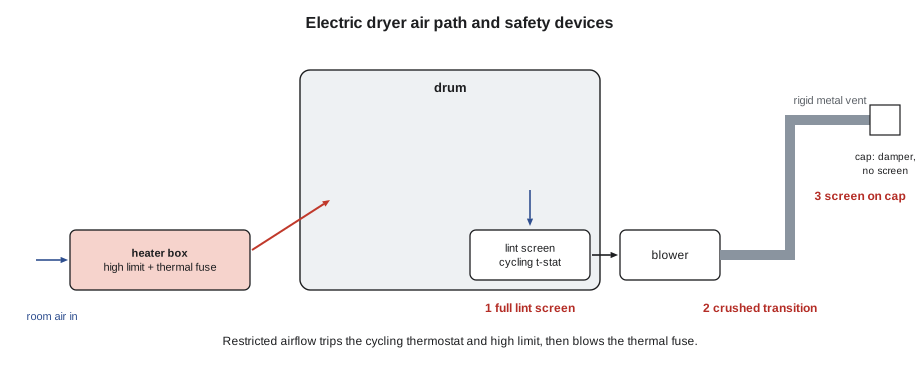
Most dryer faults trace back to airflow. A dryer moves a large volume of air through the drum and out through the vent, and anything that restricts that flow raises the temperature in the heater box, makes the cycling thermostat and high limit trip, lengthens drying times, and in the end blows the thermal fuse. The thermal fuse is a one-time safety device: replacing it without fixing the vent is the most common mistake in dryer repair.
APP-110 and APP-220 taught the venting rules: rigid or semi-rigid metal duct, typically 100 mm diameter, as short and straight as possible, with joints taped not screwed (screws catch lint), a short listed metal transition behind the dryer, and an exterior cap with a damper but no screen. The maker's instructions set the maximum length, reduced for each elbow. Where the maker gives a straight-run maximum, a common rule of thumb, close to the US code's allowances, subtracts about 1.5 m for each 90° elbow and about 0.8 m for each 45°.
Worked problem
Checking a vent run
A dryer's instructions allow 10.7 m of straight rigid duct. The run has two 90° elbows and one 45° elbow. Using allowances of 1.5 m per 90° and 0.8 m per 45°, how long may the straight duct be?
Show solution
- Allowance for fittings:
- \[2 \times 1.5 + 0.8 = 3.8 \text{ m}\]
- Straight duct allowed:
- \[10.7 - 3.8 = 6.9 \text{ m}\]
Answer: About 6.9 m of straight duct. These allowances are a common rule of thumb; the maker's table governs.
Dryer fire is the one laundry topic almost certain to appear. APP-220 cited US fire data: in 2006 to 2010, dryers and washers were involved in about 16,950 home fires a year, dryers in about 92 in 100 of them, and the leading factor was failure to clean, in about 32 in 100. The measurable fix in APP-220's Quennell case was dramatic: removing a screen from the vent cap and replacing a crushed transition raised the air speed at the cap from 3.4 m/s to 9.8 m/s, almost three times the flow.
Installation and the shipping bolt
Laundry installation questions cover levelling (all four feet firm, the machine level side to side and front to back), water connections with new hoses (braided hoses for durability), drain hose height, electrical supply (a grounded 120 V receptacle for washers and gas dryers; a 240 V four-wire connection for electric dryers, as lesson 3 reviewed), venting, and shipping bolts. Front-loaders arrive with bolts that lock the tub to the cabinet for transport. APP-220's Kettridge stacked pair had three of its four bolts still in, and the washer walked across the floor in spin. The exam may describe exactly that symptom on a new installation.
Washer controls and diagnostic codes
Modern washers have boards that run the cycle, read the pressure sensor or flow meter, drive the motor through a motor control board, lock the door and show fault codes. APP-220 used the sample Northwind codes: F10 for a slow fill, F21 for a long drain, F33 for a heating fault, F45 for a lock fault, F51 for a motor fault, F60 for a communication fault between boards, and SUD for oversudsing. Every code has several possible causes, and the exam is likely to test that idea rather than any brand's code list. A long-drain code can come from a clogged pump filter, a kinked hose, a failed pump, a wrong level reading from a sludged air trap, or even a board output fault.
Worked problem
From a code to the cause
A front-loader shows the sample code F21 (long drain). The pump filter is clean, the hose is straight and the pump runs. The pressure sensor reads a lower frequency than its empty value even when the tub is empty. What is the most likely cause?
Show solution
- The pump is moving water, so the drain path is working.
- The sensor reports water that is not there, so the board keeps draining and times out.
- The usual cause is sludge or water in the pressure hose or air trap, or a failed sensor.
Answer: A blocked pressure hose or air trap, as in APP-220's Oyarzun case. Cleaning the hose and trap restored the empty reading, and the code did not return.
Dryers have their own diagnostic tests: a thermistor-controlled dryer's board can show the exhaust temperature, and many dryers have an airflow or vent-blocked indicator that counts how long the drum takes to heat. These help prove the vent is the problem before the customer is asked to pay for a vent cleaning.
Common mistakes
MistakeReplacing a dryer thermal fuse without checking the vent.
InsteadFind and fix the airflow restriction, then replace the fuse.
MistakePushing a washer drain hose far down a standpipe and sealing it.
InsteadSet the maker's depth and leave an air gap to prevent siphoning.
MistakeUsing foil or plastic vent duct.
InsteadUse rigid or semi-rigid metal duct with a short listed transition.
MistakePutting a screen on a dryer vent cap.
InsteadUse a damper only; screens trap lint and block airflow.
MistakeBlaming the board for a washer that walks on a new installation.
InsteadCheck the shipping bolts and levelling first.
Summary and key terms
- Cleaning depends on time, temperature, chemistry and mechanical action; HE washers need HE detergent.
- Front-load bearing failure usually follows a seal failure and often means a tub assembly or replacement.
- Water level is sensed by a pressure sensor through an air trap; sludge there gives false levels.
- Drain pumps are typically 10 to 20 Ω; clogged filters, kinked hoses and siphoning hoses cause most drain faults.
- Universal motor brushes are replaced at the maker's limit; brushless direct-drive stators have three equal windings.
- Spin puts clothes under hundreds of times gravity; unbalance detection protects the machine.
- Dryer elements are protected by a high limit and thermal fuse; most heating faults are airflow faults.
- Vents are rigid metal, short, taped, with a damper cap and no screen; length is reduced for each elbow.
- Shipping bolts left in a front-loader make it walk and shake in spin.
- HE detergent
- Low-sudsing detergent made for high-efficiency washers.
- Air trap
- The chamber at the bottom of the tub where the pressure sensor hose connects.
- Siphoning
- Water draining from a washer while it fills, because the drain hose is too low or sealed.
- Thermal fuse
- A one-time safety device that opens permanently at its rated temperature.
- Cycling thermostat
- A thermostat that switches a dryer heater on and off to control the air temperature.
- Shipping bolts
- Bolts that lock a front-loader's tub to the cabinet for transport and must be removed at installation.
Practice problems
Work each problem on paper first, then reveal the answer to check.
Practice: A front-loader roars in spin and has rust stains down the back of the outer tub. What has failed?
Show answer
The tub seal and bearings.
Practice: An HE top-loader will not start a cycle and shows a lid lock fault. Its lock solenoid reads OL. What is the repair?
Show answer
Replace the lid lock assembly.
Practice: A washer fills and drains at the same time. What should be checked first?
Show answer
The drain hose height and how far it is pushed into the standpipe: the washer is siphoning.
Practice: A 5,400 W, 240 V dryer element is about what resistance?
Show answer
240² ÷ 5,400 ≈ 10.7 Ω.
Practice: A dryer has blown three thermal fuses in a year. What is the likely cause?
Show answer
Restricted airflow in the vent, lint screen housing or blower.
Practice: With allowances of 1.5 m per 90° elbow, how much is lost to three 90° elbows?
Show answer
4.5 m.
Lesson quiz · 5 questions
Score 60% or more to complete this lesson.
Create a free account to save your progress, take quizzes and earn a certificate.