
APP-420 · Lesson 2 of 12 · 27 min
Review: safety and tools
▶ Video coming soon A video version of this lesson is on the way.
On Sunday, September 20, 2026, Dee began the reviews with the material Eamon thought he knew best. "Safety and tools are where experienced people lose easy marks," she said. "Not because they work unsafely, but because the exam asks for the textbook order of steps, and habit skips a step without noticing." She put a scrapped washer on the bench, handed Eamon a meter and asked him to talk her through making the machine safe to work on, step by step, as if he were writing the answer on an exam. He forgot to test the meter on a known live source before declaring the machine dead. "That's the question," Dee said. "Every exam asks it somewhere."
This lesson reviews APP-110 (fundamentals and safety), the safety parts of every later course, and the tools and meters used throughout. On the Red Seal exam this is mostly block A, occupational skills, which has only 8 questions; but safety steps also appear inside questions in every other block, especially electrical (B) and sealed systems (F).
Electrical safety: the order of steps
Most appliance work is on equipment connected to 120 V or 240 V, and a shock from either can kill. APP-110 taught a fixed sequence for making an appliance safe, and the exam expects it in order:
- Unplug the appliance or switch off and lock out its circuit. For a hard-wired appliance such as a built-in dishwasher or cooktop, switch off the breaker, lock or tag it according to the company's procedure, and tell anyone else in the house not to switch it on.
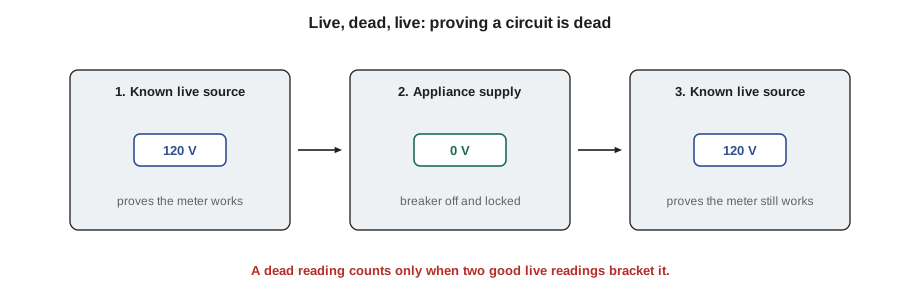
- Test the meter on a known live source (live), such as a receptacle, to prove the meter and leads work.
- Test the appliance's supply for voltage at the point where you will work (dead): line to neutral, line to ground and, on a 240 V appliance, line to line.
- Test the meter on the known live source again (live) to prove it did not fail during the test.
- Discharge any capacitors with an insulated discharge tool and resistor, then measure to confirm.
This live-dead-live test is one of the most commonly examined procedures in the trade. A meter that has failed open reads zero volts on a live circuit, so a dead reading on its own proves nothing. The second live test is what makes the dead reading trustworthy.
Some work has to be done with power on: measuring voltage at an inlet valve, checking a board's supply, measuring current with a clamp meter, or running a water test on a microwave. Live work needs the right meter and leads, insulated tools, one hand kept away from grounded metal where possible, and dry hands and floors. It never includes working inside a microwave oven's high-voltage section with power on. APP-330 taught that the high-voltage capacitor in a microwave can hold a lethal charge after the oven is unplugged, and that the high-voltage circuit is never measured with an ordinary meter.
Meters and their ratings
A digital multimeter measures volts, ohms and continuity, and often microfarads. A clamp meter measures current by closing its jaws around one conductor, without breaking the circuit. APP-110 and APP-120 covered both. The facts most likely to be examined are these:
- Measurement category (CAT) ratings describe the transient voltage a meter can withstand. Appliance work at receptacles and appliance terminals needs at least CAT II, and a meter rated CAT III or higher at the working voltage is the safer choice for service panels and fixed wiring. Leads must carry the same or a higher rating than the meter.
- Resistance and continuity are measured with power off and with the component isolated from the circuit, so that other parallel paths do not change the reading.
- Current is measured in series or, with a clamp meter, around one conductor. Clamping around a whole cord, with line and neutral inside the jaws, reads close to zero because the two currents cancel.
- A capacitor test is done on a discharged, disconnected capacitor. A run capacitor more than about 5 to 6 in 100 outside its rating is replaced, as APP-120 taught.
- Ghost voltages are small readings induced on disconnected wires by nearby live conductors. A high-impedance digital meter can show them; a low-impedance setting or load on the circuit makes them disappear.
Worked problem
Clamp meter readings
Eamon clamped a meter around a dryer's whole power cord and read 0.1 A while the dryer was heating. He then clamped one supply conductor and read 27 A. Why are the readings different, and is 27 A reasonable for a 5,400 W, 240 V element plus a motor drawing about 4.5 A?
Show solution
- Around the whole cord, the currents going out and coming back cancel inside the jaws, so the reading is almost zero.
- Element current:
- \[I = \frac{P}{V} = \frac{5{,}400}{240} = 22.5 \text{ A}\]
- Element plus motor (the motor is on one leg and neutral):
- \[22.5 + 4.5 = 27.0 \text{ A}\]
Answer: The whole-cord reading is meaningless; the single-conductor reading of 27 A matches the expected load on the leg that feeds both the element and the motor.
Lifting, moving and installing
Moving appliances causes more injuries in the trade than electricity does. APP-110 used a planning benchmark of about 23 kg for a single person's lift under good conditions, and stressed planning the route, using an appliance dolly with straps, protecting floors and working in pairs for heavy units. The exam is likely to ask about safe lifting posture (load close, back straight, lift with the legs, no twisting) and about the hazards of tipping.
Range anti-tip brackets have been required by product safety standards since 1991, and APP-110 taught that the bracket must be installed and engaged on every free-standing range, and checked whenever a range is moved. A child standing on an open oven door can tip an unanchored range onto themselves with hot food on top. Installation questions also cover clearances from the maker's instructions, level and secure mounting, correct water and drain connections (lesson 8), dryer venting (lesson 6) and the requirement to leave the appliance working and the installation instructions with the customer.
Gas, refrigerant and chemical hazards
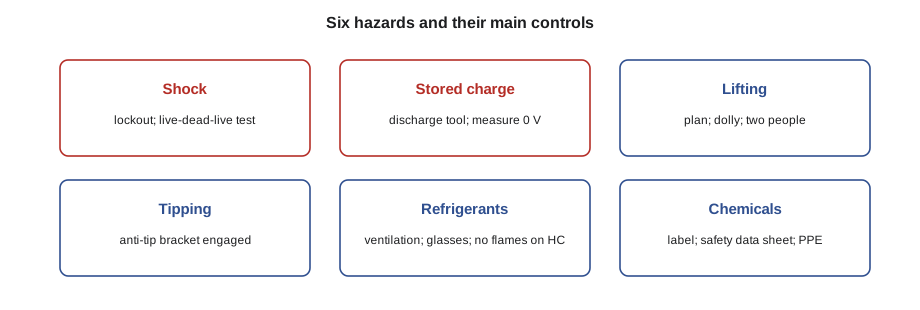
Three other hazards appear in safety questions across the trade:
- Gas. A customer who smells gas is told to leave the home and call Enbridge Gas or emergency services from outside. Technicians do not operate switches or create sparks in a home that smells of gas. At Penfold, all gas work, from connections to conversions, is done by Hiro under his TSSA certificate.
- Refrigerants. Liquid refrigerant can cause frostbite, and refrigerant vapour displaces oxygen in a small space. Hydrocarbon refrigerants such as R-600a and R-290 are flammable: no flames or brazing on the lines, good ventilation, and a leak detector rated for hydrocarbons, as APP-210 and APP-330 taught. Safety glasses and gloves are worn whenever a sealed system is opened.
- Chemicals. Coil cleaners, descalers, ice machine sanitizers and solvents carry WHMIS labels and safety data sheets. Read the label, wear the gloves and eye protection it calls for, and never mix cleaners.
Other everyday hazards include sharp sheet metal edges inside cabinets (cut-resistant gloves), hot surfaces in ovens and dryers (let them cool or wear heat gloves), springs in doors and lids (control them before releasing), and slippery floors from water spills (towels down before a water test).
Tools and their right use
Block A and Basic Skills questions also ask about tools: which tool for which job, and how to keep it safe and accurate. The tools that come up most often are:
- Nut drivers and Torx and security bits for appliance panels; a magnetic tray and photographs to keep track of screws.
- Insulated tools rated for live work, inspected for cracked insulation before use.
- Capacitor discharge tool with a resistor and insulated handle, rather than a screwdriver across the terminals.
- Pinch-off tool, piercing valve, recovery machine, gauges and scale for sealed systems (lessons 4 and 5).
- Thermometer and probe, used for refrigerator, oven and water temperatures; calibrated against a reference such as ice water.
- Manometer for gas pressures, which at Penfold is Hiro's tool.
- Leak detectors: soap solution for gas, and electronic detectors matched to the refrigerant type.
Calibration is part of tool care. Thermometers are checked in ice water, which should read 0 °C (32 °F), and Penfold checks its microwave leakage survey meters with a yearly calibration, as APP-330 described. A meter whose leads are cracked or whose fuse has been replaced with the wrong rating is unsafe and is taken out of use.
A worked safety scenario
Exam questions on safety are rarely a list of rules. More often they describe a call and ask which step is missing or which comes next. Dee wrote one out for Eamon from APP-110's washer that gave a customer a tingle, and asked him to put the steps in order before reading her version.
Worked problem
Making a washer safe after a shock complaint
A customer says she felt a tingle touching her washer's lid. The washer is plugged into a two-prong receptacle with an adapter. What should the technician do, in order?
Show solution
- Do not touch the cabinet and a grounded surface at the same time. Unplug the washer by its plug, not by pulling the cord.
- Explain to the customer, calmly, that the washer must not be used until it is checked, and why.
- Check the receptacle with a tester or meter: a two-prong receptacle has no equipment ground, so the washer's frame is not grounded.
- With the washer unplugged, measure from the cabinet to each pin of the plug. A low reading from the cabinet to a supply pin means an internal fault to the frame; APP-110's washer had a failed drain pump with leakage to its housing.
- Repair the appliance fault, and tell the customer in writing that the receptacle needs a licensed electrician to provide a grounded (and, where required, GFCI-protected) outlet before the washer is used again.
Answer: The technician makes the situation safe, finds the appliance fault, repairs it and refers the house wiring to an electrician. On an exam, the most likely wrong answers are to replace the receptacle yourself or to fit a cheater adapter.
Notes from that scenario turn into several exam questions: why a two-prong receptacle is a hazard with a metal appliance, why the cabinet-to-pin reading is taken unplugged, why receptacle work is referred, and what the customer must be told. A good habit for studying is to take any real call from your own work and ask what three exam questions could be written about it.
Personal protective equipment
Block A and Basic Skills questions also ask which protective equipment a task needs. Safety glasses for any work where something can fly or splash, including cutting, drilling, brazing and opening a sealed system. Gloves suited to the hazard: cut-resistant for sheet metal, insulated for refrigerant, chemical-resistant for cleaners and descalers. Safety boots for moving appliances. Hearing protection for long use of loud tools. A respirator or good ventilation for some chemical cleaners and for hydrocarbon work in small rooms. Disposable shoe covers protect the customer's floors, not the technician, but they appear in installation questions too.
The habit the exam rewards is choosing protection for the task, not by routine. A technician who wears gloves for everything may not notice that insulated gloves are needed to handle refrigerant lines, or that a chemical's safety data sheet calls for eye protection rated for splashes, not just impact.
Worked problem
A lifting plan
A 90 kg (about 200 lb) refrigerator must come out of a kitchen and down four steps to a van. Using the planning benchmark of about 23 kg per person under good conditions, why is a dolly with straps and two people the minimum?
Show solution
- The refrigerator is far above one person's benchmark:
- \[90 \div 23 \approx 3.9\]
- Steps make conditions worse than ideal, so a lift by hand would need more than four people.
- A dolly with straps carries the weight; the two people control it, one at the handle and one below on the steps.
Answer: A strapped dolly with two people, doors removed or taped, and the route cleared and measured first. The exam is likely to ask about the route and the second person, not just the dolly.
Common mistakes
MistakeTaking a single zero-volt reading as proof that a circuit is dead.
InsteadTest the meter on a known live source before and after the dead test.
MistakeDischarging a capacitor with a screwdriver.
InsteadUse an insulated discharge tool with a resistor, then measure to confirm.
MistakeClamping a meter around a whole power cord.
InsteadClamp one conductor; line and neutral currents cancel inside the jaws.
MistakeMeasuring resistance with the component still in circuit and powered.
InsteadPower off, isolate the component, then measure.
MistakeMoving a range without checking the anti-tip bracket afterwards.
InsteadRe-engage and check the bracket every time a range is moved.
Summary and key terms
- Make an appliance safe in order: unplug or lock out, test live, test dead, test live, discharge capacitors.
- A dead reading counts only if the meter has been proved on a live source before and after.
- Use meters with a suitable CAT rating; measure resistance with power off and current around one conductor.
- Run capacitors more than about 5 to 6 in 100 outside their rating are replaced.
- Plan every lift, use a dolly and a second person for heavy units, and always engage the range anti-tip bracket.
- Gas smells mean leaving the home and calling the utility; gas work at Penfold is Hiro's.
- Hydrocarbon refrigerants are flammable; liquid refrigerant causes frostbite; chemicals are handled by their labels and safety data sheets.
- Tools are inspected and calibrated, and damaged meters or leads are taken out of use.
- Lockout
- Switching off and securing an appliance's power source so it cannot be switched on during work.
- Live-dead-live test
- Testing a meter on a known live source, then the circuit, then the known live source again.
- CAT rating
- A meter's measurement category, describing the transient voltages it can safely withstand.
- Ghost voltage
- A small induced voltage on a disconnected wire that disappears under load or with a low-impedance meter setting.
- Anti-tip bracket
- A bracket that anchors a free-standing range to the floor or wall so it cannot tip forward.
- Discharge tool
- An insulated tool with a resistor, used to bleed the charge from a capacitor safely.
Practice problems
Work each problem on paper first, then reveal the answer to check.
Practice: A technician switches off a cooktop's breaker and reads 0 V at the terminal block. What must they do before trusting the reading?
Show answer
Test the meter on a known live source, and test it again after the dead reading.
Practice: Why does a clamp meter around a whole power cord read almost zero?
Show answer
The line and neutral currents are equal and opposite, so their magnetic fields cancel inside the jaws.
Practice: A 35 µF run capacitor measures 21.4 µF. Is it within the usual 6 in 100 tolerance?
Show answer
No. The range is about 32.9 to 37.1 µF, so the capacitor is replaced.
Practice: What makes R-600a different from R-134a for safety?
Show answer
R-600a is a flammable hydrocarbon: no flames or brazing, good ventilation and a hydrocarbon-rated leak detector.
Practice: A meter shows 30 V on a disconnected wire in a wall. What is the likely cause?
Show answer
A ghost voltage induced from nearby live wiring; it disappears with a low-impedance setting or a load.
Practice: Which hazard does an anti-tip bracket control?
Show answer
A free-standing range tipping forward, for example when someone stands on the open door.
Lesson quiz · 5 questions
Score 60% or more to complete this lesson.
Create a free account to save your progress, take quizzes and earn a certificate.