
APP-420 · Lesson 7 of 12 · 30 min
Review: cooking appliances and gas
▶ Video coming soon A video version of this lesson is on the way.
On Sunday, October 18, after the laundry review, Hiro joined Dee and Eamon for the cooking session. He had brought the glow-bar igniter from APP-230's case study, still in its bag with a tag reading "2.6 A — weak", and a clamp meter. "Electric cooking is all Ohm's law and switches," he said. "Gas cooking is Ohm's law, switches and combustion, and the combustion part is the part that can hurt somebody. You'll get electric questions on any exam. You need to understand the gas part whether the exam asks or not."
This lesson reviews APP-230 (cooking appliances) and the cooking parts of APP-110, APP-120 and APP-320. On the Red Seal exam, cooking appliances supply electrical and electronic questions in block B and some mechanical and air questions, but block G, gas systems, has no questions on the interprovincial exam, because gas work is regulated by each province. In Ontario, gas work on appliances needs a TSSA certificate, and at Penfold it is all Hiro's. The gas review here is for safety and for the parts of gas appliances an appliance technician diagnoses electrically.
Electric surface elements and their controls
Electric cooktops use coil elements, radiant elements under glass-ceramic, or induction (below). Coil and radiant elements are controlled by an infinite switch (simmerstat), which cycles the element on and off: a bimetal inside the switch heats while current flows and opens the contacts, then cools and closes them. The higher the setting, the larger the share of each cycle the element is on. A radiant element also has a limiter, a rod-type thermostat across the element that opens if the glass gets too hot, for example under a warped pan.
Worked problem
Average power from an infinite switch
A 2,200 W radiant element is on for 30 seconds of every 60 at a medium setting. What is its average power, and what should it measure cold on 240 V?
Show solution
- Average power:
- \[\frac{30}{60} \times 2{,}200 = 1{,}100 \text{ W}\]
- Resistance from the rating:
- \[R = \frac{240^2}{2{,}200} \approx 26.2\ \Omega\]
Answer: About 1,100 W on average, and about 26 Ω cold. APP-230's Elkhorn range measured 26.4 Ω, which is good; its fault was an infinite switch whose contacts had welded shut after a boil-over, so the element stayed on full at every setting.
Typical exam faults on electric surface elements are an open element (no heat on one element, OL on the meter), a welded infinite switch (full heat regardless of setting), a burned terminal block or receptacle (intermittent heat, discoloured terminals; lesson 3's burned terminal reasoning), and an open limiter on a radiant element (heats briefly, then stops, often with a warped pan as the cause, as in APP-230's Greaves case).
Ovens: bake, broil, convection, self-clean and calibration
An electric oven has a bake element under the floor or hidden beneath it, a broil element at the top, often a convection element and fan at the back, and a temperature sensor read by the control. Most modern ovens use a platinum RTD sensor of about 1,000 Ω at 0 °C that rises by about 3.85 Ω for each degree Celsius. APP-230 used those figures to check a sensor.
Worked problem
Checking an oven sensor
An oven sensor reads 1,082 Ω in a kitchen at 21 °C (70 °F). What is expected, and what should it read at 177 °C (350 °F)?
Show solution
- Expected at 21 °C:
- \[1{,}000 + 3.85 \times 21 \approx 1{,}081\ \Omega\]
- At 177 °C:
- \[1{,}000 + 3.85 \times 177 \approx 1{,}681\ \Omega\]
Answer: About 1,081 Ω at room temperature, so 1,082 Ω is correct. About 1,680 Ω at 177 °C. A sensor far from those figures, or one that reads open or shorted, gives an error code or a badly wrong oven temperature.
Calibration comes up when a customer says baking is wrong but the sensor is good. APP-230's Ashgrove oven averaged 187 °C (369 °F) with the control set to 177 °C (350 °F). Dee averaged several readings over a few heating cycles, because an oven swings above and below its setting, and then used the control's offset adjustment to lower it by 10 °C (about 20 °F, within the control's typical range of adjustment). A single thermometer reading during one cycle proves nothing.
Self-clean ovens heat to about 480 to 500 °C (900 to 930 °F), typically, with the door locked by a motorized or solenoid latch and a lock switch that tells the control the door is locked. The door unlocks only when the oven has cooled to a safe temperature. Lock faults are common exam topics: a door that will not lock (lock motor, switch or control), and a door that will not unlock after a clean (lock switch, motor, or a control that does not see the oven cool), as in APP-230's Pellow case. Self-clean also stresses thermal fuses, elements and boards, and many ovens fail during or just after a cleaning cycle.
Induction cooking
An induction element is a flat coil under the glass, driven by a power board at a high frequency, typically 20 to 100 kHz. The changing magnetic field induces currents in the pan itself, so the pan heats but the glass heats only from the pan. The pan must be magnetic (iron or magnetic stainless steel); copper, aluminum and glass pans do not work unless they have a magnetic base, which was the real problem with one of APP-230's Okonedo pans. Induction boards rectify the supply to a DC bus of about 340 V on a 240 V supply and switch it with IGBTs; the bus capacitors can stay charged after power is removed, so the bus is measured before the boards are touched, as Hiro did in APP-230 and APP-320.
The usual induction faults are pan detection (no heat with a non-magnetic pan, or a pan too small for the coil), overheating from a blocked air inlet or a failed cooling fan (APP-230's Arbuthnot and Okonedo cases), and failed power boards, which APP-320's Bromley case covered.
Gas burners, ignition and the safety valve
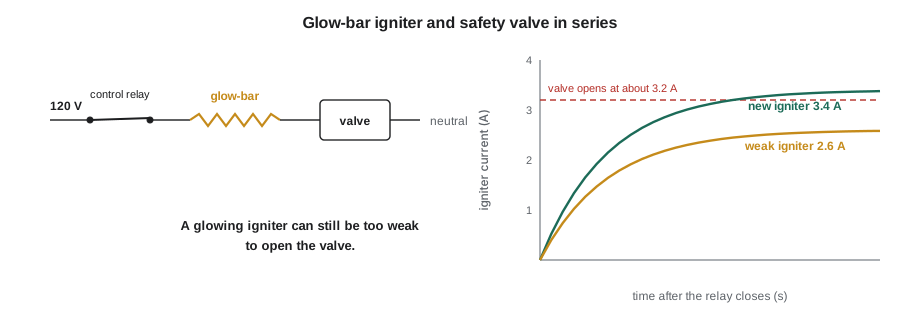
A gas range's surface burners and oven burner each have a valve, an orifice that meters the gas, an air shutter that sets the primary air, and a burner head that spreads the flame. Surface burners are usually lit by spark ignition: a spark module fires electrodes at each burner while a valve is turned to the light position. Gas ovens commonly use a glow-bar (hot-surface) igniter in series with a bimetal safety valve. The igniter's current also heats the valve's bimetal; only when the igniter is hot enough to light the gas does the current reach the level that opens the valve.
Worked problem
A weak glow-bar igniter
APP-230's Fanshawe oven took a long time to light and sometimes did not light. The glow-bar drew 2.6 A, and the valve needed at least about 3.2 A to open. A new igniter drew 3.4 A. What share of the needed current was the old igniter drawing?
Show solution
- Share of the opening current:
- \[2.6 \div 3.2 \approx 0.81\]
- The new igniter:
- \[3.4 > 3.2\]
Answer: About 81 in 100. The igniter glowed, so it looked fine, but it never drew enough current to open the safety valve reliably. A weak igniter is the most common gas oven fault, and the exam is likely to ask why an igniter that glows can still be bad.
Spark ignition faults include a spark module that clicks continuously (a switch on a burner valve is stuck closed or wet from a spill), one burner that will not light (dirty or misaligned burner head, blocked ports or a cracked electrode, as in APP-230's Delisle case), and no spark at all (module, supply or switch harness).
Combustion, carbon monoxide and the gas rules
Incomplete combustion makes carbon monoxide (CO), a colourless, odourless and poisonous gas. Causes include too little primary air, a burner head out of place, a pan or foil blocking the oven vent, and the wrong orifice for the gas. Combustion analyzers read CO in parts per million (ppm) and oxygen in per cent of the sample, and the reading is converted to air-free CO so that readings with different amounts of excess air can be compared:
Worked problem
Converting to air-free CO
Hiro's flue reading on a gas appliance in APP-310 was 45 ppm CO at 9.0 in 100 oxygen. What is the air-free CO?
Show solution
- Air-free CO:
- \[45 \times \frac{20.9}{20.9 - 9.0} = 45 \times \frac{20.9}{11.9} \approx 79 \text{ ppm}\]
Answer: About 79 ppm air-free. Penfold's company guidance for ovens, which APP-230 described, is below 100 ppm air-free acceptable, 100 to 300 investigate, and above 300 corrected before the appliance is used. The commonly cited standard limit for an oven at its test conditions is 800 ppm air-free; field action levels are set lower.
Gas work in Ontario is regulated by the TSSA under the Technical Standards and Safety Act and its regulations, and installations follow CSA B149.1 (natural gas and propane installation code). A technician needs a gas technician certificate for the work they do: a G.3 has a limited scope and, among other limits, may not perform the initial activation of a new or newly converted appliance, while a G.2 may work on appliances up to 400,000 Btu/h. Converting a range from natural gas to propane, as Hiro did for APP-230's Calloway range, uses the maker's conversion kit and instructions, changes the pressure regulator setting and orifices, adjusts the low flame, and fixes a conversion label to the appliance.
Range hoods complete the picture. A powerful hood in a tight house can pull combustion products back down a water heater or furnace flue, which is why makeup air is required for large hoods in many codes, and why APP-230's Quintal case ended with Hiro tagging a spilling water heater and an HVAC contractor adding interlocked makeup air. Every home with fuel-burning appliances should have working CO alarms, and a technician who finds one unplugged tells the customer why it matters.
Ventilation and range hoods
Range hoods appear on exams in two ways. The first is installation: duct size and length from the maker's instructions, a backdraft damper, no exhaust into an attic or wall cavity, and the hood mounted at the maker's height above the cooktop. The second is depressurization, which lesson 7 introduced with APP-230's Quintal case. A hood that exhausts several hundred cubic feet a minute from a tight house must draw the same amount of air back in from somewhere; if no makeup air is provided, it may pull it down a chimney or water heater vent, bringing combustion products into the house.
Ontario's Building Code addresses depressurization where spillage-susceptible appliances are present, and municipalities and mechanical designers decide the makeup air needed for a large hood; APP-230 described those rules in general terms. A technician who installs a large hood checks the maker's makeup air requirements and asks about fuel-burning appliances in the house.
Worked problem
Explaining a CO result to a customer
After an oven repair, Hiro's air-free CO reading at the oven vent fell from 92 ppm to 54 ppm once the burner's air shutter was adjusted. How should the finding be written for the customer?
Show solution
- Both readings were below Penfold's 100 ppm air-free action level, so the oven was acceptable before and better after.
- The written finding states what was measured, what was adjusted, and the result in plain words.
- It also reminds the customer to keep the oven vent clear and to test their CO alarms.
Answer: "Oven burner adjusted for cleaner combustion. Carbon monoxide at the oven vent measured 92, then 54 parts per million after adjustment, within normal limits. Keep the vent clear and test your CO alarms monthly." Clear findings like this one are what lesson 12's scoring rewards.
Finally, gas questions on any exam often turn on scope. A technician who is not certified for gas work can still smell gas, read a meter, measure an igniter's current and spot a kinked connector, and should report all of it. What they may not do is disconnect, adjust, convert or relight gas equipment. The right answer to "what should an uncertified technician do" is almost always to make the situation safe, record the findings and hand the work to someone certified.
Common mistakes
MistakeCondemning an igniter only if it does not glow.
InsteadMeasure its current; a glowing igniter that draws too little will not open the valve.
MistakeChecking oven calibration with one thermometer reading.
InsteadAverage several readings over complete heating cycles before adjusting the offset.
MistakeTesting an induction board before checking the DC bus has discharged.
InsteadMeasure the bus and wait for it to bleed down before touching the board.
MistakeComparing raw CO readings taken at different oxygen levels.
InsteadConvert to air-free CO first.
MistakeConverting a gas range without the maker's kit and label.
InsteadUse the maker's kit and instructions and label the conversion; at Penfold, Hiro does it.
Summary and key terms
- Infinite switches cycle elements; a welded switch gives full heat at every setting.
- Radiant elements have a limiter that opens if the glass overheats.
- Oven RTDs are about 1,000 Ω at 0 °C plus about 3.85 Ω per °C: about 1,081 Ω at 21 °C and 1,681 Ω at 177 °C.
- Calibrate ovens from averaged readings, using the control's offset adjustment.
- Self-clean locks the door; lock and lock switch faults are common, and the door unlocks only when cool.
- Induction needs magnetic pans; the DC bus of about 340 V is measured before boards are touched.
- A glow-bar must draw enough current (about 3.2 A or more in APP-230's oven) to open the safety valve.
- Convert CO readings to air-free; Penfold acts above 100 ppm air-free and corrects above 300.
- Gas work in Ontario needs a TSSA certificate; conversions use the maker's kit and a label.
- Infinite switch
- A cycling switch that controls a surface element's average power.
- Limiter
- A thermostat in a radiant element that opens if the glass becomes too hot.
- RTD
- Resistance temperature detector, an oven sensor whose resistance rises steadily with temperature.
- Glow-bar igniter
- A hot-surface igniter wired in series with a gas oven's bimetal safety valve.
- Air-free CO
- A CO reading corrected to remove the effect of excess air in the sample.
- Conversion kit
- The maker's parts and instructions for changing an appliance from one gas to another.
Practice problems
Work each problem on paper first, then reveal the answer to check.
Practice: A coil element heats on full at every setting. What has failed?
Show answer
The infinite switch, with welded contacts.
Practice: An oven sensor reads 1,150 Ω at 21 °C. Is it in range?
Show answer
No. About 1,081 Ω is expected; 1,150 Ω would make the control think the oven is about 18 °C hotter than it is.
Practice: A copper pan does not heat on an induction cooktop. Is the cooktop faulty?
Show answer
Not necessarily. Copper is not magnetic; test with a magnetic pan first.
Practice: A CO reading is 60 ppm at 12.0 in 100 oxygen. What is the air-free CO?
Show answer
60 × 20.9 ÷ 8.9 ≈ 141 ppm air-free, which Penfold would investigate.
Practice: A spark module clicks constantly even with all burners off. What is a likely cause?
Show answer
A burner valve switch stuck closed or wet from a spill.
Practice: What may a G.3 gas technician NOT do on a newly converted appliance in Ontario?
Show answer
Perform its initial activation.
Lesson quiz · 5 questions
Score 60% or more to complete this lesson.
Create a free account to save your progress, take quizzes and earn a certificate.