
APP-420 · Lesson 10 of 12 · 29 min
Practice exam strategies
▶ Video coming soon A video version of this lesson is on the way.
At home on the evening of Wednesday, October 14, Eamon wrote Dee's first full-length practice test: 120 original questions in four hours, at his kitchen table with his phone in another room. The next evening, Thursday, October 15, he brought the marked test to the shop. He had scored 79 of 120, about 66 in 100. "Five short of a pass," Dee said, "and I can see exactly where they went. Half of what you lost was knowledge. The other half was technique: you read questions too fast, you changed right answers to wrong ones, and you spent nine minutes on one calculation. Technique is the cheapest marks you will ever earn."
This lesson is about technique: how to read a multiple-choice question, how to rule out wrong answers, how to handle calculations and scenarios, how to manage time, and how to turn a practice result into a study plan. None of it replaces knowing the trade, but all of it helps a candidate who knows the trade show it.
Reading the question
Most wrong answers on trade exams come from misreading the question, not from not knowing the answer. Dee's rules for reading are:
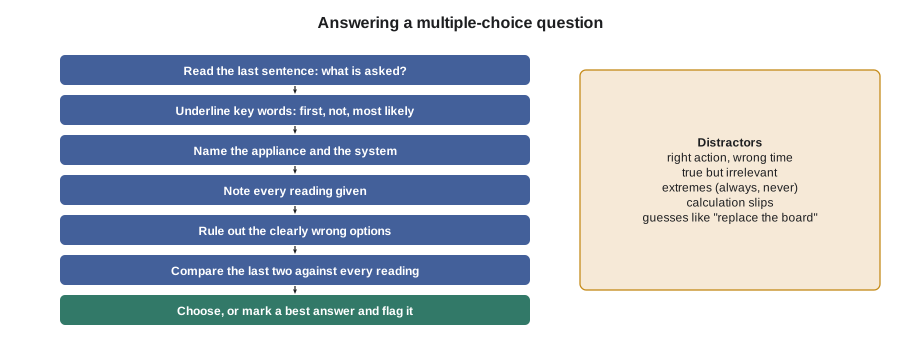
- Read the last sentence first. It says what is being asked: the cause, the next step, the value, the part. Then read the whole question with that in mind.
- Underline the key words. Words such as first, next, most likely, best, not and except change the answer completely. "What is the first step" and "what is the most important step" can have different answers.
- Identify the appliance and the system. A question about a dryer that does not heat is an electrical heater-circuit and airflow question; a question about a refrigerator with frost only at the evaporator inlet is a sealed-system question. Name the lesson it belongs to.
- Note every reading given. In a scenario question, each number is usually there for a reason. If a reading seems irrelevant, ask why the question writer included it.
- Answer the question asked, not the one you expected. A question about a familiar fault may ask about an unfamiliar part of it, such as the safety step rather than the repair.
Worked problem
Reading a "first step" question
A practice question read: "A customer reports that a dishwasher has water in its base and shows a flood code. What should the technician do FIRST?" The options were: (A) replace the flood switch, (B) disconnect power and shut off the water supply, (C) clear the code and run a test cycle, (D) replace the inlet valve. Eamon chose (D), because a cracked inlet valve had caused APP-310's flood code. Why was that wrong?
Show solution
- The question asks for the **first** step, not the most likely repair.
- Water in the base of an appliance with live wiring is a safety hazard, so making it safe comes before diagnosis.
- (A) and (D) are repairs before any diagnosis; (C) runs a fault condition again before finding the leak.
Answer: The answer is (B). Eamon knew the right repair for one cause, but the question tested the order of steps. Exam writers often make the most familiar repair a wrong option on a "first step" question.
Ruling out wrong answers
A four-option question usually has one correct answer, one or two that are clearly wrong, and one distractor: an answer that is true in some other situation, or partly right, or a common mistake. Ruling out the clearly wrong options first improves the odds even when the right answer is not obvious. Common types of distractor are:
- The right action at the wrong time, such as a repair offered as a first step.
- A true statement that does not answer the question, such as a correct fact about a different part.
- An extreme, using words such as always, never or only, which are often wrong in a trade with many exceptions, but not always: "never measure a microwave's high-voltage circuit live with a meter" is correct.
- A calculation mistake, such as an answer made with the wrong formula, a unit error or a common slip, like using 240 V wattage at 208 V.
- A guess dressed as a diagnosis, such as "replace the control board" when the readings point to a sensor.
If two options remain, compare them directly. Which one is supported by every reading in the question? Which one would Dee, or the service manual, do first? If both seem right, one is usually more complete or safer.
Calculation questions
Calculation questions are usually short: Ohm's law, power, heater resistance, air-free CO, recovery percentage, hardness conversion, water test power, vent length. They are also where time disappears. Dee's rules are:
- Write the formula first, then put the numbers in. A formula written down is harder to misapply.
- Estimate before you calculate. 240 V across about 20 Ω is a little over 10 A; if the calculator says 120 A, a key was wrong.
- Check the units and convert first if they differ, such as watts and kilowatts, grams and kilograms, or millilitres and litres.
- Look at the options. They are often spread so that a rough estimate picks the right one; the wrong options are often the results of common mistakes.
- Give a calculation at most three minutes on the first pass. If it is taking longer, flag it and return.
Worked problem
Estimating before calculating
A question asks for the current drawn by a 3,400 W, 240 V broil element, with options of 1.4 A, 14.2 A, 70.6 A and 141.7 A. How can the answer be chosen almost without a calculator?
Show solution
- Estimate: 3,400 W is a little under 3,600 W, and 3,600 ÷ 240 = 15.
- So the current is a little under 15 A.
- Exact:
- \[3{,}400 \div 240 \approx 14.2 \text{ A}\]
- The other options are what you get by dividing by 2.4, by 48 or by 24.
Answer: 14.2 A. The estimate alone rules out three options; the exact figure confirms it.
Managing time
Four hours for 120 questions is two minutes each, which sounds generous until a few long scenarios and calculations take five minutes each. Dee's plan for the real exam:
- First pass: answer every question you can in about 90 seconds or less. For any question that needs longer, choose your best answer, mark it as flagged, and move on. Never leave a question blank, because a blank is certainly wrong and a guess may be right.
- Checkpoints: write the times for the quarter, half and three-quarter marks on scrap paper, as lesson 1 described, and check them.
- Second pass: return to the flagged questions with the time left. Many are easier the second time, because a later question may have reminded you of something.
- Last minutes: check that every question has an answer. Do not reread the whole exam looking for second thoughts.
On changing answers, Dee's view is practical. Change an answer when you find a clear reason: you misread the question, you noticed a key word, or a later question reminded you of a fact. Do not change an answer because of a vague feeling. On Eamon's first practice test he changed nine answers; four of the changes were from right to wrong, all on feeling.
Worked problem
Where the time went
Eamon used 238 of his 240 minutes on the first practice test. He spent about 9 minutes on one sealed-system calculation and left the last 7 questions to a rushed guess. At 2 minutes a question, how many questions' worth of time did the one calculation take, and how many questions could he have answered calmly instead?
Show solution
- Time on the calculation:
- \[9 \text{ min}\]
- Worth in questions at 2 minutes each:
- \[9 \div 2 = 4.5\]
- If he had stopped at 3 minutes and flagged it, he would have saved 6 minutes, about 3 questions' worth.
Answer: One calculation cost about four and a half questions' worth of time. Flagging it after three minutes would have given him time for three of the seven questions he rushed.
Reading a practice result
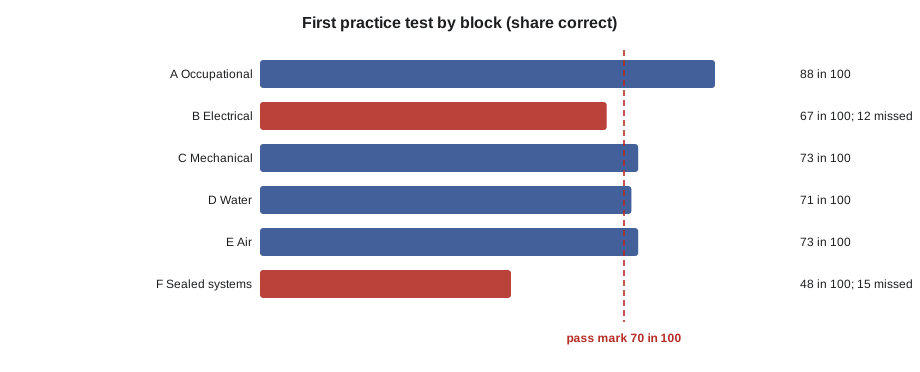
A practice score tells a candidate more than whether they would pass. Dee broke Eamon's score down by block:
| Block | Correct | Questions | Share correct |
|---|---|---|---|
| A Occupational skills | 7 | 8 | about 88 in 100 |
| B Electrical and electronic | 24 | 36 | about 67 in 100 |
| C Mechanical | 16 | 22 | about 73 in 100 |
| D Water | 10 | 14 | about 71 in 100 |
| E Air | 8 | 11 | about 73 in 100 |
| F Refrigeration sealed systems | 14 | 29 | about 48 in 100 |
| Total | 79 | 120 | about 66 in 100 |
Worked problem
Where the marks are
Using the block table, how many questions did Eamon miss in blocks B and F together, and what share of all his missed questions was that?
Show solution
- Missed in B:
- \[36 - 24 = 12\]
- Missed in F:
- \[29 - 14 = 15\]
- All missed:
- \[120 - 79 = 41\]
- Share in B and F:
- \[\frac{12 + 15}{41} = \frac{27}{41} \approx 0.66\]
Answer: 27 of the 41 missed questions, about two-thirds, were in electrical and sealed systems. That decided the next ten days: sealed-system diagnosis with Hiro's notes, then schematics, and a second full test on October 25.
Scenario questions: a worked approach
Scenario questions are the longest on any trade exam and carry the most reasoning. Dee taught Eamon to break each one into three parts on his scrap paper: the symptom (what the customer or the question reports), the evidence (every reading and observation given) and the ask (what the question wants: cause, next step, part, value). Then he wrote one line per option saying whether the evidence supported it.
Worked problem
Breaking down a scenario
A practice scenario: "A bottom-freezer refrigerator's fresh food section is at 9 °C and the freezer at −17 °C. The compressor and condenser fan run. The evaporator is evenly frosted and its fan runs. The air damper between compartments is closed and does not move when the control calls for cooling. What is the most likely cause?" Options: (A) low refrigerant charge; (B) failed defrost heater; (C) failed damper motor or its control signal; (D) failed condenser fan.
Show solution
- Symptom: fresh food warm, freezer cold.
- Evidence: compressor and condenser fan run (rules out D); evaporator evenly frosted (rules out A, which shows inlet-only frost); its fan runs and the coil is not packed with ice (rules out B for now); the damper stays closed.
- Ask: the most likely cause.
- Only (C) is supported by every piece of evidence.
Answer: (C). The question writer included the evenly frosted coil and the running fans specifically to rule out the tempting sealed-system and defrost answers.
Breaking a scenario down this way takes an extra minute on the first few questions and saves several minutes overall, because the candidate stops rereading the question. It also catches the questions where one reading in the scenario rules out the answer that would otherwise seem obvious.
When you do not know
Every candidate meets questions they cannot answer from knowledge. The worst response is to leave them blank or to spend ten minutes on them. The best is a reasoned guess: rule out what you can, choose the most likely of the rest, flag it and move on. Some options can be ruled out on general principles even without knowing the topic: an option that skips safety, an option that replaces an expensive part without diagnosis, or an option that breaks a rule stated in another question on the same exam. With two options ruled out, a guess has an even chance.
Common mistakes
MistakeAnswering the most familiar repair on a "first step" question.
InsteadRead the key word; safety and diagnosis usually come before repairs.
MistakeLeaving hard questions blank to come back to.
InsteadMark your best answer, flag it, and return if there is time.
MistakeSpending many minutes on one calculation.
InsteadEstimate first, and flag any calculation that passes three minutes.
MistakeChanging answers on a feeling.
InsteadChange only for a clear reason, such as a misread key word.
MistakeLooking only at the total practice score.
InsteadBreak it down by block or exam and study where the marks were lost.
Summary and key terms
- Read the last sentence first, underline key words such as first, not, except and most likely, and name the appliance and system.
- Every reading in a scenario is usually there for a reason.
- Rule out clearly wrong options, then compare the last two against every reading.
- Distractors include right actions at the wrong time, true but irrelevant facts, extremes, calculation slips and guesses.
- Write the formula, estimate, check units, and use the options as a check.
- First pass at about 90 seconds a question, flag the slow ones, never leave blanks, then return.
- Change an answer only for a clear reason.
- Break practice scores down by block or exam and spend study time where the marks were lost.
- Distractor
- A wrong option written to look right, such as a true statement that does not answer the question.
- Key word
- A word such as first, not, except or most likely that changes what a question is asking.
- Flag
- To mark a question for a second look after the first pass.
- First pass
- Going through every question once, answering the quick ones and flagging the slow ones.
- Checkpoint
- A planned question number to have reached by a set time.
Practice problems
Work each problem on paper first, then reveal the answer to check.
Practice: A question asks which of four actions should NOT be taken when a refrigerator is warm. What is the trap?
Show answer
Choosing the first correct action you see. With NOT, three options are correct actions and the answer is the one that is wrong.
Practice: Options for a 5,400 W, 240 V element's current are 2.25 A, 22.5 A, 44 A and 225 A. Which is right, and how do you know without a calculator?
Show answer
22.5 A: 4,800 W at 240 V would be 20 A, so 5,400 W is a little more.
Practice: Eamon has 40 minutes left and 12 flagged questions. How long can he spend on each?
Show answer
About 3 minutes each, leaving a few minutes to check that nothing is blank.
Practice: Why is "replace the control board" often a distractor?
Show answer
Many questions describe a sensor, connector or input fault that makes the board act wrongly; replacing the board would not fix it.
Practice: A candidate scores 21 of 29 in sealed systems. What share is that?
Show answer
About 72 in 100.
Practice: Give one good reason to change an answer.
Show answer
Discovering that you misread a key word, such as first or not, or remembering a fact from a later question.
Lesson quiz · 5 questions
Score 60% or more to complete this lesson.
Create a free account to save your progress, take quizzes and earn a certificate.