
APP-420 · Lesson 11 of 12 · 38 min
A full practice exam and debrief
▶ Video coming soon A video version of this lesson is on the way.
On Sunday, October 25, Eamon wrote Dee's second full-length practice test at the shop under exam conditions: 120 new original questions, four hours, no phone, a basic calculator and scrap paper. Kiran sat at the other end of the bench with the refrigerant section (lesson 5). Dee timed them and stayed out of the way. When the time was up she marked Eamon's paper at the counter while he made coffee. He had 92 of 120, about 77 in 100. "That's a pass with a margin," she said. "Now we find out why you got the other 28 wrong, because some of those are going to be on the real exam in a different form."
This lesson works through a set of original practice questions in the style of that test, each followed by the answer and Dee's debrief: why the answer is right, why the tempting wrong answer is wrong, and which lesson to go back to. The questions are grouped by topic. As with every question in this course, they are written for practice and are not taken from any real exam.
The result
| Block | First test (Oct 14) | Second test (Oct 25) | Change |
|---|---|---|---|
| A Occupational skills | 7 of 8 | 7 of 8 | 0 |
| B Electrical and electronic | 24 of 36 | 29 of 36 | +5 |
| C Mechanical | 16 of 22 | 17 of 22 | +1 |
| D Water | 10 of 14 | 11 of 14 | +1 |
| E Air | 8 of 11 | 9 of 11 | +1 |
| F Refrigeration sealed systems | 14 of 29 | 19 of 29 | +5 |
| Total | 79 of 120 | 92 of 120 | +13 |
Worked problem
Measuring the improvement
Eamon scored 79 of 120 and then 92 of 120. What were the two scores as a share of 120, and how far above the 84 needed to pass was the second?
Show solution
- First:
- \[79 \div 120 \approx 0.66\]
- Second:
- \[92 \div 120 \approx 0.77\]
- Margin over the pass mark:
- \[92 - 84 = 8 \text{ questions}\]
Answer: About 66 and then 77 in 100, with 8 questions to spare. Dee's rule is that a candidate should be scoring at least 5 questions above the pass mark on practice tests before exam day, because the real exam is new material and nerves cost a few marks.
Safety and occupational skills
Practice problems
Work each problem on paper first, then reveal the answer to check.
Question 1. A technician is about to replace a dishwasher's drain pump. The appliance is hard-wired. Which of these is the correct sequence? (A) Switch off the breaker, test the terminals for voltage, replace the pump. (B) Switch off the breaker, test the meter on a live source, test the terminals, test the meter on a live source again, then work. (C) Unplug the dishwasher at the receptacle under the sink and work. (D) Test the terminals for voltage with the breaker on, then switch off and work.
Show answer
Answer: B. Debrief: the live-dead-live test is the expected answer whenever a question asks how to prove a circuit dead. (A) skips proving the meter; (C) assumes a hard-wired unit has a plug; (D) measures with power on and never confirms the circuit is dead. Back to lesson 2.
Question 2. A free-standing range has been pulled out for a repair and pushed back. What must the technician check before leaving? (A) That the oven door seal is clean. (B) That the anti-tip bracket is engaged. (C) That the clock is set. (D) That the cord is coiled behind the range.
Show answer
Answer: B. Debrief: moving a range can disengage the bracket, and a range that can tip is a serious hazard to children. (A) and (C) are good customer service but not safety; (D) is wrong, because a cord should not be pinched or coiled tightly behind an appliance. Lesson 2.
Question 3. A meter reads 34 V on an unconnected wire inside a wall cavity. What is the most likely explanation? (A) A shorted appliance. (B) A ghost voltage induced from nearby live conductors. (C) A failed meter. (D) An open neutral.
Show answer
Answer: B. Debrief: high-impedance digital meters pick up induced voltage on wires that are not connected to anything. A low-impedance setting or a load makes it disappear. Eamon chose (D) on the first test because he connected "strange voltage" with "open neutral", which is a real fault but needs a connected circuit. Lesson 2.
Electrical and electronic
Practice problems
Work each problem on paper first, then reveal the answer to check.
Question 4. A 3,000 W, 240 V bake element in a condominium with a 208 V supply gives about how much power? (A) 3,000 W. (B) 2,600 W. (C) 2,250 W. (D) 1,500 W.
Show answer
Answer: C. Debrief: R = 240² ÷ 3,000 = 19.2 Ω, and P = 208² ÷ 19.2 ≈ 2,253 W. (B) is what you get by scaling the power in proportion to the voltage, which forgets that power goes with the square. Lesson 3.
Question 5. A dryer runs but does not heat. With the dryer running and calling for heat, there is 240 V across the element terminals. What is the most likely fault? (A) An open thermal fuse. (B) An open element. (C) An open cycling thermostat. (D) A failed timer.
Show answer
Answer: B. Debrief: full voltage across a load that is calling for heat but not heating means the load itself is open. If the thermal fuse, thermostat or timer were open, there would be no voltage across the element. Lesson 3.
Question 6. A refrigerator board shows a fresh food sensor fault. The 10 kΩ thermistor reads OL. What does the board see at its input? (A) About 0 V. (B) About 2.5 V. (C) About 5 V, its full divider supply. (D) A changing voltage.
Show answer
Answer: C. Debrief: with the thermistor open, there is no current in the divider and the input rises to the supply voltage. A shorted thermistor would give about 0 V. Lesson 9.
Question 7. An inverter refrigerator's compressor will not start. The three compressor windings read 11.9, 11.9 and 11.9 Ω and above 20 MΩ to ground. The inverter has its supply and the main board sends a start command, but there are no start attempts. What is the fault? (A) The compressor. (B) The inverter board. (C) The main board. (D) A low refrigerant charge.
Show answer
Answer: B. Debrief: equal windings and good insulation clear the compressor; a command and supply present clear the main board and the wiring. An inverter that does nothing with a command and power is at fault. Eamon chose (A) on the first test, the most expensive guess. Lesson 9.
Question 8. A microwave oven blows its line fuse every time the door is opened. What is the most likely cause? (A) A shorted magnetron. (B) A failed or misadjusted interlock, causing the monitor switch to short the line. (C) A failed turntable motor. (D) A weak high-voltage capacitor.
Show answer
Answer: B. Debrief: the monitor switch is designed to blow the fuse if the interlocks do not open in the right order. The repair is the interlock set and monitor as the maker specifies, followed by a leakage survey. Lesson 9.
Refrigeration sealed systems
Practice problems
Work each problem on paper first, then reveal the answer to check.
Question 9. A top-freezer refrigerator is warm. The compressor runs, the evaporator has frost only on its first few passes, the condenser is cool and the compressor draws well below its rated wattage. What is the most likely cause? (A) An overcharge. (B) A low charge. (C) A failed evaporator fan. (D) A failed defrost heater.
Show answer
Answer: B. Debrief: all three readings agree on too little refrigerant. An overcharge would show high wattage; a failed fan would leave the evaporator frosted evenly with cold, still air; a failed defrost heater shows a packed, evenly frosted coil. Lesson 4.
Question 10. After replacing an evaporator in an R-134a refrigerator, which step must come before charging? (A) Weigh the old charge. (B) Replace the filter-drier and evacuate the system. (C) Add refrigerant until the suction line sweats. (D) Run the compressor with the system open to clear moisture.
Show answer
Answer: B. Debrief: a new drier and a deep vacuum come before charging, and the charge is weighed in from the nameplate. (C) is charging by feel; (D) pulls moist air into the system and can damage the compressor. Lesson 4.
Question 11. Compressor terminal readings are 3.5, 6.5 and 10.0 Ω. Which reading is common to start? (A) 3.5 Ω. (B) 6.5 Ω. (C) 10.0 Ω. (D) It cannot be told from resistance.
Show answer
Answer: B. Debrief: 10.0 Ω is start to run (3.5 + 6.5); the lower of the other two, 3.5 Ω, is common to run, so 6.5 Ω is common to start. Lesson 3.
Question 12. A frost-free refrigerator's evaporator is packed with ice and its fan is silent. A forced defrost draws 0 A. The 450 W, 120 V heater measures 32 Ω at its own terminals. What should be checked next? (A) The compressor. (B) The termination thermostat and the wiring between the control and the heater. (C) The condenser fan. (D) The door gasket.
Show answer
Answer: B. Debrief: the heater is good (120² ÷ 450 = 32 Ω), so with no current in defrost the open part is elsewhere in the circuit: the termination thermostat, a connector or the control's output. Lesson 4.
Refrigerant handling
Practice problems
Work each problem on paper first, then reveal the answer to check.
Question 13. Which refrigerant may be handled without an Ontario ODP card? (A) R-134a. (B) R-600a. (C) R-22. (D) R-410A.
Show answer
Answer: B. Debrief: the regulation covers halocarbons, and R-600a is a hydrocarbon; it still needs the maker's flammable-refrigerant procedures. Lesson 5.
Question 14. Why is a recovery cylinder never filled beyond 80 in 100 of its capacity? (A) To keep the cylinder light enough to lift. (B) To leave room for the liquid to expand if the cylinder warms. (C) So that oil can be added later. (D) To make reclaiming cheaper.
Show answer
Answer: B. Debrief: a full cylinder of liquid that warms can reach a dangerous pressure. (A) is a nice side effect, not the reason. Lesson 5.
Laundry, cooking and water
Practice problems
Work each problem on paper first, then reveal the answer to check.
Question 15. A front-load washer fills and drains at the same time and never reaches its level. The drain hose is pushed about 600 mm into the standpipe and taped. What is the fix? (A) Replace the drain pump. (B) Replace the inlet valve. (C) Reset the hose to the maker's depth with an air gap. (D) Replace the pressure sensor.
Show answer
Answer: C. Debrief: the washer is siphoning. The parts are working; the installation is wrong. Lesson 6.
Question 16. A dryer has blown its thermal fuse twice in three months. Before replacing the fuse again, what should the technician do? (A) Fit a higher-rated fuse. (B) Inspect and clear the whole air path, including the vent and cap. (C) Replace the element. (D) Replace the timer.
Show answer
Answer: B. Debrief: a thermal fuse opens because of overheating, and the usual cause is restricted airflow. A higher-rated fuse (A) removes a safety device. Lesson 6.
Question 17. A gas oven's glow-bar glows but the burner does not light. The igniter draws 2.6 A; the valve needs about 3.2 A. What is the fault? (A) The oven sensor. (B) The gas supply. (C) A weak igniter. (D) The safety valve.
Show answer
Answer: C. Debrief: the igniter is in series with the valve's heater; at 2.6 A it never opens the valve. At Penfold the repair itself is Hiro's, as gas work. Lesson 7.
Question 18. A CO reading is 120 ppm at 11.5 in 100 oxygen. What is the air-free CO? (A) 120 ppm. (B) About 160 ppm. (C) About 267 ppm. (D) About 66 ppm.
Show answer
Answer: C. Debrief: 120 × 20.9 ÷ (20.9 − 11.5) = 120 × 20.9 ÷ 9.4 ≈ 267 ppm. Under Penfold's guidance that needs investigation, and it is close to the level where the appliance must be corrected before use. Lesson 7.
Question 19. A new disposer has been installed and the dishwasher on the same sink will not drain. What is the first thing to check? (A) The dishwasher drain pump. (B) The disposer's knockout plug in the dishwasher inlet. (C) The water heater. (D) The dishwasher's float switch.
Show answer
Answer: B. Debrief: the plug must be knocked out before the dishwasher hose is connected. Lesson 8.
Question 20. Water with a hardness of 205 mg/L is about how many grains per gallon? (A) 3.5 gpg. (B) 12 gpg. (C) 17.5 gpg. (D) 205 gpg.
Show answer
Answer: B. Debrief: 205 ÷ 17.1 ≈ 12 gpg. Lesson 8.
The debrief: patterns in the wrong answers
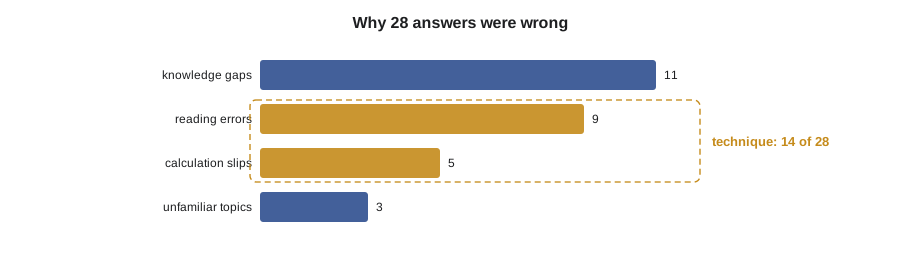
Dee did not stop at marking. She sorted Eamon's 28 wrong answers on the second test into causes, and the pattern was more useful than the score. Eleven were knowledge gaps: facts or procedures he did not know, mostly in sealed-system repair and electronic controls. Nine were reading errors: a missed "not", a "first step" answered with a repair, a reading in the question he had not used. Five were calculation slips, three of them unit errors. Three were guesses on topics he had never met on the job, such as through-wall air conditioner sleeves and ice machine harvest cycles.
Worked problem
Sorting wrong answers by cause
Of Eamon's 28 wrong answers, 11 were knowledge, 9 reading, 5 calculation and 3 unfamiliar topics. What share were reading and calculation errors together, the kind technique can fix?
Show solution
- Technique errors:
- \[9 + 5 = 14\]
- As a share:
- \[14 \div 28 = 0.5\]
Answer: Half. Dee's last six weeks of study for Eamon gave equal time to both halves: reading every practice question twice and writing every formula, and filling the eleven knowledge gaps one by one from the course notes.
Dee's last instruction was about the six weeks between the practice test and December 8. No new practice test until two weeks before the exam; a second look at every wrong answer, written out in a sentence explaining the right one; one short timed set of 30 questions each week; and nothing new the night before the exam.
Common mistakes
MistakeCelebrating a passing practice score and stopping.
InsteadDebrief every wrong answer; the same ideas will come back in a different form.
MistakeCounting only the score, not the causes of errors.
InsteadSort wrong answers into knowledge, reading, calculation and unfamiliar topics.
MistakeReading the explanation for a wrong answer and moving on.
InsteadWrite the right answer and its reason in your own words.
MistakeWriting a new practice test every few days.
InsteadSpace practice tests out and spend most of the time on the gaps they show.
MistakeCramming new material the night before.
InsteadReview lightly, sleep, and arrive early.
Summary and key terms
- A full practice test under exam conditions shows both knowledge and technique.
- Eamon improved from 79 to 92 of 120, 8 questions above the 84 needed to pass.
- Study between practice tests should go where the marks were lost.
- Debrief each wrong answer: why the right answer is right, why the tempting answer is wrong, and where to review.
- Sort wrong answers by cause; reading and calculation errors, half of Eamon's, are fixed by technique.
- Space out practice tests and use the time between them for the gaps.
- Aim for a margin of a few questions above the pass mark or target before exam day.
- Debrief
- Going through a test after marking to understand every wrong answer.
- Exam conditions
- Timed, closed-book, without notes or a phone, as on the real exam.
- Knowledge gap
- A fact or procedure the candidate did not know.
- Reading error
- A wrong answer caused by misreading the question rather than by not knowing.
- Margin
- How far above the pass mark a practice score is.
Lesson quiz · 5 questions
Score 60% or more to complete this lesson.
Create a free account to save your progress, take quizzes and earn a certificate.