
AERO-350 · Lesson 8 of 12 · 25 min
Air data and inertial sensors
An aircraft needs to know how fast it is moving through the air, how high it is, which way it is pointing and how it is accelerating. Air data sensors measure the first two from the pressure and temperature of the surrounding air; inertial sensors measure rotation and acceleration from within the aircraft itself. Together they feed the displays, the autopilot, the flight control computers, the engines' controls, the navigation system and the stall protection. If they are wrong, almost everything else becomes wrong, and several serious accidents have begun with a blocked or iced air data probe. This lesson explains how these sensors work, how their outputs are computed, and how their errors are managed.
Pitot and static pressure
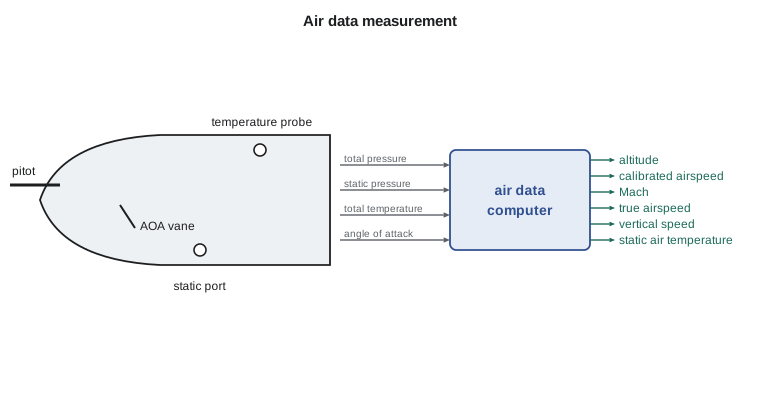
A pitot probe faces into the airflow and measures total pressure, the pressure of the air brought to rest. Static ports on the fuselage sides, placed where the local pressure is close to the undisturbed air pressure, measure static pressure. The difference is the impact pressure, which grows with speed. In incompressible flow it is simply the dynamic pressure, but at the speeds of jet aircraft compressibility matters and the full isentropic relation must be used.
Three airspeeds come from these pressures. Calibrated airspeed is the speed that would give the same impact pressure at sea level in the standard atmosphere; it is what the pilot's airspeed indicator shows, after correction for instrument and position errors, and it sets stall speeds and structural limits because the aerodynamic forces depend on it. Mach number comes from the ratio of impact to static pressure and governs compressibility effects such as the onset of buffet. True airspeed, the actual speed through the air, needs the air temperature as well and is what matters for navigation.
Temperature is measured with a total air temperature probe, which reads slightly above the true air temperature because the air is partly brought to rest at the sensor. The static air temperature is found by removing the kinetic heating, using the Mach number and the probe's recovery factor.
# Air data: Mach, calibrated and true airspeed from pitot and static pressures; then inertial
# position drift and a simple one-dimensional blend of inertial and GNSS position.
import math, random
g, R, a0, p0 = 1.4, 287.05, 340.294, 101325.0
def mach(qc, ps): return math.sqrt(5 * ((qc / ps + 1) ** (2 / 7) - 1))
def cas(qc): return a0 * math.sqrt(5 * ((qc / p0 + 1) ** (2 / 7) - 1))
ps, qc, T_tat = 17900.0, 9650.0, 242.5        # static Pa, impact pressure Pa, total air temperature K (cruise)
M = mach(qc, ps)
T_sat = T_tat / (1 + 0.2 * M**2 * 1.0)        # recovery factor taken as 1.0
TAS = M * math.sqrt(g * R * T_sat)
print(f"Mach {M:.3f}, static air temperature {T_sat-273.15:.1f} C")
print(f"calibrated airspeed {cas(qc):.1f} m/s ({cas(qc)*1.9438:.0f} kt), true airspeed {TAS:.1f} m/s ({TAS*1.9438:.0f} kt)")
# Effect of a 1 percent static pressure error (a slightly misplaced static port)
ps2 = ps * 1.01
print(f"with static reading 1 % high: Mach {mach(qc - (ps2-ps), ps2):.3f}; altitude reads about "
      f"{(math.log(1.01) * 6341.6):.0f} m low")
# Inertial drift: an uncorrected accelerometer bias of 1e-4 g grows as 1/2 b t^2 (Schuler effects ignored)
b = 1e-4 * 9.81
for t in (60, 600, 3600):
    print(f"   bias-only drift after {t:4d} s: {0.5*b*t*t:8.1f} m")
# One-dimensional blend: predict with inertial velocity, correct with noisy GNSS fixes each second
random.seed(4)
x_true, v, x_ins, x_est, P = 0.0, 230.0, 0.0, 0.0, 25.0
Qn, Rg, v_err = 0.5, 9.0, 0.3                 # process noise, GNSS variance (3 m sigma), inertial velocity error m/s
for k in range(1, 301):
    x_true += v
    x_ins += v + v_err
    x_est += v + v_err; P += Qn
    z = x_true + random.gauss(0, 3.0)
    K = P / (P + Rg); x_est += K * (z - x_est); P *= (1 - K)
    if k in (10, 60, 300):
print(f"t={k:3d} s inertial alone error {x_ins - x_true:6.1f} m blended error {x_est - x_true:5.1f} m gain {K:.2f}")Mach 0.810, static air temperature -58.8 C calibrated airspeed 123.5 m/s (240 kt), true airspeed 237.7 m/s (462 kt) with static reading 1 % high: Mach 0.800; altitude reads about 63 m low bias-only drift after 60 s: 1.8 m bias-only drift after 600 s: 176.6 m bias-only drift after 3600 s: 6356.9 m t= 10 s inertial alone error 3.0 m blended error 1.0 m gain 0.21 t= 60 s inertial alone error 18.0 m blended error 0.7 m gain 0.21 t=300 s inertial alone error 90.0 m blended error 0.4 m gain 0.21
At cruise the Swift 900 study's air data computer sees a static pressure of 17.9 kPa and an impact pressure of 9.65 kPa. The program gives Mach 0.81, a calibrated airspeed of 240 kt and, with the static air temperature of −59 °C, a true airspeed of 462 kt . The calibrated speed is barely half the true speed at this altitude, which is why airspeed limits and true speeds differ so much on a jet.
Position error and RVSM
The static ports do not sit in perfectly undisturbed air. The aircraft's own flow field changes the local pressure, and the change depends on speed, angle of attack and configuration. The resulting position error is measured in flight test, usually by comparing with a trailing cone or a calibrated pacer aircraft, and corrected in the air data computer. The program shows how sensitive altitude is: a static reading just 1 percent high makes the altimeter read about 63 m low at cruise and shifts the Mach number by 0.01.
That sensitivity matters in reduced vertical separation minimum airspace, RVSM, where aircraft between flight levels 290 and 410 are separated vertically by only 1000 ft, about 300 m. RVSM approval requires the whole altimetry system, from the static ports to the display, to meet tight error budgets, typically keeping the altimetry system error within about 200 ft for the fleet and with strict limits for each aircraft, together with an autopilot able to hold altitude closely. Approval is granted to each aircraft type and operator by Transport Canada, and height-keeping performance is monitored in service.
Angle of attack and probe failures
Angle of attack vanes, small weathervanes on the fuselage sides, or differential pressure probes measure the angle between the wing and the airflow. Angle of attack is the direct measure of how close the wing is to stalling, and it feeds stall warning, stick shakers and pushers, and the envelope protection of fly-by-wire aircraft like the Swift 900 study's pitch law from AERO-330. Because erroneous angle of attack can cause a protection system to push the nose down wrongly, recent certification work has placed great weight on comparing multiple sensors, on detecting and isolating a faulty one, and on what the crew is told.
Pitot probes can be blocked by ice, by insects, or by covers left on after maintenance. A blocked pitot with an open drain hole makes the airspeed fall towards zero; a blocked pitot with a blocked drain traps the pressure and makes the indicated speed rise in a climb like an altimeter. A blocked static port freezes the altimeter and corrupts the airspeed. Probes are therefore heated, their heating is monitored, and air data systems use three or more independent sources compared continuously so that a faulty one can be identified. Crews are trained to recognise unreliable airspeed and to fly with known pitch attitudes and power settings until the problem is resolved. A 2009 accident over the Atlantic, in which iced pitot probes led to inconsistent airspeeds and the crew lost control, reshaped both probe certification and crew training worldwide.
Inertial sensors
Inertial sensors measure rotation rate with gyroscopes and specific force, the acceleration felt, with accelerometers. An attitude and heading reference system uses them to compute pitch, roll and heading. An inertial navigation system goes further: it integrates acceleration twice to obtain velocity and position. Modern aircraft use strapdown systems, with the sensors fixed to the airframe and the computation done mathematically, rather than the stabilised gimbal platforms of the past.
Navigation-grade inertial systems use ring laser or fibre optic gyros, which sense rotation through the interference of light travelling both ways around a closed path. Their quality is often quoted as position drift of about one nautical mile per hour of free inertial navigation. Smaller aircraft increasingly use micro-electro-mechanical sensors, MEMS, which are tiny, cheap and robust but drift much faster and must be corrected frequently, usually by GNSS.
The program shows why: an accelerometer bias of only one ten-thousandth of g, if uncorrected and integrated twice, would grow to about 177 m of position error in ten minutes and more than 6 km in an hour. A real navigator does better than this simple estimate, because errors in a navigator on a rotating, gravitating Earth tend to oscillate with the 84 minute Schuler period instead of growing without bound, but the lesson stands: inertial errors grow with time, so inertial systems need an external reference.
Blending inertial and GNSS
GNSS gives position with errors that do not grow but are noisy and can be interrupted. Inertial navigation is smooth and continuous but drifts. Blending the two with a Kalman filter gives the best of both: the inertial system predicts the position between fixes, and each GNSS fix corrects it by an amount weighted by the relative confidence in the prediction and the measurement. The program shows a one-dimensional version over 300 seconds of cruise. The inertial position alone drifts 90 m because of a 0.3 m/s velocity error, while the blended estimate stays within about a metre. GEOM-300 covered GNSS itself; here the point is that the blend also keeps the aircraft navigating for a while if GNSS is lost, with the drift starting from a well-corrected state.
For the Tern Block 2, Hélène Lavoie's flight controls group has chosen dual MEMS attitude and heading reference systems blended with dual GNSS receivers and dual air data computers, plus a standby instrument with its own sensors. The Swift 900 study uses three air data and inertial reference units, an architecture common on fly-by-wire aircraft, because its pitch law of AERO-330 needs angle of attack and rates from sources that can outvote a failed one.
| Sensor | Measures | Typical failure or error | Mitigation |
|---|---|---|---|
| Pitot probe | Total pressure | Icing, blockage, covers left on | Heating, multiple probes, crew procedures |
| Static port | Static pressure | Position error, blockage | Flight test calibration, cross-side ports |
| Total air temperature probe | Total temperature | Icing, slow response | Heating, aspirated probes |
| Angle of attack vane | Flow angle | Damage, icing, misrigging | Comparison of three sources, heating |
| Ring laser or fibre optic gyro | Rotation rate | Bias drift | Calibration, GNSS blending |
| MEMS accelerometer and gyro | Acceleration and rate | Larger bias and noise | Frequent GNSS correction |
Worked problem
Calibrated airspeed
An impact pressure of 4.0 kPa is measured. What calibrated airspeed does it correspond to?
Show solution
- \(V_c = 340.3\sqrt{5[(4000/101\,325 + 1)^{2/7} - 1]} = 340.3\sqrt{5 \times 0.01113} = 80.3\) m/s.
Answer: About 80 m/s, or 156 kt.
Worked problem
Static air temperature
A total air temperature probe reads 255 K at Mach 0.78. With a recovery factor of 1, what is the static temperature?
Show solution
- \(T_s = T_t/(1 + 0.2M^2) = 255/(1 + 0.2 \times 0.608) = 255/1.122 = 227\) K.
Answer: About 227 K, or −46 °C.
Worked problem
Inertial drift
An uncorrected velocity error of 0.5 m/s persists for 20 minutes. How far off will the position be?
Show solution
- \(0.5 \times 1200 = 600\) m.
Answer: About 600 m, which is why inertial systems need GNSS or radio updates.
Common mistakes
MistakeUsing indicated or calibrated airspeed for navigation.
InsteadTrue airspeed, from Mach and temperature, is needed for navigation.
MistakeIgnoring static position error.
InsteadA 1 percent static error makes the altimeter read tens of metres wrong at cruise.
MistakeTrusting a single angle of attack source in a protection system.
InsteadSources must be compared so that a failed one cannot command the aircraft.
MistakeExpecting inertial navigation to be accurate indefinitely.
InsteadIts errors grow with time and need external correction.
Summary and key terms
- Pitot and static pressures give calibrated airspeed, Mach number and altitude; with temperature they give true airspeed.
- Static position error is calibrated in flight test and controlled tightly for RVSM, where small static errors become large altitude errors.
- Angle of attack feeds stall and envelope protection, and probe icing or blockage has caused serious accidents, so air data comes from several heated sources compared continuously.
- Inertial sensors measure rates and accelerations, with errors that grow with time, so they are blended with GNSS in a Kalman filter.
- Impact pressure
- Total pressure minus static pressure.
- Calibrated airspeed
- The airspeed that gives the measured impact pressure at standard sea-level conditions.
- True airspeed
- The aircraft's actual speed through the air mass.
- Position error
- The difference between the pressure at the static port and the undisturbed static pressure.
- RVSM
- Reduced vertical separation minimum airspace with 1000 ft vertical spacing between flight levels 290 and 410.
- Strapdown inertial system
- An inertial system with sensors fixed to the airframe and attitude computed mathematically.
Practice problems
Work each problem on paper first, then reveal the answer to check.
In the program, at the same static pressure, what impact pressure would give Mach 0.85?
Show answer
About 10.8 kPa.
Why does calibrated airspeed differ so much from true airspeed at cruise?
Show answer
Air density is much lower than at sea level.
What happens to indicated airspeed in a climb if the pitot is blocked and its drain is also blocked?
Show answer
It rises like an altimeter.
What vertical separation applies in RVSM airspace?
Show answer
1000 ft.
In the program, raise the GNSS noise to 10 m. What happens to the blended error?
Show answer
It grows, and the filter gain falls.
Why does the Swift 900 study use three air data and inertial reference units?
Show answer
So that a failed source can be outvoted for its flight controls.
Lesson quiz · 5 questions
Score 60% or more to complete this lesson.
Create a free account to save your progress, take quizzes and earn a certificate.