
AERO-350 · Lesson 6 of 12 · 26 min
Ice and rain protection
Clouds at temperatures below freezing often contain water that has not frozen. These supercooled droplets freeze on contact with an aircraft's leading edges, propellers, inlets, windshields and sensors. A few millimetres of rough ice on a wing's leading edge can cut its maximum lift coefficient by a large fraction and raise the stall speed; ice on a tailplane can cause a nose-down pitch upset when the flaps are lowered; ice in a pitot probe can make the airspeed indications wrong. Icing has caused many accidents, and it is a daily concern for aircraft that fly in Canadian and northern US winters. This lesson explains the icing environment, the ways aircraft are protected, and the different choices the Tern Block 2 and the Swift 900 study make.
The icing environment
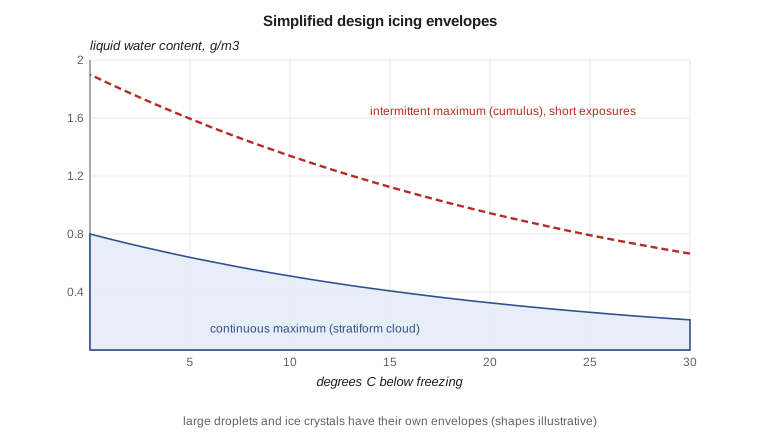
Icing intensity depends on three things: the liquid water content of the cloud, in grams of water per cubic metre of air, the size of the droplets, and the temperature. The certification rules describe the conditions an aircraft must be designed for in an appendix to the airworthiness standards, usually called Appendix C. It defines continuous maximum conditions, typical of extensive stratiform cloud, with liquid water contents up to roughly 0.8 g/m³ near the freezing level and falling at colder temperatures, and intermittent maximum conditions, typical of cumulus, with higher water contents over shorter distances. Droplets in Appendix C have median diameters up to about 50 µm.
Experience showed that this was not the whole story. Freezing drizzle and freezing rain contain much larger droplets, hundreds of micrometres across, which strike further aft on the wing, beyond the protected leading edge, and build ridges of ice that protection systems cannot remove. A 1994 accident to a regional turboprop in such conditions led to years of research and, in the mid-2010s, to a new appendix for supercooled large droplets, usually called Appendix O, for transport category aircraft. Engines must also cope with ice crystals at high altitude, which can melt and refreeze inside the compressor; a separate set of conditions covers them. The regulators of both countries apply equivalent requirements, and new designs must either show they can operate safely in these conditions or detect them and leave.
How ice builds
Not every droplet in the path of a wing hits it. Small droplets follow the air around the leading edge; larger ones cannot turn and strike the surface. The collection efficiency is the fraction that hits, highest at the stagnation line and falling to zero at the impingement limits above and below. The rate at which water arrives is the liquid water content times the airspeed times the collection efficiency. If all of it freezes on impact, typical in cold, dry conditions, the result is rime ice, white and brittle. Near the freezing point not all of it freezes at once; it runs back and freezes later as clear glaze ice, often with horns that are aerodynamically very damaging.
# Icing: how fast ice builds on an unprotected Tern leading edge, and the heat a Swift 900
# evaporative (running-dry) anti-ice system needs on its wing slats. Illustrative values.
rho_ice = 880.0                     # rime ice density kg/m3 (glaze is near 900)
def accretion(lwc, V, E):           # lwc g/m3, V m/s, collection efficiency E -> mm per minute at the stagnation line
    return lwc / 1000 * V * E / rho_ice * 1000 * 60
print("ice build-up rate at the Tern wing leading edge (105 m/s, collection efficiency 0.6)")
for lwc in (0.2, 0.5, 0.8):
    print(f"   LWC {lwc:.1f} g/m3: {accretion(lwc, 105, 0.6):5.1f} mm per minute")
# Tern: pneumatic boots shed ice once it reaches about 6 mm; how often must they cycle?
for lwc in (0.2, 0.5):
    print(f"   boot cycle every {6.0/accretion(lwc, 105, 0.6):4.1f} min at LWC {lwc}")
# Swift 900 slat anti-ice in continuous maximum icing: evaporate all the water that arrives
V, lwc, E, h_proj, span = 180.0, 0.3, 0.75, 0.04, 2 * 5.5   # m/s, g/m3, -, projected height m, protected span m
m_w = lwc / 1000 * V * E * h_proj * span                    # kg/s of water caught
T_air, T_surf = -15.0, 10.0
q_heat = 4186 * (T_surf - T_air) + 2.50e6                   # warm and evaporate each kg (J/kg)
Q_evap = m_w * q_heat
h_conv, S_wet = 120.0, 2 * 5.5 * 0.30                       # W/m2K over the heated area (illustrative)
Q_conv = h_conv * S_wet * (T_surf - T_air)
Q = Q_evap + Q_conv
print(f"\nSwift 900 slats: water caught {m_w*3600:.0f} kg/h")
print(f"evaporation {Q_evap/1000:.0f} kW + convection {Q_conv/1000:.0f} kW = {Q/1000:.0f} kW of heat")
print(f"as bleed air cooling from 200 to 40 C: {Q/(1005*160):.2f} kg/s of bleed")
Q_wet = m_w * 4186 * (5.0 - T_air) + h_conv * S_wet * (5.0 - T_air)
print(f"a running-wet design that only keeps the surface at +5 C needs about {Q_wet/1000:.0f} kW,"
      f" but the water runs back and may refreeze behind the heated area")
print(f"as electrothermal heat at 28 V: {Q/28:.0f} A, so electric ice protection needs a higher-voltage system")ice build-up rate at the Tern wing leading edge (105 m/s, collection efficiency 0.6) LWC 0.2 g/m3: 0.9 mm per minute LWC 0.5 g/m3: 2.1 mm per minute LWC 0.8 g/m3: 3.4 mm per minute boot cycle every 7.0 min at LWC 0.2 boot cycle every 2.8 min at LWC 0.5 Swift 900 slats: water caught 64 kg/h evaporation 46 kW + convection 10 kW = 56 kW of heat as bleed air cooling from 200 to 40 C: 0.35 kg/s of bleed a running-wet design that only keeps the surface at +5 C needs about 9 kW, but the water runs back and may refreeze behind the heated area as electrothermal heat at 28 V: 2011 A, so electric ice protection needs a higher-voltage system
At the Tern's cruise speed of 105 m/s, with a collection efficiency of 0.6 at the stagnation line, ice builds at about 0.9 mm per minute in light continuous icing and about 2 mm per minute at 0.5 g/m³. Five minutes in moderate icing would put a centimetre of ice on an unprotected leading edge.
De-icing and anti-icing
There are two strategies. Anti-icing prevents ice from forming, by heating the surface continuously. De-icing lets a thin layer form and then removes it periodically. Anti-icing is usually needed for surfaces where any ice is unacceptable, such as engine inlets, pitot probes and windshields; de-icing is acceptable for wing and tail leading edges on many aircraft, provided the ice between cycles does not degrade performance too much.
The Tern uses pneumatic de-icing boots on its wing and tail leading edges, the traditional solution for turboprops. Rubber boots bonded to the leading edge are inflated briefly with air from a small electric compressor, cracking the ice so that the airflow carries it away, and then sucked flat by vacuum. Boots work best when the ice is a few millimetres thick: too thin and it may not crack cleanly. The program shows that with a shedding thickness of about 6 mm the boots must cycle every 7 minutes in light icing and every 3 minutes in moderate icing; the Tern's system has a fast and a slow cycle that the crew selects, and newer guidance encourages operating the boots as soon as icing is encountered rather than waiting for a thickness. Propellers are protected by electrothermal heater mats on each blade's root, energised in sequence, and the Tern's electric motors make this simpler than on a turboprop because power is already available at high voltage in the nacelle.
The Swift 900 study uses hot bleed air on its wing slats and engine inlets, the usual choice for jets. Bleed air is ducted through a piccolo tube, a perforated pipe inside the leading edge, which blows hot air onto the inside of the skin. Two design philosophies are possible. An evaporative, or running-dry, system supplies enough heat to evaporate all the water that arrives; a running-wet system only keeps the surface above freezing and lets the water run back. The program shows the difference for the Swift's slats in continuous maximum icing at −15 °C: evaporating the 64 kg of water caught each hour takes about 46 kW, plus 10 kW of convection, while a running-wet design needs only about 9 kW. But running-wet water can refreeze behind the heated area as runback ice, which is exactly what happened in some of the accidents that led to the large-droplet rules, so the study adopts an evaporative design for the slats and accepts the bleed air it costs, about 0.35 kg/s.
| Method | Principle | Typical use | Notes |
|---|---|---|---|
| Pneumatic boots | Inflate to crack ice off | Turboprop wings and tails | De-icing; ice forms between cycles |
| Hot bleed air | Heat the skin from inside | Jet wings, slats and engine inlets | Anti-icing; costs engine power |
| Electrothermal | Resistive heating elements | Propellers, probes, windshields; some wings on bleedless aircraft | Large electrical loads at high power |
| Fluid | Freezing point depressant seeps through porous panels | Some small aircraft | Limited by fluid quantity carried |
| Ground de-icing and anti-icing fluids | Remove frost, snow and ice before take-off | All aircraft | Holdover times depend on fluid type and weather |
Electrothermal ice protection is the bleedless alternative. Its power demand is the obstacle: the evaporative slat heat of 56 kW would be about 2000 A at 28 V, impossible on a small aircraft, which is another reason bleedless designs push toward higher-voltage electrical systems. Some newer designs use electro-mechanical expulsion systems, which crack ice off with very rapid small deflections of the skin and need much less power.
Ice detection and crew procedures
Ice detectors warn the crew when icing begins and can switch on protection automatically. A common type uses a small probe that vibrates at a known frequency; ice on the probe adds mass and lowers the frequency, and the detector then heats the probe to clear it and repeat. Crews also watch visual cues, such as ice on the windshield wipers or a reference probe. For supercooled large droplets, cues include ice aft of the protected areas and water splashing on the side windows.
Operating rules forbid take-off with frost, ice or snow adhering to critical surfaces, the clean aircraft concept. Ground de-icing removes contamination with heated fluid, and anti-icing fluids protect the surfaces for a limited holdover time that depends on the fluid and the precipitation. Winnipeg operators deal with this every winter, and the Tern's operators in northern Manitoba and Nunavut often have no de-icing truck at all, so the Tern's design includes hangar-free ways to keep its wings clean, such as covers and its own heated propellers for ground runs.
Rain and windshields
Windshields are heated electrically, both to prevent ice and to keep the inner layers of the laminated glass or acrylic at a temperature where they are strong and tough against bird strikes. Rain removal uses wipers on slower aircraft and, on many jets, hydrophobic coatings that make water bead and blow off, sometimes with air blast systems. Pitot probes, static ports, angle of attack vanes and temperature probes are heated whenever the engines run; Lesson 8 returns to the air data consequences of probe icing, which have been a factor in serious accidents.
Worked problem
Water catch
A probe of projected area 4 cm² flies at 120 m/s through cloud with 0.4 g/m³ of liquid water and a collection efficiency of 0.9. How much water strikes it each minute?
Show solution
- \(\dot m = 0.4\times10^{-3} \times 120 \times 0.9 \times 4\times10^{-4} = 1.73\times10^{-5}\) kg/s.
- Per minute: \(1.04\times10^{-3}\) kg, about 1 g.
Answer: About 1 g per minute, which the probe heater must warm and evaporate or shed.
Worked problem
Boot cycle time
Ice builds at 1.5 mm per minute. How often must boots cycle to keep ice below 5 mm?
Show solution
- \(5/1.5 = 3.3\) minutes.
Answer: Every 3 minutes or so; the boots' fast cycle is usually about this.
Worked problem
Heat to evaporate
How much heat is needed to warm 50 kg of water per hour from −15 °C to +10 °C and evaporate it?
Show solution
- Per kg: \(4186 \times 25 + 2.50\times10^6 = 2.60\times10^6\) J.
- Rate: \(50/3600 \times 2.60\times10^6 = 36\) kW.
Answer: About 36 kW, almost all of it the latent heat of evaporation.
Common mistakes
MistakeWaiting for thick ice before cycling boots.
InsteadCurrent guidance favours operating the boots as soon as icing is met.
MistakeAssuming protected leading edges cover all icing.
InsteadLarge droplets can freeze beyond the protected area and form ridges.
MistakeChoosing running-wet heating without checking runback.
InsteadRunback water can refreeze behind the heated area.
MistakeTaking off with a thin layer of frost.
InsteadEven thin frost on critical surfaces can cut lift and raise stall speed.
Summary and key terms
- Supercooled droplets freeze on leading edges, propellers, inlets, windshields and probes, raising stall speeds and corrupting sensors.
- Design icing conditions are defined by liquid water content, droplet size and temperature, with separate rules for large droplets and ice crystals.
- Ice builds at a rate set by water content, speed and collection efficiency.
- De-icing boots remove ice periodically; anti-icing by bleed air or electric heat prevents it, with evaporative designs avoiding runback ice at a high heat cost.
- Ice detectors, ground de-icing and the clean aircraft concept complete the protection.
- Supercooled droplet
- A liquid water droplet below 0 °C that freezes on impact.
- Liquid water content
- The mass of liquid water per unit volume of cloud.
- Collection efficiency
- The fraction of droplets in a body's path that strike it.
- Rime ice
- Opaque, brittle ice that forms when droplets freeze on impact.
- Glaze ice
- Clear ice formed when water runs back before freezing, often with horns.
- Runback ice
- Ice formed when water from a heated area freezes behind it.
Practice problems
Work each problem on paper first, then reveal the answer to check.
In the program, at what liquid water content would the boots need to cycle every 2 minutes?
Show answer
About 0.7 g/m³.
Why are supercooled large droplets especially dangerous?
Show answer
They strike beyond the protected leading edge and build ridges of ice.
What is the difference between anti-icing and de-icing?
Show answer
Anti-icing prevents ice; de-icing removes ice after a thin layer forms.
In the program, how much bleed air would a running-wet slat system need if all its heat came from bleed cooled from 200 to 40 °C?
Show answer
About 0.06 kg/s.
How does a vibrating-probe ice detector sense ice?
Show answer
Ice adds mass and lowers the probe's vibration frequency.
What is the clean aircraft concept?
Show answer
No take-off with frost, ice or snow on critical surfaces.
Lesson quiz · 5 questions
Score 60% or more to complete this lesson.
Create a free account to save your progress, take quizzes and earn a certificate.